Is pet insurance worth it? For some households and some dogs, yes. For others, a dedicated savings fund does a similar job with fewer strings attached. The honest answer depends on your budget, your dog’s age and history, and how a surprise vet bill would land in your home.
This guide doesn’t tell you to buy a policy or skip one. It explains how policies actually pay, where the fine print tends to bite, and which questions to ask before you sign. You’ll also see a worked example built on round, made-up numbers, plus the industry figures we could trace to a named, dated source.
Reading a policy isn’t anyone’s favorite evening. It is still the step that separates a considered decision from a hopeful one. By the end, you’ll have a question list, a way to run your own math, and a clear picture of the alternatives.
What’s in this guide
- Is pet insurance worth it? The honest short answer
- What pet insurance is, and what it is not
- What the industry numbers show (as of September 2026)
- Accident-only, accident-and-illness, and wellness coverage
- Premium, deductible, reimbursement, and limits in plain English
- A worked example: how one policy pays (illustrative)
- Waiting periods
- Pre-existing conditions
- Exclusions: hereditary, dental, behavioral, and more
- How claims work: reimbursement, direct pay, and paperwork
- How premiums change over time
- The math: premiums versus a savings fund
- Who tends to find insurance useful, and who may not
- Alternatives and companions to insurance
- Questions to ask before you enroll
- Consumer-protection basics: the NAIC model act and your state
- A one-evening plan for deciding
- Common mistakes when weighing pet insurance
- Is pet insurance worth it? Common questions answered
- Sources
Is Pet Insurance Worth It? The Honest Short Answer
Pet insurance is worth it when the policy’s rules match the risk you’re worried about, at a price you can keep paying. It isn’t worth it when the fine print excludes that risk, or when the premium squeezes the rest of your budget. Same product, different answers, depending on the household.
That isn’t a dodge. It’s how insurance works. You pay a known, smaller amount on a schedule to reduce the odds of facing an unknown, larger bill. Whether that trade makes sense depends on how you would cope with the larger bill.
Three questions carry most of the weight:
- Could you absorb a large, unplanned vet bill today? If the honest answer is “not without borrowing or making a painful choice,” a risk-sharing tool deserves a serious look. If the answer is “yes, without much strain,” the case for insurance gets weaker.
- Would the policy really cover what you’re worried about? Waiting periods, pre-existing conditions, and exclusions decide this. The price tag doesn’t.
- Can you keep paying the premium for years? A policy you drop after a price change protects you only while it lasts.
A plain note before we go further
This guide is general education. It isn’t financial, insurance, legal, or veterinary advice, and it doesn’t recommend that you buy or skip any policy. Policies differ by insurer, plan, and state, so the documents in front of you always control. For questions about a specific policy, consider a licensed insurance professional or your state insurance department.
Whichever way you lean, you’re not a better or worse owner for it. Plenty of devoted owners insure. Plenty of equally devoted owners self-fund. The goal is a plan you understand, not a purchase you feel pressured into.
What pet insurance is, and what it is not
Pet insurance is a contract. You pay premiums, and the insurer agrees to reimburse part of your dog’s covered veterinary costs. The contract spells out what counts as covered, how much you pay first, how much of the rest you share, and the most the insurer will pay.
That last part matters more than the marketing suggests. A policy isn’t a general promise to pay vet bills. It’s a specific set of rules, and every rule can work for you or against you.
Here’s a quick way to hold both ideas at once:
- It is a way to share the risk of large or unexpected veterinary bills with an insurer.
- It is a contract with limits, waiting periods, and exclusions you can read before you buy.
- It is not a discount card. Insurance doesn’t lower what your clinic charges.
- It is not coverage for problems your dog already has. Pre-existing conditions are among the exclusions the NAIC model act tells insurers to disclose.
- It is not the same thing as a wellness plan, even though the two often get sold side by side.
That last distinction has a formal definition. The NAIC, the National Association of Insurance Commissioners, wrote a model law for pet insurance in 2022. It describes a wellness program as “a subscription or reimbursement-based program that is separate from an insurance policy that provides goods and services to promote the general health, safety, or wellbeing of the pet.”
The difference matters when you compare prices. A wellness program mostly covers predictable, routine costs. Insurance is built around the unpredictable ones.
What the industry numbers show (as of September 2026)
The trade group NAPHIA, the North American Pet Health Insurance Association, published its State of the Industry report on June 21, 2026. It covers calendar year 2025. The figures below come from the highlights version of that report. Because NAPHIA represents the industry, treat them as industry-reported data rather than an independent audit.
| Measure (U.S., 2025 data) | Figure | How to read it |
|---|---|---|
| Gross written premium, U.S. | $5.7 billion | Total premiums written in the year. It shows market size, not the value of any one policy. North America overall: $6.2 billion. |
| Growth in U.S. gross written premium, 2024 to 2025 | 19.7% | The market grew fast. The highlights don’t say how much came from new policies and how much from price changes. |
| Insured U.S. pets | 6.98 million (5.23 million dogs, 1.75 million cats) | Dogs made up 74.9% of insured pets. |
| Share of U.S. dogs insured | 5.99% | Most U.S. dogs didn’t have a policy. That’s a description, not a verdict. |
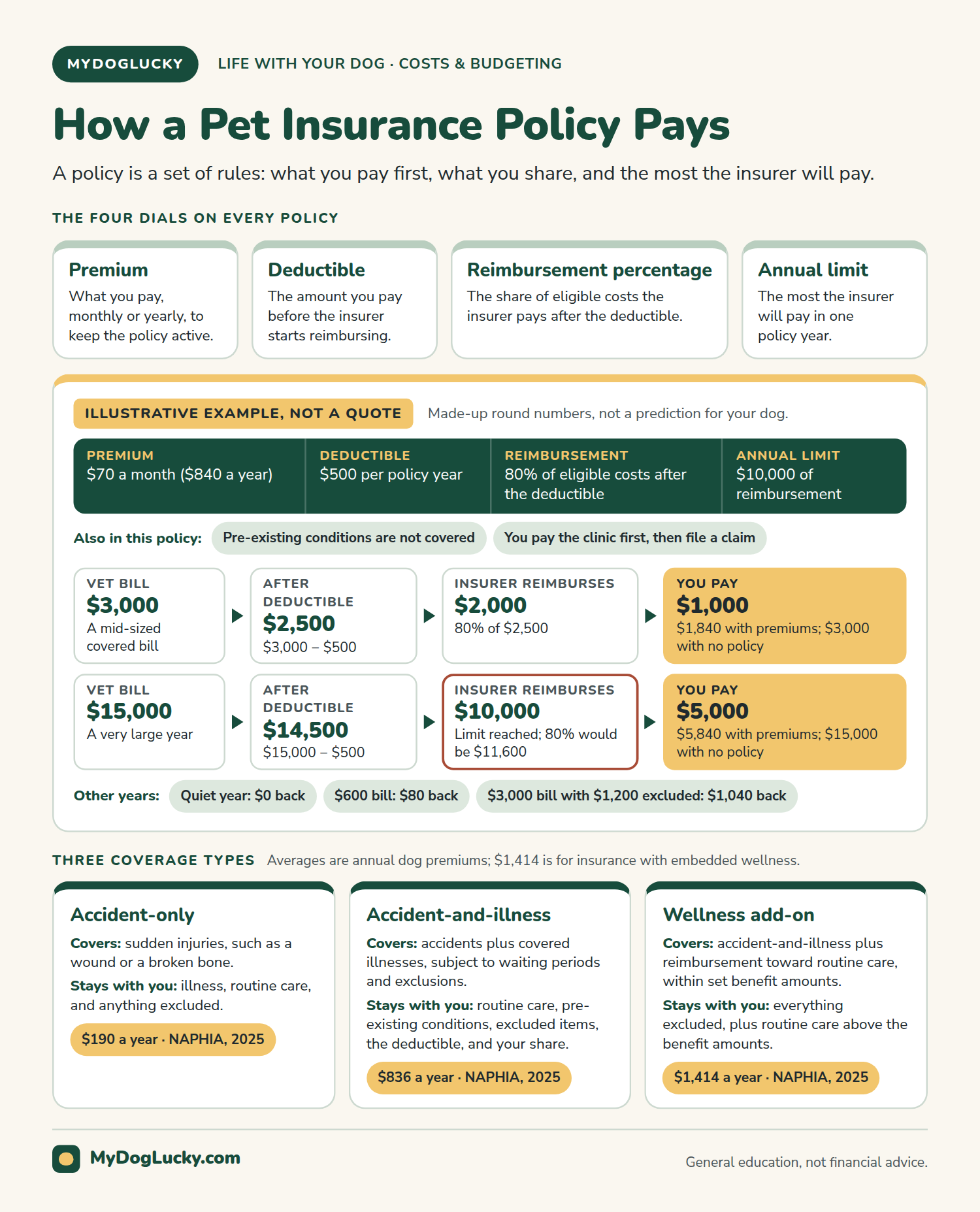
| Average annual premium, dogs, accident-only | $190 | About $16 a month, by simple division. |
| Average annual premium, dogs, accident-and-illness | $836 | About $70 a month, by simple division. |
| Average annual premium, dogs, insurance with embedded wellness | $1,414 | About $118 a month, by simple division. |
How to read averages without over-reading them
Averages blend many dogs, ages, deductibles, and limits into one number. Your quote could land well above or below it. The highlights also don’t explain what drives the figures, so they can’t tell you whether a given policy is worth it for your dog.
There’s a second trap. Don’t subtract $836 from $1,414 and call the result “the price of wellness.” The policies in those two groups differ in other ways too, including deductibles, limits, and insurers.
So is pet insurance worth it at those prices? The averages can’t say. They can only give you a yardstick to hold your own quotes against.
One more note on the 5.99% figure. Households cover vet costs in different ways: savings, family help, payment arrangements, or a policy. Not holding a policy doesn’t mean a household made a mistake.
Accident-only, accident-and-illness, and wellness coverage
NAPHIA tracks four product groups: accident-only, accident-and-illness, insurance with embedded wellness, and endorsements. Marketing names vary, but most plans you’ll meet fit one of these shapes. The table sums up what each shape generally does. Your actual policy may differ, so treat it as a frame, not a description of any specific plan.
| Coverage shape | What it generally covers | What usually stays with you | Average annual dog premium (NAPHIA, 2025) |
|---|---|---|---|
| Accident-only | Sudden injuries, such as a wound or a broken bone | Illness, routine care, and anything excluded | $190 |
| Accident-and-illness | Accidents plus covered illnesses, subject to waiting periods and exclusions | Routine care, pre-existing conditions, excluded items, the deductible, and your share | $836 |
| Insurance with embedded wellness | Accident-and-illness plus reimbursement toward routine care, within set benefit amounts | Everything excluded, plus routine care above the benefit amounts | $1,414 |
| Endorsement (add-on) | An optional extra attached to a base policy. Contents vary widely. | Whatever the endorsement doesn’t list | Not given in the highlights |
Accident-only coverage
Accident-only plans are the narrowest shape. NAPHIA’s 2025 average for dogs was $190 a year, versus $836 for accident-and-illness. By design, an accident-only policy won’t help if your dog develops an illness.
Ask how the policy defines an “accident.” Also ask whether follow-up care after an injury counts. Under the NAIC model act, waiting periods for accidents are prohibited. State law and your policy control, though, so confirm the start date in writing.
Accident-and-illness coverage
This is the broad category, and it’s where most of the fine print lives. Waiting periods, pre-existing conditions, hereditary exclusions, and limits all show up here. It’s also where the deductible, the reimbursement percentage, and the annual limit do their work.
If you’re comparing plans, most of your reading time belongs in this category. The sections below take those terms one at a time.
Wellness: three ways it can show up
Wellness coverage arrives in different packages, and the package changes the rules. It can be embedded in the policy itself. It can be an endorsement, meaning an add-on. Or it can be a separate wellness program, which the NAIC model act treats as distinct from insurance.
Wellness is prepayment, not risk-sharing. Routine care is predictable, so the math works differently than for an emergency. To test it, add up the extra premium for the year. Then compare it with the maximum reimbursement you’d realistically use.
If the extra premium equals or exceeds the reimbursement ceiling, you can’t come out ahead. If you’d skip some covered services anyway, you could lose more. Some households still like wellness benefits because they turn routine care into a steady monthly line item. That’s a legitimate budgeting preference. Just don’t mistake it for extra protection against a large bill.
Premium, deductible, reimbursement, and limits in plain English
Every policy is built from the same handful of dials. The NAIC model act’s disclosure list names most of them: waiting periods, deductibles, coinsurance, and annual or lifetime limits. Learn these and any policy becomes readable.
| Term | Plain meaning | Ask this |
|---|---|---|
| Premium | What you pay, monthly or yearly, to keep the policy active | Is it fixed? What can change it at renewal? |
| Deductible | The amount you pay before the insurer starts reimbursing | Is it per year, per condition, or per incident? Does it reset? |
| Reimbursement percentage (coinsurance) | The share of eligible costs the insurer pays after the deductible | What is the percentage, and what does “eligible” include? |
| Annual limit | The most the insurer will pay in one policy year | Is there also a limit per condition or per incident? |
| Lifetime limit | The most the insurer will pay over your dog’s whole life | Does this policy have one, and how much of it is left after a big claim? |
| Benefit schedule or usual and customary limit | A rule that caps what the insurer counts as eligible, even if the clinic charged more | How does the insurer decide the eligible amount for a bill? |
How the dials trade off
A lower premium usually shifts something to you. That might be a higher deductible, a smaller reimbursement percentage, or a lower limit. There’s no free dial.
That’s why price alone makes a poor comparison. Line up policies with the same deductible, percentage, and limit first. Then compare prices. Otherwise you’re comparing two different products with the same label.
The dial people forget: the limit
Most owners think about the deductible and percentage. Fewer think about the limit until a large claim arrives. An annual limit caps what the insurer pays in a policy year, no matter how large the bills grow.
Ask whether the limit is annual, lifetime, or per condition. A per-condition limit can matter a lot if one illness needs months of care. The worked example below shows how a limit can change the outcome in a big year.
Order of operations
Policies differ on how they apply the deductible and the percentage. Some reimburse the percentage of the eligible bill after the deductible. Others may work differently. The simplest fix is to ask each insurer to run a sample bill through its own rules, in writing.
A worked example: how one policy pays (illustrative)
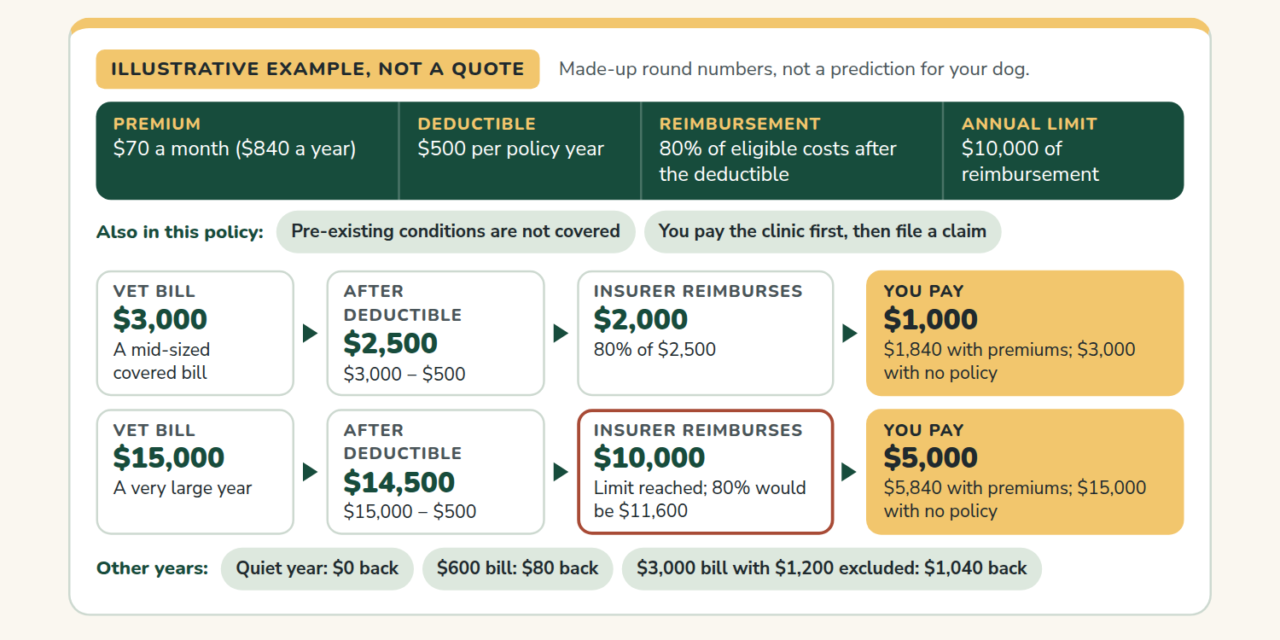
Illustrative, not a quote
Every number in this section is a made-up round figure chosen for easy arithmetic, worked out in September 2026. None of it is an average, a price, or a prediction for your dog. The $70 monthly premium sits near NAPHIA’s 2025 average for dog accident-and-illness policies ($836 a year) only so the math feels familiar.
Here is the invented policy we’ll use:
| Setting | Value in this example |
|---|---|
| Premium | $70 a month ($840 a year) |
| Deductible | $500 per policy year |
| Reimbursement percentage | 80% of eligible costs after the deductible |
| Annual limit | $10,000 of reimbursement |
| Exclusions | Pre-existing conditions are not covered |
| How you’re paid | You pay the clinic first, then file a claim |
The insurer’s payment works out as (eligible bill minus deductible) times 80%, and never more than the annual limit. You cover everything else. Now watch five different years play out.
| Scenario | Vet bills | Insurer reimburses | You pay toward the bills | Your share plus $840 premiums | Same year, no policy |
|---|---|---|---|---|---|
| 1. A quiet year | $0 | $0 | $0 | $840 | $0 |
| 2. One small bill | $600 | $80 | $520 | $1,360 | $600 |
| 3. One mid-sized covered bill | $3,000 | $2,000 | $1,000 | $1,840 | $3,000 |
| 4. Same bill, $1,200 of it excluded | $3,000 | $1,040 | $1,960 | $2,800 | $3,000 |
| 5. A very large year | $15,000 | $10,000 (limit reached) | $5,000 | $5,840 | $15,000 |
How the numbers were worked out
In scenario 2, only $100 of the $600 bill sits above the deductible, and 80% of $100 is $80. In scenario 3, $3,000 minus $500 leaves $2,500, and 80% of that is $2,000. In scenario 4, only $1,800 is eligible, so $1,800 minus $500 leaves $1,300, and 80% of that is $1,040.
In scenario 5, $15,000 minus $500 leaves $14,500, and 80% would be $11,600. The $10,000 annual limit stops it there. You pay the remaining $5,000.
What the table teaches
- A quiet year costs the premium and returns nothing. That is the price of having protection in place. Whether it’s a fair price is the whole question.
- Small bills barely register. A $600 bill produced $80 back. Insurance is built for large bills, not small ones.
- You always share the cost. Even in scenario 3, you still paid $1,000 of a $3,000 bill.
- Exclusions shrink the payout. The same $3,000 bill returned $2,000 in scenario 3 and $1,040 in scenario 4.
- Limits matter most in the biggest years. The 80% rule would have paid $11,600. The limit paid $10,000.
- You may need to front the money. In a reimbursement policy, you’d cover the $3,000 first and wait for the $2,000 to come back.
Try it with real numbers
Take a sample policy from any insurer you’re considering. Swap in its deductible, percentage, and limit. Then test three bills: a small one, a mid-sized one, and a very large one. That ten-minute exercise tells you more than most comparison charts.
Waiting periods
A waiting period is time after you enroll when you’re paying premiums, but some or all coverage hasn’t started. The NAIC model act defines it as “the period of time specified in a pet insurance policy that is required to transpire before some or all of the coverage in the policy can begin.”
Section 5 of the model act allows waiting periods that don’t exceed 30 days for illnesses or for orthopedic conditions that don’t result from an accident. It prohibits waiting periods for accidents. The NAIC adopted the model in 2022, and states decide whether and how to adopt it. Your state’s rule and your policy’s wording are what count.
Why waiting periods matter more than they look
The clock isn’t harmless. Under the model act’s definition of a pre-existing condition, a problem that appears “during any waiting period” can count as pre-existing. In practice, that means timing is part of the decision. A policy bought after symptoms begin may not cover the problem that prompted the purchase.
Orthopedic conditions get named separately in the model act. If your dog has any history of joint or bone trouble, ask the insurer exactly how it treats those conditions and how long it makes you wait.
Questions to ask about waiting periods
- How long is the wait for accidents, for illnesses, and for orthopedic conditions?
- Can a veterinary exam shorten the wait or confirm your dog’s starting condition?
- Does the wait restart if you raise your coverage later?
- What happens to a condition that first shows up during the wait?
Pre-existing conditions
This is where owners most often feel surprised. The NAIC model act defines a pre-existing condition as one where, before the policy’s effective date or during a waiting period, at least one of three things is true. A veterinarian gave medical advice about it. The pet received treatment for it. Or, “based on information from verifiable sources, the pet had signs or symptoms directly related to the condition for which a claim is being made.”
Read that carefully. Advice alone can count, even without treatment. Treatment counts. And signs or symptoms can count even if your dog never saw a vet, when verifiable sources show them. The definition reaches beyond what’s written in a vet chart.
What that means in real life
- Records matter. Keep your dog’s veterinary records. Answer application questions accurately, and ask how the insurer reviews history.
- Timing matters. The earlier a policy starts relative to any symptoms, the fewer things the exclusion can touch.
- Renewal has a protection. Section 3 of the model act says a condition for which coverage was afforded “cannot be considered a preexisting condition on any renewal of the policy.” State law and your policy control, so confirm it applies to yours.
Adopted dogs and dogs with long histories
If you adopted a dog with thin records, ask how the insurer handles unknown history. Some owners choose to have a veterinary exam on file before enrolling. Ask your vet what documentation would help.
For an older dog with a long list of past conditions, the exclusion list may be long too. New problems may still be covered. Ask for the exclusions in writing, then decide whether what remains is worth the price.
One question worth asking every insurer
Does a pre-existing condition ever become eligible again, and what does the policy require for that to happen? Get the answer in writing. Vague reassurance on a phone call won’t help you later.
Exclusions: hereditary, dental, behavioral, and more
Section 4 of the NAIC model act requires insurers to disclose exclusions for pre-existing conditions, hereditary disorders, congenital anomalies, and chronic conditions. That list works as a map of where the fine print hides. The table below adds dental and behavioral care, which are worth checking on any policy.
| Category | Plain meaning | What to check |
|---|---|---|
| Hereditary disorders | Conditions passed down through genes | How the policy defines it. A broad definition can sweep in conditions linked to a breed or breed mix. |
| Congenital anomalies | Conditions present from birth | Whether a problem that shows up later, but traces to birth, is excluded. |
| Chronic conditions | Long-lasting conditions that need ongoing care | Whether ongoing treatment is covered after the first diagnosis, or only the first episode. |
| Dental | Care for teeth and gums | Whether dental illness and dental injury are treated differently from routine cleanings. |
| Behavioral | Evaluation and treatment of behavior problems | Whether any behavior-related visits or therapy are covered at all. |
Read the exclusions before you read the price
Exclusions are part of how insurers price coverage, and they aren’t unusual. Still, a policy’s real value gets decided here. A plan that excludes the exact condition you worry about is a different product from the one the sales page implied.
Ask for the sample policy, meaning the full contract and not the brochure. Read the exclusions section first. Then scan for anything you’d have assumed was covered.
If your dog’s breed comes with known health risks
If your dog’s breed or breed mix is associated with certain conditions, read the hereditary and congenital wording twice. A known breed risk doesn’t mean the condition is covered. It doesn’t mean it’s excluded either. The policy language decides, and it varies from one plan to the next.
How claims work: reimbursement, direct pay, and paperwork
The NAIC model act also requires insurers to disclose the claim payment basis and any benefit schedules or usual and customary fee limits. In plain terms, ask two things before you enroll. How is a claim calculated? And how does the money reach you?
Reimbursement
Many policies work like this. You pay the clinic in full, then submit a claim with the invoice and medical records. The insurer reviews it and pays you the covered amount. In the worked example, that meant paying $3,000 up front and waiting for $2,000 to return.
Plan for the gap. Decide how you’d cover the bill before reimbursement arrives. Ask each insurer how long claims typically take, and get any timing promises in writing.
Direct pay
Some insurers can pay a clinic directly, and some clinics will bill an insurer on your behalf. Availability varies by insurer and by clinic. Ask both. Also ask whether you’d still owe the deductible and your share at checkout, since direct pay doesn’t erase them.
How the payment amount gets decided
If a policy uses a benefit schedule or a usual and customary limit, the insurer may count a lower “eligible” amount than the clinic charged. The percentage then applies to the lower number. That’s one reason two clinics, or two insurers, can produce different payouts on the same treatment.
A simple claims routine
- Ask the clinic for an itemized invoice and the visit records.
- Check your policy for the claim filing deadline, then submit early.
- Keep copies of everything you send and the date you sent it.
- Answer any records request from the insurer promptly.
- Compare the payout with your own math from the policy’s rules.
If a claim is denied
Ask for the decision and the reason in writing, with the policy language the insurer relied on. Compare it with your contract. Ask about the insurer’s appeal process, and note every date. If the issue stays unresolved, contact your state insurance department to ask about complaint options.
How premiums change over time
The premium is the part you feel every month, and the part most likely to shift. The NAIC model act defines renewal as issuing, at the end of a policy period, “a policy which supersedes a policy previously issued.” That reset is one reason to ask what can change when the policy renews.
Section 4 goes further. It requires insurers to disclose whether they reduce coverage or increase premiums based on three things: the insured’s claim history, the age of the covered pet, or a change in geographic location. So those three levers are worth asking about by name.
What to ask about pricing
Quote forms usually ask for your dog’s age, breed, and location. Ask each insurer how those inputs, and any claims you file, affect pricing at renewal. Also ask whether the deductible, percentage, or limit can change, not only the premium.
For context, NAPHIA reported that U.S. gross written premium grew 19.7% from 2024 to 2025. The highlights don’t say how much of that came from price. A sensible takeaway is modest: don’t assume today’s quote is next year’s.
A budget stress test
Ask yourself a hypothetical question. If your premium rose by a quarter, would the plan still fit your budget? If the answer is no, you may want a plan with more room, or a different approach altogether.
A policy you drop after a price change protects you only for the months you held it. That doesn’t make the payments wasted, but it does change the math you did at the start.
Switching insurers
A new policy generally looks at your dog’s history as of its own start date. Conditions that developed under an earlier policy may look pre-existing to a new insurer. Ask any insurer how it treats a dog switching from another policy, before you cancel the old one.
The math: premiums versus a savings fund
Start with NAPHIA’s 2025 average annual premium for dog accident-and-illness policies: $836, or about $70 a month. That’s an industry average, not your quote. It still makes a useful yardstick, and it lets us compare two paths honestly.
In each scenario below, Path A is the illustrative policy from the worked example, with $840 a year in premiums. Path B is a savings fund that receives $840 a year, with no interest and no other deposits. Both are simplified, and both are made-up illustrations as of September 2026.
| Scenario | Path A: the illustrative policy | Path B: a fund at $840 a year |
|---|---|---|
| No large bills in five years | You paid $4,200 in premiums. Nothing comes back. | The fund holds $4,200, and it’s still yours. |
| One $3,000 bill in year 1 | Year-1 cost: $1,840 ($840 premiums plus your $1,000 share). | The fund holds at most $840, so at least $2,160 must come from elsewhere. |
| One $3,000 bill in year 5 | Five years of premiums ($4,200) plus your $1,000 share: $5,200. | The fund covers the bill and has about $1,200 left by year’s end. |
| One $15,000 bill in year 3 | Premiums so far ($2,520) plus your $5,000 share: $7,520. | The fund holds at most $2,520, so at least $12,480 must come from elsewhere. |
What the comparison shows
Insurance changes the outcome most in the early, unlucky scenarios, before a fund has time to grow. A fund tends to come out ahead in quiet or moderate years, because unspent money stays yours and can cover things a policy excludes.
Nobody can tell in advance which scenario your dog will get. That uncertainty is exactly what insurance is designed to address. It’s also why “the fund always wins” and “insurance always wins” are both sales pitches, not analysis.
What the table leaves out
Real premiums can change at renewal. Real policies may exclude parts of a bill, as scenario 4 showed. A fund could earn interest. And many households can’t set aside $70 a month on top of everything else. The table is a thinking tool, not a forecast.
Who tends to find insurance useful, and who may not
The bigger question isn’t “is pet insurance worth it?” in general. It’s whether a specific policy is worth it for a specific dog and household. The table below turns that into decision signals. These are not recommendations. Most households will see themselves in both columns.
| Signal | Reasons insurance may deserve a serious look | Reasons it may be less useful |
|---|---|---|
| Your cushion | A large, unplanned bill would force borrowing or a painful choice. | You hold a funded reserve you’d be comfortable using for a vet emergency. |
| Your dog’s history | Few or no existing conditions, so fewer things to be excluded. | A long history means more conditions may be excluded, which shrinks what’s left to cover. |
| Policy fit | The exclusions and limits you read still cover the risks you worry about most. | The conditions you worry about most are excluded or capped. |
| Budget over time | The premium fits comfortably now and would still fit after a price rise. | The premium strains the budget, or you’d likely drop coverage after a renewal increase. |
| Paperwork tolerance | You’re comfortable keeping records and filing claims. | You’d rarely file, or the process would put you off. |
| Money preferences | You value a predictable monthly cost over an occasional large one. | You value flexibility and keeping unspent money. |
Middle paths exist
Neither column wins by default. Some households mix approaches. One example: accident-only coverage, which NAPHIA’s 2025 average puts at $190 a year for dogs, paired with a savings fund for illness. Another: an accident-and-illness policy with a higher deductible, plus a fund to cover that deductible.
Those are illustrations of how people combine tools, not suggestions. The right mix depends on your budget, your dog, and how you feel about risk.
Alternatives and companions to insurance
Insurance isn’t the only way to prepare for vet costs. It also isn’t all-or-nothing. Here are the common alternatives, described generically, along with what each one asks of you.
A dedicated savings fund
A separate account, named for your dog, keeps vet money from blending into everyday spending. Automatic transfers help. The trade-off is time: a fund starts near zero, and a large bill can arrive before it grows.
The benefit is flexibility. Unspent money stays yours, and the fund can pay for anything, including items a policy would exclude.
Prepaid or subscription wellness programs
These fit the NAIC’s definition of a wellness program: a subscription or reimbursement-based program, separate from insurance, that provides goods and services for the pet’s general health. They tend to help with routine costs, not emergencies. Read what happens if you cancel or if your dog needs a service the program doesn’t list.
Payment options at the clinic
Some clinics offer payment arrangements, and some work with outside payment programs. Ask what’s available before you need it. If a program involves credit, read the interest, fees, and any deferred-interest terms carefully. This guide doesn’t endorse any program or product.
A conversation with your veterinarian
Many veterinarians will talk through options at different cost levels if you ask. Ask for written estimates when possible. It also helps to raise costs early, at a routine visit, rather than during an emergency. Vets can’t always match every budget, but a direct question opens the conversation.
Community and charitable help
Some local charities, humane organizations, and veterinary school clinics offer help with vet costs. Availability is limited and varies by area, and eligibility rules differ. It’s worth keeping a short list of possibilities in your area before you need one.
A household plan
If more than one person shares your dog’s care, agree in advance on who decides and who pays. Decide at what dollar amount you’ll pause and talk before saying yes. That small agreement prevents a stressful argument on the worst possible day.
Questions to ask before you enroll
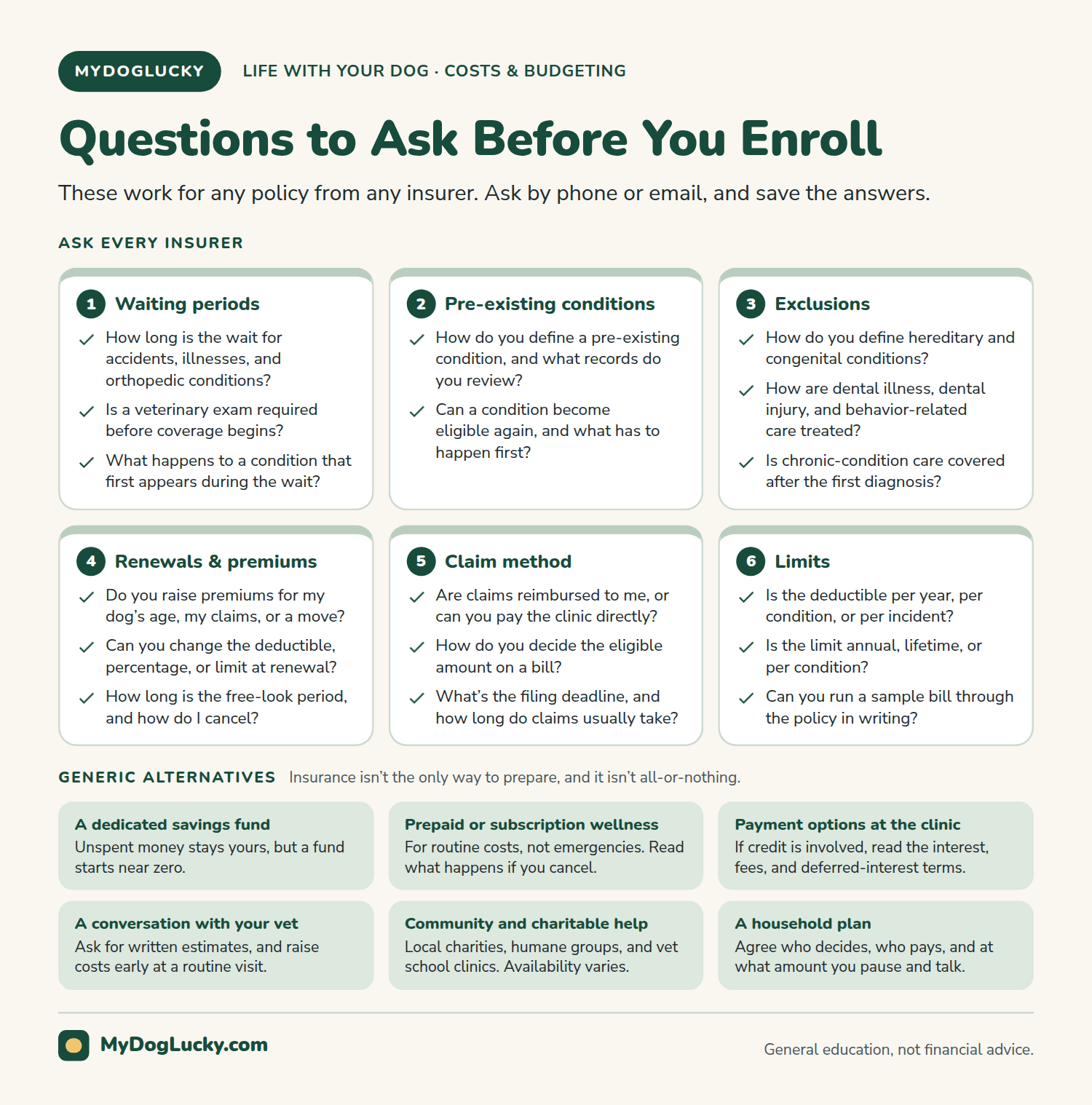
These questions work for any policy from any insurer. Ask them by phone or email, and save the answers. Where a question involves your rights, check your state’s rules and the policy text as well.
Coverage start
- How long is the waiting period for accidents, illnesses, and orthopedic conditions?
- Is a veterinary exam required before coverage begins?
- What happens to a condition that first appears during the wait?
History and exclusions
- How do you define a pre-existing condition, and what records do you review?
- Can a condition become eligible again, and what has to happen first?
- How do you define hereditary and congenital conditions, and is there a list?
- How are dental illness, dental injury, and behavior-related care treated?
- Is ongoing treatment for a chronic condition covered after the first diagnosis?
Payments and claims
- Are claims reimbursed to me, or can you pay the clinic directly?
- How do you decide the eligible amount on a bill?
- What’s the filing deadline, and how long do claims usually take?
- What happens if a claim is denied, and how do I appeal?
Limits and money
- Is the deductible per year, per condition, or per incident?
- Is the limit annual, lifetime, or per condition?
- Can you run a sample bill through the policy in writing?
Renewals and exits
- Do you raise premiums based on my dog’s age, my claims, or a move to a new location?
- Can you change the deductible, percentage, or limit at renewal?
- How long is the free-look period, and how do I cancel?
Consumer-protection basics: the NAIC model act and your state
The NAIC adopted its Pet Insurance Model Act (#633) at its Summer 2022 National Meeting. According to the NAIC’s pet insurance page, last updated April 16, 2025, the request for a model law came in 2019, and the working group finished its work in 2023. The model addresses wellness programs, pre-existing conditions, consumer protections, and training for insurance producers.
A model is a template, not a law
A model act becomes law only when a state adopts it, often with changes. The NAIC page points readers to state adoption information. That means your protections depend on where you live, and the exact wording in your state may differ from what’s described here.
The free-look period
The model’s sample disclosure language describes a review window, often called a free-look period. It says you have “15 days from the day you receive this policy, certificate or rider to review it and return it to the company if you decide not to keep it.” It adds that the company will refund any premium paid within 30 days.
State versions and individual policies can differ. Confirm your own window in writing, and note the date your policy documents arrive.
Where to take questions
Your state insurance department is the place to ask how pet insurance is regulated where you live, and how to file a complaint. A licensed insurance professional can help with questions about a specific policy. This guide can’t do either.
A one-evening plan for deciding
You don’t need to settle this in a rush. A single unhurried evening is enough to reach a decision you understand. Here’s a sequence that works whether you end up buying, skipping, or waiting.
- Name the risk. Are you worried about a large emergency, an ongoing condition, or predictable routine costs? Each points to a different tool.
- Check your cushion. Write down the largest vet bill you could pay without borrowing or making a painful trade-off. That number anchors everything else.
- Collect samples. Request quotes and sample policies for your dog’s age and location. Ask for the same deductible, percentage, and limit from each.
- Read the fine print first. Start with waiting periods, pre-existing conditions, and exclusions. Price comes last.
- Run the arithmetic. Test a small, a mid-sized, and a very large bill, as in the worked example above.
- Ask your questions. Use the checklist. Get answers in writing.
- Decide, or decide to decide later. Buying, skipping, and waiting with a plan are all reasonable results. If you defer, set a date to revisit it.
When you ask yourself whether pet insurance is worth it, this sequence turns a vague worry into a set of concrete comparisons. It also protects you from the two worst reasons to decide: a sales pitch and a scare.
Common mistakes when weighing pet insurance
Comparing on price alone
Two policies with different deductibles, percentages, and limits aren’t comparable by premium. Line up the settings first. Then compare price.
Assuming a breed condition is covered
Owners of breeds with known health risks sometimes assume those risks are the whole point of insurance. Hereditary and congenital exclusions can say otherwise. Read that wording before you decide.
Waiting until symptoms start
Because pre-existing conditions and waiting periods work the way they do, a policy bought after symptoms begin may not cover the reason you bought it. Timing is part of the decision, so factor it in early.
Skipping the sample policy
Asking “is pet insurance worth it” without reading a real policy is like judging a recipe from its photo. The brochure summarizes. The contract decides.
Forgetting the reimbursement lag
A policy that reimburses you still needs you to cover the bill first. Plan how you’d pay $3,000 today, not just how you’d get $2,000 back later.
Buying the wellness add-on without doing the math
Compare the extra premium with the most you could realistically get back. If it isn’t obviously ahead, you’re paying for convenience, which is fine, as long as you choose it on purpose.
Ignoring renewal terms
The price you see today isn’t a promise about next year. Ask what can change at renewal, and run the budget stress test above.
Treating insurance as a full replacement for savings
Deductibles, percentages, exclusions, and limits mean you’ll still pay part of most bills. Even with a policy, a small cushion for your share helps.
Letting fear or a sales pitch decide
Worry about a future bill is real and reasonable. It’s still a poor guide on its own. Slow down, read the contract, and decide with the numbers in front of you.
Is pet insurance worth it? Common questions answered
Is pet insurance worth it for a puppy?
A young dog with no history has fewer conditions to be excluded as pre-existing, which some owners see as a reason to look early. That doesn’t settle the question. Budget, coverage fit, and your comfort with a long-term premium still decide it. Puppies also have short records, so ask how the insurer handles them.
Is pet insurance worth it for an older dog?
It depends on what remains covered. Existing conditions are typically excluded, and the NAIC model act tells insurers to disclose whether age raises premiums. New problems may still be covered, though. Ask for the exclusions and the price in writing, then judge what’s left.
Is pet insurance worth it for a mixed-breed dog?
Breed is one input on a quote form, and mixed breeds don’t automatically face lower or higher risk. The more useful question is what the policy excludes as hereditary or congenital. Read that wording rather than relying on assumptions about any breed or mix.
Does pet insurance cover vaccines and checkups?
Only if you have wellness coverage, in some form. Standard accident-only and accident-and-illness policies focus on injuries and illnesses. If wellness is included, check the maximum reimbursement for each routine item.
Does the insurer pay my vet directly?
Sometimes, but many policies reimburse you after you pay the clinic. Availability depends on the insurer and the clinic. Ask both, and ask whether you’d still owe the deductible and your share at checkout.
Will my premium go up after I file a claim?
The NAIC model act requires insurers to disclose whether they reduce coverage or raise premiums based on claim history, the pet’s age, or a change in location. Read that disclosure for each policy you consider. Then ask the insurer directly.
Can I cancel or switch a policy?
Usually you can cancel, but the terms depend on the policy and your state. The model act’s sample language describes a 15-day free-look window after you receive the policy. If you switch, a new insurer may treat conditions from the old policy as pre-existing, so ask before you cancel.
How is a wellness plan different from pet insurance?
The NAIC model act calls a wellness program a subscription or reimbursement-based program that’s separate from an insurance policy. It covers goods and services for general health. Insurance is built around unexpected costs. Some products bundle both, so ask exactly what you’re buying.
What if the condition I worry about is excluded?
Then the policy may not protect you from that risk, even if it covers others. You can weigh whether the remaining coverage justifies the price, look at another policy, or plan to self-fund that specific risk. Get the exclusion in writing first.
What if I can’t afford a premium or a large fund?
That’s common, and it isn’t a failing. Start with what fits, even a small automatic transfer. Ask your vet about cost options and payment arrangements, and keep a short list of local assistance programs. Planning something beats planning nothing.
How much should I keep in a savings fund?
There’s no universal number. A practical approach is to ask your vet what common emergencies and treatments might cost at your clinic, then set a target you can grow toward. Revisit it as your dog ages.
Who regulates pet insurance?
Insurance is regulated by state insurance departments. The NAIC, which is made up of state insurance regulators, wrote the model law that states may adopt. Your state’s department can tell you what applies where you live.
How do I compare two policies fairly?
Match the deductible, percentage, and annual limit first. Compare waiting periods, pre-existing conditions, and exclusions next. Price comes last, and a sample bill run through each policy in writing is the fairest test.
Is pet insurance worth it if my dog is rarely sick?
Nobody can know that in advance, which is the point of insurance. A dog who has been healthy so far can still have an accident or a new illness. Whether the premium is worth that uncertainty is your call, based on your budget and comfort with risk.
So, is pet insurance worth it? It depends on what the policy really covers, what you can absorb without it, and whether you can keep the premium going for years. Some households will say yes after reading the fine print. Others will decide a dedicated fund fits better. Both are reasonable. Pick one small step this week: request a sample policy, or open a separate account for your dog’s vet costs.
Sources
- NAPHIA (North American Pet Health Insurance Association). State of the Industry Report 2026, Highlights. Report dated June 21, 2026, covering calendar year 2025. Used for gross written premium, insured pets, insured share of dogs, average annual dog premiums by coverage type, and product categories. Retrieved September 2026.
- NAIC (National Association of Insurance Commissioners). Pet Insurance Model Act (#633). Adopted at the NAIC Summer 2022 National Meeting. Used for definitions of pre-existing condition, waiting period, wellness program, and renewal, the waiting period limits, the disclosure requirements, and the free-look language. Retrieved September 2026.
- NAIC. Pet Insurance (insurance topics page, last updated April 16, 2025). Used for the model act’s adoption timeline and scope. Retrieved September 2026.
- Further reading, not used as a source for any figure or term in this guide: American Veterinary Medical Association, Do you need pet insurance?, and American Animal Hospital Association, How Does Pet Insurance Work.
This article is general education for U.S. dog owners. It is not financial, insurance, legal, or veterinary advice, and it does not recommend that you buy or skip any policy. Statistics and policy terms are as of September 2026 and can change. Model-act language describes a template that states may adopt with changes, so your policy documents and your state’s rules control. Ask a licensed insurance professional, your state insurance department, or your veterinarian about anything specific to your dog and your household.