
The best tricks to teach your dog are the ones that suit your dog’s body, your schedule, and your patience. They’re quick to learn, gentle on the joints, and useful for more than applause. Start with a hand target, a scent game called find it, and a go-to-mat settle. Those three are easy, low-impact, and they make nearly every other trick easier to teach.
This guide covers twelve tricks in three tiers. Each one comes with numbered steps, ways to make it easier or harder, the most common snag with its fix, and a body-safety note. You’ll also get the five-minute foundations, treat math, stress signals, and a four-week plan built for people who have jobs, dogs, and about ten spare minutes.
One promise up front: nothing here needs force, scolding, or special gear. The American Veterinary Society of Animal Behavior (AVSAB) says reward-based learning should be used for all canine training, and tricks are a low-stakes place to practice it.
Tricks are also physical. A roll-over asks more of a spine than a hand target does, so every trick below carries a body-load label. When in doubt, ask your vet before you teach anything physically demanding.
What’s in this guide
- Tricks to teach your dog: the short answer
- The twelve-trick ladder at a glance
- Why tricks are worth teaching, and what we can and can’t prove
- The five-minute foundations recap
- Body safety before you start
- Treats, calories, and rewards that aren’t food
- Lure, capture, or shape, then the same five stages every time
- Tier 1: four starter tricks
- Tier 2: four builder tricks
- Tier 3: four stretch tricks
- Troubleshooting: five problems almost every trick hits
- Stress signals, pain clues, and when to stop
- A four-week practice plan
- Common mistakes when teaching tricks
- When a professional trainer helps
- Frequently asked questions about tricks to teach your dog
- Your next ten minutes
- Sources
Tricks to Teach Your Dog: The Short Answer
If you want one answer, here it is. Teach the tricks that match your dog’s body and your goal, and go from easy to hard. Nobody needs to start with roll over. Most dogs and most owners do better starting with tricks that build skills you’ll use again.
Which Tricks First?
Use whichever line below sounds most like your household.
- New to training, or new to dogs: hand target, find it, and go to mat.
- Senior dog or joint trouble: hand target, find it, go to mat, chin rest, close the door, and a soft-toy bring-it, all at a gentle pace and after a vet check.
- High-energy dog who needs a job: find it with harder hides, spin, back up, and fetch-and-bring.
- Puppy: hand target and find it first. Save jumping, twisting, and long sessions for later, and ask your vet what your puppy’s body is ready for.
- You want something to show off: shake, then wave, then bow. Roll over comes last, and only if your dog’s body and comfort allow it.
How Long Will It Take?
There’s no honest single number. Many owners notice a first glimmer of understanding within a few short sessions, while a trick that holds up in three rooms and around a doorbell often takes weeks. Those are observations, not benchmarks, and your dog isn’t behind schedule if it takes longer.
Three Rules That Cover Every Trick
- Reward what you like, right away. A dog can’t guess which second earned the treat.
- Keep sessions short and end on a win. Stop while your dog is still keen.
- Stop when the body or the mood says stop. Pain and stress beat any trick on this list.
The Twelve-Trick Ladder at a Glance
Here are twelve tricks to teach your dog, grouped into three tiers. Tier 1 needs nothing but a working reward marker. Tier 2 builds on tier 1. Tier 3 asks for more polish from you or more from your dog’s body, so read those body-safety notes twice.
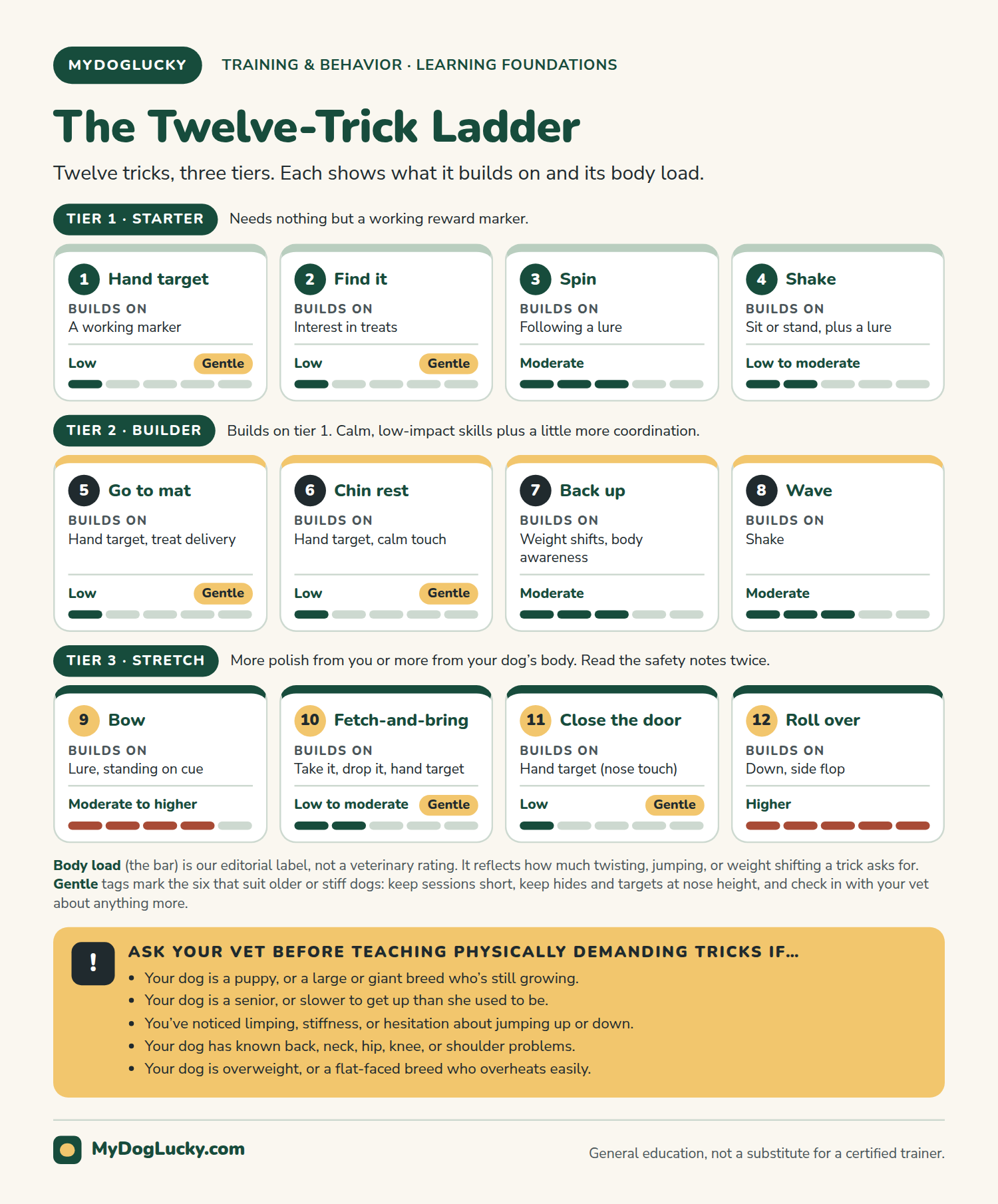
| Tier | Trick | Builds on | Body load |
|---|---|---|---|
| 1 Starter | 1. Hand target | A working marker | Low |
| 1 Starter | 2. Find it | Interest in treats | Low |
| 1 Starter | 3. Spin | Following a lure | Moderate |
| 1 Starter | 4. Shake | Sit or stand, plus a lure | Low to moderate |
| 2 Builder | 5. Go to mat | Hand target, treat delivery | Low |
| 2 Builder | 6. Chin rest | Hand target, calm touch | Low |
| 2 Builder | 7. Back up | Weight shifts, body awareness | Moderate |
| 2 Builder | 8. Wave | Shake | Moderate |
| 3 Stretch | 9. Bow | Lure, standing on cue | Moderate to higher |
| 3 Stretch | 10. Fetch-and-bring | Take it, drop it, hand target | Low to moderate |
| 3 Stretch | 11. Close the door | Hand target (nose touch) | Low |
| 3 Stretch | 12. Roll over | Down, side flop | Higher |
“Body load” is our editorial label, not a veterinary rating. It reflects how much twisting, jumping, or weight shifting a trick asks for. Your vet knows your dog’s body. We don’t.
Why Tricks Are Worth Teaching, and What We Can and Can’t Prove
Owners and trainers usually name three payoffs from the tricks to teach your dog: mental work, comfort with being handled, and training time that feels like a game you both like. Those are commonly reported benefits. We didn’t find a source we could fetch that measures them, so treat them as owner-reported and trainer-reported, not as research findings.
What We Can Source
AVSAB’s position statement says reward-based learning “offers the most advantages and least harm” and should be used for all canine training. It also says aversive methods shouldn’t be used. Tricks are a friendly place to practice the mechanics: marking, rewarding, and raising difficulty gradually. The American Kennel Club (AKC) describes trick training as fun for both dogs and their trainers, and we’ll take that one at face value.
Practical Payoffs That Show Up in Real Life
Several tricks earn their keep beyond the party.
- Hand target moves your dog through a doorway or around a corner without a leash tug.
- Go to mat gives your dog a job when the doorbell rings.
- Chin rest and shake give you practice with the kind of touching that ear checks and nail trims involve. Trainers often use them as building blocks for cooperative handling. They don’t replace professional help for a dog who’s afraid of being handled.
- Find it works in a small apartment, on a rainy day, and with a dog who can’t run.
There’s a smaller, sillier payoff too. A dog who bows on cue makes a strong first impression on relatives who have opinions about your housekeeping.
The Five-Minute Foundations Recap
Every trick below leans on the same few basics. If you’ve already worked through clicker training or marker training, skim this section. If not, five minutes here saves weeks later.
Marker and Timing
A reward marker is a short signal, such as the word “yes” or a click, that means “that exact thing earned a treat.” To charge it, say the marker and then give a treat. AKC says that after about 10 to 20 repetitions, most dogs understand that the marker predicts a reward.
Timing is the skill. Mark the moment the behavior happens, then deliver the treat. A marker that lands two seconds late rewards whatever your dog did two seconds later.
The Reward Check
Before you teach anything, test your rewards.
- Pick a quiet room and offer a tiny, soft treat.
- If your dog takes it happily and looks for more, you’re set.
- If she sniffs and walks away, try a smellier treat, a quieter room, or practice before a meal using part of her daily food.
AKC notes that a reward is anything your dog values, so a quick game of tug counts. If a dog who normally loves food suddenly refuses every treat, that’s a question for your vet, not a training problem.
Session Rules
These are our practical suggestions, not research-established numbers.
- Keep sessions short. A few minutes, a few times a day, beats one long slog.
- Add the cue late. Say the word only once the behavior is happening reliably, and say it once.
- Use a success check. Aim for about 8 of 10 correct tries before you raise the difficulty.
- Change one thing at a time. Add distance, or duration, or distractions, but never all three together.
Body Safety Before You Start
Tricks look harmless because they’re fun. Some of them ask a lot of joints, backs, and hips, especially when repeated. That’s why each of the tricks to teach your dog on this ladder carries a body-load label, and why some crowd-pleasers didn’t make the cut.
Ask your vet before teaching physically demanding tricks if…
- Your dog is a puppy, or a large or giant breed who’s still growing.
- Your dog is a senior, or slower to get up than she used to be.
- You’ve noticed limping, stiffness, or hesitation about jumping up or down.
- Your dog has known back, neck, hip, knee, or shoulder problems.
- Your dog is overweight, or a flat-faced breed who overheats easily.
Jumping and Leaping
Repeated jumping loads joints and the spine. That’s why this ladder has no jump-through-a-hoop, leap-into-your-arms, or jump-over-a-bar tricks. For growing puppies, VCA Animal Hospitals advises avoiding long jogs or hikes, jumping hurdles, and competitive agility until the growth plates close. VCA says that may be a little over 6 months for small dogs and closer to 1.5 years for giant breeds, and it suggests letting a puppy regulate her own activity. Your vet can tell you where your puppy falls.
Hind-Leg Stands and Roll-Overs
Two more families of tricks deserve caution. “Sit pretty,” begging, and walking on hind legs put a lot of weight on hips, knees, and the lower back, and they demand core strength and balance. We left them off the ladder. Roll over made the ladder, but it’s labeled higher-load, because rolling twists the spine. Skip both families unless your vet has said your dog’s body is ready.
Arthritis, Back Trouble, and Older Dogs
Older dogs can learn tricks, and they often enjoy the attention. The signs of arthritis in dogs can be subtle. VCA’s arthritis page (last updated March 31, 2026) lists hesitation to jump up or down and loss of stamina among the clues. It also suggests soft, padded bedding, non-skid floors, and a ramp or step for cars and furniture.
If your dog is older or stiff, these six tricks are the gentlest: hand target, find it, go to mat, chin rest, close the door, and a bring-it with a light soft toy. None of them asks for jumping, twisting, or standing on hind legs. Keep sessions short, keep hides and targets at nose height, and check in with your vet about anything more.
Surfaces and Heat
Slick floors turn spins, back-ups, bows, and roll-overs into risky moves. Practice on carpet, a rug that won’t slide, or a mat with grip.
Heat matters too. The American Animal Hospital Association (AAHA) lists flat-faced breeds, obesity, young and senior pets, and pre-existing conditions as higher-risk for heatstroke, and it advises avoiding outdoor activity during peak heat. Heavy panting and thick, ropey drool are warning signs. On a hot day, practice indoors in a cool room.
Treats, Calories, and Rewards That Aren’t Food
Most tricks to teach your dog run on treats, and treats have calories. The World Small Animal Veterinary Association (WSAVA) says treats should make up less than 10% of a dog’s daily calories and should never replace a meal. Its guide also says to count treats as part of the daily food plan, and to ask your veterinary team about the right quantity and type for dogs with medical conditions or prescribed diets.
What That Looks Like in Practice
Here’s illustrative math, not a feeding prescription. Suppose your vet’s plan for your dog is 400 calories a day. Ten percent is 40, so treats need to stay under 40 calories. If a training treat has 4 calories, that’s nine pieces or fewer. Check the package for calories per piece, and adjust the meal to match.
- Cut treats tiny. Pea-sized or smaller works for most dogs.
- Use part of the meal. Pull the training rewards out of her daily kibble.
- Use non-food rewards. A short tug game, a favorite toy, or a scratch behind the ears counts if she loves it.
- Look at the extras. For ideas, see our guide to healthy dog treats.
If your dog has food allergies, weight concerns, or a medical diet, ask your vet which rewards fit before you start.
Lure, Capture, or Shape, Then the Same Five Stages Every Time
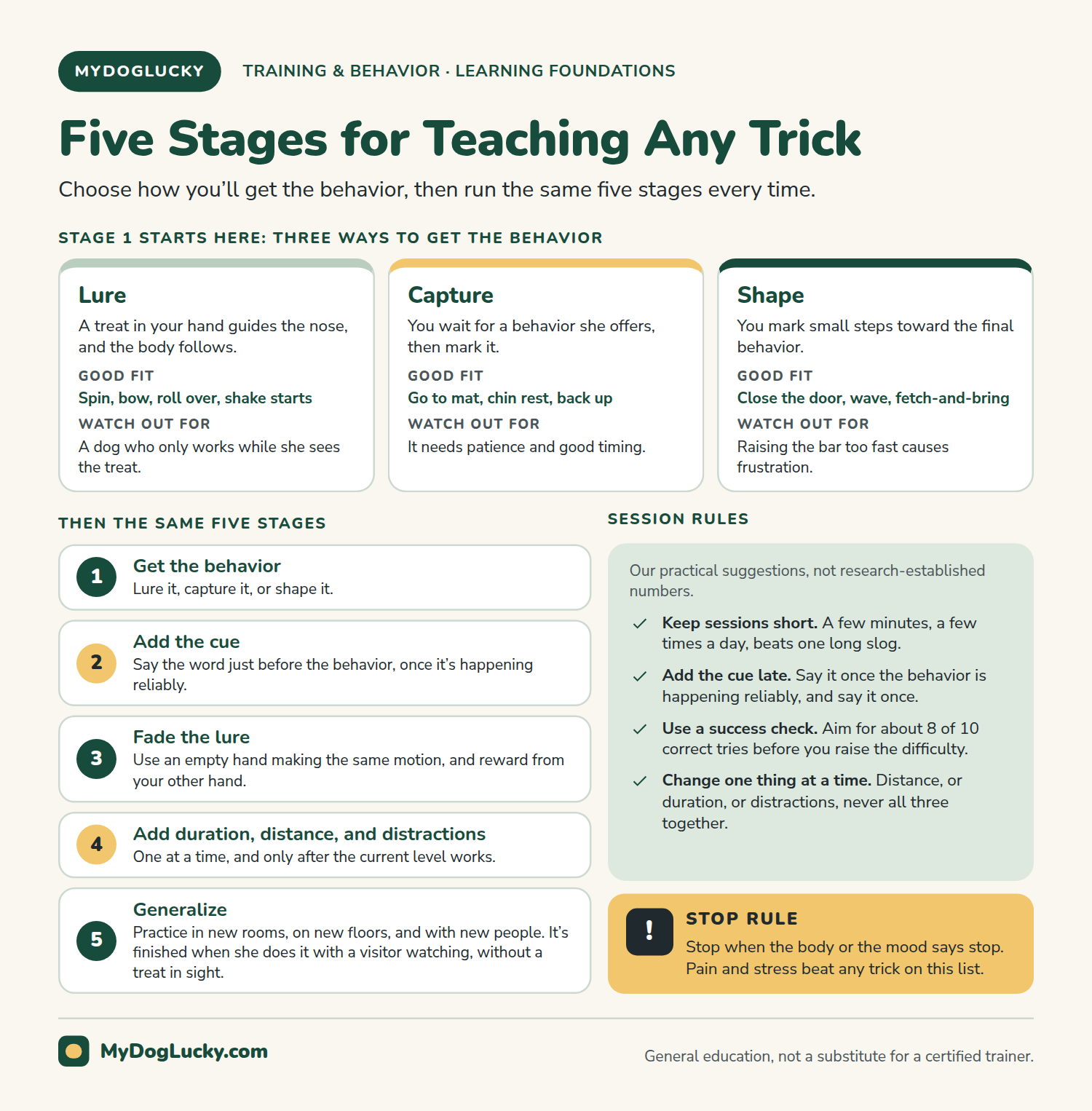
You can teach a trick three ways. AKC’s clicker training article describes them like this. Luring uses a reward to guide your dog into the behavior. Capturing means marking a behavior your dog does naturally, such as lying quietly on a mat. Shaping means building a more complex behavior through small steps.
| Method | How it works | Good fit | Watch out for |
|---|---|---|---|
| Lure | A treat in your hand guides the nose, and the body follows | Spin, bow, roll over, shake starts | A dog who only works while she sees the treat |
| Capture | You wait for a behavior she offers, then mark it | Go to mat, chin rest, back up | Needs patience and good timing |
| Shape | You mark small steps toward the final behavior | Close the door, wave, fetch-and-bring | Raising the bar too fast causes frustration |
Whatever method you choose, every trick then follows the same five stages.
The Five Stages
- Get the behavior. Lure it, capture it, or shape it.
- Add the cue. Say the word just before the behavior, once the behavior is happening reliably.
- Fade the lure. Use an empty hand making the same motion, and reward from your other hand.
- Add duration, distance, and distractions. One at a time, and only after the current level works.
- Generalize. Practice in new rooms, on new floors, and with new people.
A trick isn’t finished when your dog does it once in the kitchen. It’s finished when she does it in the living room, with a visitor watching, without a treat in sight. That takes repetition, and it’s why the steps below keep coming back to the same ideas.
Tier 1: Four Starter Tricks
These four need nothing beyond a working marker. Teach them in any order, though hand target and find it tend to pay off fastest.
Trick 1: Hand Target (Nose Touch)
Good for: guiding your dog through a doorway without a leash tug, redirecting attention, and building toward spin, go to mat, and close the door. Body load: low.
- Hold your flat palm a couple of inches from your dog’s nose, at nose height. Stay quiet.
- The moment her nose touches your palm, say your marker and hand over a treat with your other hand.
- Repeat five to eight times. Then shift the palm slightly left, right, or lower so she has to move.
- Once she bumps your hand quickly, say “touch” just before you present it.
- Move your palm a step away so she walks to it.
- Practice from farther away, with either hand, and in a second room.
Easier: hold your palm right at her nose and reward simply looking at it. Harder: a moving palm, a target you hold while walking, or a different object, such as a small plastic lid.
Most common problem: licking or mouthing the hand. Present the palm briefly, pull it away, and mark only nose contact. If she’s nose-shy, reward looking at your hand for a few reps first.
Body-safety note: keep the target at nose height, not high over her head, which strains the neck. With a small dog, kneel or sit down instead of coaxing her to stretch upward.
Trick 2: Find It (Scent Game)
Good for: mental work on a rainy day, a confidence boost for cautious dogs, and a fully low-impact game for seniors or dogs with mobility limits. Body load: low.
- Show a small treat, then drop it a foot or two in front of your dog, in plain sight.
- As she moves toward it, say “find it.” Repeat five times, dropping treats in different directions.
- Ask her to wait, or have a helper gently hold her. Place a treat in plain sight a few steps away, then release her with “find it.”
- Move to partly hidden treats: behind a chair leg, beside a doorway, under a folded towel.
- Add two or three hiding spots per round, then hide treats in the next room.
- End with “all done” and pick up any leftovers, so the game has a clear finish.
Easier: drop treats right by her nose on a towel or carpet. Harder: hide around corners, in different rooms, or in a muffin tin covered with tennis balls. You can also scatter part of her meal, counted in her daily food.
Most common problem: she gives up when she can’t see the treat right away. Go back to visible treats, make hides easier, and celebrate each find.
Body-safety note: keep hides at floor-to-nose height. Treats on high shelves invite jumping or stretching onto hind legs. Clear the floor of anything you’d hate for her to find, such as human food or pills.
Trick 3: Spin
Good for: a warm-up wiggle, body awareness, and an easy first lure trick. Body load: moderate.
- With your dog standing in front of you, hold a treat at her nose.
- Draw the treat in a wide, low circle toward her shoulder so her head follows and her body turns. Reward a quarter turn.
- Build to a half, then three-quarters, then a full circle before she gets the treat. Mark each success.
- When she follows smoothly, say “spin” just before you start the lure.
- Shrink the lure: make the same circle with an empty hand and reward from the other hand.
- Teach the opposite direction as its own trick once the first is reliable.
Easier: reward partial turns on carpet. Harder: cue it from a distance, spin on a mat, or spin and then sit.
Most common problem: she backs up or hops instead of turning. Keep the lure low and close to her nose, circle slowly, and reward smaller pieces of the turn.
Body-safety note: twisting and pivoting on slick floors is hard on hips, knees, and spine. Use a non-slip surface, keep the circle wide and slow, alternate directions, and stop after a few repetitions. Ask your vet first if your dog has known hip, knee, or back problems.
Trick 4: Shake (Paw)
Good for: the classic crowd-pleaser, teaching your dog to offer a body part on purpose, and building toward wave. It also gives a friendly first taste of paw handling. Body load: low to moderate.
- With your dog in whichever position is comfortable, sit or stand, hold a treat in a closed fist near her chest.
- Wait. Many dogs paw at the fist. The moment a paw leaves the floor, mark and reward.
- Repeat until lifting comes easily. Then wait for a slightly higher lift or a brief touch to your hand.
- Hold your open palm just under her paw and mark when they touch.
- Say “shake” as she lifts.
- Fade the fist: reward from your other hand, then add a one-second hold before you mark.
Easier: reward any weight shift toward lifting a paw. Harder: switch paws, shake from a down, or ask for a high five by lifting your palm a little higher.
Most common problem: scratching, pouncing, or mouthing the fist. Keep your fist still and low, mark only the paw, and trim nails if scratches sting.
Body-safety note: never lift or pull the paw for her. Let her place it. A long sit can bother some dogs’ hips, so standing or lying down may be kinder. Stop if she pulls away.
Tier 2: Four Builder Tricks
These build on tier 1. Go to mat and chin rest are calm, low-impact skills. Back up and wave ask for a little more coordination.
Trick 5: Go to Mat
Good for: settling during meals or at the door, giving your dog a job when visitors arrive, and a foundation for calm behavior anywhere. Body load: low.
- Put a non-slip mat or folded towel on the floor and stand beside it.
- Toss a treat onto the mat. When she steps on to eat it, mark and reward there.
- Repeat until she heads for the mat quickly. Then wait for her to step on by herself and mark that.
- Say “mat” as she moves toward it.
- Once she’s on it, wait for a sit or a down, reward there, and use a release word such as “okay” to end.
- Build a few seconds of duration, then a few feet of distance, then a new room.
Easier: keep the mat right beside her and deliver treats on it. Harder: longer stays with a chew, a doorbell rehearsal, or a mat in a new spot.
Most common problem: she grabs the treat and leaves. Deliver treats faster while she’s on the mat, and shorten what you ask her to wait for.
Body-safety note: choose a thick, non-slip mat. VCA recommends padded bedding and non-skid floors for dogs with arthritis. Don’t insist on a down if a sit or a stand is more comfortable.
Trick 6: Chin Rest
Good for: a quiet, calm behavior, practice with gentle handling, and a relaxing pause in a busy vet waiting room. Trainers often use it as a building block for ear checks and exams. Body load: low, and a good pick for seniors.
- Sit on the floor or a low stool so your open palm, or a folded towel on your knee, sits at your dog’s chin height.
- Offer the palm or towel just under her chin. Any touch of chin to hand earns a mark and a treat.
- Reward chin touches until she offers them. Then wait for a bit of weight resting.
- Add one second of rest before marking, then two, feeding while her chin stays down.
- Say “chin” as she lowers her head.
- Add a light touch to her cheek for one second, then treat. Do this only if she stays relaxed.
Easier: reward the first touch, with no weight needed. Harder: longer rests, chin on your knee while you stand, or chin on the floor.
Most common problem: she lifts her head the moment you mark. Bring the treat to her mouth while her chin still rests, so staying is what pays.
Body-safety note: never lift or pin her head. If she stiffens, turns away, or won’t lower her head at all, stop. Reluctance to lower the head can be a sign of discomfort, so mention it to your vet.
Trick 7: Back Up
Good for: body awareness, hind-end coordination, and a polite “please give me space” cue that beats shooing your dog away from the stove. Body load: moderate.
- Stand facing your dog in a hallway or between two pieces of furniture, so she has a straight path.
- Take one slow step toward her with your hands quiet. Mark any shift backward, even a weight rock.
- Deliver the treat at her side so she stays put, then reset.
- Ask for one full back step, then two.
- Say “back” as she steps.
- Fade your body movement to a small hand signal and build to three or four steps.
Easier: reward weight shifts in a narrow hallway. Harder: more steps, a wider space, or a cue from a distance.
Most common problem: she sits or turns around. Use a narrower space, move slowly, mark earlier, and reset with a treat toss if she sits.
Body-safety note: dogs can’t see where their feet are going backward. Clear the path, avoid stairs, slopes, and slick floors, and keep it to a few steps. Ask your vet first for dogs with hip, knee, or back problems.
Trick 8: Wave
Good for: a friendly greeting and a step up in precision from shake. Body load: moderate, because she balances on three legs.
- Start with a reliable shake.
- Hold your open palm a little higher and a few inches farther away than you did for shake.
- Mark a paw lift toward the palm, even if she doesn’t quite touch it.
- Move your palm another inch away each time she succeeds, until her paw moves in the air.
- Mark two small paw movements in a row, then three. That’s a wave.
- Say “wave” as she lifts, then fade your hand.
Easier: let her touch your palm again. Harder: several waves in a row, or a wave from across the room.
Most common problem: she keeps trying to touch your hand. Move the palm before contact and reward paw movement in the air.
Body-safety note: a wave asks her to balance on three legs. Keep sessions short and use a non-slip floor. Skip it for dogs with shoulder, elbow, or hip problems unless your vet approves, and never lift the leg yourself.
You’ve now run the sequence on eight tricks. Here it is on one page, along with the session rules, so you can keep it handy for the stretch tier.
Tier 3: Four Stretch Tricks
Stretch tricks ask for more skill from you or more from your dog’s body. Read the body-safety notes twice before you start bow or roll over.
Trick 9: Bow
Good for: a natural-looking stretch, a funny greeting, and a trick people love. Body load: moderate to higher.
- Start with your dog standing on a non-slip surface, facing you.
- Hold a treat at her nose. Lower it straight down and slightly back toward her chest, between her front legs.
- Mark the moment her elbows dip while her hips stay up. Reward at floor level.
- If her hips drop, reward the smaller dip and try again with a shorter lure.
- Add a second of duration, then say “bow” as she dips.
- Fade the lure to a hand signal and ask from a stand.
Easier: reward any front-end dip. Harder: hold it for a few seconds, or finish a routine with a bow.
Most common problem: her hips fold and she lies down. Lure less far and feed sooner. Some dogs need several sessions of small dips.
Body-safety note: a held bow keeps the front end low and hips high, which can bother shoulders, back, or neck. Keep it brief, and skip it for dogs with back, hip, or shoulder pain. Ask your vet first for puppies and seniors.
Trick 10: Fetch-and-Bring
Good for: putting a natural retrieve to work (the remote, a slipper, a toy from the yard) and building mouth control through take it and drop it. Body load: low to moderate with short, walking-speed retrieves.
- Pick a soft, light object she already likes to carry.
- Offer it. When her mouth touches or closes on it, mark and reward. That’s “take it.”
- Teach “drop it”: present a treat at her nose, and when she opens her mouth and releases the object, mark and reward.
- Toss the object one step away. When she picks it up, mark and reward.
- Reward turning toward you with it, then coming closer, then putting it in your low hand.
- Say “bring it” as she heads back, and add distance a few steps at a time.
Easier: keep the object within a step and sit on the floor so she needn’t reach up. Harder: longer distances, different objects, or a named item.
Most common problem: she grabs it and plays keep-away. Shorten the distance, reward before she leaves, and don’t chase. Chasing turns it into a game she wins.
Body-safety note: stay at walking speed on non-slip floors. Skip leaping catches and fast turns on slick surfaces. Choose objects that can’t splinter or break, never sticks, and stop if she starts chewing it apart.
Trick 11: Close the Door (Nudge an Object)
Good for: a genuinely useful household trick, nose-targeting skill, and a confidence boost. Body load: low.
- Choose a light interior door with a stopper so it can’t slam.
- Hold your palm against the door at nose height. Mark and reward a touch.
- Take your hand away so she touches the door itself. Mark and reward.
- With the door open a couple of inches, ask for a touch and mark when the door moves.
- Reward bigger pushes until the door closes, then celebrate.
- Say “close it” as she pushes, and widen the gap a little at a time.
Easier: leave the door open only a couple of inches. Harder: a wider gap, a longer walk to the door, or a cue from across the room.
Most common problem: pawing or scratching the door. Mark only nose touches, go back to your palm as a target, and keep nails trimmed.
Body-safety note: teach nose pushes, not paw scratches or standing against the door. Keep tails and paws clear of hinges. Never teach this with exterior doors, refrigerators, dryers, or ovens.
Trick 12: Roll Over (With Caution)
Good for: a dramatic finish and a full-body trick. It’s also the highest body load on this list, so treat it as optional. Body load: higher.
- Start with a solid down on a cushioned, non-slip surface.
- Lure her nose toward her shoulder so she shifts her weight onto one hip. Mark and reward the hip roll alone.
- Repeat until she flops onto her side easily.
- Lure the nose a little farther over the shoulder so she tips toward her back. Reward that small tip.
- Continue in small stages until she rolls to the other side. Mark the full roll.
- Say “roll” as she starts, then fade the lure.
Easier: stop at the side flop, which is a trick on its own. Harder: a cue from a distance, or a faster roll.
Most common problem: she stops on her back and pops up. Slow the lure, reward the pause, then continue in smaller stages. If she seems uneasy on her back, stop. Not every dog enjoys this one.
Body-safety note: rolling twists the spine. Skip it for seniors and for dogs with back, neck, hip, or joint problems, and ask your vet before teaching it to puppies, especially large-breed puppies. Keep it to a few repetitions on a cushioned surface.
Want a goal? Kennel-club trick titles
Some kennel-club programs recognize trick performance. As of September 2026, AKC’s Trick Dog program offers Novice, Intermediate, Advanced, Performer, and Elite Performer titles. Dogs need an AKC number, through registration, Purebred Alternative Listing, or Canine Partners enrollment. Puppies can train but can’t earn titles before 4 months, and testing can be in person or virtual with an approved evaluator. Details change, so check AKC’s current rules.
Troubleshooting: Five Problems Almost Every Trick Hits
Most stalls with tricks to teach your dog come from the same handful of causes. Change one thing at a time, and check whether the trick got easier before you blame your dog.
Your Dog Loses Interest Halfway Through
Common causes fall into four groups: a reward that isn’t exciting enough, a session that’s too long, a room that’s too distracting, or a dog who’s full, tired, or hot. Shorten the session, try a smellier treat (counted in her daily food), move somewhere quieter, or practice before a meal. If she refuses even favorite treats or seems off, call your vet.
The Trick Only Works While You Hold the Lure
This is lure dependence, and it’s the most common trick problem. Fade sooner and more gradually. Make the same motion with an empty hand and reward from the other hand or a pocket. Then vary how often the treat appears, so the hand signal alone is what your dog reads.
Your Dog Gets Frantic, Barky, or Jumpy
Excitement can spill into pawing, barking, and hopping up. Make the task easier, reward faster, and pause for a few seconds of calm between tries. A treat scattered on the floor works as a reset. If the frenzy grows, end the session and try again later. Reward calm four-on-the-floor moments as often as any trick.
Your Dog Knows It in the Kitchen and Nowhere Else
That’s generalization, and it’s normal. Dogs learn a trick as “this behavior in this place with these cues.” Change one thing at a time: a new room, then a new floor, then a new person. Drop back to an easier version in each new setting and rebuild.
Your Dog Avoids the Trick or Seems Uneasy
Stop. The cause could be body discomfort, a slippery floor, confusion, or fear. Make the task much smaller, or skip it entirely. If you suspect pain, talk to your vet. If fear or handling discomfort is part of it, a certified trainer can help, and the next section shows what to look for.
Stress Signals, Pain Clues, and When to Stop
A dog who’s enjoying tricks usually looks eager. She has a loose body, she comes back for another round, and she recovers quickly after each treat. A dog who isn’t enjoying them looks different.
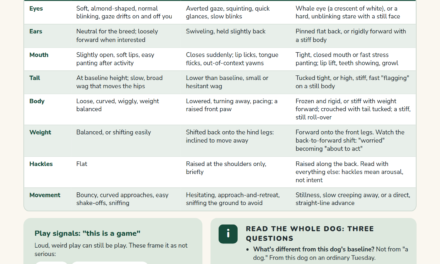
AVSAB’s statement lists stress-related behaviors seen in dogs trained with aversive methods: a tense body, lowered body posture, lip licking, tail lowering, lifting a front leg, panting, yawning, and yelping. Several of these also happen when a dog is hot, tired, or confused, so read the whole picture. For a fuller guide, see our article on dog body language.
Stop the session and call your veterinarian if your dog…
- Yelps or cries out during a trick.
- Limps, or won’t put weight on a leg.
- Suddenly hesitates to jump, climb, or lie down.
- Seems stiff afterward or the next morning.
Heavy panting and thick, ropey drool are signs of heat stress, and AAHA calls heatstroke a medical emergency. If you see them, or your dog collapses, move her to a cool, shaded or air-conditioned space and get veterinary care right away. If she growls, snaps, or freezes, stop, don’t scold, and talk to your vet or a certified trainer.
A growl is information. Punish it, and some dogs stop warning you without feeling any calmer. That’s a worse outcome for everybody.
A Four-Week Practice Plan
Twelve tricks in four weeks is too much, so this plan doesn’t try. Pick the tricks to teach your dog that suit her body and your goals. The session lengths below are our suggestions, not research-established numbers.
| Week | Focus | Daily practice | Check before moving on |
|---|---|---|---|
| 1 | Charge the marker, hand target, find it | Two or three sessions of two to three minutes | Hand target works about 8 of 10 in one room; find it works with three visible treats |
| 2 | Go to mat, plus shake or spin | Two sessions, one trick each | She goes to the mat from a few feet away and stays for a few seconds |
| 3 | Chin rest, plus back up or spin | Two sessions, plus a one-minute review of week 1 and 2 tricks | Chin rests for a few seconds; at least one week 1 or 2 trick works in a second room |
| 4 | One trick from tier 2 or 3 that suits her body, plus review | Two sessions, plus one new room or new person per trick | Cues work without lures in at least two places |
Bow and roll over are optional, and only after your vet says your dog’s body is ready. After week four, keep going at whatever pace is fun. A relaxed rate of one new trick every couple of weeks still leaves you with a well-stocked repertoire by the end of a season.
Common Mistakes When Teaching Tricks
Teaching Too Many at Once
Two new tricks a week is plenty. Dogs learn better when each one has room to settle.
Luring Forever
If the treat is always visible, the trick isn’t learned yet. Fade the lure once your dog follows it smoothly.
Repeating the Cue
“Spin, spin, spin” teaches your dog that the first cue isn’t important. Say it once, wait a few seconds, and help if she needs it.
Forcing the Body
Pushing a rear end down, pulling a paw, or flipping a dog over can hurt and can frighten her. Let her make the movement.
Forgetting the Treats Count
A dozen tricks a day adds up. Count treats in the daily food plan.
Scolding Wrong Answers
A wrong answer usually tells you something about the teaching, not the dog. Make the task easier and try again. AVSAB says aversive methods shouldn’t be used in training.
When a Professional Trainer Helps
Tricks to teach your dog are a friendly place to start training, but they’re not a substitute for expert help. Consider a certified trainer if:
- Your dog seems anxious or avoids handling during tricks.
- You’ve tried the fixes above and progress has stalled.
- You want help with a specific goal, such as a trick title.
- You’d rather learn in a group class with an instructor watching your timing.
Look for credentials from bodies such as the Certification Council for Professional Dog Trainers (CCPDT) or the International Association of Animal Behavior Consultants (IAABC), and choose someone who uses reward-based methods. Whoever you choose, ask about their methods and what happens when a dog gets stuck before you book.
Growling, snapping, guarding, or intense fear during handling calls for a certified trainer or a veterinary behaviorist, not more repetitions. And any sign of pain calls for your veterinarian first.
Frequently Asked Questions About Tricks to Teach Your Dog
What’s the easiest trick to teach first?
Hand target is a strong first pick. It takes seconds to start, it’s low-impact, and it gives you a tool you’ll use in several other tricks. Find it is a close second, especially for dogs who love food.
How old does a dog need to be?
Dogs can start learning early, and AKC says puppies can train for its Trick Dog program even though titles can’t be earned before 4 months. The question is what the body can handle. Stick with low-impact tricks for puppies and ask your vet about anything physical.
Can an older dog learn new tricks?
Yes. Hand target, find it, go to mat, chin rest, and close the door suit many seniors. Keep sessions short, use padded, non-slip surfaces, and ask your vet before adding anything that involves twisting or jumping.
How long should a training session last?
Short. A few minutes is enough for most dogs, and it’s our suggestion rather than a research-established number. End while she’s still keen, and stop sooner if she seems tired, hot, or uneasy.
Do I need a clicker?
No. A spoken marker like “yes” works. AVSAB’s statement mentions marking systems such as clickers alongside verbal and visual cues, and it doesn’t require any one of them. What matters most is consistent timing.
What if my dog isn’t food-motivated?
Try a smellier or softer treat, a quiet room, or practice before a meal. AKC also notes a reward can be anything your dog values, such as tug. If a normally food-loving dog turns down treats, mention it to your vet.
How many treats is too many?
WSAVA says treats should make up less than 10% of a dog’s daily calories. Count them in the daily food plan, keep them tiny, and ask your vet about dogs with medical conditions or special diets.
Are roll over and sit pretty safe?
They’re the ones we flag. Roll over twists the spine, and sit pretty puts weight on hips and lower back. Ask your vet before teaching either, and skip them if your dog has back, hip, or joint concerns.
Can tricks help with vet visits and grooming?
Owners and trainers often report that chin rest, hand target, and paw handling make handling easier. That’s a commonly described benefit, not a proven one. If your dog is afraid of being touched, bring in a certified trainer.
How do I keep going without a yard or much space?
Most of this ladder works in a hallway. Find it, hand target, go to mat, and chin rest need almost no space, so apartments and small homes are fine.
Your Next Ten Minutes
Choose one of the tricks to teach your dog from tier 1. Cut a handful of treats into pea-sized pieces, count them into today’s food, and find a quiet spot. Charge your marker, then teach the hand target for two or three minutes. Stop while your dog still wants more.
Tomorrow, do it again in a different room. That’s how a hobby starts. If your dog seems stiff, uneasy, or in pain at any point, stop and call your vet. Everything else on this ladder can wait.
Sources
- American Kennel Club. AKC Trick Dog (program page; accessed September 2026; lists the 2026 entry period as August 1 to October 1, 2026).
- American Veterinary Society of Animal Behavior. Position Statement on Humane Dog Training. 2021.
- Gibeault S. Clicker Training: Mark & Reward Dog Training Using Clickers. American Kennel Club. Updated July 19, 2023.
- World Small Animal Veterinary Association. Feeding treats to your dog (guide; the web address shows November 2025; the document itself shows no date; accessed September 2026).
- VCA Animal Hospitals. Weir M, Llera R, Downing R. Arthritis in Dogs. Last updated March 31, 2026.
- VCA Animal Hospitals. How Exercise Can Damage Puppy Growth Plates (no date shown on the page; accessed September 2026).
- American Animal Hospital Association. Too Hot to Handle: A Guide to Heatstroke in Pets. Last updated June 11, 2026.
This article is general education for U.S. dog owners. It is not individualized training, behavior, or veterinary advice for your dog. Limping, yelping, stiffness, or reluctance to move during or after tricks is a reason to talk with your veterinarian. Fear, growling, snapping, or guarding during handling should be evaluated by a certified trainer, Certified Applied Animal Behaviorist, or veterinary behaviorist.