
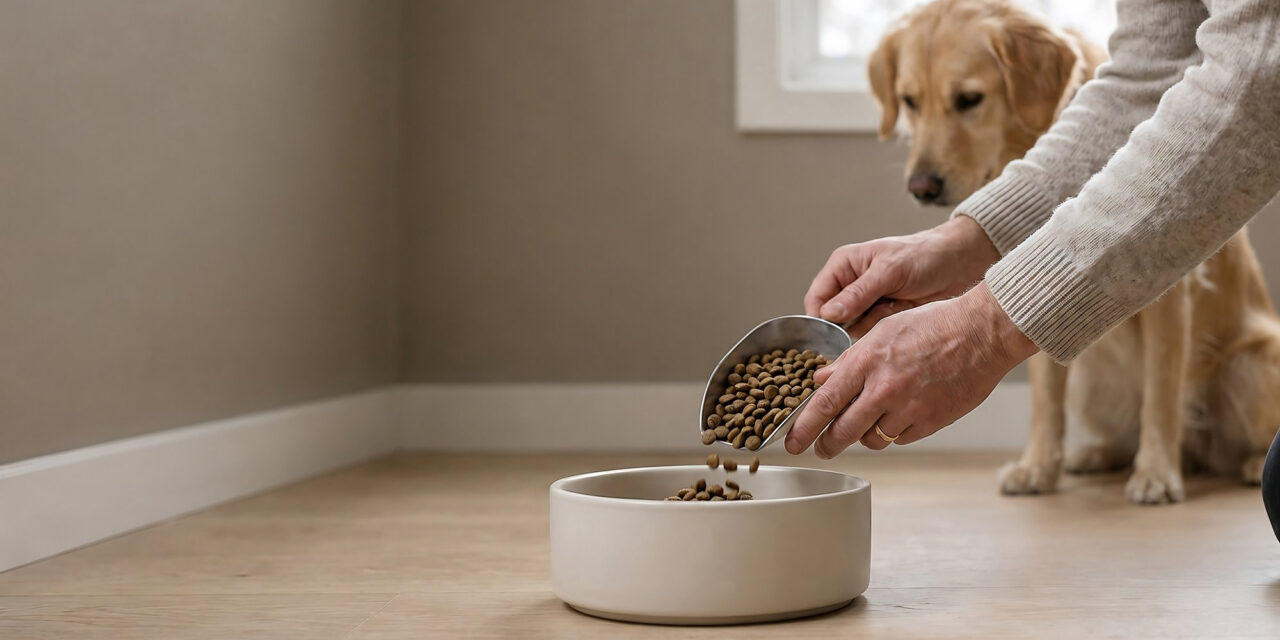
How often should you feed a dog? For most healthy adult dogs, the short answer is twice a day, spaced roughly twelve hours apart. Puppies need meals more often than that, seniors and dogs with certain medical conditions sometimes need a different rhythm, and the “right” schedule always bends around your dog’s age, health, and your household’s actual routine.
Maybe you just brought a dog home and you’re not sure when the puppy schedule is supposed to change. Maybe you’ve been free-feeding for years and a friend just told you that’s a problem. Maybe you searched this at 10 p.m. because your dog swallowed dinner in eleven seconds flat and you read something scary about bloat. All of those questions belong in the same conversation, and none of them have a single universal answer — but they do have a clear, evidence-based set of defaults you can start from tonight.
One note on scope before we get into it: this article covers timing and frequency — when and how often to feed, not how many calories or cups to put in the bowl. The math behind portion size lives in its own question, “how much should I feed my dog,” and we’ll point to the calculation tools without re-deriving the whole thing here. What follows focuses on the schedule itself: life-stage frequency, free feeding versus scheduled meals, the bloat and GDV question specifically, and how to build a routine that survives a real Tuesday.
What’s in this guide
- The short answer: how often should you feed a dog?
- Puppies: small stomachs, frequent small meals
- Adult dogs: why two meals a day is the common default
- Seniors and medical conditions that change the math
- Free feeding vs. scheduled meals: an honest comparison
- Why consistent timing helps with more than digestion
- Splitting your dog’s daily calories across meals
- What changes how often you should feed
- The bloat/GDV question: what current research actually says
- Fast eaters and slow-feeder tools
- Multi-dog households: feeding without the free-for-all
- Travel, schedule changes, and keeping routine through chaos
- Signs your feeding schedule isn’t working
- Common mistakes that undermine a feeding schedule
- A practical framework for building your dog’s schedule
- Frequently asked questions about dog feeding frequency
- Sources
The Short Answer: How Often Should You Feed a Dog?
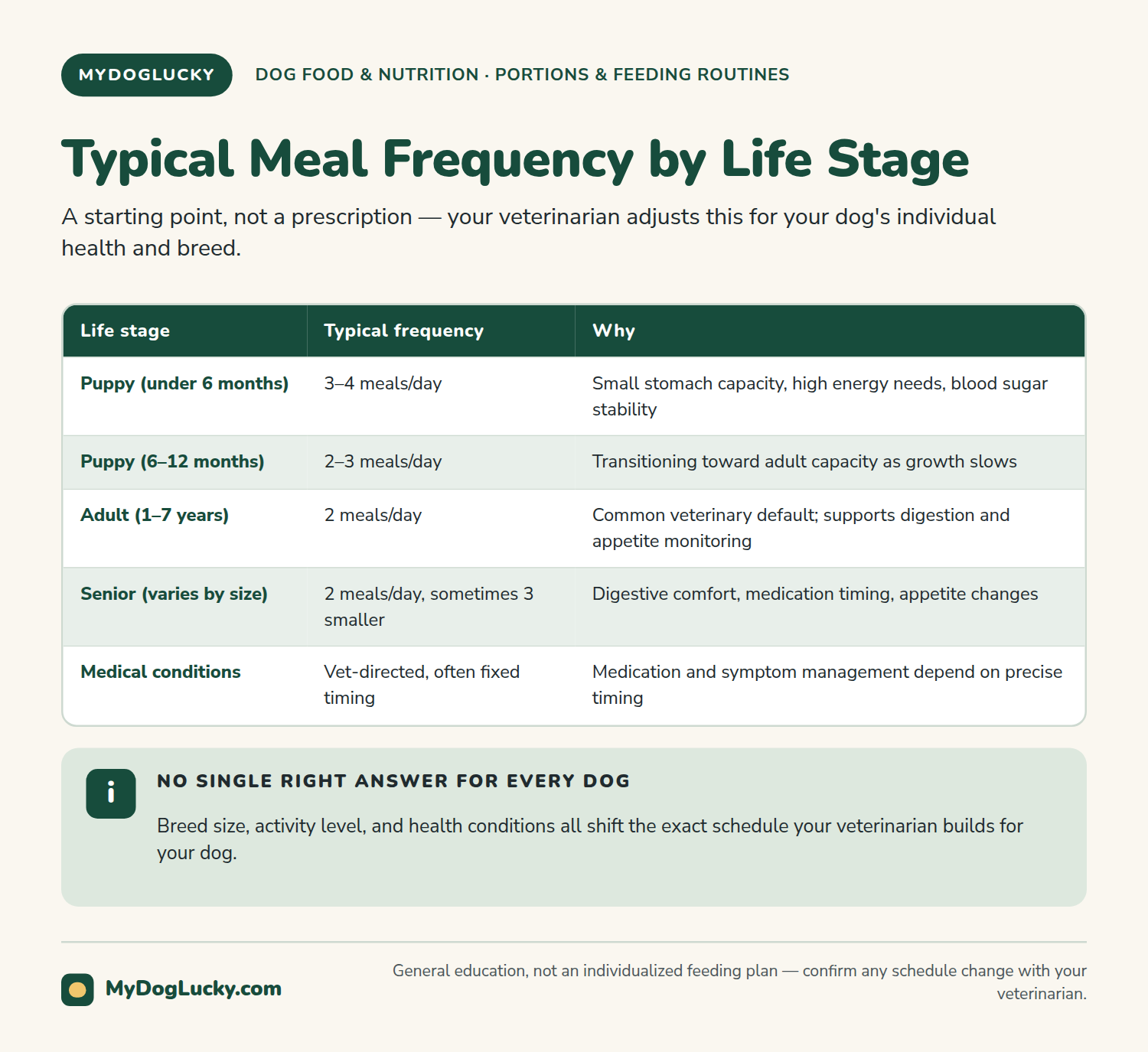
Here’s the framing worth anchoring on before anything else: feeding frequency depends mostly on life stage, with health status and lifestyle adjusting it from there. Puppies under about six months generally need three to four meals a day. Most healthy adults do well on two. Seniors often stay on two, sometimes shifting to smaller, more frequent meals if their digestion or appetite has changed. Dogs with specific medical conditions, like diabetes, may need a schedule built around medication timing rather than general guidelines.
None of that is arbitrary. Twice-daily feeding for adult dogs shows up consistently across veterinary sources, including VCA Animal Hospitals, which notes that feeding at least two meals a day helps prevent a dog’s stomach from sitting empty for long stretches and gives owners a clearer, more frequent window into appetite and eating behavior.
A Quick Reference by Life Stage
This table is a starting point, not a prescription. Individual dogs — a toy breed puppy prone to low blood sugar, a senior with kidney disease, a working dog burning far more calories than an average pet — will need adjustments your veterinarian is better positioned to make than any general chart.
| Life stage | Typical frequency | Why |
|---|---|---|
| Puppy (under 6 months) | 3–4 meals/day | Small stomach capacity, high energy needs, blood sugar stability |
| Puppy (6–12 months) | 2–3 meals/day | Transitioning toward adult capacity as growth slows |
| Adult (1–7 years, most breeds) | 2 meals/day | Common veterinary default; supports digestion and appetite monitoring |
| Senior (varies by size) | 2 meals/day, sometimes 3 smaller ones | Digestive comfort, medication timing, appetite changes |
| Medical conditions (diabetes, GI disease, etc.) | Vet-directed, often fixed timing | Medication and symptom management depend on precise timing |
Why There’s No Single Right Answer for Every Dog
A 6-pound Chihuahua puppy, a 70-pound adult Labrador, and a 12-year-old dog with early kidney disease are not the same feeding problem wearing different bodies. Breed size affects blood sugar stability in puppies. Activity level affects how much fuel an adult dog burns and when. Health conditions can make timing a matter of medication management, not just convenience. The rest of this guide walks through each of those variables, but the table above is where most owners can start tonight.
Puppies: Small Stomachs, Frequent Small Meals
Puppies need to eat more often than adult dogs for two straightforward reasons: their stomachs are small relative to how much energy they’re burning, and very young or very small puppies can run into blood sugar problems if a meal is skipped or delayed too long.
Typical Puppy Feeding Frequency by Age
Most puppies under six months do best with three to four meals spread across the day. Toy and small-breed puppies are often kept on the higher end of that range, sometimes four to six small meals during their first three months, because their smaller body mass means less reserve if a meal runs late. As puppies approach six months, many households transition to three meals, then to the adult standard of two sometime between nine and twelve months, depending on the individual dog and the breed’s expected adult size.
This article isn’t the place to re-derive the full puppy nutrition picture — growth-stage calorie needs, transitioning to adult food, and the specifics of large-breed growth control deserve their own deep dive. What matters here is the timing logic: frequent, smaller meals during the puppy months, tapering toward the adult schedule as growth slows.
Why Frequent Meals Matter More Than the Exact Number
The underlying goal isn’t hitting an exact meal count. It’s avoiding long gaps where a small, fast-growing body has burned through its available energy. A puppy who free-feeds constantly can end up overweight before his adult teeth finish coming in; a puppy who’s skipped too long between meals, especially a toy breed, can become lethargic, wobbly, or worse from low blood sugar. Scheduled, frequent, appropriately portioned meals split the difference, and that’s the goal worth keeping in mind more than any specific number on a chart.
Watch for Low Blood Sugar Signs in Very Small Puppies
Toy-breed and very young puppies are the group most worth watching closely here. Weakness, wobbliness, unusual sleepiness, or trembling between meals are signs worth calling your veterinarian about promptly, particularly in a puppy under four months old who weighs just a few pounds. This isn’t a reason for alarm with every skipped snack — it’s a reason to keep meals reasonably close together and to know what to watch for in the smallest, youngest puppies especially.
Adult Dogs: Why Two Meals a Day Is the Common Default
Once a dog reaches adulthood, usually somewhere between nine months and two years depending on breed size, the feeding conversation simplifies. Two meals a day, spaced roughly twelve hours apart, is the most common recommendation across veterinary sources, and it’s worth understanding why that specific number tends to win out over one meal or three.
The Case for Twice-Daily Feeding
VCA Animal Hospitals lists several reasons twice-daily feeding tends to be the default: it keeps a dog’s stomach from sitting empty for extended stretches, which can contribute to stomach discomfort in some dogs, and it gives you two daily checkpoints on appetite instead of one. A dog who skips breakfast but eats dinner normally is a different, less urgent situation than a dog who hasn’t touched food in twenty-four hours — and you only get that distinction if you’re offering food twice.
When Once a Day Can Work (and When It’s Riskier)
Some healthy adult dogs do fine on one meal a day, and some owners genuinely prefer it for schedule reasons. It’s not automatically wrong. But it comes with tradeoffs worth naming plainly: a once-daily meal is, by definition, a larger single volume of food, and large single meals show up repeatedly in the bloat and GDV research discussed later in this guide as a relevant risk factor, particularly in large, deep-chested breeds. If you’re feeding once a day, splitting that same daily total into two smaller sittings is a low-cost change that several veterinary sources associate with lower risk, without changing anything else about your dog’s diet.
Three Meals: Not Wrong, Just Less Common
Some adult dogs do better on three smaller meals — dogs prone to reflux or vomiting on an empty stomach, dogs who eat small volumes at a time and never seem hungry for a big meal, or households whose schedule naturally supports it. There’s nothing wrong with three meals for an adult dog; it’s simply less common than two, and the daily calorie total matters more than the exact number of sittings it’s divided into.
Seniors and Medical Conditions That Change the Math
Aging and certain health conditions are the two biggest reasons a feeding schedule that worked for years suddenly needs revisiting.
Senior Dogs and Slowing Metabolism
Most senior dogs stay on a twice-daily schedule, but a few things commonly shift. Metabolism tends to slow with age, which means the same food volume that maintained a healthy weight at five years old can start adding pounds at ten. Appetite can also become less predictable — some senior dogs eat less overall and do better with a third, smaller meal added rather than trying to get the same total into two larger sittings. Dental changes, including tooth loss or discomfort, can make some senior dogs reluctant to eat a large meal quickly, which is another reason smaller, more frequent portions sometimes work better later in life.
Diabetes and the Need for Precise Timing
Diabetes is the clearest example of a medical condition where feeding time stops being a lifestyle preference and becomes part of treatment. Cornell University’s Riney Canine Health Center is direct about this: a diabetic dog needs meals timed consistently rather than free-choice feeding, because insulin dosing is built around predictable food intake.
Their guidance notes that meals spaced roughly ten to twelve hours apart work well for most diabetic dogs, and that skipping a meal is a reason to skip that insulin dose too, not push forward with it — giving insulin without food on board risks dangerously low blood sugar. If your dog has diabetes, this is a schedule your veterinarian builds with you specifically, not something to adjust on your own.
GI Sensitivity, Pancreatitis, and Other Conditions
Dogs with sensitive digestion, a history of pancreatitis, or certain GI conditions often do better on smaller, more frequent meals rather than two larger ones, since smaller volumes are generally easier on an already-stressed digestive system. Reflux and gastroesophageal issues can go the other direction from what you’d expect — some of these dogs actually do worse with long gaps between meals, since an empty stomach can worsen reflux symptoms, which is part of why “just feed once a day” isn’t universal advice even for otherwise healthy adult dogs. Any of these situations calls for your veterinarian’s specific input rather than general guidance, since the right adjustment depends on the exact diagnosis.
Free Feeding vs. Scheduled Meals: An Honest Comparison
Free feeding — leaving food out all day for a dog to graze on whenever he wants — used to be common practice, and plenty of owners still do it. It isn’t automatically dangerous or irresponsible. But it comes with real tradeoffs that scheduled meals don’t, and it’s worth an honest look at both sides rather than a blanket verdict either way.
The Case for Free Feeding (and Its Real Limits)
Free feeding is simple. There’s no clock to watch, no risk of a missed meal if you’re stuck at work late, and for some dogs — particularly naturally light eaters who self-regulate well — it can work without issue for years. The Tufts Cummings School’s Petfoodology program, through veterinary nutritionist Dr. Deborah Linder, frames free feeding as workable specifically in one condition: every dog with access to that food needs to already be at an ideal body condition and capable of maintaining it independently. That’s a narrower group than “most dogs,” and it’s the detail that gets lost when free feeding gets recommended as a general default.
The Case for Scheduled Meals
Scheduled meals give you portion control, which is the single biggest lever in preventing weight gain over time. They give you a clear appetite check twice a day instead of a vague sense of “the bowl seems less full than usual.” They make housetraining more predictable, since food in means output on a roughly predictable timeline. And for multi-dog households, scheduled meals are close to a requirement rather than a preference — more on that below.
Weight Management Implications
This is where the free-feeding conversation usually lands, because it’s the most consequential difference. A bowl that’s never empty removes the natural appetite cues that help most dogs self-regulate, and it makes overeating easy to miss day to day, since nobody’s measuring exactly how much disappeared and when. Scheduled meals with a measured portion make it far easier to catch weight creep early, adjust before it becomes a larger problem, and have a concrete, shareable number to bring to your veterinarian if your dog’s weight trend needs a closer look.
Multi-Dog Households Complicate Free Feeding Fast
Free feeding in a household with more than one dog introduces a problem that doesn’t exist with a single dog: you generally can’t tell which dog ate how much. A more food-motivated dog can out-eat a slower, more relaxed housemate, leaving one dog overweight and the other undernourished, with neither situation obvious from a glance at the shared bowl. This is one of the clearest, most practical reasons multi-dog households tend to do better with scheduled, separated meals — not as a rule for its own sake, but because it’s the only reliable way to know what each individual dog is actually eating.
| Factor | Free feeding | Scheduled meals |
|---|---|---|
| Convenience | High — no timing to track | Requires a routine, but flexible once set |
| Weight management | Harder to control; easy to miss creep | Portion control built in |
| Appetite monitoring | Vague; hard to notice a missed meal | Clear signal twice a day |
| Multi-dog households | Difficult to track individual intake | Each dog’s intake is known |
| Housetraining | Less predictable bathroom timing | More predictable output timing |
| Best fit | A single, lean, self-regulating adult dog | Puppies, multi-dog homes, weight-prone dogs, most households |
Why Consistent Timing Helps With More Than Digestion
Feeding your dog at roughly the same times each day pays off in places that have nothing to do with his stomach directly.
Housetraining and Predictable Bathroom Breaks
Food in, output out, on a fairly predictable delay — that’s most of the logic behind housetraining timelines. A puppy or newly adopted dog on an irregular feeding schedule gives you a moving target for bathroom breaks, which makes housetraining slower and messier than it needs to be. Consistent meal times let you predict, with reasonable confidence, when your dog will need to go out, which is most of what makes a housetraining routine actually work.
Building a Routine Your Whole Household Can Follow
A feeding schedule that only one person remembers isn’t really a schedule. Consistent timing gives everyone in the house — partners, kids, a dog walker, a pet sitter — a shared, simple rule to follow instead of a guess. That matters more than it sounds like it should, especially in households where care responsibilities are already split across a few different people and a busy week.
Giving Your Vet a Clearer Picture of Appetite Changes
This is the benefit that’s easy to underrate until it matters. A dog on a consistent schedule gives you a reliable baseline: you know roughly how enthusiastically he normally eats breakfast, how quickly he finishes dinner, whether he typically cleans the bowl or leaves a little behind. Appetite change is one of the more useful, more commonly overlooked signals of an underlying health issue, and it’s far easier to notice a change against a consistent baseline than against the vague, hard-to-track pattern free feeding tends to produce. If your dog suddenly skips a scheduled meal, hesitates at the bowl, or eats with less enthusiasm than usual for more than a day, that’s specific, useful information to bring to your veterinarian.
Splitting Your Dog’s Daily Calories Across Meals
Once you know how many meals a day fits your dog’s life stage and health, the next question is simpler than it sounds: how do you divide his daily calorie total across those meals?
Finding Your Dog’s Daily Calorie Target
Your dog’s daily calorie need — sometimes called maintenance energy requirement — depends on his weight, age, activity level, and whether he’s spayed or neutered. The World Small Animal Veterinary Association’s Global Nutrition Toolkit provides starting-point calorie charts and body condition scoring tools that veterinary teams use to estimate this number, and most pet food labels also list a feeding guideline based on body weight as a starting point. Neither is a substitute for your veterinarian’s assessment, especially if your dog needs to lose or gain weight, but both give you a reasonable number to start dividing.
The Math: A Worked Example
Say your veterinarian estimates a 40-pound adult dog’s daily energy need at around 900 calories, based on his weight, activity level, and body condition. Splitting that across two meals is simple division: 450 calories in the morning, 450 in the evening. If that same dog does better on three smaller meals — because of reflux, a slower eating pace you’re trying to encourage, or personal preference — the math is just as simple: 300 calories per meal, three times a day. The daily total stays the same either way; only the number of sittings it’s divided across changes.
A simple way to think about the split
- Find the daily total. Use your vet’s calculation or the food label’s feeding guideline as a starting point.
- Decide the number of meals based on life stage, health, and your household’s schedule.
- Divide evenly, unless your vet has a specific reason to recommend uneven portions (for example, a smaller evening meal for a dog prone to nighttime reflux).
- Measure consistently — a kitchen scale or a dedicated measuring cup kept with the food, not a scoop that varies by whoever’s feeding that day.
Adjusting Portions Without Overthinking It
This doesn’t need to be recalculated from scratch every week. Most healthy adult dogs on a stable activity level can stay on roughly the same daily total for months at a time, adjusted based on body condition checks rather than a rigid formula. If you’re noticing your dog’s waist disappearing or his ribs getting harder to feel, that’s the signal to trim the total slightly and split it the same way you have been — not a reason to change how many meals he’s getting.
What Changes How Often You Should Feed
A handful of factors reliably shift a dog off the standard default, and it helps to know which ones apply to your dog specifically.
Activity Level and Working or Sporting Dogs
A dog doing serious daily exercise — agility training, hunting, herding work, long-distance running with an owner — burns meaningfully more energy than an average companion dog, and that higher calorie need sometimes translates into an extra small meal rather than two much larger ones. Very active dogs often do better avoiding a large meal right before or right after intense exercise, which is a separate consideration from total calorie count and worth discussing with your vet if your dog has a demanding activity schedule.
Medical Conditions That Require Precise Timing
Diabetes is the clearest example, covered above, but it’s not the only one. Dogs on certain medications that need to be given with food, dogs recovering from GI surgery, and dogs managing chronic pancreatitis often have feeding schedules built specifically around their treatment plan. In these cases, “how often should you feed a dog” stops being a general question and becomes part of a plan your veterinarian designs for that specific diagnosis.
GI Sensitivity and Reflux
Dogs prone to vomiting bile on an empty stomach, a pattern sometimes called bilious vomiting syndrome, often do better with a small meal later in the evening or earlier in the morning to shorten the overnight fasting gap. This is one of the more common reasons a veterinarian might recommend a schedule that looks different from the standard twice-daily default, even for an otherwise healthy adult dog.
Age-Related Metabolism Changes
As covered in the seniors section above, slowing metabolism and changing appetite patterns are two of the most common reasons a feeding schedule that worked for years needs revisiting later in a dog’s life. This isn’t a one-time adjustment at a specific birthday — it’s worth reassessing periodically as your dog ages, particularly if his weight, energy, or enthusiasm at mealtime shifts.
The Bloat/GDV Question: What Current Research Actually Says
This is the question that brings a lot of owners to this article in the first place, usually after watching their dog inhale dinner in under a minute. It deserves a straight answer, and it also deserves honesty about where the research is genuinely still unsettled.
What Bloat and GDV Actually Are
Bloat, more precisely gastric dilatation-volvulus or GDV, happens when a dog’s stomach fills with gas and, in the more severe form, twists on itself. It’s a true emergency. The twisting can cut off blood supply to the stomach and surrounding organs within hours, and dogs with GDV need immediate veterinary treatment to survive it.
Seek emergency veterinary care now if you see
- A visibly swollen or hard abdomen
- Unproductive retching — trying to vomit with little or nothing coming up
- Restlessness, pacing, or an inability to get comfortable
- Excessive drooling
- Rapid breathing, weakness, or collapse
GDV progresses quickly. Don’t wait to see if symptoms pass — this is an emergency-room situation, not a monitor-at-home one.
Which Dogs Are Most at Risk
GDV is far more common in large and giant breeds with deep, narrow chests — Great Danes, Saint Bernards, Standard Poodles, Weimaraners, German Shepherds, and similar builds show up repeatedly in the research as higher-risk. It can occur in smaller or differently built dogs, but the strongest evidence and the clearest prevention guidance center on these deep-chested breeds specifically.
What the Meal-Frequency Research Shows
Multiple veterinary sources consistently list once-daily feeding, or a single large meal, as an identified risk factor for GDV. The Merck Veterinary Manual names once-daily feeding and rapid food consumption among recognized risk factors, and the American College of Veterinary Surgeons similarly identifies being fed a single large meal once daily as an established association, recommending multiple smaller meals — typically two to three a day — as part of both prevention and post-surgical management for at-risk breeds. The American Kennel Club’s coverage puts a number on it, citing research that dogs fed once daily face roughly twice the bloat risk of dogs fed twice daily.
What the Eating-Speed Research Shows
Eating speed is frequently named alongside meal frequency, but the underlying evidence is more mixed than the confident tone of most articles on the topic suggests. A 2016 knowledge summary published in Veterinary Evidence, reviewing the available studies on eating rate and GDV, found that most of the existing evidence indicated no clear effect of eating speed on GDV risk, and that no studies found slow eating to be associated with increased risk.
Where an effect showed up at all, it pointed toward faster eating as the higher-risk pattern, never the reverse. The author was direct about the underlying problem: the literature on this specific question is limited and inconsistent in quality, which means firm conclusions aren’t really available yet. The practical takeaway holds regardless: slowing a fast eater down isn’t going to increase risk, and it may offer modest benefit, even though the certainty behind that benefit is genuinely weaker than a lot of pet-product marketing implies.
A Complicating Study: The Dog Aging Project’s Once-Daily Findings
Here’s where the picture gets more interesting, and more honest, than a simple “once a day is dangerous” headline suggests. A large observational study from the Dog Aging Project, published in the journal GeroScience in 2022 and drawing on data from more than 24,000 dogs, found that dogs fed once daily showed lower odds of several general health condition categories — including gastrointestinal, dental, orthopedic, kidney, and liver-related issues — compared to dogs fed more frequently, along with better scores on measures of cognitive function in a smaller subset of the sample.
That’s a genuinely different signal than the bloat-specific literature above, and it’s worth being precise about what it does and doesn’t show. This was a cross-sectional, correlational study built on owner-reported data, not a controlled trial, and the researchers themselves were clear that their design can’t establish cause and effect — dogs fed once daily might differ from more-frequently-fed dogs in other ways (owner habits, activity level, breed mix) that better explain the pattern. The study also wasn’t focused specifically on isolating GDV as a distinct outcome from the broader “gastrointestinal disorders” category it examined.
It doesn’t cancel out the bloat-specific research above, particularly for large, deep-chested breeds, and it shouldn’t be read as a reason to switch a bloat-prone dog to one large meal a day. What it does show is that the relationship between feeding frequency and overall dog health is more complicated than any single recommendation captures — which is exactly why this remains a genuinely unsettled area, and why blanket certainty in either direction is worth treating with some skepticism.
What Veterinary Consensus Actually Recommends Today
Weighing the available evidence, the practical, current guidance for GDV-prone breeds leans toward multiple smaller meals rather than one large one, and toward tools or techniques that slow down a genuinely fast eater, since neither adjustment carries meaningful downside and both have research suggesting at least modest benefit.
What the evidence does not support is treating either meal frequency or eating speed as a guaranteed or complete prevention strategy — other factors, including genetics, breed, age, and individual anatomy, play a real role that a feeding schedule alone can’t fully offset. If your dog is a large or giant breed with a deep chest, this is worth a direct conversation with your veterinarian about your dog’s individual risk profile, family history, and whether a preventive procedure called gastropexy might be worth discussing, separate from feeding schedule changes.
Fast Eaters and Slow-Feeder Tools
Plenty of dogs treat dinner like a timed event, and while the GDV research on eating speed is more nuanced than the internet often suggests, there are still good reasons — comfort, choking risk, vomiting after meals — to help a genuinely fast eater slow down.
Why Some Dogs Gulp Their Food
Fast eating shows up for a few common reasons: competition instinct in a multi-dog or multi-pet household, a dog who was food-insecure earlier in life, sheer excitement about mealtime, or simply an individual dog’s temperament. None of these need to be “fixed” through punishment or restriction — they’re patterns that respond well to changing the eating setup itself.
Slow-Feeder Bowls, Mats, and Puzzle Feeders
This is a category worth knowing about broadly rather than any specific product: bowls with raised ridges or obstacles that a dog has to eat around, silicone licking mats that spread a meal thin across a textured surface, and food puzzles that require some problem-solving to release kibble. The American Veterinary Medical Association specifically recommends this category — a bowl, mat, or puzzle that makes gulping harder — as a practical tool for slowing a fast eater down, alongside the broader benefit of smaller, more frequent meals. All of these work on the same basic principle: make each bite require more effort or more time than simply lowering the head and inhaling.
Safety Notes for Slow Feeders
A few practical cautions apply. Introduce a new slow feeder gradually rather than switching cold turkey to something dramatically harder, since a frustrated dog who can’t figure out a difficult puzzle on day one may just give up on the meal entirely. Supervise the first several uses to make sure your dog isn’t flipping the bowl, chewing through silicone material, or getting frustrated enough to paw at or bite the device itself. And size the challenge to your dog — a puzzle that’s genuinely difficult on day one but manageable with practice works better than one that’s either too easy to matter or so hard it becomes a source of stress rather than a helpful slowdown.
Multi-Dog Households: Feeding Without the Free-for-All
Feeding more than one dog adds a layer of logistics that single-dog households don’t have to think about, and getting it right matters for both nutrition and household harmony.
Separate Space, Separate Bowls
Feed each dog in his own space, whether that’s separate rooms, opposite ends of a kitchen, or crates during mealtime, especially if any dog in the household shows signs of food guarding or if there’s a noticeable difference in eating speed or food motivation between dogs. This isn’t about assuming a problem exists — it’s a low-cost setup that prevents one from developing, and it’s the only reliable way to know exactly what each dog ate.
Matching Schedules to Individual Needs
Dogs of different ages, sizes, or health conditions in the same household often need genuinely different schedules — a puppy on three meals alongside an adult on two, or a senior with a medical condition on a fixed timing schedule while a younger housemate eats on the standard default. There’s no requirement that every dog in a household eat at the exact same time or frequency; matching each dog’s individual needs matters more than keeping everyone synchronized.
Resource Guarding at Mealtime
Tension around food bowls is common enough in multi-dog households that it’s worth planning around proactively rather than reactively. Watch for stiffening, growling, or one dog positioning himself between another dog and the food. If you’re seeing early signs of resource guarding between dogs at mealtime, separating feeding spaces completely and consulting a qualified trainer or veterinary behaviorist is a more reliable path than hoping it resolves on its own.
Travel, Schedule Changes, and Keeping Routine Through Chaos
Even the most consistent feeding routine eventually meets a travel day, a new work schedule, or some other disruption. A little planning keeps the disruption from turning into a genuine problem.
Time Zone Changes and Travel Days
Dogs don’t experience jet lag the way people do, but a sudden multi-hour shift in meal timing can still cause a rough day or two of digestive upset, especially layered on top of travel stress. When possible, shift meal times gradually over a few days before a major time zone change rather than jumping straight to the new schedule on arrival. If gradual isn’t realistic, expect a day of adjustment and keep meals simple and familiar rather than introducing anything new on top of the disruption — this isn’t the moment to also be working through how to switch dog food.
New Jobs, New Shifts, and Other Life Changes
A new work schedule, a household member moving out, or any other disruption to who’s normally around at mealtime is a common, ordinary reason a feeding schedule needs to shift. The adjustment period is usually short — most dogs settle into a new consistent schedule within a week or two, as long as the new schedule stays consistent once it starts, rather than shifting day to day while everyone figures out the new normal.
Boarding, Sitters, and Written Instructions
Anyone else feeding your dog — a boarding facility, a pet sitter, a family member during travel — needs more than “feed him twice a day.” Write down exact times, exact portions, the specific food, and any medication that needs to go with a meal. This matters even more for dogs with medical conditions like diabetes, where a vague verbal instruction genuinely isn’t enough information for someone else to manage safely.
Signs Your Feeding Schedule Isn’t Working
Most feeding schedules, once established, run quietly in the background for years. A few patterns are worth paying attention to as signs that something about the current setup needs a second look.
Escalating Begging or Food-Seeking Behavior
Some mealtime enthusiasm is completely normal. A dog who’s constantly hovering near the kitchen, has started counter-surfing, or seems genuinely distressed rather than just eager between meals may be telling you the current schedule isn’t meeting his actual needs — sometimes it’s a calorie total that’s too low for his activity level, sometimes it’s meals spaced further apart than work for him individually. This is worth a conversation with your veterinarian rather than just adding more treats to quiet the behavior.
Unexplained Weight Change
Weight gain or loss without a clear cause — no change in food, no change in activity — is one of the more reliable signals that something about the current feeding approach, or your dog’s underlying health, needs a closer look. This is exactly the kind of change that’s easier to catch on a scheduled feeding routine with measured portions than on a free-feeding setup, since you have an actual baseline to compare against.
GI Upset Tied to Meals
Vomiting, diarrhea, or noticeable discomfort that seems to track with feeding times — right after meals, or consistently on an empty stomach before the next one — is worth mentioning to your veterinarian with specifics about timing. That pattern often points toward a schedule adjustment (more frequent, smaller meals, or a different timing relative to activity) rather than a food problem, but only your vet can make that determination with a full picture of your dog’s health.
Call your veterinarian if you notice
- Weight change without a clear cause
- Vomiting or diarrhea that repeats or worsens
- A sudden drop in appetite lasting more than a day
- Food-seeking behavior that’s escalating rather than staying steady
- Any appetite or eating change in a puppy, senior, or medically vulnerable dog
Common Mistakes That Undermine a Feeding Schedule
Letting the Schedule Drift
Feeding sometime around noon one day and 3 p.m. the next erodes most of the benefit consistent timing provides — housetraining predictability, appetite monitoring, a stable routine everyone in the house can follow. A rough window, kept genuinely consistent, beats an exact time that shifts constantly.
Free Feeding a Multi-Dog Household
Covered above, and worth repeating because it’s such a common, easy-to-miss setup problem. A shared, always-full bowl in a home with more than one dog makes it nearly impossible to know what any individual dog actually ate.
Changing Food and Schedule at the Same Time
If your dog is having digestive issues, it’s harder to tell whether a new schedule or a new food is the cause when you change both at once. Adjust one variable at a time when possible, so you can actually identify what helped or what didn’t.
Assuming Once-Daily Feeding Is Automatically Fine for Any Dog
As the bloat/GDV section above lays out, once-daily feeding carries a documented association with higher risk in large, deep-chested breeds specifically. It’s not an automatic problem for every dog, but it’s not a neutral choice for every dog either, and breed and body type matter to that decision.
Treating a Feeding Schedule as Permanent
A schedule that worked for a healthy three-year-old dog may not fit that same dog at ten, or after a medical diagnosis, or after a significant activity change. Revisit the schedule periodically rather than assuming what worked once will always keep working.
A Practical Framework for Building Your Dog’s Schedule
All of the guidance above is meant to inform a schedule that actually fits your household, not to hand you a rigid template. Here’s a practical way to put it together.
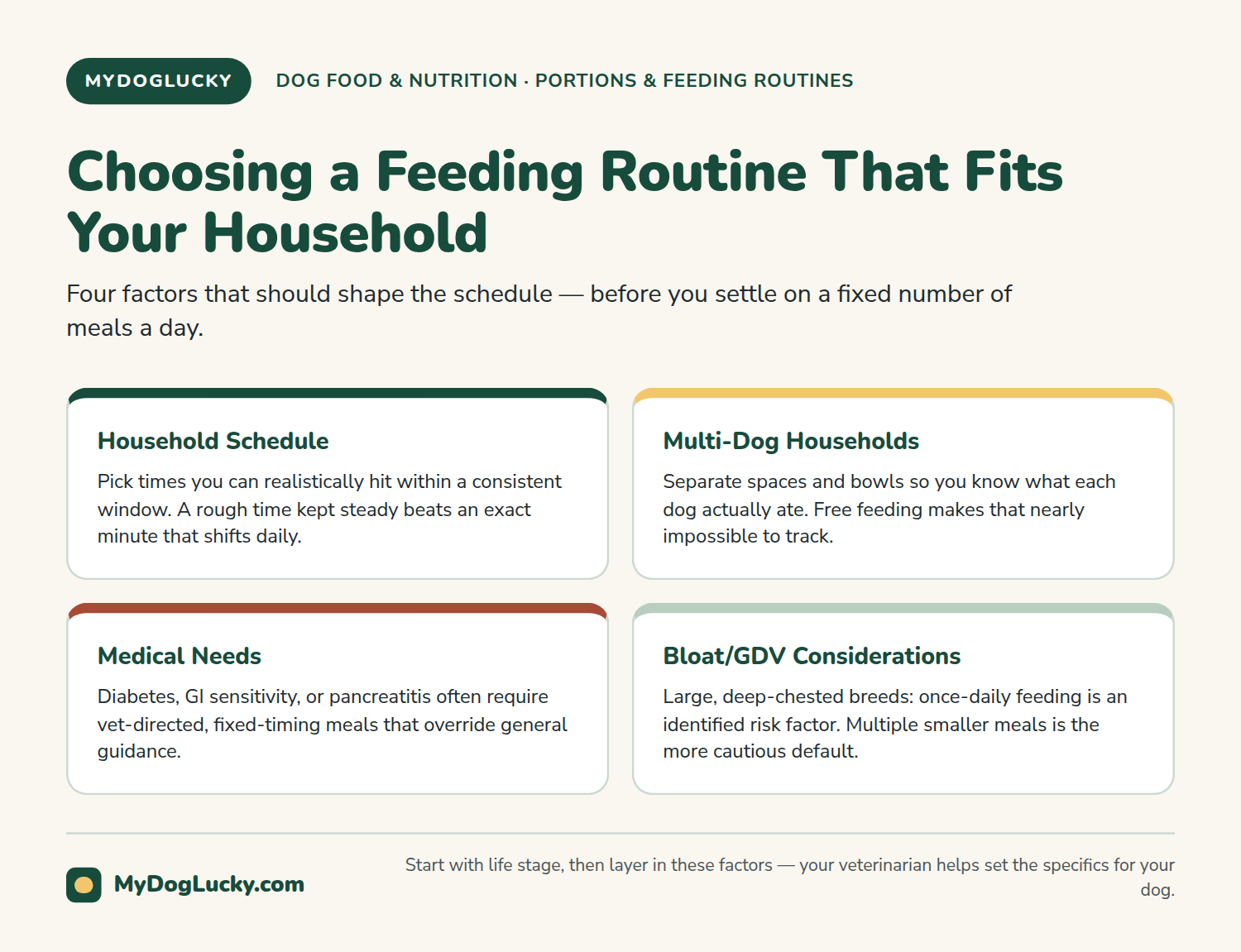
- Start with life stage. Use the reference table earlier in this guide as your baseline: puppy, adult, or senior sets the general frequency range before anything else gets factored in.
- Layer in health status. Any diagnosed medical condition, from diabetes to GI sensitivity, takes priority over the general life-stage default. Confirm the specifics with your veterinarian.
- Check breed and body type against the bloat research. If your dog is a large or giant breed with a deep chest, weight the meal-frequency evidence above more heavily and default toward multiple smaller meals.
- Fit it to your actual household routine. A schedule that requires someone to be home at exactly 1 p.m. every day isn’t sustainable for most working households. Pick times you can realistically hit within a consistent window — roughly the same hour each day beats a precise-but-unrealistic exact minute.
- Calculate and divide the daily total. Use your vet’s calorie estimate or the food label as a starting point, then split it evenly across your chosen number of meals.
- Write it down somewhere every caregiver can see it — a note on the fridge, a shared phone note — especially in households with more than one person feeding the dog or more than one dog to feed.
- Reassess periodically. Body condition checks every few months, and a fresh look anytime health, age, or activity level changes meaningfully.
Most households land on something close to the standard defaults — two meals a day for a healthy adult, three or four for a puppy, adjusted around any medical needs. The framework above exists for the dogs and households that don’t fit neatly into that default, which is more common than a single one-size-fits-all answer would suggest.
Frequently Asked Questions About Dog Feeding Frequency
How often should you feed a dog every day?
Most healthy adult dogs do well on two meals a day, spaced about twelve hours apart. Puppies under six months typically need three to four meals a day, and seniors or dogs with specific medical conditions may need a different frequency based on their individual health.
Is it bad to feed a dog once a day?
Not automatically, but it’s not risk-free for every dog either. Once-daily feeding is associated with a documented increase in bloat/GDV risk, particularly in large, deep-chested breeds, largely because it means a bigger single meal. For small or medium breeds without that risk profile, once-daily feeding can work for some individual dogs, though twice-daily remains the more common veterinary default across the board.
Can I free-feed my dog instead of scheduling meals?
You can, for a dog who’s already at a healthy weight and reliably self-regulates how much he eats. It’s a poor fit for puppies, for multi-dog households, for dogs prone to weight gain, and for any dog whose appetite you want to monitor closely for health reasons.
Does feeding a dog too infrequently cause bloat?
Once-daily feeding, and the larger single meal that usually comes with it, is one of several factors research associates with higher GDV risk, mainly in large and giant deep-chested breeds. It isn’t the only factor, and the certainty behind it varies by which specific claim you’re looking at — meal frequency has fairly consistent supporting evidence; eating speed’s evidence is genuinely more mixed. Neither one is a complete explanation for why GDV happens.
How do I know if my dog is eating too fast?
A dog who finishes a full meal in under a minute, gulps audibly, or seems to inhale food without much chewing is generally considered a fast eater. Signs like frequent regurgitation shortly after meals or visible gulping during eating are worth mentioning to your veterinarian, and a slow-feeder bowl or puzzle is a reasonable first step to try.
Should I change my senior dog’s feeding schedule?
Possibly, and it’s worth periodically reassessing rather than assuming the schedule that worked in adulthood still fits. Slowing metabolism, changing appetite, and dental changes are common reasons senior dogs benefit from smaller, more frequent meals or an adjusted daily calorie total. Your veterinarian can help determine what’s actually needed based on your dog’s specific health.
What’s the right feeding schedule for a diabetic dog?
This needs to be set by your veterinarian, built specifically around your dog’s insulin timing. Cornell’s veterinary guidance notes that meals spaced roughly ten to twelve hours apart, timed consistently with insulin doses, work well for many diabetic dogs, and that a skipped meal generally means skipping that insulin dose too, not adjusting it, until you’ve spoken with your vet.
Can I feed my dog three times a day instead of two?
Yes, for most healthy adult dogs, three smaller meals is a completely reasonable alternative to two larger ones, as long as the daily calorie total stays the same. Some dogs with reflux or GI sensitivity actually do better on three meals, since the gaps between them are shorter.
How long can a healthy adult dog go without eating?
An occasional skipped meal from mild pickiness usually isn’t an emergency in an otherwise healthy adult dog, but a dog who refuses food entirely for more than 24 hours, or who shows other signs of illness alongside not eating, needs veterinary attention rather than a wait-and-see approach. Puppies, seniors, and medically vulnerable dogs need a much shorter leash on this — a missed meal in those groups is worth calling your vet about sooner.
Do multiple dogs in the same house need to eat at the same time?
Not necessarily, though it often simplifies your routine if they do. What matters more is that each dog’s individual schedule and portion match his own life stage and health needs, and that you can account for what each dog specifically ate, which usually means separate bowls and separate spaces regardless of timing.
What if I need to change my dog’s feeding times because of a new work schedule?
Shift the times gradually over several days if your dog’s schedule allows it, rather than jumping straight from one routine to a very different one overnight. Most dogs adjust within a week or two of consistent new timing. Keep the daily calorie total and number of meals the same during the transition, and only adjust those separately if needed.
Sources
- VCA Animal Hospitals. Feeding Times and Frequency for Your Dog
- VCA Animal Hospitals. Nutrition – General Feeding Guidelines for Dogs
- American Kennel Club. How Often Should Dogs Eat and How Much Should You Feed Them?
- American Kennel Club. Bloat (GDV) in Dogs: What Is It and How Is It Treated? (updated November 15, 2024)
- Tufts Cummings School of Veterinary Medicine, Petfoodology. Linder, D.E. How Often Should I Feed My Pet? (February 8, 2021)
- Merck Veterinary Manual. Gastric Dilation and Volvulus in Small Animals
- Cornell University College of Veterinary Medicine, Riney Canine Health Center. Gastric Dilatation-Volvulus (GDV) or “Bloat”
- Cornell University College of Veterinary Medicine, Riney Canine Health Center. Diets for Diabetic Dogs
- American College of Veterinary Surgeons. Gastric Dilatation-Volvulus (October 30, 2023)
- Buckley, L.A. Are Dogs That Eat Quickly More Likely to Develop a Gastric Dilatation (+/− Volvulus) Than Dogs That Eat Slowly? Veterinary Evidence, 1(4) (December 13, 2016)
- McKenzie, B.A., et al. Once-Daily Feeding Is Associated With Better Health in Companion Dogs: Results From the Dog Aging Project. GeroScience (published online April 28, 2022)
- Association of American Feed Control Officials (AAFCO). Selecting the Right Pet Food
- World Small Animal Veterinary Association (WSAVA). Global Nutrition Guidelines and Toolkit
- American Veterinary Medical Association. Your Pet’s Healthy Weight
This article is general education for U.S. dog owners. It is not an individualized feeding plan or veterinary advice for your dog. Any change to feeding frequency for a puppy, senior, or dog with a diagnosed medical condition — including diabetes, GI disease, or a history of bloat/GDV — should be discussed with your veterinarian. Sudden appetite changes, repeated vomiting or diarrhea, unexplained weight change, or any sign of bloat/GDV listed above warrant prompt veterinary attention.



Trackbacks/Pingbacks