

Somewhere between the fortieth “sit” of a training session and the fourth time your dog gives the pantry door a meaningful stare, most owners lose count of the treats. That’s completely normal — treats are small, quick, and easy to hand out without thinking twice. It’s also exactly how a jar of healthy dog treats turns into a genuine dent in your dog’s diet, without anyone meaning for that to happen.
This guide walks through the actual math behind healthy dog treats: the 10%-of-daily-calories guideline that shows up across veterinary nutrition advice, how that plays out with real numbers, and why training-heavy households burn through the budget faster than anyone expects. We’ll cover the practical difference between a treat and a topper, how to choose treats by criteria instead of packaging, what the VOHC seal on a dental chew actually certifies, and how to keep a prescription diet from getting quietly undone by good intentions.
One thing this article won’t do: hand you one specific calorie number for your dog. Every dog’s needs depend on weight, age, activity level, and health status, and a prescription diet changes the math again. Think of what follows as the framework. The exact numbers are a conversation for you and your veterinary team, especially if your dog is managing weight, an allergy, or a chronic condition.
What’s in this guide
- Why the 10% Treat Rule Matters (and How to Use It)
- Treats vs. Toppers: What’s Actually Different
- How Treat Calories Add Up Faster Than You’d Think
- Choosing Healthy Dog Treats: A Practical Checklist
- Reading a Dog Treat Label: What the Numbers Actually Tell You
- Dental Chews and the VOHC Seal
- High-Value vs. Low-Value Training Treats
- Treats for Dogs With Dietary Restrictions
- Homemade Treats: Safety Basics
- Topper Ideas That Add Nutrition, Not Just Calories
- Portion Math for Multi-Dog and Multi-Treat Households
- Common Mistakes That Blow the Treat Budget
- Building Your Dog’s Daily Treat Budget
- Frequently Asked Questions About Dog Treats and Toppers
- Sources
Why the 10% Treat Rule Matters (and How to Use It)
Where the 10% Guideline Comes From
The World Small Animal Veterinary Association’s nutrition guidance recommends keeping treats under 10% of a dog’s total daily calories, with the other 90% coming from a complete and balanced diet. Veterinary hospitals and professional groups across the U.S. echo the same figure, including VCA Animal Hospitals and the American Kennel Club. That consistency matters. It isn’t a marketing number pulled from a single product’s packaging — it’s a working consensus among the people who study canine nutrition for a living.
“Treats,” in this context, means more than the biscuits in a jar. WSAVA’s guidance defines treats broadly: anything fed in addition to a complete and balanced diet, including snacks, chews, dental treats, and even the pill pocket used to hide a medication. If it isn’t part of your dog’s regular meal, it counts toward that 10%, whether it came from a bag labeled “treat” or from your own plate.
A Worked Example, Step by Step
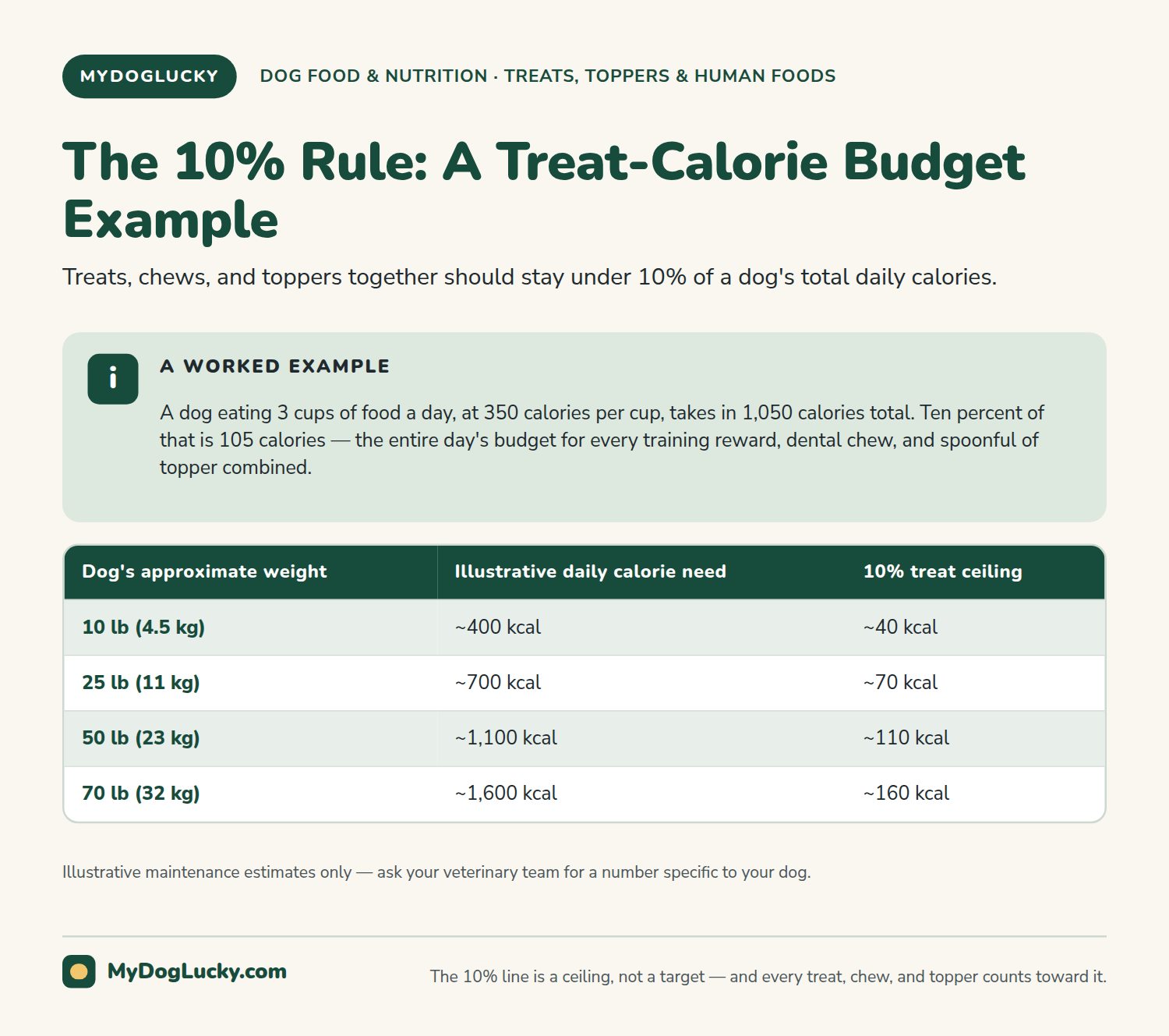
Here’s how the math actually plays out. Say your dog eats 3 cups of food a day, and that food provides 350 calories per cup — 1,050 calories total. Ten percent of 1,050 is 105 calories. That’s the entire daily treat and topper budget: every training reward, every dental chew, every spoonful of topper, added together.
Smaller dogs have a tighter budget than their appetites suggest. A 10-pound dog eating around 400 calories a day has roughly 40 calories of treat room — not much more than a single higher-calorie biscuit. A 70-pound dog eating 1,600 calories a day has about 160 calories to work with, enough for a more generous handful of small training treats spread across a session.
The number that actually matters isn’t the treat itself. It’s the calories per treat, checked against your dog’s daily total. Two treats can look nearly identical in size and still differ by a factor of three in calories, depending on fat content and ingredients.
Roughly How This Scales by Size
The table below is illustrative, not a substitute for a number specific to your dog, but it shows how quickly the treat ceiling shifts across different sizes.
| Dog’s approximate weight | Illustrative daily calorie need* | 10% treat ceiling |
|---|---|---|
| 10 lb (4.5 kg) | ~400 kcal | ~40 kcal |
| 25 lb (11 kg) | ~700 kcal | ~70 kcal |
| 50 lb (23 kg) | ~1,100 kcal | ~110 kcal |
| 70 lb (32 kg) | ~1,600 kcal | ~160 kcal |
*Illustrative maintenance estimates only. Your dog’s actual calorie need depends on age, activity, body condition, and spay/neuter status — ask your veterinary team for a number specific to your dog.
Why the Guideline Exists in the First Place
Complete and balanced dog food is formulated to deliver the right ratio of protein, fat, vitamins, and minerals across an entire day — not just enough calories. Treats, even good ones, rarely carry that same nutritional profile. Stack too many on top of a balanced diet, and you start diluting the overall nutrition your dog is actually getting, even while staying within a reasonable-looking calorie count. The 10% line exists to keep that dilution small enough that it doesn’t matter.
Treats vs. Toppers: What’s Actually Different
Two Different Jobs
Owners often use “treat” and “topper” interchangeably, but they solve different problems. A treat’s job is behavioral: it rewards a sit, marks good leash manners, or just says “good dog” after a nail trim. A topper’s job is nutritional or logistical: it makes an otherwise fine meal more appealing, adds a little variety, or gets a reluctant eater to actually finish a bowl.
That difference in purpose changes how each one should be used. Treats are often calorie-dense on purpose, because a small, punchy reward works better mid-training than a large, bland one. Toppers are meant to be used in smaller amounts relative to the whole meal, layered onto food your dog already eats rather than replacing part of it with something less balanced.
Side by Side
| Category | Treats | Toppers |
|---|---|---|
| Main purpose | Reward behavior, mark training moments | Boost palatability or nutrition of a meal |
| Typical calorie density | Often higher, by design | Usually lower per serving |
| Typical amount used | Small, frequent pieces during a session | A spoonful or two mixed into a meal |
| Best used for | Training, dental chewing, special occasions | Picky eaters, seniors, appetite support |
| Watch for | Calorie creep during frequent training | Portion drift — “just a little” adds up daily |
Why the Distinction Actually Matters for the Budget
Both treats and toppers count against that same 10% ceiling, so the distinction isn’t about which one is “allowed” and which isn’t. It’s about matching the right tool to the right moment. Reaching for a calorie-dense training treat every time your dog looks a little bored at dinner wastes a tool built for something else. Reaching for a topper when you actually need a fast, high-value training reward doesn’t work well either, since most toppers aren’t built to be handed out one small piece at a time.
How Treat Calories Add Up Faster Than You’d Think
The Training Treat Trap
Training treats are where the 10% budget disappears fastest, and it’s rarely because anyone is being careless. A single session for a new skill can easily involve twenty or thirty repetitions, and each repetition usually means a treat. Multiply that across two or three short sessions a day — completely normal for a puppy or a newly adopted dog — and you can burn through a full day’s treat budget before lunch.
A Concrete Example
Picture a 25-pound adolescent dog eating about 700 calories a day. Ten percent of that is 70 calories — the entire treat and topper allowance. If a small, soft training treat runs about 3 calories each, that’s roughly 23 treats for the whole day, covering every session, every reward, every “good boy” moment.
A single focused session on a new cue — working on a solid “stay,” say — can use 15 or more repetitions in ten minutes. That’s most of the day’s budget gone in one sitting, before a single dental chew, a single walk-reward, or a single “because you’re cute” biscuit ever shows up.
New Dog and Rescue Households Run Into the Same Wall
It isn’t only puppies. A newly adopted adult dog, still learning house rules, a name, a leash routine, and basic manners, often gets trained just as intensively as a puppy would — sometimes more, if there’s a specific behavior the household is working to change quickly. The calorie math doesn’t care whether the dog is eight weeks old or eight years old; it only cares how many small rewards changed hands that day.
Why This Hits Training-Heavy Households Hardest
Puppy owners and anyone bringing home a new dog tend to train the most, and therefore treat the most, in exactly the weeks when consistent reward-based learning matters most. That’s not a reason to train less. Frequent, well-timed rewards are how reward-based training actually works. It’s a reason to get smarter about treat size and calorie count, not treat frequency.
Two practical fixes handle most of this. First, use genuinely tiny training treats — pea-sized or smaller for a medium dog — instead of full-sized biscuits broken apart mid-session. Second, swap in your dog’s own measured kibble as a training reward for at least some repetitions. Most dogs work just as hard for a piece of their regular food as for a specialty treat, and kibble used this way doesn’t add anything to the treat side of the ledger. It’s just breakfast, delivered one piece at a time.
Choosing Healthy Dog Treats: A Practical Checklist
Start With the Ingredient List, Not the Packaging
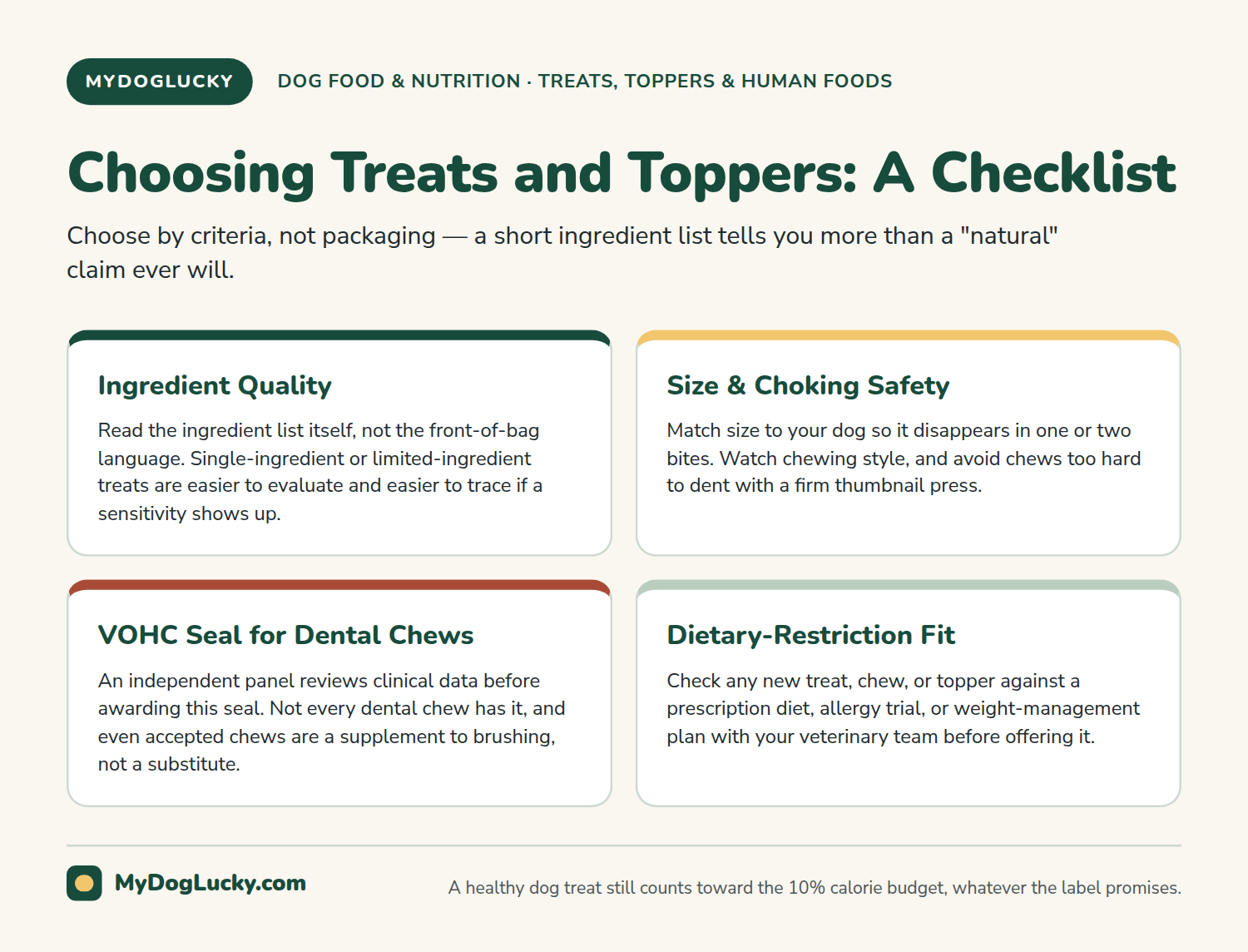
Packaging sells a feeling — “natural,” “wholesome,” “grain-free” — that doesn’t always match what’s actually inside. A more useful habit is reading the ingredient list itself. Single-ingredient treats, like a plain dehydrated sweet potato or a freeze-dried piece of meat, and other limited-ingredient options give you a clear picture of exactly what your dog is eating, with fewer variables if a sensitivity ever shows up.
This matters more than it sounds like it should. AAFCO’s guidance on treats and chews notes that treats aren’t required to meet the same nutritional standards as complete and balanced food, and that some are calorie-dense enough to meaningfully affect an otherwise good diet if used carelessly. A short, recognizable ingredient list makes it easier to spot exactly where those calories and additives are coming from, which is most of what makes a treat one of the genuinely healthy dog treats worth keeping in rotation.
Match Size to Your Dog, Not the Other Way Around
A treat sized for a 70-pound retriever is a choking risk for a 10-pound terrier, and a treat sized for a small dog barely registers as a reward for a large one. Size training treats so they can be swallowed in one or two bites without much chewing. That’s what keeps a session moving and keeps a piece from getting lodged somewhere it shouldn’t.
A rough rule of thumb for treat size
A training treat that disappears in one or two bites, with minimal chewing, keeps a session moving and lowers choking risk. For most small to medium dogs, that’s roughly pea-sized. For large and giant breeds, something closer to a grape or a small marshmallow in size still counts as “small” relative to their mouths.
Think About Your Dog’s Actual Chewing Style
Some dogs nibble. Some dogs are aggressive chewers who treat everything like a personal challenge. A treat or chew that’s perfectly safe for a gentle nibbler can be a genuine hazard for a dog who tries to swallow it whole or breaks off large chunks. Watch how your dog handles a new treat the first few times, and skip anything that splinters into sharp pieces or breaks into chunks large enough to swallow without chewing.
Avoid excessively hard chews — the kind that don’t give at all under a firm thumbnail press — since they carry a real risk of a fractured tooth, not just choking. This applies to some antlers, hooves, and very hard synthetic chews, not just to poorly made products. Supervise any new chew for the first several sessions, regardless of how sturdy the packaging claims it is.
Consider Where the Treat Was Made
Manufacturing standards and quality control vary by company and by country of origin. Treats made by companies with documented sourcing and a traceable recall history you can actually find are generally a safer bet than treats with no traceable information at all. This is a “do a little homework” step, not a guarantee. No single fact on a label eliminates risk entirely, but a treat you can trace tends to be a treat you can trust more.
Make the Calories Work Harder With Enrichment
The same treat calories can go further, and last longer, depending on how you deliver them. Scattering a handful of small training treats in the grass for a sniffing game, or loading a portion of your dog’s own kibble into a slow feeder or a puzzle toy, stretches the same calorie count across ten or fifteen minutes of engagement instead of ten or fifteen seconds. That’s a genuinely useful swap for a dog who seems to want “more treats,” when what’s actually missing is more time spent working for them.
This doesn’t change the math on the 10% rule. It changes how satisfying that same budget feels, which matters just as much on the days when the calorie ceiling is already tight.
Reading a Dog Treat Label: What the Numbers Actually Tell You
The Nutritional Adequacy Statement (or the Lack of One)
Complete and balanced dog food carries a specific nutritional adequacy statement, confirming it meets recognized nutrient standards for a dog’s entire diet. Most treats don’t carry that same statement, and per FDA guidance, that’s expected: treats, snacks, and toppers are typically not intended to be a dog’s sole diet, so they aren’t held to the same standard. AAFCO’s guidance on treats and chews confirms that treats aren’t required to meet complete and balanced nutrient profiles, though some manufacturers choose to formulate treats that do, and label them accordingly.
That’s not a red flag by itself. It just means a treat’s job is different from a meal’s job, and reading the label with that distinction in mind keeps you from expecting a level of nutritional completeness a treat was never designed to deliver.
Find the Calorie Statement
The single most useful number on a treat bag, for budget purposes, is calories per treat or calories per serving — not the ingredient list. Not every treat bag prints this clearly. Some only offer a feeding guideline in pieces per day, with no calorie figure attached at all. When that happens, a rough estimate based on a comparable product, or a quick question to the manufacturer, beats guessing entirely.
What “Snack” or “Treat” on the Package Actually Signals
AAFCO requires products intended as treats to say so clearly on the front of the package, using the word “snack” or “treat.” That label is a regulatory signal, not a marketing choice. It tells you the product wasn’t formulated or tested as a complete diet, which is exactly the category this whole 10% conversation is about.
Exempt Products Deserve a Second Look
Some chews — certain bones, hooves, and rawhide-style products — are exempt from the full labeling requirements that apply to other treats, unless the manufacturer makes a specific nutrition claim. These products can be calorie-dense, and because they’re exempt from some labeling rules, the calorie information you’d normally rely on may simply not be printed anywhere. Treat anything in this category with extra caution around portion size, precisely because the label may not be telling you as much as you’d expect.
Dental Chews and the VOHC Seal
What Dental Chews Are Actually Claiming to Do
Dental chews are marketed on a simple promise: chewing mechanically scrapes plaque off teeth, which can help slow the buildup that leads to tartar and gum disease. That mechanism is real, but not every product on a shelf labeled “dental” has actually been tested to prove it works the way the packaging implies.
What the VOHC Seal Actually Certifies
The Veterinary Oral Health Council, an independent group of veterinary dentists and dental scientists, reviews clinical data that manufacturers submit and decides whether a product has demonstrated real effectiveness at controlling plaque, tartar, or both. VOHC doesn’t run its own lab tests. It reviews the evidence a company submits against a defined clinical standard, and awards its seal only when that evidence holds up.
According to VOHC, regular use of a product carrying its seal is associated with a genuine reduction in the severity of periodontal disease, alongside regular veterinary exams and professional cleanings when they’re needed. That’s a meaningfully different claim than “helps clean teeth” printed on a bag with no data behind it.
Not Every Dental Product Has the Seal — and That’s Worth Noticing
Because VOHC certification is voluntary and requires a company to submit real clinical data, plenty of dental chews on the market simply haven’t gone through the process. That doesn’t automatically mean an uncertified product does nothing. It does mean the claim is unverified by an independent body, which is a meaningfully different level of confidence than a product carrying the seal.
If dental health is the actual goal, not just a chew your dog enjoys, checking for the VOHC seal is a fast, concrete way to narrow the field. It’s one of the few genuinely objective markers in a category otherwise full of marketing language, and it’s worth looking for specifically among healthy dog treats marketed for dental benefit.
VOHC maintains a current, publicly searchable list of accepted products on its own website, organized by category and species. Checking that list directly, rather than trusting a paw-print logo or a vague “vet recommended” claim printed on packaging, is the most reliable way to confirm a specific product actually carries the seal.
Chews Aren’t a Replacement for Brushing
Even a VOHC-accepted product is a supplement to dental care, not a substitute for it. Daily brushing, when a dog will tolerate it, remains the most effective thing an owner can do at home, and professional veterinary dental cleanings catch problems chewing alone can’t reach, like disease below the gumline. Treat dental chews as one tool in a routine, not the whole routine.
High-Value vs. Low-Value Training Treats
Not All Rewards Are Created Equal
Ask your dog to sit in a quiet living room, and a piece of dry kibble usually gets the job done. Ask the same dog to hold that sit at the edge of a dog park with three other dogs running past, and kibble often doesn’t stand a chance. That gap is the whole idea behind high-value and low-value treats: matching the size of the reward to the size of the ask.
What Counts as High-Value
High-value treats tend to be soft, strongly scented, and something your dog doesn’t get outside of training — a small piece of plain cooked meat, a bit of cheese, or a specialty training treat with a stronger smell than everyday kibble. They’re reserved for genuinely hard moments: learning a brand-new skill, practicing around real distractions, or working through something your dog finds a little scary or overstimulating.
What Counts as Low-Value
Low-value treats are the everyday stuff: dry biscuits, plain kibble, the treats your dog has had a hundred times before. They’re perfectly effective for reinforcing behaviors your dog already knows well, like a sit at the front door or a settled “down” on a mat during a calm evening. Saving the exciting stuff for the exciting moments keeps it exciting.
Why the Distinction Also Helps the Calorie Budget
Here’s the part that connects back to the 10% rule: high-value treats are often more calorie-dense, so using them only where they’re actually needed — not for every single rep of a skill your dog already has down cold — keeps the daily budget from getting blown on repetition your dog didn’t need extra motivation for in the first place. Save the good stuff for when it earns its calories.
A useful habit: keep your dog’s regular measured kibble as the default low-value reward, and set aside a small, separate portion of something higher-value for the specific moments that call for it. That way, “training treats” mostly comes out of a meal your dog was already going to eat, instead of adding a second stack of calories on top of it.
Treats for Dogs With Dietary Restrictions
When a Treat Can Undo a Therapeutic Diet
A prescription or therapeutic diet is formulated for a specific medical purpose: a low-fat recipe for a dog recovering from pancreatitis, a novel-protein or hydrolyzed recipe for a dog with food allergies, a restricted-mineral recipe for kidney disease. That formulation is precise on purpose. A treat that seems perfectly reasonable in general terms — a plain dehydrated chicken strip, for instance — can still work against a diet that’s specifically trying to avoid chicken protein, or trying to limit fat, or trying to control sodium.
This is one of the more common ways a therapeutic diet quietly stops working as intended: not because the prescription food itself failed, but because treats, toppers, or table scraps layered on top reintroduced exactly the thing the diet was designed to avoid. It’s an easy mistake to make, since most treat labels don’t flag this kind of conflict at all.
Allergies and Ingredient Sensitivities
A dog on an elimination diet for a suspected food allergy needs every treat, chew, and flavored medication coating checked against that same restricted ingredient list, for the whole length of the trial. A single treat with the wrong protein source can reintroduce the allergen and send the entire diagnostic process back to the start. Some manufacturers make treats formulated to match specific prescription or limited-ingredient diets, which is worth asking your veterinary team about directly rather than guessing from a treat label alone.
Weight Management
For a dog on a calorie-restricted weight-loss plan, treats deserve extra scrutiny, not less. The instinct to treat a dog “just a little” out of guilt during a diet is understandable and extremely common, and it’s also one of the more common reasons a weight-management plan stalls. Low-calorie vegetables, a small portion of the dog’s own measured food used as a reward, or specific weight-management treats formulated to be lower in calories can all help keep training and affection going without derailing the plan.
A Few Common Scenarios
| Situation | What matters most | What usually helps |
|---|---|---|
| Food allergy or sensitivity trial | Every ingredient and protein source checked against the restricted list | Single-ingredient treats matching the trial diet’s protein and carb source |
| Weight management | Total daily calories, not just treat calories | Low-calorie vegetables or a portion of the dog’s own measured food |
| Kidney or urinary support diet | Mineral and protein content, not just calories | Treats formulated or approved for that specific condition |
| GI sensitivity or pancreatitis history | Fat content specifically | Low-fat, plain treats; skip anything fatty, cheesy, or fried |
The One Rule That Covers All of This
Before adding any new treat, chew, or topper to a dog on a prescription diet, a weight-management plan, or an active allergy trial, run it by your veterinary team first. This isn’t overcaution for its own sake. A therapeutic diet’s entire value comes from consistency, and even a small, well-meaning treat can undo weeks of careful management if it isn’t cleared first.
Homemade Treats: Safety Basics
Keep the Ingredient List Genuinely Simple
Homemade treats can be a good option for dogs with sensitivities, since you control exactly what goes in. Plain cooked lean meat, small amounts of dog-safe vegetables like carrots or green beans, and plain canned pumpkin (not pie filling) are common, low-risk starting points. Skip added salt, sugar, butter, and seasoning blends. Onion and garlic powder in particular show up in seasoning mixes far more often than owners expect, and both are on the list of foods dogs should never eat.
Know the Foods That Are Always Off the List
A handful of ingredients are unsafe for dogs regardless of quantity or preparation: chocolate, grapes and raisins, macadamia nuts, alcohol, and xylitol, an artificial sweetener that shows up in some peanut butter, baked goods, and sugar-free products. Xylitol is worth double-checking on any peanut butter you’re using in homemade treats, since it can cause a rapid and dangerous drop in blood sugar even in small amounts. If you’re ever unsure whether a specific food is safe, it’s worth a quick check of a reliable source on foods dogs should never eat before it goes anywhere near the mixing bowl.
Ingredients that never belong in a homemade dog treat
- Chocolate, in any form.
- Grapes and raisins, even in small amounts.
- Xylitol, often hiding in peanut butter, baked goods, and sugar-free products.
- Onion and garlic, including powdered forms in seasoning blends.
- Macadamia nuts and raw bread dough.
- Alcohol, including unbaked dough with active yeast.
Handle and Store Them Like Food, Because They Are
Homemade treats without commercial preservatives don’t last as long as a shelf-stable bag from the store. Refrigerate anything made with meat, egg, or dairy, and use it within a few days, or freeze a batch in small portions. Treat food safety the same way you would in your own kitchen: wash your hands, use clean surfaces, and don’t leave anything perishable sitting out for hours during a long training day.
Count the Calories Anyway
A homemade treat isn’t automatically low-calorie just because you made it yourself. A small piece of a homemade meatloaf-style treat can carry as many calories as a specialty commercial one, especially if it includes fat or cheese. Estimate calories the same way you would for a store-bought treat — roughly, using the ingredients and portion size — and count it toward the same 10% budget, rather than treating “homemade” as a free pass.
Topper Ideas That Add Nutrition, Not Just Calories
The Goal Is Enhancement, Not Addition
A good topper makes an existing meal more appealing or slightly more nutritious, without meaningfully changing the calorie count your dog is already eating. That’s a different goal than a treat, and it changes what you should reach for.
Low-Calorie Options Worth Trying
A spoonful of plain canned pumpkin adds fiber and moisture without many calories. A splash of low-sodium bone broth — check the ingredient list for onion or garlic, which sometimes sneaks into flavored broths — can make a bowl more appealing for a picky eater or an older dog with a fading sense of smell. A small amount of plain, unsweetened yogurt can add variety for dogs who tolerate dairy well, though plenty of dogs don’t, so introduce it in a small amount first.
Freeze-Dried and Dehydrated Options
A light sprinkle of freeze-dried meat crumbles works well as a topper because a little goes a long way. The concentrated flavor and aroma can make an unenthusiastic eater more interested in the bowl, without needing much volume to do it. Use these sparingly; freeze-dried products are often calorie-dense per gram, so “a light sprinkle” really does mean a light sprinkle, not a generous handful.
How Much Is “A Little,” Really
As a rough sense of scale: a single tablespoon of plain canned pumpkin runs somewhere around 5 to 10 calories, and a tablespoon of plain yogurt is similarly modest. A teaspoon of freeze-dried meat crumbles can carry noticeably more, simply because the moisture has been removed and the calories are concentrated into a smaller volume. When in doubt, check the label on whatever you’re using and treat a topper serving like a small fraction of the meal, not an extra course.
When a Topper Makes the Most Sense
Toppers earn their keep in a few specific situations: a senior dog whose appetite has quietly declined, a picky eater who’s started skipping meals, a dog recovering from illness who needs encouragement to eat, or a transition period when you’re switching foods and want to smooth the changeover. Outside of those situations, a dog eating a complete and balanced diet with a healthy appetite generally doesn’t need a topper at all. It’s a tool for a specific problem, not a daily requirement.
If appetite loss shows up suddenly, or persists for more than a day or two, that’s worth a call to your veterinarian rather than solving it with a topper alone. A topper can mask a symptom worth investigating just as easily as it can fix an ordinary bout of pickiness.
Portion Math for Multi-Dog and Multi-Treat Households
One Treat Size Doesn’t Fit Every Dog in the House
Handing out the same treat, in the same amount, to every dog in a multi-dog household is one of the easiest ways to accidentally overfeed the smallest one and underreward the largest. A 12-pound dog and a 60-pound dog do not share a treat budget, even if they share a treat jar.
A Two-Dog Worked Example
Say your household has a 15-pound dog with an 80-calorie treat ceiling and a 55-pound dog with a 130-calorie treat ceiling. Handing both dogs the same three biscuits at 40 calories each uses exactly half the small dog’s daily budget and less than a third of the larger dog’s. Multiply that across a full day of shared training, and the smaller dog is running a real risk of being overtreated relative to the bigger one, even though “everyone got the same treats” feels fair in the moment.
Build a Per-Dog Budget, Not a Household One
The cleanest approach is calculating each dog’s own daily calorie need and 10% treat ceiling separately, then keeping that math in mind at group training sessions or shared treat time. It sounds like extra work, and it is, a little, but it usually only takes setting it up once. After that, it’s mostly a matter of remembering which dog gets the smaller piece.
Rotating Treat Types Without Losing Track
A household that uses several different treat types — a high-value training treat, a dental chew, an occasional topper — needs to track all of them together per dog, not separately. It’s easy to stay well under budget on training treats and still blow past it with a single calorie-dense chew handed out later the same day. Keeping a simple running mental tally, or a note on the fridge, helps catch that before it becomes a pattern.
Managing Treat Time Without a Free-for-All
Multiple dogs competing for the same treats at the same time can also turn into a management problem that has nothing to do with calories: pushing, grabbing, or guarding around a valuable resource. Separate spaces or separate handlers for treat-heavy training sessions solve two problems at once — accurate portions per dog, and a calmer, lower-tension treat time for everyone involved.
Common Mistakes That Blow the Treat Budget
Not Counting Training Treats as Real Calories
Training treats feel separate from “real” food because they’re small and used for a purpose. Calorically, they aren’t separate at all. Skipping them in your mental tally is one of the fastest ways to blow past 10% without noticing.
Treating High-Calorie Chews as an Afterthought
A long-lasting chew can pack far more calories than its size suggests, especially anything fatty or dense. A single chew treat can sometimes use up a meaningful share of a small dog’s entire daily treat budget on its own.
Free-Feeding Toppers Without Adjusting Anything Else
A daily topper added on top of an already-full meal, with nothing else adjusted, adds calories every single day, not just occasionally. If a topper becomes a permanent daily habit, it’s worth accounting for it the same way you would a treat.
Assuming “Natural” or “Grain-Free” Means Low-Calorie
Marketing language on packaging describes ingredients, not calorie content. A natural, grain-free treat can still be calorie-dense; the only way to know is checking the actual calorie information, not the front-of-bag claims.
Giving a New Treat to a Dog on a Restricted Diet Without Checking First
Covered above, and worth repeating here because it’s a common and avoidable slip: a treat that’s fine for most dogs can undo weeks of careful management for a dog on a therapeutic diet. When in doubt, ask before you offer.
Forgetting Multi-Dog Households Need Separate Math
Handing out identical treats to dogs of very different sizes is one of the most common and least obvious mistakes in a multi-dog home, since it feels perfectly fair in the moment even when the calorie impact isn’t fair at all.
Skipping the Size Check
Grabbing whatever treat is closest, regardless of your dog’s size or chewing style, is how choking incidents happen with otherwise safe products. Matching size to dog takes a few extra seconds and meaningfully lowers the risk.
Building Your Dog’s Daily Treat Budget
Put all of this together, and a practical treat budget isn’t complicated to build. It just takes a few concrete steps, done once, then kept in mind day to day.
A simple four-step way to set your dog’s treat budget
- Find your dog’s daily calorie need. Your dog food’s feeding guide, your veterinarian, or a veterinary weight-management calculation are all reasonable starting points.
- Calculate 10% of that number. That’s the full daily ceiling for every treat, chew, and topper combined.
- Check the calories per treat on the packaging, or estimate a homemade treat’s calories the same way you’d estimate any food.
- Divide the budget across the day — training sessions, a dental chew, an occasional topper — instead of spending it all in one sitting.
Once the budget exists, the daily habit is mostly just checking in against it. A sticky note near the treat jar with your dog’s daily calorie ceiling written down is a low-tech solution that works better than trying to hold the running total in your head during a busy training session.
For multi-dog households, repeat the same four steps separately for each dog, and keep the numbers somewhere visible so anyone giving treats — a partner, a kid, a pet sitter — is working from the same information you are.
Revisit the Budget as Your Dog Changes
A treat budget isn’t a one-time calculation. A growing puppy’s calorie needs shift as growth slows. A dog who’s lost weight on a management plan needs the whole budget recalculated at the new target weight, not the old one. A newly diagnosed health condition can change which treats are even on the table. Building the habit of revisiting the numbers every few months, or whenever your veterinary team adjusts your dog’s diet, keeps the framework useful instead of stale.
None of this is about eliminating treats. Treats and toppers are genuinely useful tools: for training, for bonding, for getting a reluctant eater through dinner, for making a nail trim slightly less miserable for everyone involved. The budget just keeps those tools working the way they’re supposed to, instead of quietly working against the rest of your dog’s diet.
Frequently Asked Questions About Dog Treats and Toppers
How many treats can I give my dog per day?
Enough to stay under about 10% of your dog’s total daily calories, combining every treat, chew, and topper. The exact number depends on your dog’s calorie needs and the calorie count of the specific treat, so there’s no single figure that applies to every dog.
What’s the real difference between a treat and a topper?
A treat is mainly for rewarding behavior and tends to be more calorie-dense by design. A topper is mainly for making a meal more appealing or nutritious, used in smaller amounts layered onto food your dog already eats. Both count toward the same daily calorie budget.
Do training treats count toward the 10% rule?
Yes, every one of them. Training treats don’t get a calorie exemption just because they’re small or used for a good reason. In training-heavy households, they’re often the single biggest source of treat calories in a day.
What does the VOHC seal actually mean on a dental chew?
It means an independent panel of veterinary dentists reviewed clinical data a manufacturer submitted and confirmed the product demonstrably helps control plaque, tartar, or both. Not every dental chew on the market has gone through that process, so the seal is a genuinely useful marker when dental benefit is the actual goal.
Are dental chews a substitute for brushing my dog’s teeth?
No. Even a VOHC-accepted chew works best as a supplement to a dental care routine, not a replacement for it. Daily brushing and regular veterinary dental checkups still matter for a dog’s oral health.
Can I use my dog’s regular kibble as a training treat?
Yes, and it’s one of the easiest ways to protect your treat budget. Most dogs work just as hard for a piece of their normal food as for a specialty treat, and using kibble this way doesn’t add extra calories on top of a meal your dog was already going to eat.
My dog is on a prescription diet. Can he still have treats?
Sometimes, but it needs to go through your veterinary team first. A treat that seems harmless in general terms can undo the specific purpose of a therapeutic diet, whether that’s a restricted protein, limited fat, or controlled mineral content. Ask before adding anything new.
What human foods are safe as occasional treats?
Small amounts of plain cooked lean meat, certain fruits and vegetables like carrots or blueberries, and plain canned pumpkin are common low-risk options for many dogs. Whether your dog specifically can eat fruits and vegetables safely can still depend on quantity and individual sensitivities, so introduce anything new in a small amount and watch how your dog handles it.
How do I know if a treat is high-value or low-value for my dog?
Watch your dog’s reaction. A high-value treat usually gets an immediate, enthusiastic response even with distractions nearby. A low-value treat works fine in a quiet, familiar setting but often gets ignored somewhere more exciting. Every dog’s ranking is a little different, and it’s worth testing a few options to see what actually holds your dog’s attention.
Is it okay to give treats to multiple dogs the same way?
Not if the dogs are different sizes. Each dog needs their own calorie budget based on their own size and needs, even if they’re getting the same type of treat at the same time.
What toppers work well for a picky eater or a senior dog?
Plain canned pumpkin, a splash of low-sodium broth without onion or garlic, or a light sprinkle of freeze-dried meat crumbles are common options that add appeal without much extra calorie load. Persistent appetite loss is worth a veterinary visit rather than a topper alone.
Can puppies have the same treats as adult dogs?
Not automatically. Growing puppies have different nutritional needs than adult dogs, and some treats are labeled specifically for growth or “all life stages.” Checking a treat’s life-stage guidance matters more for a puppy than for a healthy adult, and the same 10% calorie ceiling still applies on top of that.
Should treat calories be subtracted from meals, or just added on top?
If treats and toppers are a regular part of your dog’s day rather than an occasional extra, it’s worth slightly adjusting meal portions to account for those calories, so total daily intake stays where it should be. An occasional treat here and there usually doesn’t need a meal adjustment; a daily habit generally does. This ties back to the broader question of how much should I feed my dog in the first place — treats are part of that same total, not a separate category.
How do I estimate calories in a homemade treat with no label?
Add up the approximate calories of each ingredient based on the amount used, then divide by the number of pieces the batch makes. It won’t be exact, but a rough estimate is far more useful for budget purposes than assuming a homemade treat is automatically low-calorie.
Are rawhide-style chews a healthy treat option?
They’re a mixed bag. Some are exempt from the labeling rules that apply to other treats, which means calorie and ingredient information can be hard to find, and they carry a real choking and blockage risk for dogs who swallow large pieces instead of chewing them down gradually. Supervision matters more here than with most other treat categories, and any piece that’s gotten small enough to swallow whole should be taken away.
How often should I rotate the types of treats I use?
There’s no fixed schedule, but rotating between a couple of low-value everyday options and one or two higher-value choices for tougher training keeps both categories useful. A dog who gets the exact same treat every single day, regardless of the situation, tends to lose enthusiasm for it exactly when you need that enthusiasm most.
Where This Leaves Your Dog’s Treat Jar
Healthy dog treats aren’t the enemy of a good diet. An untracked treat jar is. The 10% guideline gives you a real ceiling to work from, and a few minutes of calorie math up front means the rest of the day is just enjoying training, dental chews, and the occasional topper without second-guessing every piece.
If your dog is managing a health condition, an allergy, or a weight-loss plan, loop your veterinary team into that math before adding anything new to the routine. For every other dog, the framework above is enough: know the budget, check the calories, size the treat to the dog, and save the good stuff for the moments that actually earn it.
Sources
- WSAVA Global Nutrition Committee. Feeding Treats to Your Dog
- Veterinary Oral Health Council. VOHC Seal of Acceptance
- VCA Animal Hospitals. Dog Treats
- American Kennel Club. How Many Treats Can a Dog Have Per Day?
- Association of American Feed Control Officials. Treats and Chews
- U.S. Food and Drug Administration, Center for Veterinary Medicine. “Complete and Balanced” Pet Food
- U.S. Food and Drug Administration, Center for Veterinary Medicine. Potentially Dangerous Items for Your Pet
- ASPCA. People Foods to Avoid Feeding Your Pets
This article is general education for U.S. dog owners. It is not an individualized feeding plan or veterinary advice for your dog. Dogs with food allergies, a prescription diet, a weight-management plan, or any chronic health condition should have all treats, chews, and toppers reviewed by their veterinary team before starting them. Sudden appetite loss, vomiting, diarrhea, or any suspected ingestion of a toxic food is a reason to contact your veterinarian or an animal poison control line right away.




Trackbacks/Pingbacks