
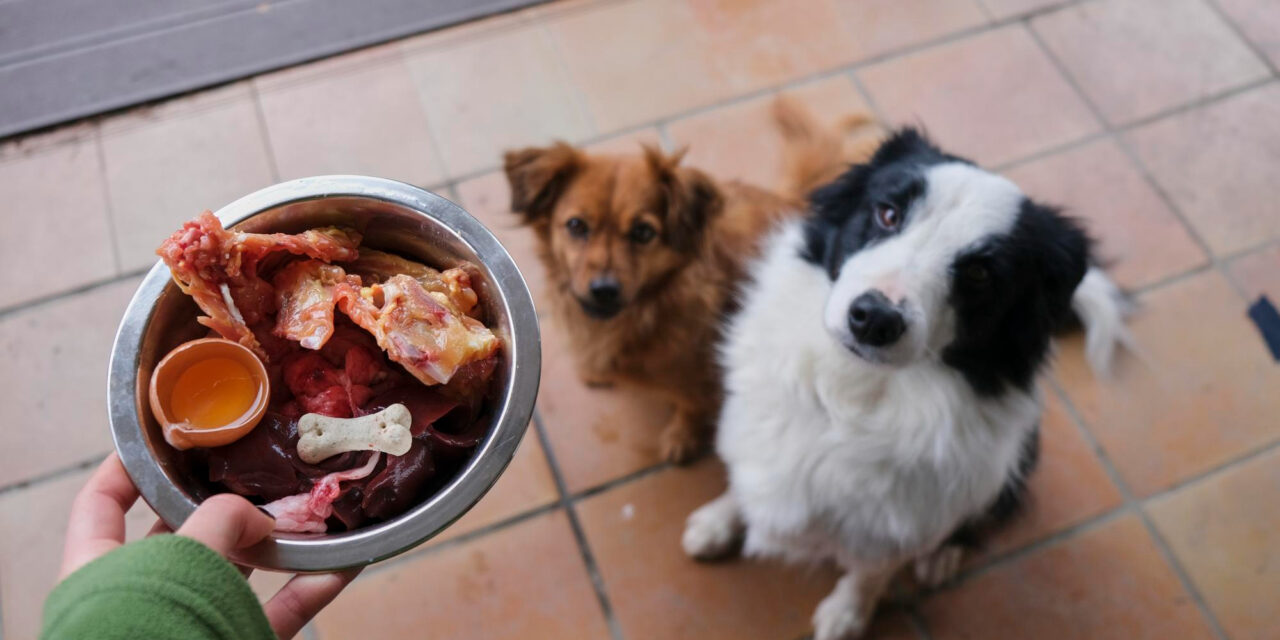
Raw dog food shows up everywhere lately. The freezer case at the pet store. A neighbor’s feeding group. The careful way your veterinarian’s face changes when you bring it up. Here’s the honest, unglamorous answer first. The evidence behind raw dog food’s most popular claims is thin. The risks, on the other hand, are well documented and dated. Whether raw feeding makes sense for your household depends on real facts about your dog, your kitchen, and the people who live with you. A blog post can’t know those facts. Only you and your vet can weigh them.
Nobody outside your veterinary team can tell you raw feeding is the “right” choice for your specific dog. What this article can do is lay out the facts:
- What raw feeding actually involves, across every common format.
- What proponents claim, and what veterinary and nutrition consensus organizations actually say when they review the research.
- The documented contamination and injury risks.
- What safe handling actually requires if your household goes this route.
- Who in your household probably shouldn’t be involved at all.
One thing this article won’t do is tell you raw feeding is either a miracle or a menace. This is a genuinely contested topic among dog owners. Thoughtful people land in different places after looking at the same information. What follows is the evidence and the tradeoffs, laid out as plainly as we can manage. Use it to have a more useful conversation with the person who actually knows your dog’s health history: your veterinarian.
What’s in this guide
- What “Raw Dog Food” Actually Means
- What Proponents Claim vs. What the Evidence Shows
- Why This Topic Divides Owners and Vets So Sharply
- The Documented Risks of Raw Dog Food
- Does High-Pressure Processing Make Raw Food Safe?
- Nutritional Adequacy: Why Home-Prepared Raw Needs a Formulated Recipe
- The AAFCO Adequacy-Statement Question for Commercial Raw
- Handling and Hygiene: What Safe Raw Feeding Actually Requires
- Who Should Not Be in a Raw-Feeding Household
- Cost Realities of Feeding Raw Dog Food
- How to Have This Conversation With Your Veterinarian
- Balanced Alternatives: Freeze-Dried and Gently Cooked Fresh Food
- Common Mistakes That Increase Risk
- Frequently Asked Questions About Raw Dog Food
- Sources
What “Raw Dog Food” Actually Means
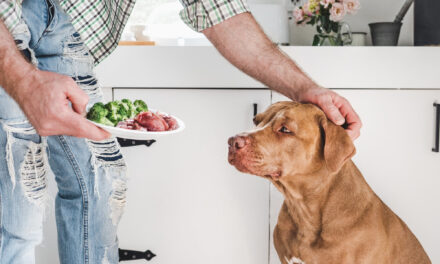
“Raw dog food” isn’t one product. It’s a category, and a wide one. It covers everything from a manufactured, tested, frozen product you scoop out of a bag. It also covers a home-assembled meal built from a recipe you found last week. Before weighing benefits and risks, it helps to know which version of raw feeding you’re actually comparing.
In general, raw feeding means offering uncooked animal protein instead of food that’s been cooked, extruded, or canned. That protein is usually muscle meat and organ meat, sometimes with ground or whole raw bone. Other ingredients get added too, like vegetables, fruit, or a dairy product. That’s the common thread. The differences between formats matter far more than that shared definition suggests.
Commercial Frozen and Freeze-Dried Raw
Commercial raw products are manufactured, packaged, and sold as complete meals or mix-ins. Two formats dominate the category. Frozen raw comes as patties, chubs, or nuggets. It needs freezer storage and a thawing step before feeding. Freeze-dried raw has most of its moisture removed under vacuum and low temperature. That process makes it shelf-stable at room temperature until it’s rehydrated or fed as-is.
Some manufacturers apply an additional food-safety step called high-pressure processing, which we cover in detail below. Others don’t. That single difference changes the contamination picture meaningfully, and it’s worth checking rather than assuming.
Home-Prepared Raw and BARF-Style Diets
Home-prepared raw means assembling meals yourself. You buy raw ingredients at a grocery store or butcher, rather than a manufactured product. Some owners follow a general ratio-based framework instead of a specific recipe. That framework is often described using the acronym BARF. Different sources trace the term to either “bones and raw food” or “biologically appropriate raw food.” Either way, it suggests rough proportions of muscle meat, bone, and organ. Other owners work from a specific recipe instead. Ideally, that recipe is built by a board-certified veterinary nutritionist, not assembled by eye.
That distinction matters a lot. A ratio-based framework and a professionally formulated recipe are not the same thing. Which one you choose is one of the most consequential decisions in this entire topic. We’ll return to it in detail in the nutritional adequacy section below.
For orientation, here’s how the three common formats compare on the factors that matter most for a safety-and-nutrition decision:
| Format | Typical pathogen-reduction step | Nutritional adequacy | Relative cost |
|---|---|---|---|
| Commercial frozen raw | Varies by manufacturer; some use high-pressure processing, some don’t | Often carries an AAFCO adequacy statement, but verify on the specific bag | Higher than kibble; varies by brand |
| Commercial freeze-dried raw | Low moisture may reduce some bacterial survival, but freeze-drying is not equivalent to cooking | Often carries an AAFCO adequacy statement; check the label | Typically the priciest format per pound |
| Home-prepared raw | None, unless you add one yourself (there generally isn’t one for raw ingredients) | No adequacy statement exists; depends entirely on the recipe and your accuracy in following it | Varies widely; add the cost of a nutritionist consult if formulating a recipe |
What Proponents Claim vs. What the Evidence Shows
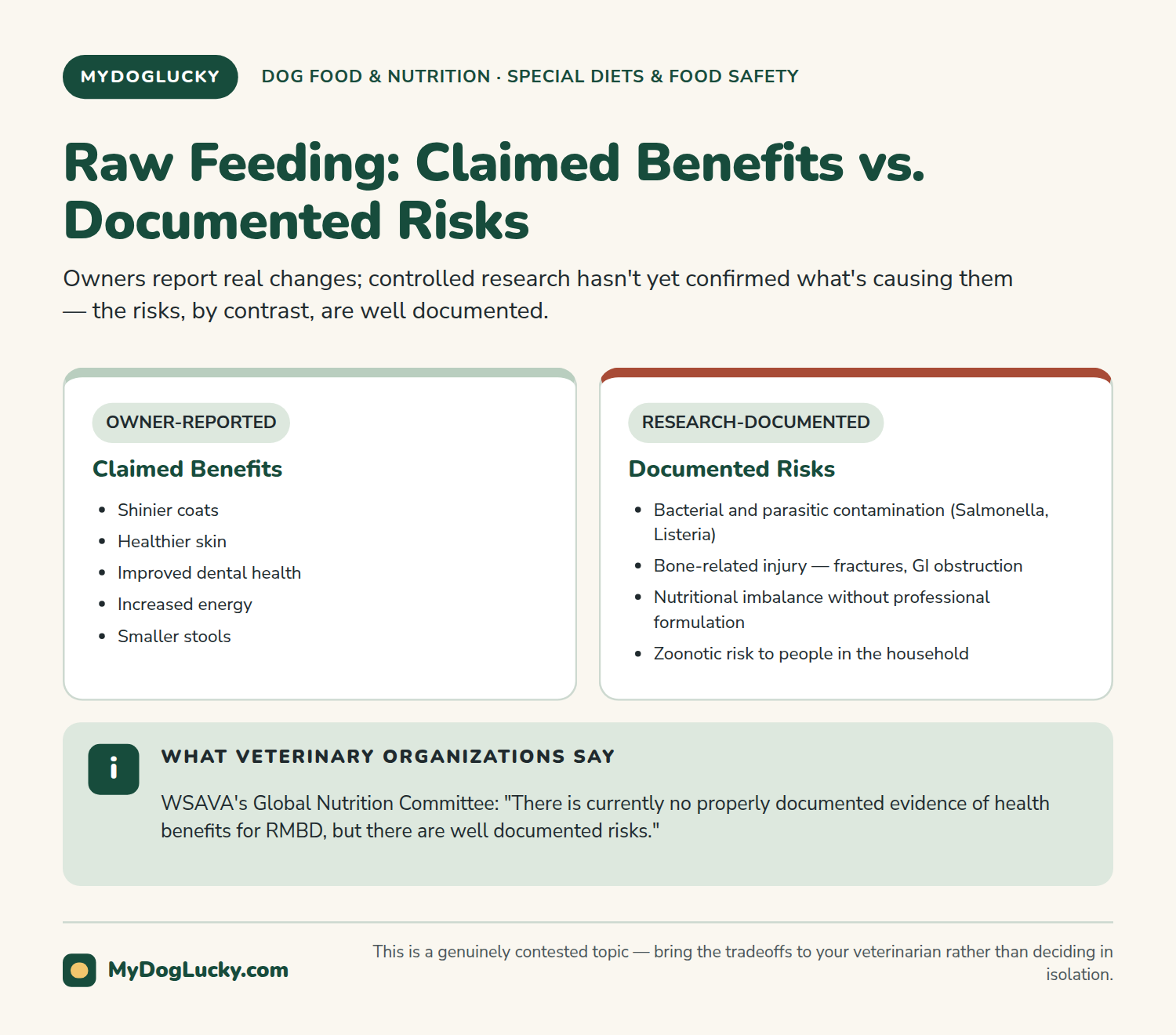
This is the part most raw-feeding conversations skip past, and it’s worth slowing down for. There’s a real gap here. Owners who feed raw dog food report noticing changes. Controlled research hasn’t actually confirmed what’s causing them.
The Benefits Owners Report
According to the American Kennel Club, advocates of raw feeding commonly point to several benefits:
- Shinier coats
- Healthier skin
- Improved dental health
- Increased energy
- Smaller stools
Owners who’ve made the switch often describe these changes as noticeable and lasting. For what it’s worth, we’re not suggesting those observations are imagined or dishonest.
What separates an observation from evidence, though, is whether it holds up under controlled comparison. That means different diets tested against each other, with other variables held constant. It means looking across many dogs and over time, not just one household’s before-and-after story. That’s the piece that’s largely missing.
What AVMA, WSAVA, and AAHA Actually Say About the Evidence
Major veterinary and nutrition organizations have reviewed the available research. Their conclusions are consistent with each other, even though the groups operate independently. The WSAVA Global Nutrition Committee put it plainly in its formal statement on raw meat-based diets: “There is currently no properly documented evidence of health benefits for RMBD, but there are well documented risks.” Based on that evidence balance, the committee recommends that raw meat-based diets not be fed to dogs or cats.
The American Veterinary Medical Association’s policy takes a similarly direct position. The AVMA “discourages feeding any raw or undercooked animal-sourced proteins… to dogs and cats because of their risk to human and animal health.” The American Animal Hospital Association goes further still. Its 2021 nutrition guidelines state that AAHA doesn’t endorse feeding raw or non-sterilized animal-origin foods to pets.
It’s worth being precise about what these organizations are and aren’t saying. None of them claim raw feeding has been proven harmful in every case. None claim every dog fed raw gets sick. What they’re saying is narrower, and more useful. Given the current research, the documented risks are better established than the claimed benefits. That asymmetry should factor into your decision.
The evidence ladder, in plain terms
Not all information carries equal weight. Peer-reviewed research and consensus guidelines from veterinary and public-health organizations sit at the top. They’re built from data, reviewed by other experts, and updated as new evidence comes in. Owner testimonials and social-media anecdotes sit lower. They’re genuinely useful as lived context. But they’re not proof that a diet caused an outcome — diet is rarely the only thing that changed. Good decision-making usually means weighing both, while being honest about which is which.
Why This Topic Divides Owners and Vets So Sharply
It’s worth pausing on why raw dog food generates such strong opinions on both sides. Most nutrition questions settle quietly; this one doesn’t. Understanding the actual disagreement helps more than picking a side.
Raw-feeding advocates often start from an ancestral or evolutionary argument. Dogs descend from wild canids that ate raw prey. A diet closer to that ancestral pattern gets framed as more “natural,” or biologically appropriate. Some owners arrive at raw feeding a different way, after a negative experience with a commercial food. A recall. A quality concern. A dog with digestive issues that seemed to improve after switching. That lived experience carries real weight for the people who went through it.
The scientific caution runs in a different direction. Domestic dogs have lived alongside humans, and eaten human food scraps, including cooked food, for thousands of years. That’s long enough that dogs show genetic adaptations for digesting starches their wolf ancestors don’t share. “Ancestral” and “nutritionally optimal” aren’t automatically the same claim. A dog’s improvement after a diet change doesn’t isolate raw feeding as the cause, either. Portion changes, ingredient changes, or simply more attentive feeding around the same time can all produce similar results. That’s exactly why controlled research matters more than any single household’s story.
Neither side of that disagreement is dishonest. It’s a genuine values-and-evidence gap. Your veterinarian navigates that same gap with individual clients regularly. That’s exactly why the conversation covered later in this article is worth having directly. Don’t just choose a diet based on which online community feels most persuasive.
The Documented Risks of Raw Dog Food
Unlike the benefits, the risks of raw dog food have been measured directly. Different research groups have measured them repeatedly, over more than a decade. Three categories come up consistently: pathogen contamination, bone-related injury, and zoonotic transmission to the people in the household.
Bacterial and Parasitic Contamination
The FDA’s own multi-year testing program remains one of the most cited data points here. Between October 2010 and July 2012, FDA and six state agriculture labs tested over a thousand pet food samples. In one 196-sample raw pet food batch, 15 samples tested positive for Salmonella. Another 32 tested positive for Listeria monocytogenes. VCA Animal Hospitals cites a similar figure from that era. It notes that nearly a quarter of raw food samples tested positive for harmful bacteria.
More recent research tells the same story. A 2025 Cornell University study in Communications Biology tested 85 raw cat food samples against 27 cooked ones. Researchers cultured viable bacteria — including Salmonella enterica, E. coli, and Klebsiella — from 42% of the raw products. They found none in the cooked ones. The same study found parasite DNA only in raw products. It also found antibiotic-resistant bacterial genes more often in raw foods than cooked ones. Cornell’s Riney Canine Health Center cites related research too. University of Pennsylvania researchers found that 10% of raw canine food products contained antibiotic-resistant Gram-negative bacteria. A separate 2017 study identified raw meat consumption as a significant risk factor for Salmonella shedding in dogs.
These aren’t only historical findings, either. FDA continues to issue raw pet food recalls tied to Salmonella and Listeria contamination. These advisories come on a regular basis. That’s a reminder: this is an ongoing challenge, not a problem that’s been solved and left behind.
A dog can carry and shed these pathogens without looking sick. That’s part of what makes the risk easy to underestimate. A visibly healthy, energetic dog on a raw diet can still shed Salmonella in feces and saliva. That creates exposure for other pets and people in the home, even when nothing looks wrong.
Bone-Related Injury Risk
Raw bone is a common ingredient in both commercial and home-prepared raw dog food. It carries its own separate risk category, apart from bacterial contamination. The WSAVA Global Nutrition Committee lists several documented risks tied to bone ingestion: constipation, diarrhea, dental fractures, and gastrointestinal obstruction. VCA Animal Hospitals notes something important here. Bone fragments causing a foreign-body obstruction sometimes require surgical removal. That’s not a rare, worst-case scenario — it’s a recognized, recurring complication.
Bone size, density, and how a dog tends to chew all affect the risk level. That’s exactly why this isn’t the kind of thing to decide by eye. If bones are part of a raw feeding plan you’re considering, raise that specific question with your veterinarian. Don’t assume any raw bone is inherently safer than any cooked one. (Cooked bones carry their own, different risk — they tend to splinter rather than crack cleanly. That’s a separate topic from raw feeding, but worth knowing regardless of which diet a dog eats.)
It’s also worth distinguishing between ground bone mixed into a meal and a whole recreational bone offered separately. Ground bone, processed into the food itself, generally carries a lower fracture and obstruction risk. A large, dense weight-bearing bone handed over whole — a femur or knuckle bone, for instance — carries more. Size relative to your dog matters too. A bone small enough to swallow largely intact is a different risk than one too large to fit in the mouth at all. None of this makes any bone automatically safe. It just means “bones” isn’t one uniform risk category. The specifics are worth discussing with your veterinarian, before they become a routine part of your dog’s diet.
Zoonotic Risk to the People Who Live There
The pathogens found in raw dog food don’t stay contained to the bowl. The CDC’s guidance on raw pet food safety notes plainly that raw meat and other raw animal protein “can have germs like Salmonella and Listeria.” Those organisms can spread to the people handling the food. They can spread through cleanup after a dog, too, or through close contact with a dog’s face, saliva, or feces.
The CDC estimates that salmonellosis causes roughly 1.2 million or more illnesses in the U.S. each year, across all sources. Symptoms include fever, diarrhea, nausea, vomiting, and stomach pain. Listeria infections are less common but considerably more severe. VCA cites hospitalization rates above 90% among diagnosed cases. Newborns, older adults, pregnant people, and immunocompromised individuals face the highest risk of serious illness. We cover exactly who that means for a raw-feeding household in a dedicated section below.
Does High-Pressure Processing Make Raw Food Safe?
High-pressure processing, usually shortened to HPP, is a non-thermal food-safety technique. Instead of cooking the product, manufacturers subject sealed packages to extremely high hydrostatic pressure. That pressure inactivates many bacteria and parasites. It doesn’t raise the internal temperature enough to change the meat’s raw texture, or to trigger the legal definition of “cooked.” That’s why HPP-treated products can still be marketed and sold as raw.
Research on HPP’s effectiveness is genuinely encouraging, with real limits. Peer-reviewed studies on HPP applied to raw pet food have found it substantially reduces Salmonella, Shiga toxin-producing E. coli, and Listeria monocytogenes populations. That effect is strongest when HPP is combined with acidulation (a mild acidifying step) and frozen storage. But “substantially reduces” isn’t the same as “eliminates.” The research also shows that lethality varies by pathogen species, and even by bacterial strain. Some organisms are simply more pressure-resistant than others. That means no single HPP protocol guarantees the same result against every possible contaminant.
The American Animal Hospital Association’s nutrition guidelines make this same point directly. HPP does not guarantee a sterile product. It shouldn’t be treated as equivalent to cooking, or to other validated pathogen-elimination methods. A product that’s undergone HPP is very likely safer than an otherwise-identical product that hasn’t. But “safer than” and “safe” are different claims. Keep that distinction in mind, rather than treating HPP as a guarantee.
A practical takeaway
If you’re comparing commercial raw dog food products, check whether HPP (or another validated pathogen-reduction step) was used. It’s a genuinely useful filter. It’s not, on its own, a reason to skip safe handling practices at home. Recontamination can happen after a package is opened, during thawing, or on a prep surface — regardless of what happened at the manufacturing plant.
Nutritional Adequacy: Why Home-Prepared Raw Needs a Formulated Recipe
Pathogen risk gets most of the attention in raw feeding conversations. But nutritional imbalance is arguably the more common problem in home-prepared raw diets specifically. It’s a slower, quieter problem, too, which makes it easier to miss.
Why “Eyeballing It” Doesn’t Work
Dogs need specific amounts of protein, fat, calcium, phosphorus, and a long list of vitamins and trace minerals. Those nutrients also need to be in roughly the right ratios to each other, not just present in adequate total quantity. Getting the calcium-to-phosphorus ratio wrong, for instance, is a well-documented problem in home-prepared diets. It matters most during growth. An imbalance during a puppy’s development can contribute to skeletal problems that don’t show up until later.
The AAHA nutrition guidelines are direct about how common this gap actually is: “the majority of these recipes, even those written by veterinarians, do not provide complete and balanced nutrition.” That’s not a knock on any individual owner’s effort or intentions. It reflects how much specific, technical knowledge complete-and-balanced formulation actually requires. Most recipe authors don’t have that knowledge, including some well-meaning professionals.
What a Board-Certified Veterinary Nutritionist–Formulated Recipe Actually Provides
A board-certified veterinary nutritionist is a veterinarian with additional residency training and board certification, specifically in clinical nutrition. Working with one to formulate a home-prepared recipe — raw or cooked — changes the math considerably. Ingredient amounts, supplement additions, and ratios get calculated to meet a dog’s actual nutrient requirements for their age, size, and health status. None of it gets approximated from a general guideline.
That precision only holds if the recipe is followed precisely. AAHA’s guidelines flag a specific, common failure point here. Owners tend to gradually modify recipes over time. They swap a protein source. They skip a supplement that’s inconvenient to source. They adjust portions by eye. Most don’t realize that even small, well-intentioned changes can reintroduce the imbalance the recipe was designed to prevent. AAHA recommends reviewing home-prepared recipes on a roughly annual basis, and updating them with a board-certified veterinary nutritionist as needed. A dog’s needs change over time too.
The bottom line on home-prepared raw
A raw diet assembled from a general ratio, or a recipe found online, carries a real risk of nutritional deficiency or excess without professional formulation. That’s true even when every ingredient itself is safe and fresh. The risk exists whether or not contamination is also a concern. If home-prepared raw is something your household is seriously considering, working with a board-certified veterinary nutritionist on the actual recipe isn’t an optional upgrade. It’s the step that makes the diet nutritionally defensible in the first place.
The AAFCO Adequacy-Statement Question for Commercial Raw
The Association of American Feed Control Officials, or AAFCO, doesn’t manufacture or test pet food itself. Its model standards are what most U.S. pet food labels are built around. AAFCO describes the nutritional adequacy statement as “perhaps the most important part of a label.” That’s because it’s the part that tells you whether a product is actually meant to be a complete diet.
“Complete” means the product contains all the nutrients a dog needs at a given life stage. “Balanced” means those nutrients exist in the right proportions relative to each other, not just present in some quantity. A product’s adequacy statement will typically say one of two things. Either it’s formulated to meet AAFCO’s nutrient profiles for a specific life stage — growth, maintenance, gestation and lactation, or all life stages. Or it’s been substantiated through AAFCO feeding trials.
Here’s the practical implication for raw dog food shoppers specifically. This labeling requirement applies to raw products the same way it applies to kibble or canned food. Not every commercial raw product on the market carries a complete-and-balanced adequacy statement, though. Some are explicitly labeled for “intermittent or supplemental feeding only.” That means they’re not designed to be a dog’s sole diet. That distinction is easy to miss on packaging that emphasizes ingredients and marketing language over the label’s actual legal claim.
Reading that adequacy statement is one of the most useful five-minute checks you can do. Understand what life stage it’s formulated for before buying any commercial raw dog food. It’s the same skill that matters when comparing any dog food label, raw or not.
What to actually look for on a commercial raw label
- The adequacy statement itself. Look for language matching AAFCO’s nutrient profiles for a named life stage, or “all life stages,” versus a supplemental-feeding-only claim.
- Which life stage it covers. A product formulated for adult maintenance isn’t automatically appropriate for a growing puppy, and vice versa.
- Whether a pathogen-reduction step is disclosed. Not every label states this clearly; if it isn’t listed, it’s a reasonable question to ask the manufacturer directly.
- The manufacturer’s contact information and any recall history. A company that responds clearly to safety questions, and has a findable recall record, is worth more confidence than marketing copy alone.
Handling and Hygiene: What Safe Raw Feeding Actually Requires
If a household decides to feed raw dog food, the handling and hygiene practices aren’t optional extras. That’s true whether it’s commercial or home-prepared. FDA and CDC guidance both treat raw pet food the same way food-safety guidance treats raw meat for human meals. The pathogens involved are the same. They don’t distinguish between a dog’s bowl and a dinner plate.
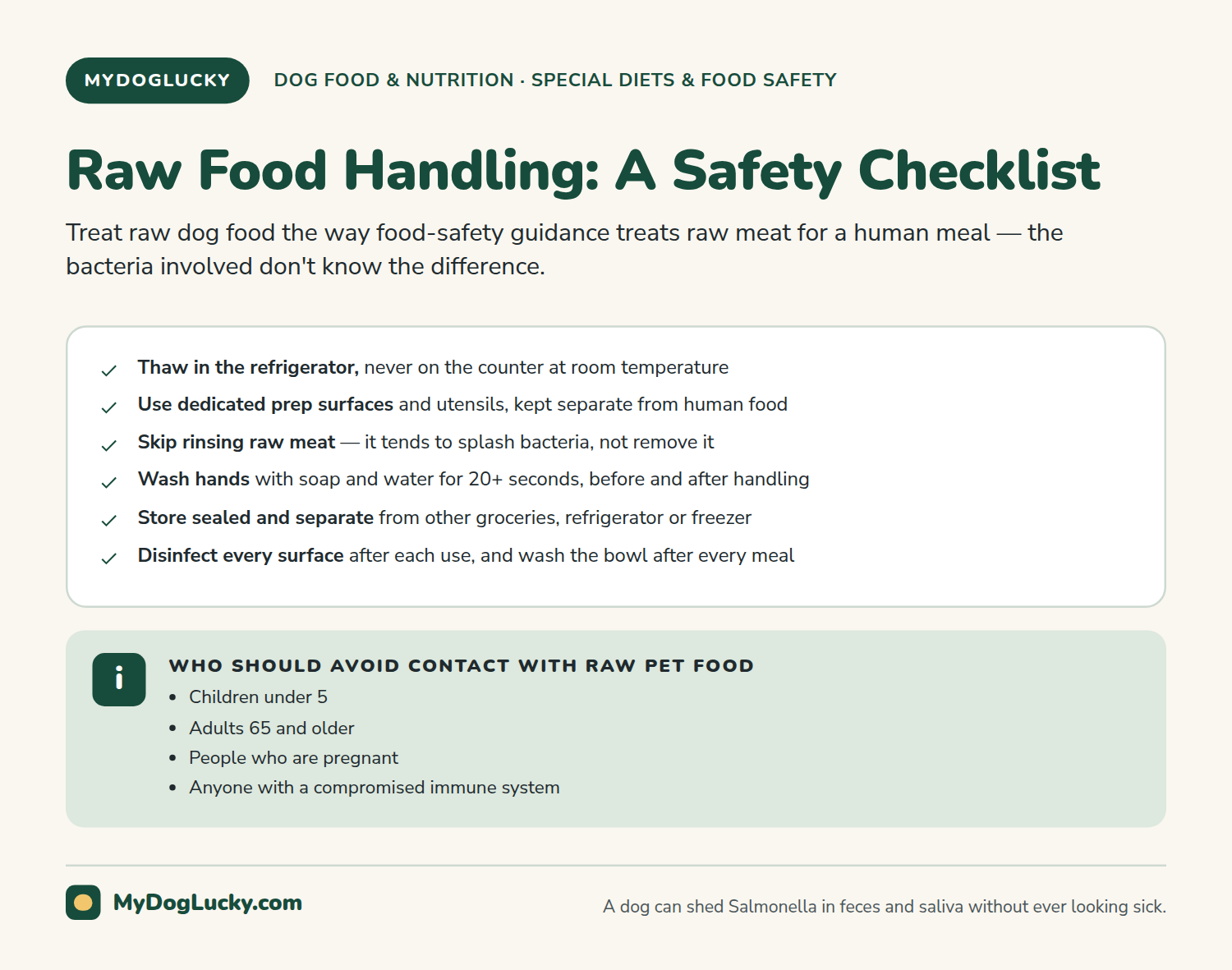
Thawing
Thaw frozen raw dog food in the refrigerator, not on the counter at room temperature. Room-temperature thawing gives bacteria a window to multiply, well before the food reaches your dog’s bowl. Need a faster option? A sealed package thawed under cold running water works. So does a brief defrost in the microwave, if you’re feeding it immediately afterward. Both beat leaving it out.
Prep Surfaces and Utensils
Use a cutting board, bowl, and utensils dedicated to raw pet food prep. Keep them separate from anything used for human food. The FDA specifically advises against rinsing raw meat under the tap before use. That habit tends to splash bacteria onto nearby surfaces, sponges, and hands, rather than removing it. Wash your hands with soap and water for at least 20 seconds, before and after handling raw pet food. Every time, not just when it’s convenient.
Storage
Keep raw pet food in sealed, leak-proof containers. Store it separately from human food, in the refrigerator or freezer. Don’t let raw pet food touch other groceries during storage or the trip home from the store. Treat timing the way you would raw meat for your own dinner. Don’t leave it sitting out. Refrigerate leftovers promptly. Don’t feed food that’s been sitting at room temperature for an extended stretch.
Cleanup
Clean and disinfect every surface, bowl, and utensil that touched raw pet food, after each use. FDA guidance recommends washing with hot, soapy water first. Follow that with a disinfecting rinse. A diluted bleach solution — roughly one tablespoon of bleach per quart of water — is one option FDA specifically names. Wipe down counters and any surface your dog’s raw food bowl sat on. Wash your dog’s bowl after every meal, rather than topping it off.
| Task | What safe practice looks like |
|---|---|
| Thawing | Refrigerator or cold water, never left out on the counter |
| Prep surfaces | Dedicated board and utensils, kept separate from human food prep |
| Rinsing | Skip it — rinsing raw meat tends to splash bacteria, not remove it |
| Hand washing | Soap and water, 20+ seconds, before and after every handling |
| Storage | Sealed containers, separate from other food, refrigerator or freezer |
| Cleanup | Hot soapy water, then a disinfecting rinse, on every contact surface |
| Bowls | Washed after every meal, not reused without cleaning |
Boarding, Travel, and Pet Sitters
Raw feeding adds real logistical weight to situations that are already a little complicated. Boarding. Travel. Days when someone else is covering your dog’s care. A frozen raw diet needs reliable freezer access. Many boarding facilities either can’t accommodate that or charge extra for it. Some decline to handle raw food altogether, over liability concerns. A pet sitter or dog walker covering a single day needs explicit thawing and handling instructions. Don’t assume “he just eats what’s in the freezer” is self-explanatory.
If raw feeding is part of your routine, ask any boarding facility or sitter directly whether they’re equipped and willing to handle it. Do this before you need the arrangement. Don’t wait to discover the gap the week before a trip. Freeze-dried raw travels considerably easier than frozen. That’s one practical reason some raw-feeding households keep it on hand specifically for travel days, even when frozen is the everyday default.
Who Should Not Be in a Raw-Feeding Household
This part of the raw dog food conversation gets the least attention, relative to how much it matters. The risk isn’t limited to the dog eating the food. It extends to anyone who shares a home, a kitchen, or close contact with a raw-fed dog.
People Who Should Avoid Handling Raw Pet Food
The CDC identifies several groups at meaningfully higher risk of severe illness from the pathogens commonly found in raw pet food:
- Children under 5
- Adults 65 and older
- People who are pregnant
- Anyone with a compromised immune system, whether from a medical condition or its treatment
For these groups, an infection that would mean an unpleasant few days for a healthy adult can mean hospitalization, or worse.
That doesn’t necessarily mean a raw-feeding household is off-limits entirely, if one of these people lives there. It means that person should not handle the raw food, prep surfaces, or the dog’s bowl. They should also avoid close face and hand contact with the dog right after it eats. In practice, for many households, that level of separation is genuinely hard to maintain consistently. It’s worth being honest about that before committing to raw feeding, not after.
Dogs Who Generally Shouldn’t Eat Raw
The concern isn’t only about human household members. According to AKC guidance, dogs with certain health conditions are generally better suited to cooked food. That list includes pancreatitis, cancer, and other conditions affecting immune function. Puppies are typically included in that caution too, given their developing immune systems and the added nutritional-adequacy stakes during growth.
Does your dog work as a therapy or service animal? If so, and they visit hospitals, schools, or long-term care facilities, check that facility’s specific policy before switching to raw. Many such institutions restrict or exclude raw-fed animals from visiting programs. The concern is pathogen-shedding risk for medically vulnerable populations.
Worth a direct conversation with your vet before starting
- Anyone in the household who is pregnant, under 5, 65 or older, or immunocompromised.
- A dog with a diagnosed immune condition, cancer, pancreatitis, or another condition affecting digestion or immunity.
- A puppy, given both the immune-system and the nutritional-formulation stakes.
- A household that includes another pet with a compromised immune system.
- A dog that works as a therapy or service animal in a healthcare or care-facility setting.
Multi-Pet and Multi-Species Households
A raw-feeding decision made for one dog doesn’t stay contained to that dog. Not if other animals share the home. Cats, other dogs, or small pets that share floor space or water bowls can pick up the same pathogens through contact. So can a pet that simply grooms a raw-fed dog’s face after mealtime. None of that requires eating the food itself. A cat with a compromised immune system, or another dog undergoing immune-suppressing treatment, adds another layer worth flagging to your veterinarian before you start.
Litter boxes and shared outdoor spaces raise a related question. A raw-fed dog’s feces can carry the same pathogens found in the uneaten food. Cleanup consistency and hand hygiene after yard duty matter just as much as kitchen handling does.
Cost Realities of Feeding Raw Dog Food
Cost rarely gets equal billing with safety and nutrition in raw feeding discussions. But it’s a real factor in whether a plan is sustainable. And sustainability matters, for a dog who’ll be eating this way for years.
Commercial frozen and freeze-dried raw dog food both tend to cost noticeably more per pound than comparable-quality kibble. Freeze-dried is typically the priciest format of the three, since the processing itself adds cost. Home-prepared raw can sometimes come in cheaper on ingredients alone, especially for owners who buy protein in bulk. But that comparison changes once you add other costs: a nutritionist consultation to formulate a safe recipe, ongoing supplement purchases, and the time cost of consistent, careful prep.
There are hidden costs worth budgeting for beyond the food itself. Frozen raw needs real freezer space. It’s more than most households expect, until they’re rearranging the chest freezer around it (alongside whatever emergency ice cream reserve was already living there). A prolonged power outage also becomes a bigger financial risk, when a freezer full of raw dog food is part of what’s at stake. And any household choosing home-prepared raw should factor in a recurring nutritionist check-in, not a one-time recipe purchase. AAHA’s guidance recommends revisiting formulated recipes roughly annually, as a dog’s needs change.
There’s one more cost category that’s easy to leave out of the budget entirely: the cost of things going wrong. A dental fracture or gastrointestinal obstruction from a bone can mean an emergency vet visit. So can a gastrointestinal illness traced back to contaminated food. Either one might mean imaging or surgery, on top of whatever the diet itself already costs. That’s not a reason to assume the worst will happen. It’s a reason to budget as though safe handling and a properly formulated recipe are part of the real cost of raw feeding — not optional extras that only matter if you’re unlucky.
How to Have This Conversation With Your Veterinarian
Major veterinary organizations generally discourage raw feeding. Because of that, some owners assume there’s no point bringing it up with their vet at all — better to just decide quietly and move forward. That assumption tends to backfire. A veterinarian who knows your dog well is best positioned to flag a real risk early. That means knowing the health history, current medications, and underlying conditions specific to your dog. It’s true whether or not they’d personally recommend raw feeding in general.
Coming prepared with specific questions tends to produce a more useful conversation than a vague “what do you think about raw food”:
- Does my dog’s current health history rule out raw feeding, or make it higher-risk? Conditions like kidney disease, pancreatitis, or a compromised immune system change the calculation.
- If we’re considering home-prepared raw, can you refer us to a board-certified veterinary nutritionist to formulate the recipe? Many general practice vets can make this referral even if formulating the recipe isn’t their own specialty.
- What monitoring should we do if we go ahead — bloodwork frequency, fecal testing, weight checks? A vet can set a monitoring schedule appropriate to your specific dog.
- Is there anyone in our household whose risk changes this decision? Your vet may not know your household’s makeup unless you tell them.
- If we’re feeding a commercial raw product, does it meet AAFCO adequacy standards for my dog’s life stage? Bring the label; a quick label review is often genuinely useful.
If a veterinarian declines to recommend raw feeding, that’s professional judgment based on the evidence discussed above. It’s not a personal judgment of you as an owner. Most vets would rather stay involved in monitoring a raw-fed dog than be shut out of the conversation entirely.
Balanced Alternatives: Freeze-Dried and Gently Cooked Fresh Food
Is the appeal of raw dog food really about “raw” specifically? Or is it about minimally processed, recognizable ingredients, instead of a bag of extruded kibble? If it’s the latter, it’s worth knowing that raw isn’t the only category that offers that.
Freeze-Dried: A Partial Step, Not a Guarantee
Freeze-dried raw dog food removes most of the product’s moisture through a vacuum-drying process, rather than heat. That low moisture content may reduce bacterial survival somewhat. Some limited research has found freeze-dried samples with lower contamination rates than comparable frozen raw samples. But the evidence here is still thin, based on small sample sizes. Researchers are consistently clear on one point, though: freeze-drying is not equivalent to cooking. Bacteria like Salmonella can survive in a dried, dormant state for a long time. Treat freeze-dried raw with the same handling caution as any other raw product. It’s not a safer shortcut.
Gently Cooked Fresh Food as a Middle Ground
Gently cooked, or lightly cooked, fresh dog food is a separate category from both raw and traditional kibble. It uses fresh, less-processed ingredients that get cooked briefly, usually delivered frozen or refrigerated. The goal is something closer to a home-cooked meal than a shelf-stable bag. Because the product is actually cooked to a food-safe temperature at some point, the pathogen risk profile looks considerably different from raw. It’s closer to any other cooked commercial pet food than to raw feeding.
This category won’t deliver identical results to raw feeding in every respect some proponents describe. It isn’t automatically nutritionally complete just because it’s fresh, either — the same AAFCO adequacy-statement check applies here too. But for a household that wants to move away from raw’s contamination risk, while still avoiding highly processed shelf-stable kibble, gently cooked fresh food is a genuine middle-ground option. Research it by category, and check against AAFCO labeling, the same way you’d evaluate any other diet change.
Common Mistakes That Increase Risk
Assuming a Healthy-Looking Dog Means a Safe Diet
A dog can shed Salmonella in feces and saliva without showing any symptoms at all. “My dog seems fine” isn’t evidence that a raw diet is free of contamination risk to the humans in the house. It’s evidence that this particular dog hasn’t gotten sick yet — a narrower claim.
Skipping the Nutritionist for a “Just This Once” Recipe
Owners sometimes plan to use a professionally formulated recipe long-term. But they improvise something simpler for the first few weeks, intending to switch later. Nutritional deficiencies from an unbalanced diet build gradually, and “later” has a way of stretching out. If a formulated recipe is the plan, start with it.
Treating HPP as a Substitute for Safe Handling at Home
High-pressure processing reduces pathogen load at the manufacturing stage. It does nothing to prevent recontamination once a package is opened, thawed, and sitting on your counter. Handling practices still apply to every raw product, HPP-treated or not.
Letting a Recipe Drift Over Time
Swapping a protein source because it’s on sale. Skipping a supplement that’s inconvenient to reorder. Adjusting portions by eye. Each change can seem minor on its own. Together, over months, they can meaningfully undo the balance a formulated recipe was built to provide.
Forgetting the Vulnerable People in the House
It’s easy to plan handling precautions around the person doing most of the food prep. It’s just as easy to overlook someone else. A grandparent who visits weekly. A toddler who crawls where the dog’s bowl sits. A family member starting chemotherapy. Raw feeding risk assessment needs to cover everyone in regular contact with the dog or its food. Not just the primary handler.
Frequently Asked Questions About Raw Dog Food
Is raw dog food better than kibble?
“Better” depends on what you’re measuring. On documented safety and nutritional-adequacy grounds, major veterinary organizations like AVMA, WSAVA, and AAHA generally favor properly formulated cooked or commercially processed diets. That preference cites the contamination and nutrition-balance risks discussed throughout this article. Owners who feed raw often report benefits like coat quality or stool size. But those reports haven’t been confirmed through controlled research comparing raw to other complete, balanced diets. This is a genuinely contested area. The right answer for your dog depends on individual health factors your veterinarian is best positioned to weigh.
Can raw dog food make my dog sick even if my dog seems fine?
Yes. A dog can carry and shed pathogens like Salmonella in feces and saliva without showing any symptoms. The bigger risk in that scenario is often to the people in the household, not the dog. That risk comes through handling the food, or close contact with the dog.
Is freeze-dried raw dog food safer than frozen raw?
It may carry somewhat lower contamination risk, based on limited research. But the evidence is thin, and freeze-drying is explicitly not equivalent to cooking. Bacteria can survive in a dried state for a long time. Freeze-dried raw dog food should be handled with the same precautions as any other raw product.
Does high-pressure processing make raw dog food completely safe?
No. HPP substantially reduces pathogen levels. It’s a meaningful safety improvement over untreated raw product. But research shows its effectiveness varies by pathogen species and strain, and it doesn’t guarantee a sterile product. Safe handling at home still matters for HPP-treated raw dog food.
Can I make a balanced raw diet myself without a nutritionist?
It’s genuinely difficult to do reliably. AAHA’s nutrition guidelines note that most home-prepared recipes don’t provide complete and balanced nutrition. That includes some written by veterinarians without specific nutrition training. Working with a board-certified veterinary nutritionist to formulate and periodically review the recipe substantially reduces that risk.
Who shouldn’t be around raw dog food at all?
Based on CDC guidance, several groups face higher risk of severe illness from the pathogens in raw pet food. That includes children under 5, adults 65 and older, pregnant people, and anyone with a compromised immune system. Each of these groups should avoid handling raw pet food directly.
Are raw bones safe for dogs?
Raw bones carry documented risks, according to WSAVA’s nutrition guidance. Those risks include dental fractures, gastrointestinal obstruction, constipation, and diarrhea. Whether a specific bone is appropriate depends on your dog’s size, chewing style, and health history. That’s a conversation worth having directly with your veterinarian. Don’t assume any raw bone is automatically safer than a cooked one.
Do commercial raw dog food products have to meet the same labeling standards as kibble?
Yes. AAFCO’s nutritional adequacy statement requirement applies to raw products the same way it applies to any other pet food. Not every raw product on the market is labeled complete and balanced, though. Some are explicitly for intermittent or supplemental feeding only. Checking the specific label matters.
Is raw dog food cheaper than kibble?
Generally not. Commercial frozen and freeze-dried raw dog food typically cost more per pound than comparable kibble. Home-prepared raw can sometimes be cheaper on ingredients alone. But the total cost usually rises once you factor in a nutritionist consultation, ongoing supplements, and freezer storage.
What’s the difference between raw dog food and gently cooked fresh dog food?
Raw dog food is never heated to a food-safe temperature during preparation. That’s what creates its pathogen-contamination risk. Gently cooked fresh food is cooked briefly at some point in the process. That changes its safety profile considerably, closer to other cooked commercial diets than to raw feeding. It still uses fresher, less-processed ingredients than traditional kibble, though.
My vet is against raw feeding. Should I find a different vet?
Not necessarily. Major veterinary organizations generally discourage raw feeding, based on the evidence discussed in this article. Your vet’s position likely reflects that broader consensus, rather than a personal opinion about you. It’s usually more productive to have a direct conversation about your specific reasons for considering raw, and your dog’s individual health picture. That beats looking for a different answer elsewhere.
Can puppies eat raw dog food?
Puppies are generally considered higher-risk for raw feeding, according to AKC guidance. Their immune systems are still developing. The stakes are also higher for getting calcium-to-phosphorus and other nutrient ratios right, during a critical growth window. Any raw feeding plan for a puppy should involve your veterinarian. For home-prepared diets, add a board-certified veterinary nutritionist too.
Can I mix raw dog food with kibble at the same meal?
Mixing formats is less about food safety in itself. It’s more about making sure the overall diet stays complete and balanced. It’s also about handling the raw portion with the same care you would if it were the whole meal. If you’re combining a raw topper with a complete kibble, check for a nutrient excess or gap between the two. Still follow full handling precautions for the raw component. This is a good specific question to bring to your veterinarian.
Does raw feeding reduce food allergies or sensitivities in dogs?
There’s no strong controlled evidence that raw feeding, as a category, reduces allergies or food sensitivities. Some dogs do better on a novel or limited-ingredient diet, raw or cooked, when a specific ingredient was the trigger. But that’s an argument for identifying and avoiding the specific allergen, with your veterinarian’s guidance. It’s not evidence that raw preparation itself changes a dog’s allergic response.
What does it mean if a vet describes themselves as “raw-friendly”?
It generally means a veterinarian is willing to discuss and help monitor a raw-feeding plan. They won’t steer every client away from it outright, even if their personal or organizational guidance leans cautious. A raw-friendly vet can still recommend against raw feeding for your specific dog. The description is about willingness to engage with the decision, not an endorsement of raw feeding as a category.
I’m nervous about the risks but still want to try raw feeding. What’s a lower-risk way to start?
Start with a commercial product instead of an improvised home-prepared recipe. Look for one with an AAFCO adequacy statement and a disclosed pathogen-reduction step like HPP. That combination generally narrows two of the biggest risk categories at once: nutritional imbalance and unmanaged contamination. Pair it with strict handling practices and a conversation with your veterinarian before you start. That addresses the most consequential variables you actually control.
Making the Decision With Your Vet, Not Alone
If you take one thing from this article, make it this: raw dog food isn’t a single, simple choice between “natural” and “processed.” It’s a set of tradeoffs instead. Documented pathogen and nutritional risks, against reported (not yet controlled-study-confirmed) benefits. How that plays out depends on your specific dog, your household, and how consistently you can commit to real food-safety practices.
If you’re buying commercial raw dog food, read the label. Check for an AAFCO adequacy statement, and whether the manufacturer uses a validated pathogen-reduction step like HPP. If you’re preparing raw at home, work with a board-certified veterinary nutritionist, not a general ratio guideline. Handle raw dog food the way food-safety guidance says to handle any raw meat, every time, not just when it’s convenient. Keep anyone who’s pregnant, very young, older, or immunocompromised away from raw food handling. The same goes for close contact with the dog right after it eats.
Most of all, bring this decision to your veterinarian, rather than making it in isolation. They know your dog’s actual health history. They can flag risks specific to your situation. They’re the person best positioned to help you monitor things, if you do go ahead. This is genuinely a topic where the evidence and the tradeoffs matter more than any single strong opinion — yours, ours, or anyone else’s on the internet.
Sources
- American Veterinary Medical Association. Raw or Undercooked Animal-Source Protein in Cat and Dog Diets
- WSAVA Global Nutrition Committee. Statement on Risks of Raw Meat-Based Diets
- American Animal Hospital Association. 2021 AAHA Nutrition and Weight Management Guidelines — Raw Protein Diet
- American Animal Hospital Association. 2021 AAHA Nutrition and Weight Management Guidelines — Home-Prepared Diets
- U.S. Food and Drug Administration. Get the Facts! Raw Pet Food Diets Can Be Dangerous to You and Your Pet
- U.S. Food and Drug Administration. Tips for Safe Handling of Pet Food and Treats
- U.S. Food and Drug Administration. FDA Cautions Pet Owners Not to Feed Performance Dog Raw Pet Food Due to Salmonella, Listeria monocytogenes
- Centers for Disease Control and Prevention. Raw Pet Food (Healthy Pets, Healthy People)
- Association of American Feed Control Officials. Reading Labels
- VCA Animal Hospitals. Dogs and Raw Food Diets
- American Kennel Club. Fresh vs Raw Dog Food vs Kibble: Which Diet Is Best for Your Dog?
- Cornell University, Riney Canine Health Center. Raw Foods for Dogs: Evidence-Based Advice
- Tufts Cummings School of Veterinary Medicine, Clinical Nutrition Service. Raw Pet Food Risks: A Research Update (2025)
- ScienceDirect / PubMed. High Pressure Processing to Control Salmonella in Raw Pet Food Without Compromising the Freshness Appearance: The Impact of Acidulation and Frozen Storage
This article is general education for U.S. dog owners about raw dog food. It is not an individualized nutrition or veterinary recommendation for your dog. Raw feeding decisions, especially involving home-prepared recipes, bone content, or a dog with an existing health condition, should be made with your veterinarian and, for home-prepared diets, a board-certified veterinary nutritionist. Anyone in your household who is pregnant, very young, an older adult, or immunocompromised should talk with their own healthcare provider about the added risk of handling raw pet food.



Trackbacks/Pingbacks