
If you’re searching for how to stop dog barking, you probably want the noise to end today. Fair enough. Here’s the honest version of the answer: you stop barking by figuring out what the bark is for, managing the trigger so your dog stops rehearsing it, meeting the need underneath it, and teaching your dog what to do instead. You do not stop it by punishing the sound. Punishment can quiet a dog for an afternoon, and it tends to make the underlying problem worse.
That answer isn’t as satisfying as “press this button,” and we know it. But barking is communication, not a defect. A dog who barks at the delivery truck every morning has decided the truck is a threat to national security. A dog who barks at you at 6 p.m. has learned that barking makes dinner appear. Those are two different problems, and they need two different plans.
This guide gives you both. It walks through a field guide to bark types, the management that buys you quiet this week, the training protocols that build a quieter dog over the coming months, and the situations that need a certified trainer or a veterinarian rather than a better routine.
What’s in this guide
- How to stop dog barking: the short answer
- Why dogs bark, and why punishing the noise backfires
- What kind of barking is it? A field guide
- Management first: stop the rehearsal before you train
- Meet the need: exercise, sniffing, enrichment, and routine
- Teaching “quiet” through an incompatible behavior
- The “thank you, done” protocol for alert barking
- Changing how your dog feels about triggers: “look at that” and engage-disengage
- Mat and settle training
- Demand barking: extinction done correctly
- Specific situations: visitors, the yard, the car, the crate, and barrier frustration
- Apartments, neighbors, and what to say
- Senior dogs, hearing loss, and cognitive decline
- When barking signals fear, separation distress, or pain
- Why we don’t recommend anti-bark collars
- Debarking surgery: what the AVMA says
- Realistic timelines and a week-one practice plan
- Troubleshooting five likely problems
- The smallest useful practice plan
- Common mistakes that keep dogs barking
- Frequently asked questions about dog barking
- Sources
How to Stop Dog Barking: The Short Answer
Every plan that works for how to stop dog barking has the same four moving parts. The order matters, because each step makes the next one easier.
- Identify the function. What does the barking get your dog? Distance from something scary, attention from you, a view of the mail carrier leaving, relief from boredom? Watch the body, the timing, and what happens right after the bark stops.
- Manage the trigger. Block the window, change the walking route, put the dog in another room before guests arrive. Every bark your dog practices makes the habit stronger, so the first job is to reduce the reps.
- Meet the need. A dog who’s under-exercised, under-stimulated, or anxious will keep finding reasons to bark. Sniff walks, food puzzles, predictable routines, and rest often reduce barking before you’ve trained anything.
- Teach the alternative. Give your dog a specific, rewarded behavior that competes with barking: lie on a mat, look at you, go find a chew, bring a toy to the door. Then practice it below the level where barking takes over, and raise the difficulty slowly.
What’s missing from that list is any version of “make the bark unpleasant.” That’s on purpose. The American Veterinary Society of Animal Behavior (AVSAB) reviewed the evidence in its 2021 position statement on humane dog training and concluded that there’s no evidence aversive methods are necessary, and that reward-based methods are the recommended approach for both teaching skills and addressing unwanted behavior. We’ll come back to why in a moment.
A realistic expectation to start with
Management can cut barking noticeably within days. Training a reliable “quiet” or a calm response to the mail carrier takes weeks. Changing how a fearful dog feels about strangers walking past the fence takes months. And most dogs will still bark sometimes, because barking is how dogs talk. The goal is a dog who barks a few times and stops, not a dog who never makes a sound.
Why Dogs Bark, and Why Punishing the Noise Backfires
Dogs bark to alert, to warn, to request, to greet, to release frustration, and sometimes just because another dog started it. The ASPCA’s guidance on barking lists eight distinct categories, and VCA Animal Hospitals describes barking as a natural behavior that serves as a territorial warning and a way to reconnect with the family when separated. None of those are malfunctions. They’re a communication system that was useful long before anyone bred dogs to live in apartments.
That’s the first thing to understand about how to stop dog barking: you’re not removing a bug. You’re redirecting a feature. The most vocal dogs are often doing exactly what their genes and their learning history tell them to do, and they’re doing it well.
Barking Works, Which Is Why It Sticks
Most persistent barking has been rewarded, usually by accident. The dog barks at the mail carrier, the mail carrier leaves, and from the dog’s point of view the barking worked. The dog barks at you during a phone call, you say “shh” and pat him, and the barking worked again. Even yelling counts as attention for a bored dog. Once a behavior pays off a few hundred times, it becomes the dog’s first guess in that situation.
This is good news, oddly. Behavior that was built by consequences can be rebuilt by consequences. You don’t need to change your dog’s personality. You need to change what barking gets him, and what quiet gets him instead.
What Punishment Actually Teaches
Yelling, shaker cans, spray bottles, and bark collars all work on the same principle: make barking unpleasant enough that the dog stops. Sometimes it does stop, briefly. The problem is what else the dog learns. AVSAB’s position statement lists the documented fallout from aversive methods: acute stress signs during training, increased anxiety and avoidance, more aggression toward people and other dogs, learned helplessness, and a damaged relationship with the owner. The statement also names spray bottles, shaker cans, and compressed air specifically as intimidation tools it advises against.
There’s a practical failure too. Punishment doesn’t tell the dog what to do instead, and it doesn’t touch the reason for the bark. A dog who barks because a stranger at the fence scares him, and then gets sprayed for barking, now has two scary things at the fence. A dog who barks from boredom gets a brief burst of attention, which is what he wanted. And a dog who learns that barking is dangerous when you’re home may simply save it for when you’re gone, which is exactly the version your neighbors hear.
Yelling Sounds Like Joining In
Owners notice this one a lot: you shout “QUIET” over the barking, and the dog barks harder. From the dog’s side, you just joined the alarm. The household is now barking together at the window, which confirms the threat was real. A calm, quiet interruption is more effective, and we’ll get to the specific version of it.
What Kind of Barking Is It? A Field Guide
Any honest answer about how to stop dog barking starts with a question: which barking? The plan for an alert barker is different from the plan for a demand barker, and both are different from a dog with separation distress. Watch for a few days before you change anything. Note the time, the trigger, your dog’s posture, and what ends the bark. That log is the most useful tool in this entire article.
Alert and Territorial Barking
What you see: your dog rushes toward a window, door, or fence, body forward, tail up, ears pricked, with a series of sharp, repeated barks. The barking usually stops once the “intruder” moves on, and it happens at home more than anywhere else. Some dogs give a low, rumbling warning bark; others produce a rapid volley that could wake the block. Deliveries, joggers, the neighbor’s cat, and anyone with the nerve to walk past the house are the classic triggers.
The first move: block the view and reduce the sound (window film, a closed blind, a gate that keeps the dog off the front-room couch, white noise). Then teach the “thank you, done” protocol described later.
Demand and Attention-Seeking Barking
What you see: your dog looks directly at you, often with a loose body, and barks in single, spaced-out bursts. Sometimes there’s a pause between barks while he checks whether it worked. It happens when you’re eating, on the phone, working, or holding a toy he wants. If you respond in any way, even with a “no,” the barking tends to increase over time.
The first move: make sure the need is being met at other times (attention, play, food on schedule), then stop paying for barking and start paying for quiet. The extinction section below covers how to do that without waiting the dog out for an hour.
Boredom and Frustration Barking
What you see: barking with no obvious trigger, often when your dog is alone in a yard or a room, sometimes paired with pacing, digging, or chewing. The barks may sound monotone and repetitive rather than urgent. Frustration barking looks a little different: the dog wants something he can’t reach (a dog across the street, a ball under the couch), and he barks at the obstacle with whining mixed in.
The first move: more to do. Sniff walks, food puzzles, training games, and scheduled interaction. A tired, satisfied dog has less reason to narrate the afternoon.
Excitement and Greeting Barking
What you see: the doorbell rings, and your dog spins, jumps, wags the whole back half of his body, and barks in a higher-pitched, staccato pattern. Same thing at the park gate, when you pick up the leash, or when a favorite person walks in. The body is loose and wiggly, not stiff.
The first move: manage the arrival (leash, gate, or a chew in another room), and teach a station behavior so your dog has a job when guests come in.
Fear and Anxiety Barking
What you see: a dog who barks while backing away, with weight shifted toward the rear, ears back, tail low or tucked, and often a stiff body. The barks may be higher and more frantic, sometimes mixed with growling. Common triggers include strangers, unfamiliar dogs, loud noises, or specific places like the vet lobby. The barking is trying to make the scary thing go away or keep it at a distance.
The first move: add distance and stop pushing. This is not a quiet-cue problem. It’s an emotional-response problem that needs desensitization and counterconditioning, usually with professional help.
Separation-Related Barking
What you see: barking or howling that starts shortly after you leave and continues in bouts, often paired with pacing, drooling, scratching at doors, destruction near exits, or house soiling in an otherwise housetrained dog. The tell is that it happens only when your dog is alone or separated from a specific person. The ASPCA’s guidance on separation anxiety describes exactly this pattern, and notes that it’s distress, not misbehavior.
The first move: record your dog while you’re gone. A ten-minute video usually answers the question. If the pattern looks like distress, talk with your veterinarian before doing any training, because standard barking protocols won’t help and can make things worse.
Play Barking
What you see: bouncy, loose barks during tug, fetch, or wrestling with another dog, often with play bows and a wagging tail. Many dogs bark to keep a game going or to invite one.
The first move: usually nothing. If it’s getting too loud for the apartment, pause the game briefly whenever the barking starts and resume when your dog takes a breath. Over a few sessions, most dogs learn that quiet keeps the game going.
Compulsive and Socially Facilitated Barking
What you see: repetitive barking at shadows, reflections, ceiling fans, or nothing you can identify, often paired with pacing or spinning, and difficult to interrupt. The ASPCA lists compulsive barking as its own category and recommends a veterinary behaviorist or Certified Applied Animal Behaviorist for it. Socially facilitated barking is simpler: your dog barks because a dog down the street started, and stops when they do.
The first move: for compulsive patterns, a veterinary visit, since these can have medical and anxiety components. For socially facilitated barking, white noise and a “thank you, done” routine usually help.
Medical and Cognitive Barking
What you see: a new or changed barking pattern in a dog who didn’t bark this way before, especially a senior. Barking at night, barking at walls or corners, barking that seems disoriented, or barking that appears when your dog is touched or moves in a certain way. Hearing loss can also make an older dog bark louder and more often, because he can’t hear himself or the reassurance you’re offering.
The first move: a veterinary exam. Pain, sensory decline, and cognitive dysfunction all change how a dog vocalizes, and no training plan fixes a medical cause.
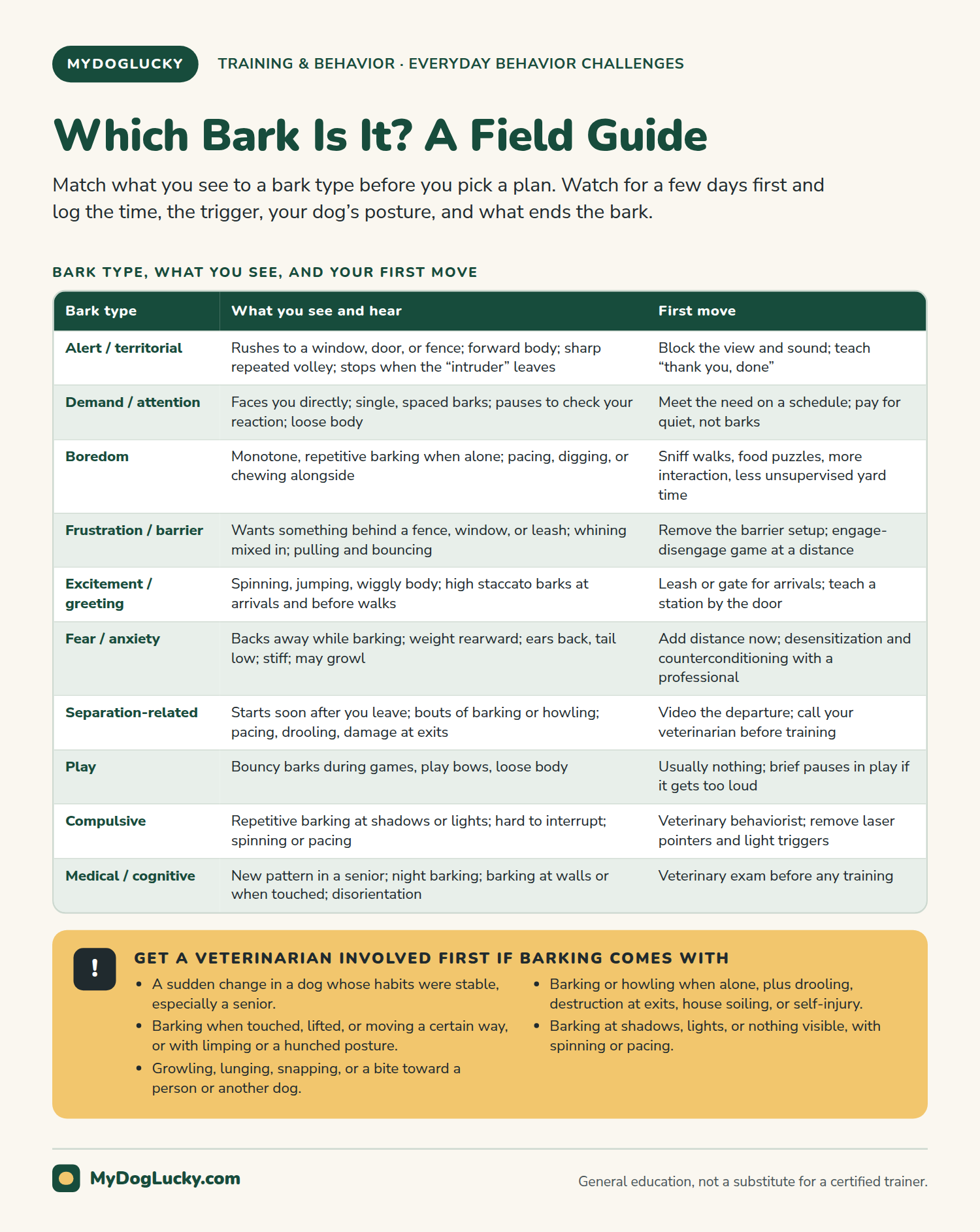
Bark Type, What You See, and Your First Move
| Bark type | What you see and hear | First move |
|---|---|---|
| Alert / territorial | Rushes to window, door, or fence; forward body; sharp repeated volley; stops when the “intruder” leaves | Block the view and sound; teach “thank you, done” |
| Demand / attention | Faces you directly; single spaced barks; pauses to check your reaction; loose body | Meet the need on a schedule; stop paying for barks, pay for quiet |
| Boredom | Monotone, repetitive barking when alone; pacing, digging, or chewing alongside | Sniff walks, food puzzles, more interaction, less unsupervised yard time |
| Frustration / barrier | Wants something behind a fence, window, or leash; whining mixed in; pulling and bouncing | Remove the barrier setup; engage-disengage game at a distance |
| Excitement / greeting | Spinning, jumping, wiggly body; high staccato barks at arrivals and before walks | Manage arrivals with a leash or gate; teach a station by the door |
| Fear / anxiety | Backs away while barking; weight rearward; ears back, tail low; stiff; may growl | Add distance now; desensitization and counterconditioning with a professional |
| Separation-related | Starts soon after you leave; bouts of barking or howling; pacing, drooling, damage at exits | Video the departure; call your veterinarian before training |
| Play | Bouncy barks during games, play bows, loose body | Usually nothing; brief pauses in play if it gets too loud |
| Compulsive | Repetitive barking at shadows or lights; hard to interrupt; spinning or pacing | Veterinary behaviorist; remove laser pointers and light triggers |
| Medical / cognitive | New pattern in a senior; night barking; barking at walls or when touched; disorientation | Veterinary exam before any training |

Management First: Stop the Rehearsal Before You Train
If you take one structural idea from this guide on how to stop dog barking, make it this: management comes before training, not after. Every time your dog gets to bark at the window for five minutes, that habit gets a little stronger and a little harder to replace. Management interrupts the practice so your training has a chance to compete.
Management isn’t cheating, and it isn’t forever. It’s the scaffolding that holds the building up while you pour the foundation.
Block the View
Alert barkers need a window. Take the window away and a surprising amount of barking disappears on day one. Options, from cheapest to most involved:
- Frosted or decorative window film on the lower half of front-facing windows. It’s removable, it lets light in, and it removes the sidewalk from your dog’s world.
- Closed blinds or curtains during the hours when foot traffic peaks.
- Furniture rearranged so the couch no longer doubles as a guard tower.
- A baby gate or closed door that keeps your dog out of the front room when you can’t supervise.
- Privacy screening or solid panels on a chain-link fence, if yard barking is the issue.
Soften the Sound
Dogs who bark at footsteps in the hallway, a neighbor’s dog, or the mail slot respond well to a masking layer. A white-noise machine, a fan, or a radio at conversational volume near the door raises the floor so small sounds don’t stand out. Many apartment owners notice that alone cuts hallway barking in half.
Change the Route or the Timing
If your dog barks at other dogs on walks, walk earlier, later, or somewhere with fewer dogs while you work on the training below. If the school bus at 3:10 sets him off, that’s the moment to be in the back of the house with a chew. Avoiding the trigger during the learning phase isn’t giving up. It’s controlling the difficulty.
Set Up the Room Before Guests Arrive
Greeting barkers do best when the arrival is choreographed. Before the doorbell, put your dog on a leash, behind a gate, or in another room with something good to chew. Let guests come in and sit down. Then bring your dog out, on leash, once the energy has dropped. The first thirty seconds at the door is where most greeting barking lives, and you can simply skip them for now.
A management checklist to run through this week
- Which window or door does the barking start at? Can you block it today?
- What time of day does most of the barking happen? Can your dog be somewhere else then?
- Is your dog alone in the yard for long stretches? Can yard time become supervised and shorter?
- Are the loudest moments predictable (deliveries, the bus, the neighbor’s dog)? Can you plan a chew for those moments?
- Does your dog have a quiet, comfortable place to rest away from the front of the house?
Meet the Need: Exercise, Sniffing, Enrichment, and Routine
A lot of barking is a symptom of a day with nothing in it. You don’t have to run your dog into the ground, and you don’t need a yard. You need to give him legitimate outlets for the things he’d otherwise do at the window.
Sniff Walks Beat Marches
A twenty-minute walk where your dog gets to stop and read every fence post does more for his brain than a brisk mile with no sniffing allowed. Sniffing is how dogs gather information, and it tends to leave them calmer afterward. If your schedule allows only one walk, make it a slow one on a longer leash somewhere with interesting smells.
Feed the Brain, Not Just the Bowl
Food puzzles, snuffle mats, scatter feeding in the grass, stuffed rubber chews, and short training games all turn a thirty-second meal into a fifteen-minute project. A dog who spends part of the afternoon working a frozen stuffed chew is not spending it at the window. Rotate the options so they stay interesting, and keep the difficulty at a level that slows your dog down without frustrating him.
Predictable Routines Lower the Baseline
Dogs who know roughly when meals, walks, play, and rest happen tend to bark less for those things. That’s the demand-barking angle: if dinner reliably arrives at 6:00, there’s less reason to start lobbying at 5:15. Predictability also lowers general arousal, which makes alert barking easier to interrupt.
Rest Is a Need Too
An overtired dog is a reactive dog. Puppies and adolescents in particular can bark more when they’ve skipped naps, and adult dogs living in busy households sometimes never fully switch off. A crate or a quiet room with the door closed, used for real downtime rather than punishment, gives your dog permission to stop being on duty.
Teaching “Quiet” Through an Incompatible Behavior
Here’s where most people expect the guide on how to stop dog barking to begin. It comes fourth on purpose. A “quiet” cue works well once management has lowered the volume and the dog’s needs are met. Without those, you’ll be asking for quiet from a dog who has every reason to keep going.
A quiet cue isn’t magic. It’s a signal that says “stop barking and do this other thing, and it will pay.” The “other thing” is the key: a dog who is eating a stream of tiny treats, or sniffing the floor for scattered kibble, is physically not barking. You’re not suppressing the bark. You’re replacing it.
Step 1: Build the Cue When It’s Easy
Start when your dog isn’t barking at all. Say “quiet” in a calm, ordinary voice, then immediately feed three or four pea-sized treats one after another. Repeat ten times across a session. You’re teaching your dog that this word predicts good things, so when you later say it during a bark, he has a reason to stop and look at you.
Step 2: Use It on Low-Level Barking
Wait for a mild bark, the kind where your dog gives a couple of woofs at a sound but isn’t fully launched. Let him bark two or three times, then say “quiet” once, and the moment there’s a pause, feed a steady stream of tiny treats for five to ten seconds. The ASPCA’s guidance describes this same approach: allow a few barks, cue quiet, then reward the silence with a series of small treats. We skip the version that involves holding the muzzle closed. It isn’t necessary, and for many dogs it adds a hand-around-the-face conflict that makes the whole thing worse.
Step 3: Stretch the Quiet
Once your dog reliably pauses when he hears the cue, start spacing the treats out: one treat, two seconds of quiet, another treat, four seconds, and so on. If he barks again during the gap, that’s information. Shorten the gap next time. You’re building a longer and longer quiet in exchange for the same reward.
Step 4: Add a Next Job
“Quiet” followed by nothing leaves your dog standing at the window with the trigger still outside. So attach a follow-up: “quiet,” then “go to your mat,” or “quiet,” then a treat scatter on the kitchen floor. The follow-up moves your dog away from the trigger and gives him something to do that lasts longer than a single treat.
Success criteria before raising difficulty
- Your dog stops barking within two seconds of the cue, in the easy setup, on eight out of ten tries.
- He can hold quiet for ten seconds between treats without re-barking.
- He’ll leave the window or door on the follow-up cue without you pulling him.
Only then move to a stronger trigger. If the success rate drops below about half, back up a step.
Some owners also teach a “speak” cue first, so they can practice “speak” then “quiet” deliberately. It’s a reasonable approach with dogs who don’t bark much on their own. With a dog who already barks plenty, you don’t need to add reps. Skip it.
The “Thank You, Done” Protocol for Alert Barking
Alert barking is the hardest to eliminate and the easiest to shorten. Dogs bred to watch and warn are going to notice the delivery truck. The realistic goal is a dog who barks two or three times, gets acknowledged, and then hands the situation over to you.
Why Acknowledging Works Better Than Ignoring
Alert barking is partly a request: “Did you see this? Are you handling it?” Ignoring an alert barker often makes him louder, because from his side nobody has responded to the emergency. Calmly acknowledging the alert and then dismissing it answers the question. Many owners notice a dramatic drop in duration within a couple of weeks once they stop ignoring and start acknowledging.
The Protocol
- Your dog barks at the window. Let him get two or three barks out. That’s the alert doing its job.
- Walk to the window calmly. Look out. Say something quiet and consistent: “Thank you. Done.” No excitement in your voice.
- Turn away and move to a spot away from the window, ideally to a mat or the kitchen. Call your dog with you.
- Reward him for coming with you and for settling away from the window, with a treat scatter or a chew.
- If he goes back and barks again, repeat, without irritation. Consistency across dozens of repetitions is what teaches the pattern.
Success Criteria
You’re looking for three things. First, the volley shortens on its own, from ten barks to three or four. Second, your dog starts looking toward you after the first bark, checking whether you’re coming. Third, he follows you away from the window without being called. When all three are showing up most days, you can start thanking him from across the room instead of walking over.
What Not to Do
Don’t join in at the window, don’t yell, and don’t wait until he’s mid-frenzy to start. If he’s already at full volume, use management (close the blind, bring him away on leash) and try the protocol on the next, smaller alert.
Changing How Your Dog Feels About Triggers: “Look at That” and Engage-Disengage
Some barking isn’t a habit. It’s an emotion. A dog who barks at strangers, other dogs, or bikes because they worry him doesn’t need a quiet cue. He needs to feel differently about the trigger, and that’s what desensitization and counterconditioning do. AVSAB’s position statement names systematic desensitization, done gradually rather than by flooding, as the humane approach for fear-related behavior.
The “look at that” game (from trainer Leslie McDevitt’s work with reactive dogs) and the closely related engage-disengage game are the most owner-friendly versions of this. They teach your dog that noticing the trigger predicts good things, and that looking back at you is the next step.
Find the Distance Where Your Dog Can Think
Every dog has a threshold: the distance at which he notices the trigger but can still eat, look at you, and move his body loosely. Closer than that, he stiffens, stares, and barks. Your job is to work under threshold, not at it. For some dogs that’s 20 feet from another dog; for others it’s across a parking lot. Start further than you think you need.
Stage 1: Engage
Your dog notices the trigger (head turns, ears up). The moment he looks, mark it (a click or a calm “yes”) and feed a treat. You’re not asking him to look away. You’re paying him for noticing calmly. Repeat every time he glances at the trigger. Within a session, many dogs start looking at the trigger and then whipping their head back to you for the treat.
Stage 2: Disengage
Once your dog looks at the trigger and then looks back at you on his own, start marking the look-back instead of the look. Now the sequence is: notice, check in with you, get paid. That check-in is the behavior that replaces barking, and it’s what you’ll use on real walks.
Stage 3: Close the Distance Slowly
Each session, if your dog is succeeding on most reps, cut the distance by a few feet. If he barks, you went too far too fast. Move back to the last distance where he could do it, and end the session on a success. This is slow. It’s also the only approach that changes the emotion rather than suppressing the display.
Success criteria before decreasing distance
Your dog looks at the trigger and back at you, unprompted, on at least eight of ten reps, with a loose body and no growling. If he’s barking, lunging, or refusing food, the distance is wrong, not the dog.
Mat and Settle Training
A mat is a portable off-switch. Once your dog knows that lying on his mat pays reliably, you can use it at the door when guests arrive, in the living room during the evening barking hour, in the car, and in the vet lobby. It’s the “what to do instead” for half the situations in this article.
Building the Behavior
- Put a mat down. The moment your dog looks at it, treat. Step on it, treat. Lies on it, treat several times in a row.
- Add duration. Once he’s lying down readily, wait two seconds before treating, then four, then ten. Feed on the mat, so the mat itself becomes the good place.
- Add a release word (“free,” “okay”) so he learns the mat is a job with a clear end.
- Add mild distractions. Walk a few steps away. Drop a toy. Open a cupboard. Treat for staying.
- Move the mat to the places you’ll need it: by the front door, in the car, in the yard.
Pairing the Mat With Barking Triggers
When the mat behavior is strong in quiet conditions, start using it as the follow-up to “quiet” or “thank you, done.” Cue the mat, walk your dog to it, feed him there, and let him have a chew there while the trigger passes. Over time, many dogs go to the mat on their own when the doorbell rings, because the mat is where the good stuff has always been.
Success Criteria
Your dog will go to the mat on cue from across the room and stay there for two minutes while you move around normally. Once you have that, you can start using it in real situations, beginning with the easiest ones.

Demand Barking: Extinction Done Correctly
Demand barking is the one where most well-meaning advice goes wrong. The usual instruction is “just ignore it.” That’s half right. The full version is: stop rewarding barks, start rewarding quiet, and make quiet the fastest route to what your dog wants. Done that way, it’s humane and it works. Done as “ignore him until he gives up,” it can turn into an hour-long standoff that teaches both of you nothing useful.
First, Check the Schedule
Demand barking usually means a real need with a bad delivery system. If your dog barks at you at 5 p.m. every day, ask whether 5 p.m. is when he needs a walk, dinner, or ten minutes of play. Meeting that need on a predictable schedule, before the barking starts, removes most of the reason to lobby.
Then, Change What Pays
- When the barking starts, go neutral. No eye contact, no talking, no “shh,” no pushing away. Turn your body slightly. The ASPCA’s guidance on attention-seeking barking is blunt about this: eye contact, touching, and scolding all count as attention.
- Watch for the first quiet second. Even a breath counts. The moment it happens, mark it and reward: attention, a treat, or the thing he was asking for if it’s reasonable.
- Ask for an easy alternative before the barking resumes: a sit, a hand touch, or going to the mat. Reward that heavily. You want your dog to learn that sitting quietly is what gets the ball, not barking.
- Repeat, every time, from everyone. Intermittent success is what makes demand barking so durable. If barking works one time in five, your dog will keep trying.
Expect the Extinction Burst
Around day two or three, the barking usually gets louder and longer before it gets better. That’s the extinction burst, and it’s a sign the plan is working. Your dog is trying harder because the old strategy stopped paying. Hold steady, keep rewarding quiet, and it passes within days for most dogs. If you give in during the burst, you’ve taught him that louder and longer is the new price.
Why “Waiting Him Out” for an Hour Isn’t the Plan
Pure ignoring, with nothing rewarded, leaves your dog guessing what would work. Frustrated dogs escalate: barking becomes jumping, jumping becomes grabbing sleeves. Rewarding the first quiet moment gives him a clear answer fast, so most extinction sessions last seconds, not an hour. If a session is going past a minute or two, redirect to an easy known behavior and reward that, then reset.
Specific Situations: Visitors, the Yard, the Car, the Crate, and Barrier Frustration
The protocols above cover most barking. A few situations come up so often that they’re worth their own plans.
Greeting Barking With Visitors
Management first: leash, gate, or a separate room with a chew during the actual arrival. Then station training: teach your dog that the doorbell means “go to your mat and wait for a treat.” Practice with a family member ringing the bell, then a friend, then a friend who comes in and sits without greeting the dog. Ask guests to ignore your dog until he has four paws on the floor and has stopped barking, then greet him calmly. Most greeting barking shrinks as your dog learns that visitors are boring for the first minute and pleasant after that.
Barrier Frustration on Leash or at the Fence
Some dogs bark at other dogs not from fear but from frustration: they want to say hello and the leash or fence says no. The body is forward and bouncy, often whining, with none of the backing-away posture of a fearful dog. The engage-disengage game works well here, combined with a decision: on-leash greetings aren’t happening for now. Practice calm check-ins at a distance, reward walking past, and provide off-leash social time in safer settings if your dog enjoys it. Remove fence-line rehearsal with screening or by keeping yard time supervised.
Barking in the Yard
A dog left alone in a yard for hours is a dog with a job and no supervisor. Yard barking usually blends boredom, territorial patrol, and socially facilitated barking with the neighbors’ dogs. The fix is mostly a change in habits: shorter, supervised yard time; scatter feeding or a chew in the yard so there’s something to do; recall practice, calling him in for a treat when he starts to bark; and privacy screening on the fence. If your dog barks at the neighbor’s cat sunning itself on the fence, the cat will not be negotiating, so the view is the thing to change.
Barking in the Car
Car barking is usually excitement (the car predicts the park) or alert barking at everything going by at 30 miles an hour. Start with management: a crate with a light cover, or a harness seat belt with a window shade so the moving scenery isn’t a highlight reel. Then train in a parked car with the engine off: mat or crate, chew, calm. Add the engine, then a trip around the block, then longer drives, always keeping the chew and the calm. If the barking is frantic, with drooling and trembling, that’s fear or motion sickness and needs a veterinary conversation first.
Barking at Night in a Crate
Before any training, run the needs checklist. Does your dog need to go out? Puppies often do. Is he hungry, too hot, too cold, or in a crate that’s too far from the family? Did he sleep all afternoon and get no exercise? Is he a new arrival still adjusting? If a real need is behind the barking, meet it, calmly and without a party. Take a puppy out, let him relieve himself, and put him back with minimal fuss.
If needs are met and your dog is otherwise comfortable in the crate, wait for a pause in the barking and then quietly reward it, ideally with a calm word or by dropping a treat in. Move the crate closer to your bedroom if that settles him. And if crate barking is paired with frantic scratching, drooling, or escape attempts, stop and reassess: that’s distress, and crate training needs to start over more gradually, possibly with professional help.
Apartments, Neighbors, and What to Say
Barking in an apartment carries a stress the yard-and-fence version doesn’t: someone else is listening, and they may have already complained. Here’s the practical plan for anyone working on how to stop dog barking with a neighbor on the other side of the wall.
Find Out What’s Actually Happening
A dog who barks when you’re home is only part of the story. Set up a camera or a recording app for a few departures. You’ll learn whether your dog barks for two minutes and settles, barks in bursts at hallway sounds, or barks continuously in a pattern that looks like separation distress. Each of those has a different plan, and the recording tells you which one you have.
Management That Works Through Walls
- White noise or a fan near the front door and any shared wall.
- Window film on any window facing a walkway, courtyard, or parking lot.
- A resting spot in the quietest room, away from the hallway, with the door partly closed.
- A long-lasting chew or frozen food puzzle at departure, so the first ten minutes have something in them.
- A midday walker or a daycare day if your dog is alone for long stretches, when the budget allows.
What to Say to a Neighbor
Get ahead of it. A short, direct conversation before a complaint lands makes everything easier. Something like: “I know Milo has been barking when I’m out. I’m working on it with a trainer, and I’ve set up a camera so I can see what’s happening. Would you mind texting me the times you hear him? That helps me figure out the pattern.” Then follow up. A neighbor who feels heard is far more patient than one who has been ignored, and their timestamps are useful data.
Know Your Local Rules
Noise ordinances vary by city and county, and many leases have their own quiet-hours clauses. Look yours up so you know what’s expected. If you’ve received a formal complaint, respond in writing, describe the steps you’re taking, and give a realistic timeline. Property managers generally want the problem solved, not the dog gone.
Senior Dogs, Hearing Loss, and Cognitive Decline
Barking that starts or changes in an older dog deserves a different first question: what’s changed in the dog? Cornell’s Riney Canine Health Center describes canine cognitive dysfunction syndrome as an age-related decline that can show up as disorientation, altered interactions with people, disrupted sleep-wake cycles, house soiling, changes in activity, and new anxiety. Vocalizing at night, barking at nothing, or standing in a corner and barking are common versions owners report.
Hearing loss changes barking too. A dog who can’t hear his own voice may bark louder and longer, and he can’t hear you reassuring him from the other room. Vision loss makes ordinary shapes startling. Arthritis pain can make a dog bark when he’s touched, moved, or asked to get up.
What to Do
- Book a veterinary exam and bring a log: when the barking happens, what it looks like, and what else has changed (sleep, appetite, house training, getting stuck behind furniture).
- Adjust the environment rather than the dog: night lights, a consistent bedtime routine, a predictable layout, a comfortable bed in a quiet spot, and gentle hand signals if hearing is fading.
- Keep training gentle and short. Mat and settle work still helps older dogs, but the goal is comfort, not obedience.
- Ask about treatment options. Your veterinarian may discuss diet, supplements, enrichment, or medication depending on what the exam shows. That’s a conversation for the clinic, not for a website.
There’s no humor in this section on purpose. A senior dog barking at 3 a.m. because the room doesn’t make sense anymore is a dog who needs help, and an owner who is exhausted and worried. Both deserve a plan.
When Barking Signals Fear, Separation Distress, or Pain
Most of this guide is about ordinary barking. Some barking is a symptom, and the kindest, fastest thing you can do is stop trying to train it and get the right professional involved.
Get a veterinarian involved now if barking comes with any of these
- A sudden change in barking in a dog whose habits were stable, especially a senior.
- Barking when touched, lifted, or moving in a particular way, or paired with limping, panting at rest, or a hunched posture.
- Barking or howling when alone, along with drooling, destruction at doors or windows, house soiling, or self-injury from escape attempts.
- Barking at shadows, lights, or nothing visible, with spinning, pacing, or difficulty interrupting.
- Barking with growling, lunging, snapping, or a bite toward a person or another dog.
None of these mean your dog is beyond help. They mean the plan needs a professional’s eyes before you spend months on the wrong protocol.
Fear-Based Barking
If your dog barks while retreating, stiffening, or trying to hide, treat it as fear until proven otherwise. Fear needs distance, patience, and a desensitization plan built for your specific dog. A certified trainer with experience in reactivity, a Certified Applied Animal Behaviorist, or a veterinary behaviorist (a veterinarian board-certified in behavior) can build that plan. Pushing a fearful dog closer to what scares him, or correcting him for barking at it, reliably makes fear worse.
Separation Distress
Separation-related barking doesn’t respond to quiet cues or ignoring, because your dog isn’t choosing to bark. He’s panicking. The plan involves gradual departure training, environmental changes, and in many cases medication prescribed by a veterinarian alongside behavior modification. Start with your regular veterinarian, who can refer you to a veterinary behaviorist if needed. Don’t crate a distressed dog to contain the noise; dogs with separation anxiety can injure themselves trying to escape.
Pain and Medical Causes
Barking is one of the ways dogs tell you something hurts, and pain doesn’t always look like limping. Any barking that seems tied to movement, touch, a particular time of night, or a general change in mood should go on the list for your next veterinary visit. Rule out the medical explanation first, then train.
Who to Call, and How to Find Them
For ordinary barking, a certified professional dog trainer is the right first call. Look for credentials such as CPDT-KA or CPDT-KSA through the Certification Council for Professional Dog Trainers, or a certified behavior consultant through the International Association of Animal Behavior Consultants. CCPDT’s published policy requires its certificants to follow “least intrusive, minimally aversive” (LIMA) principles, which means they’ll start with management and reinforcement, not corrections. For fear, aggression, separation distress, or compulsive behavior, ask your veterinarian for a referral to a veterinary behaviorist.
Why We Don’t Recommend Anti-Bark Collars
This is the part where someone in the comments will say a bark collar fixed their dog in a weekend. Sometimes it does look that way. Here’s why MyDogLucky still doesn’t recommend shock, spray, or ultrasonic collars in any guide on how to stop dog barking.
What They Do
All three types deliver something unpleasant when the collar detects barking: an electric stimulation, a burst of citronella or unscented spray toward the face, or a high-pitched tone. The dog learns that barking causes the unpleasant thing and, if it works, stops barking while the collar is on.
What the Behavior Organizations Say
AVSAB’s 2021 humane training statement opposes training tools that rely on pain or intimidation, and it lists electronic shock collars and spray devices among them. The statement is clear that there’s no evidence such tools are necessary for behavior change and that reward-based methods produce better long-term outcomes. The ASPCA’s guidance calls anti-bark collars punishment devices that aren’t recommended as a first choice, notes that citronella collars performed about as well as shock collars in comparison, and describes dogs becoming “collar-wise”: quiet with the collar on, back to barking when it’s off.
The Fallout
- The collar doesn’t know why the dog is barking. A fearful dog gets punished for being afraid. An alert dog gets punished for doing his job. A dog with separation panic gets punished for panicking.
- Wrong-target associations. If the collar fires while a child walks past the window, the dog may learn that children predict pain. AVSAB’s review lists increased aggression and anxiety among the documented risks of aversive methods.
- Other dogs’ barking can trigger it. Sound-activated collars in multi-dog homes sometimes fire on the wrong dog.
- Suppression isn’t resolution. The need behind the barking is still there. It often comes out somewhere else: chewing, pacing, whining, or barking the moment the collar comes off.
- Ultrasonic devices affect every dog in range, including the neighbor’s dog who did nothing, and they can be aversive to dogs with sensitive hearing even when they don’t stop the barking.
What to Do Instead
Everything above: management, meeting needs, and one trained alternative at a time. If you’ve been using a bark collar, you don’t need to feel judged; most people who bought one were desperate and told it was humane. Take it off, log the barking for a few days, and start with the field guide. If you’re not sure where to begin, a certified trainer can build the plan with you in a single session.

Debarking Surgery: What the AVMA Says
Devocalization, sometimes called debarking, is a surgery that removes tissue from the vocal folds to reduce the volume of a dog’s bark. Readers occasionally ask about it after a landlord’s ultimatum, so it’s worth addressing plainly.
The American Veterinary Medical Association’s current policy strongly discourages devocalization of dogs because of the surgery’s negative impact on welfare. The policy points out that barking is a natural behavior and an important form of canine communication, that the surgery can reduce but not eliminate the intensity and pitch of the bark, and that owners and veterinarians should identify the underlying cause of barking and address it with humane behavior modification.
Earlier versions of the policy framed the procedure as a final alternative after behavior modification had failed; the current wording is firmer. The AVMA does consider medically therapeutic laryngeal surgery, performed by a licensed veterinarian for a medical condition, to be appropriate care. That’s a different situation.
Some states also restrict or prohibit non-therapeutic devocalization. MyDogLucky doesn’t recommend it. If you’re facing a housing deadline, a certified trainer plus aggressive management will usually get you further, faster, and with your dog’s voice intact.
Realistic Timelines and a Week-One Practice Plan
People who search for how to stop dog barking usually want a date. Here’s an honest range, based on what owners and trainers commonly report. Individual dogs vary, and a dog who has practiced barking for six years will take longer than a puppy who started last month.
- Management: noticeable reduction within one to three days, because the trigger simply isn’t available.
- Meeting needs: many owners see a calmer baseline within a week or two of adding sniff walks and food puzzles.
- “Quiet” cue: reliable at home, on mild triggers, in two to four weeks of short daily practice.
- “Thank you, done”: shorter volleys within two to three weeks; dogs who self-interrupt after a bark or two in one to three months.
- Demand-barking extinction: the burst in days two to five, real improvement within one to two weeks if everyone is consistent.
- Engage-disengage for reactive or fearful dogs: months, with a professional guiding the distance work. Progress is measured in feet, not days.
- Separation-related barking: weeks to many months, with veterinary involvement.
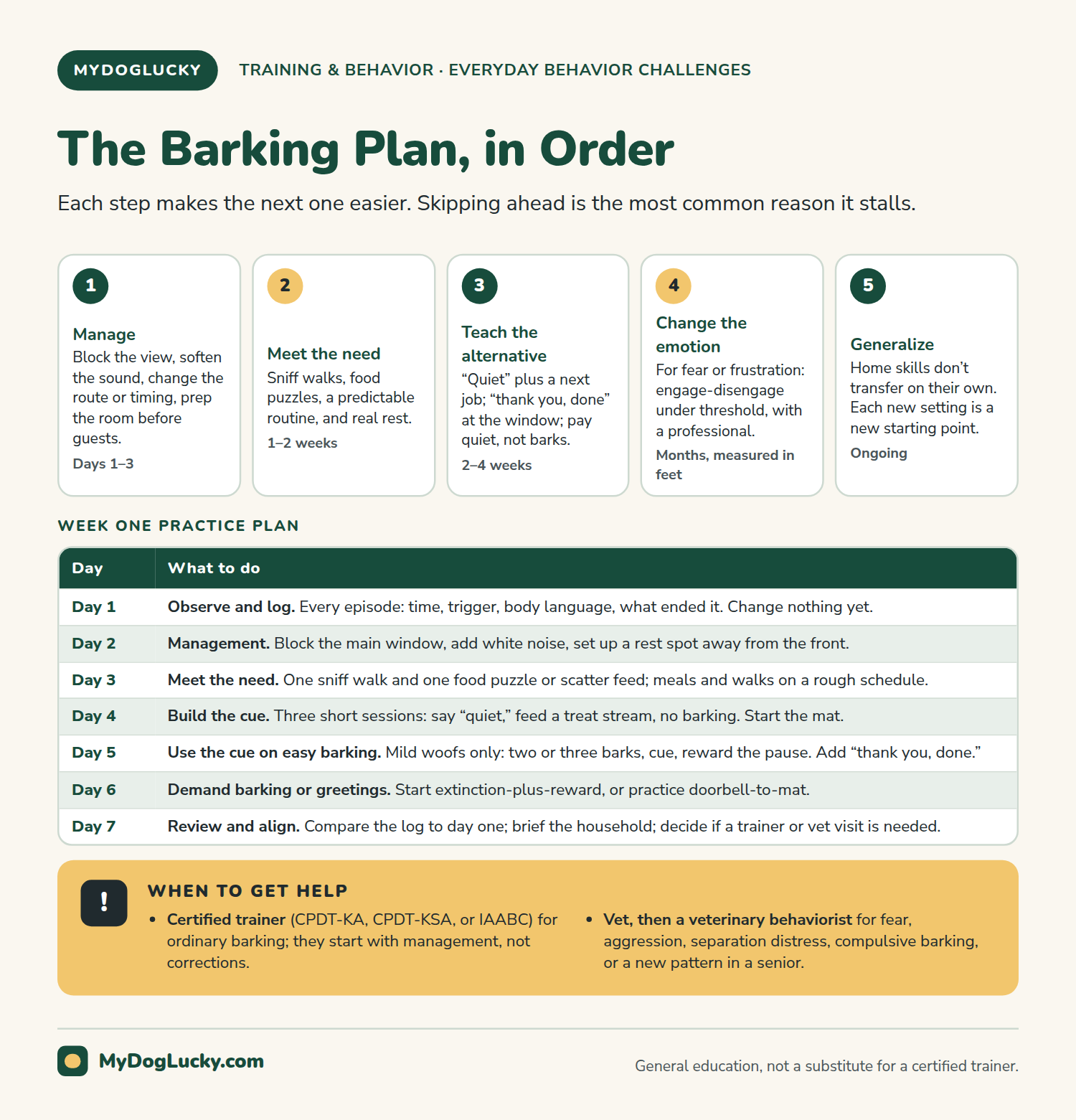
Week One Practice Plan
| Day | Focus | What to do | Success looks like |
|---|---|---|---|
| Day 1 | Observe and log | Write down every barking episode: time, trigger, body language, what ended it. Change nothing yet. | You can name the top two bark types in your house |
| Day 2 | Management | Block the main window, add white noise, set up a rest spot away from the front of the house. | Fewer episodes at the main trigger, same day |
| Day 3 | Meet the need | Add one sniff walk and one food puzzle or scatter feed. Put meals and walks on a rough schedule. | A dog who settles more easily in the evening |
| Day 4 | Build the cue | Three short sessions: say “quiet,” feed a treat stream, no barking involved. Start mat training with the first two steps. | Your dog looks at you when he hears the word |
| Day 5 | Use the cue on easy barking | On mild woofs only: two or three barks, cue, reward the pause. Add “thank you, done” at the window if you have an alert barker. | Pauses within two seconds on most easy tries |
| Day 6 | Demand barking or greetings | Pick the one that fits your dog: start the extinction-plus-reward plan, or practice doorbell-to-mat with a family member. | First quiet moments are getting rewarded consistently |
| Day 7 | Review and align | Compare the log to day one. Brief everyone in the house on the plan. Decide whether a trainer or vet visit belongs on the list. | Shorter episodes and a written plan for week two |
Troubleshooting Five Likely Problems
“He stops when I say quiet, then starts again ten seconds later”
The cue is working; the follow-up is missing. Your dog stopped, got a treat, and is still standing at the window with the trigger outside. Attach a next job every time: “quiet,” then mat, or “quiet,” then a treat scatter in another room. The goal is to move him away from the trigger, not just pause him in front of it.
“He won’t take treats when he’s barking”
A dog who refuses food is over threshold. This is the most common reason plans on how to stop dog barking stall. Stop training in that moment and manage instead: close the blind, add distance, leash him away. Then go back to practicing at a lower intensity, farther from the trigger, where he can eat. The training only happens where your dog can think.
“The barking got worse when we started ignoring it”
That’s the extinction burst, and it means the old strategy stopped paying. It passes in a few days if nobody gives in. Check two things: is anyone in the house still responding to barks, even with a “no”? And are you rewarding the first quiet second, so your dog has a clear alternative? Pure ignoring with no rewarded alternative drags the burst out.
“He’s quiet with me and barks nonstop when I’m gone”
Record a departure. If the recording shows bursts at hallway sounds, that’s alert barking and management (white noise, a quiet room, a chew) plus the quiet work will help. If it shows continuous barking or howling with pacing, drooling, or scratching at the door, that’s likely separation distress. Stop the barking protocols and call your veterinarian.
“He’s better at home but still barks at every dog on walks”
Home skills don’t automatically transfer outdoors, and dogs on walks are a bigger trigger than anything through a window. Back up to the engage-disengage game at a distance where he can succeed, and treat every setting as a new starting point. If the barking comes with lunging or a stiff, staring body, get a trainer who works with reactivity involved.
The Smallest Useful Practice Plan
If the full guide feels like too much, here’s the version that fits a busy week and still moves things forward. It’s the shortest honest answer to how to stop dog barking that we can give.
- Block the one window or door where most barking starts. Today.
- Add one sniff walk or one food puzzle per day.
- Practice “quiet” for two minutes a day in easy conditions, with a treat stream.
- Use “thank you, done” at the window every time, calmly, and walk your dog away.
- Reward quiet, not barks, when your dog asks you for things. Everyone in the house, every time.
That’s five things. Do them for two weeks, keep your log, and you’ll know whether you’re on the right track or whether it’s time to bring in a certified trainer.
Common Mistakes That Keep Dogs Barking
Starting With the Cue Instead of Management
Asking for “quiet” from a dog who has a front-row seat to the sidewalk is asking him to ignore his job. Block the view first, then train.
Yelling Over the Barking
It sounds like joining in, it raises the energy in the room, and it’s attention for a dog who wanted attention. Calm and quiet beats loud every time.
Inconsistent Responses in the Household
One person rewards quiet; another hands over the ball to make the barking stop. The dog learns which person to bark at. Agree on one plan and write it on the fridge.
Treating Fear Like a Habit
A fearful dog doesn’t need a quiet cue. He needs distance and a plan to change how he feels. Correcting fear-based barking makes fear worse.
Leaving the Dog in the Yard to “Get It Out of His System”
Unsupervised yard time is unsupervised barking practice. Shorter, supervised, and with something to do beats longer and alone.
Skipping the Vet Visit on a Changed Pattern
New barking in an older dog, or barking tied to touch or movement, needs a medical rule-out before any training. Training a dog to be quiet about pain is not the goal.
Giving Up After Four Days
Most of these protocols take weeks, and the extinction burst arrives right when it feels like nothing is working. Keep the log; it shows progress that memory doesn’t.
Frequently Asked Questions About Dog Barking
Will my dog ever stop barking completely?
Probably not, and that’s not the goal. Barking is normal communication. A realistic outcome is a dog who barks a few times at real events, stops when acknowledged, and doesn’t bark for attention or out of boredom. Some individual dogs, and some breeds developed for alerting, will always be more vocal than others.
Does ignoring barking work?
For demand barking, ignoring the bark is half the plan. The other half is rewarding the quiet moment and an alternative behavior like a sit. Ignoring doesn’t work for alert barking (your dog wants acknowledgment), fear barking (he needs distance), or separation distress (he’s panicking, not choosing).
How long does it take to stop dog barking?
Management works within days. A quiet cue on mild triggers takes two to four weeks. Alert-barking protocols show shorter volleys in a few weeks and self-interruption in one to three months. Fear-based barking takes months. Anyone who tells you how to stop dog barking in a weekend is describing suppression, not learning.
Is it too late to train an older dog to bark less?
No. Adult and senior dogs learn the same way puppies do; they just have a longer history to compete with. Start with a veterinary check if the barking is new, then use the same management and reward-based plan, with shorter sessions and lower expectations for speed.
Should I let my puppy bark it out in the crate at night?
Check needs first: bathroom, hunger, temperature, and whether the crate is too far from you. Meet a real need calmly. If needs are met, wait for a pause and quietly reward it rather than opening the door mid-bark. Frantic barking with scratching or drooling is distress, not protest, and crate training should slow down.
Do bark collars work?
They can suppress barking while worn, and some dogs stop barking only when the collar is on. AVSAB and the ASPCA both advise against them, because they don’t address the reason for the barking and they carry documented risks of increased fear, anxiety, and aggression. We don’t recommend them.
My dog barks and lunges at every dog on walks. Is he aggressive?
Barking and lunging on leash is usually reactivity, which can come from fear, frustration, or over-excitement. It’s not a character verdict. A trainer with reactivity experience can tell you which one you’re seeing and build a distance-based plan. If there’s growling, snapping, or a bite, ask your veterinarian for a veterinary behaviorist referral.
Why does my dog bark at me when I’m on the phone?
Because it has worked. You’re focused on something else, he barks, and you look at him or say “shh.” That’s attention. Give him a chew before the call, ignore barks during it, and reward the quiet moments. Most dogs figure out the new rule within a couple of weeks.
Will getting a second dog help my barker?
Rarely, and it often doubles the noise. Dogs bark socially, so a second dog is more likely to join in than to calm things down. If your dog’s barking is boredom-based, the better investment is more enrichment and interaction from you.
Should I ask my vet about medication for barking?
Yes, if the barking looks like anxiety, separation distress, compulsive behavior, or cognitive decline. Medication doesn’t stop barking by itself; when it’s appropriate, it lowers anxiety enough that behavior modification can work. Your veterinarian or a veterinary behaviorist decides whether it fits your dog. It’s not a first step for ordinary alert or demand barking.
Where to Start Tonight
Pick the window your dog barks at most and cover it. Put a chew or a scatter of kibble in the quietest room. Then watch your dog for the next few days and write down what you see. By the end of the week you’ll know which kind of barker you live with, and the rest of this guide turns into a plan instead of a list.
And if what you’re seeing looks like fear, panic when you leave, or a sudden change in an older dog, skip ahead: call your veterinarian, ask about a trainer or behaviorist, and let someone who can see your dog help you build the plan. Barking is fixable in nearly every home. The right order, and the right help, is what makes it fixable in yours.
Sources
- American Veterinary Society of Animal Behavior. Position Statement on Humane Dog Training (2021)
- American Veterinary Society of Animal Behavior. Position Statement on the Use of Punishment for Behavior Modification in Animals (2007)
- American Veterinary Medical Association. Policy: Canine Devocalization (accessed September 2026; references a 2023 literature review)
- ASPCA. Barking (accessed September 2026)
- ASPCA. Separation Anxiety (accessed September 2026)
- VCA Animal Hospitals. Barking in Dogs (accessed September 2026)
- Cornell University College of Veterinary Medicine, Riney Canine Health Center. Cognitive Dysfunction Syndrome (accessed September 2026)
- Cornell University College of Veterinary Medicine, Riney Canine Health Center. Senior Dog Dementia (accessed September 2026)
- Certification Council for Professional Dog Trainers. Least Intrusive, Minimally Aversive (LIMA) Effective Behavior Intervention Policy (2021)
- International Association of Animal Behavior Consultants. Certified behavior consultant directory and position statements (accessed September 2026)
- American Kennel Club. How to Stop Dog Barking (accessed September 2026)
- Merck Veterinary Manual. Behavior Problems of Dogs (accessed September 2026)
This article is general education for U.S. dog owners. It is not individualized training or veterinary advice for your dog. Barking that involves fear, aggression, separation distress, compulsive patterns, or a sudden change in an older dog should be evaluated by your veterinarian, a certified professional dog trainer, a Certified Applied Animal Behaviorist, or a veterinary behaviorist. MyDogLucky does not recommend shock, spray, or ultrasonic anti-bark collars or devocalization surgery.