
When should you schedule your puppy’s first vet visit? The short answer: within the first few days of bringing him home — especially if he came from a shelter, a rescue, or any source where his health history is a little bit of a mystery. Even if a breeder already handled an early wellness check, your own veterinarian still needs to meet your puppy, review whatever records exist, and start the relationship you’ll lean on for the next decade or more.
That appointment can feel like a lot at once. A new address, a strange room, a scale that beeps, someone in scrubs asking to look inside your puppy’s ears. You’re managing all of that while trying to remember the six questions you meant to ask and forgot the second you walked in. A puppy first vet visit doesn’t have to be chaotic, though — a little prep goes a long way. This guide walks through when to book your puppy’s first vet visit, exactly what to bring, what actually happens once you’re in the exam room, and how to make the whole experience less overwhelming for a puppy who’s already had a big week.
One quick scope note before we get into it: this article covers the visit itself — timing, prep, what happens, cost expectations, and follow-up. The full puppy vaccination schedule, including which shots happen when and why, lives in a separate MyDogLucky article dedicated to that topic. Here, vaccines come up as part of the visit, but the deep dive on the schedule itself is elsewhere.
What’s in this guide
- When to schedule your puppy’s first vet visit
- What to bring to the appointment
- What happens during the exam
- Questions to bring to the vet
- Making the visit less stressful for your puppy
- What a first vet visit commonly costs
- Follow-up visits: the booster schedule
- Red flags that mean don’t wait for the scheduled visit
- Building an ongoing relationship with a vet practice
- Common mistakes first-time owners make
- Frequently asked questions about a puppy’s first vet visit
- Sources
When to Schedule Your Puppy’s First Vet Visit
Book it fast. Most veterinary guidance points to the same window: a puppy’s first vet visit should happen within the first few days of coming home, and often within 72 hours if he came from a breeder, or immediately if he came from a shelter or rescue. AAHA’s life-stage guidance notes that most puppies see a veterinarian for the first time at around six to eight weeks old, which usually lines up with the week a puppy leaves his litter and joins a new household.
The reasoning is simple. You don’t yet know this specific puppy’s health picture. A breeder or shelter can hand over paperwork, but paperwork isn’t the same as a licensed veterinarian actually listening to his heart, checking his eyes, and feeling his abdomen. Starting that relationship on day two or three, rather than waiting until “things settle down,” catches problems early and gets his vaccination and parasite-prevention schedule moving while it still matters most.
Why an Unknown Health History Raises the Urgency
A puppy from a shelter, a rescue, a friend’s unplanned litter, or a source you don’t know especially well deserves a same-week visit, not a “when I get around to it” visit. He may have been exposed to intestinal parasites, an upper respiratory infection, or other puppies with unknown vaccination status. None of that is a reason to panic — it’s a reason to get a professional set of eyes on him quickly, before a minor issue has a chance to become a bigger one.
A puppy from a reputable breeder who already had an early wellness exam and a first round of deworming still needs his own appointment with your vet. Records travel; your puppy’s actual, current condition needs to be checked in person by the person who’s going to be managing his care going forward.
The 6-to-8-Week Window and Why It Tends to Line Up This Way
There’s a practical reason this timing shows up so consistently in veterinary guidance. Most puppies leave their litter around eight weeks old, which is also roughly when maternal antibodies — the temporary immune protection passed from mother to puppy — start to fade and a puppy’s own vaccine series needs to pick up the slack. Coming home and seeing a vet in that same window means the visit lines up naturally with when protection actually needs to start ramping up, rather than happening weeks after the fact.
It also happens to be a good time, developmentally, to start a working relationship with a vet before your puppy has formed strong opinions about car rides or exam tables one way or the other. A puppy who meets calm, gentle handling early tends to generalize that experience going forward, which is part of why this early visit matters beyond just the medical checklist.
If You Adopted an Older Puppy or a Puppy Mid-Series
Some puppies come home at four months old instead of eight weeks, already partway through their vaccine series or with gaps in their records. The same urgency applies: get him in quickly so your vet can review whatever documentation exists, run a fecal test, and figure out where he actually stands rather than guessing. Missing or incomplete paperwork isn’t a disqualifier for good care — it’s just information your vet needs sooner rather than later.
The same logic holds even further out. A six-month-old or a nearly grown “puppy” adopted from a shelter with zero history still deserves a prompt first visit, not a lower-priority one just because he’s past the classic eight-week image most people picture. Age doesn’t reduce the value of a first exam — unknown history does, and that can apply at any age.
Puppy First Vet Visit Checklist: What to Bring
A little prep the night before saves you from standing in a parking lot, patting your pockets, wondering where you put the paperwork. Here’s the practical puppy first vet visit checklist.
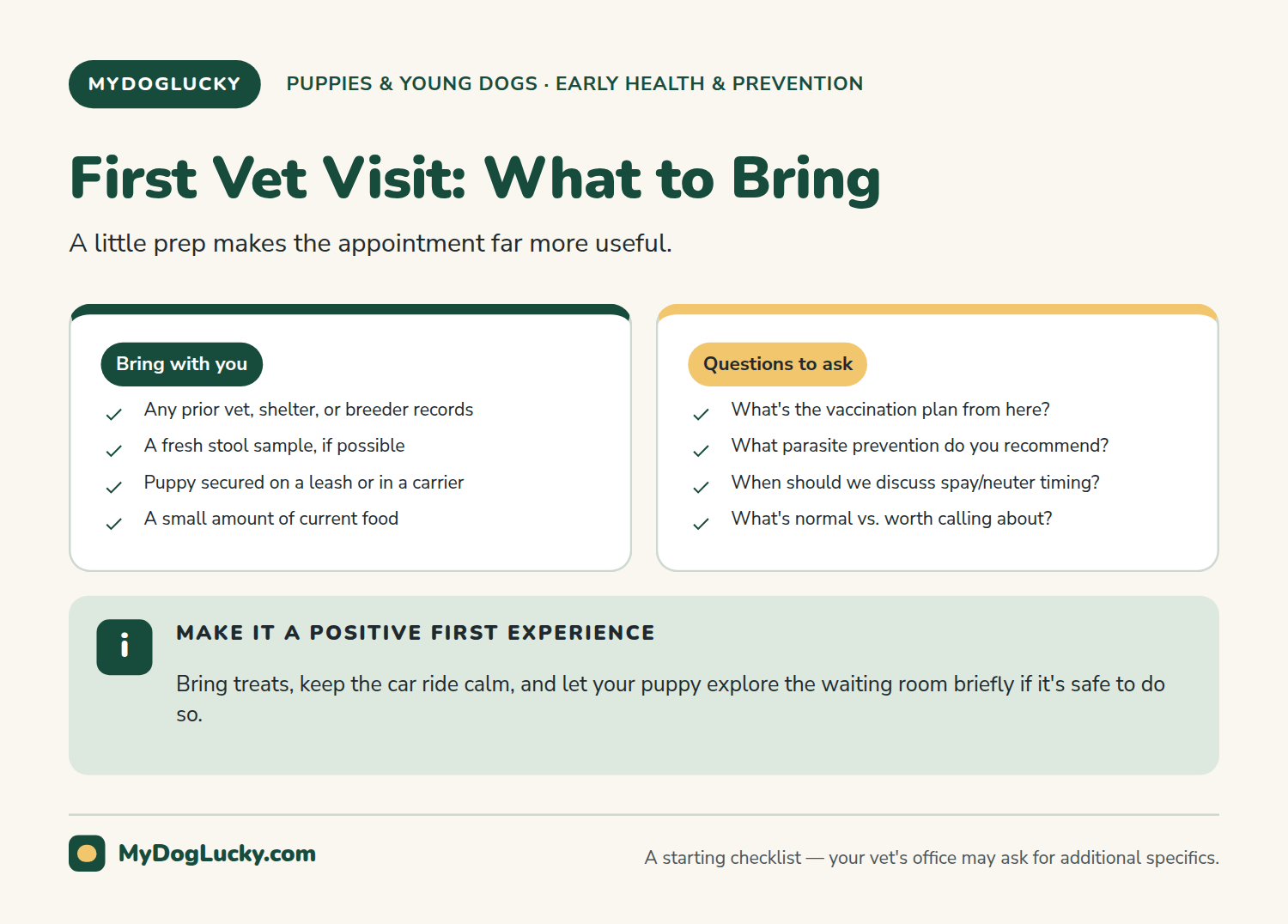
- Any prior records. Medical history from a breeder, shelter, rescue, or previous owner — vaccination dates, deworming treatments, any noted health concerns. Even a partial history is useful.
- A fresh stool sample, if you can manage it. A small amount, collected within the past 24 hours if possible, in a sealed bag or container, lets the clinic run a fecal parasite check the same day instead of asking you to bring one back.
- Your puppy, secured. A leash and well-fitted collar or harness, or a carrier for a small puppy. Parking lots and waiting rooms are exactly where an unsecured puppy tends to make a break for it.
- A written list of questions. You will forget half of them the moment someone in scrubs walks in with a friendly, distracting puppy voice. Write them down first.
- A small amount of your puppy’s current food. Enough for a day or two, in case the visit runs long or your puppy needs a meal away from home. It also avoids an abrupt diet change, which is a common and avoidable cause of a puppy’s first upset stomach.
- A few quick notes on the days since he came home. Eating, drinking, sleeping, and bathroom habits since arrival — anything that seems off, even slightly, is worth mentioning.
- A familiar comfort item, if it helps. A small blanket or toy that smells like home can take the edge off a strange new room for an anxious puppy, and it’s easy to toss in a bag on your way out the door.
Why the Stool Sample and Current Food Actually Matter
Two items on that list are easy to skip and worth explaining. A fresh stool sample lets your vet check for intestinal parasites — roundworms, hookworms, and others are extremely common in young puppies — without asking you to make a second trip. AKC’s guidance on fecal testing notes that a sample collected recently and kept cool gives the most accurate read, so a bag from the morning of the appointment works better than one that’s been sitting for two days.
Bringing your puppy’s current food matters for a quieter reason: a sudden switch to a new brand or formula, especially layered on top of the stress of a new home, is one of the more common and entirely preventable causes of puppy diarrhea. If your vet ends up recommending a different food, that’s a conversation to have and a transition to plan for — not something to do cold on day one, on top of everything else that’s already new.
Collecting the stool sample is simpler than it sounds. A small, sealed bag or a clean container with a golf-ball-sized amount is plenty — you don’t need to bring anything dramatic. Collect it as close to the appointment as you reasonably can, keep it cool if there’s a delay, and label it with your puppy’s name so it doesn’t get mixed up with anyone else’s sample in a busy waiting room.
What Happens During the Exam
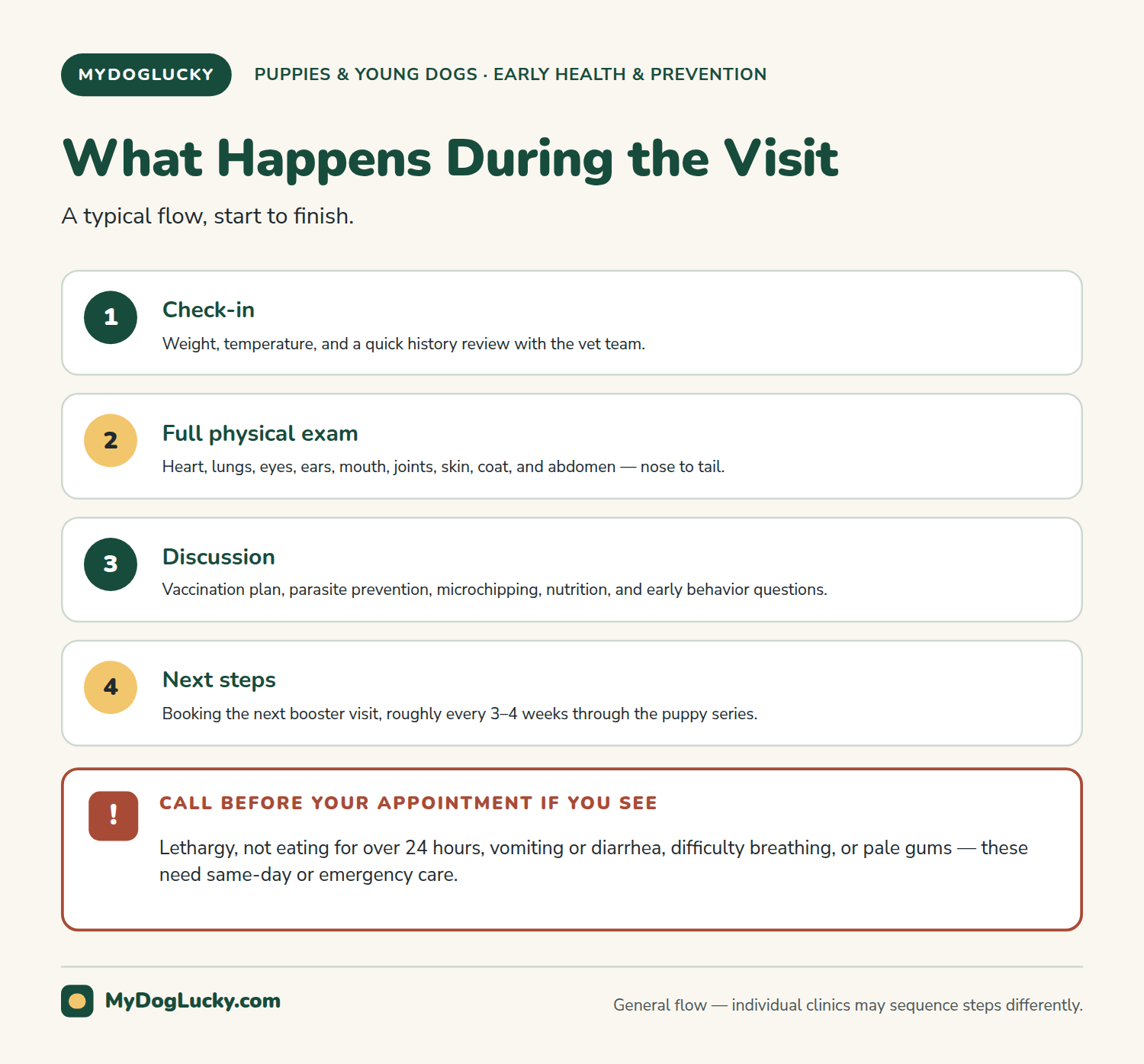
Most puppy first exams follow a similar shape: check-in, a full physical exam, then a conversation covering vaccines, parasite prevention, nutrition, and whatever’s on your written list. Expect the whole visit to run somewhere between 20 and 45 minutes, longer if it’s a first appointment with a lot of ground to cover.
The Full Physical Exam, Nose to Tail
The physical exam is the heart of the appointment, and it’s more thorough than most first-time owners expect. A veterinary team typically checks:
- Weight and body condition. A baseline number that later visits will track against, to make sure growth is on a reasonable curve.
- Temperature. A quick, routine check for fever or other red flags.
- Heart and lungs. Listened to with a stethoscope for rhythm, rate, and any unusual sounds.
- Eyes, ears, mouth, and teeth. Checked for discharge, redness, mites, retained baby teeth, or an bite alignment that looks off.
- Joints and gait. A look at how your puppy moves and stands, watching for anything that suggests discomfort or a developmental concern worth monitoring.
- Skin and coat. Checked for fleas, ticks, rashes, or anything unusual in coat condition.
- Abdomen palpation. Gentle pressing to check organ size and feel for anything tender or out of place.
- A hernia check. Umbilical and inguinal hernias are common and usually minor in puppies, and this is a routine part of a first exam, not a sign anything’s wrong.
None of this needs to feel clinical or scary from your end. A confident, gentle vet tech or veterinarian usually narrates as they go — “just checking his ears now,” “nice heart sounds” — which tends to keep both you and your puppy calmer than a silent, all-business exam would.
A few of these checks matter more than they might seem to at first glance. Weight and body condition, tracked over several visits, is how your vet spots a growth curve that’s drifting too fast or too slow long before it becomes an obvious problem. Joint and gait checks matter especially for large and giant-breed puppies, where subtle early signs of a developmental orthopedic issue are far easier to manage if they’re caught early rather than months later. And a hernia check — feeling for a small, soft bulge near the belly button or groin — is genuinely routine; most umbilical hernias found in puppies are small and simply monitored rather than treated as an emergency.
How the Exam Typically Flows, Step by Step
Knowing the rough order ahead of time can take some of the mystery out of it. Most first visits move through a predictable sequence: check-in and a weigh-in on the clinic scale, a temperature check, listening to the heart and lungs, a look at the eyes, ears, mouth, and teeth, hands-on palpation of the abdomen and a hernia check, and a look at how your puppy stands and moves. The whole physical portion usually takes ten to fifteen minutes, with the remaining time in the appointment going to the vaccine, parasite-prevention, and nutrition conversation covered next.
Starting or Confirming the Vaccination Schedule
Your vet will review whatever vaccination history exists and either start or continue your puppy’s core vaccine series. The exact timing and which vaccines apply depend on your puppy’s age, health, and where you live, and that full schedule — including booster timing and which vaccines are considered core versus lifestyle-based — is covered in MyDogLucky’s dedicated article on the puppy vaccination schedule. What matters for this visit is simpler: your vet will tell you where your puppy stands and what’s due next.
You may also hear the terms “core” and “non-core” or “lifestyle” vaccines during this conversation. Core vaccines are recommended for essentially all puppies; non-core vaccines get added based on individual risk factors, like whether your puppy will be around a lot of other dogs at daycare or boarding, or how much time he’ll spend in areas with standing water. Your vet is the right person to sort out which category applies to your specific puppy and household.
Fecal Parasite Check and Deworming
If you brought a stool sample, this is where it gets used. A fecal test checks for intestinal parasites, and if anything shows up — or even as a precaution when a sample isn’t available — your vet will likely recommend a course of deworming medication. Intestinal parasites are genuinely common in young puppies, related more to how puppies explore the world than to anything about their upbringing, and a straightforward treatment plan is the normal response, not a red flag about your puppy’s history.
Roundworms and hookworms are the two most frequently seen in young puppies, and some intestinal parasites can also pose a risk to people, particularly young children, according to public health guidance from the CDC. That’s not a reason for alarm — it’s a reason routine deworming and basic hygiene, like washing hands after yard cleanup and promptly picking up waste, matter for the whole household, not just your puppy.
Heartworm, Flea, and Tick Prevention
Expect a conversation about ongoing parasite prevention, covering heartworm, fleas, and ticks. Heartworm disease is transmitted by mosquitoes and can be serious, which is why prevention starts early and continues year-round in most parts of the country, according to guidance from Cornell University’s College of Veterinary Medicine. Your vet will factor in your location, your puppy’s age and weight, and your household’s specific risk — a puppy in a mosquito-heavy climate and a puppy in a drier one may land on a slightly different plan.
Most heartworm, flea, and tick preventives are given monthly, and many combine protection against more than one parasite in a single dose. If you’re adopting an older puppy with an unclear history, your vet may recommend a heartworm test before starting prevention, since giving certain preventives to a dog who’s already infected can cause a reaction. That’s a quick blood test, not a separate ordeal, and it’s usually done the same day.
Microchipping
Microchipping often comes up at this visit or a following one. A microchip is a small, rice-grain-sized device placed just under the skin with a needle, not a procedure that requires anesthesia on its own. The AVMA describes microchips as having “an excellent track record for reuniting lost pets with their people,” provided the registration stays current with your actual contact information. It’s a quick conversation, and many practices offer it as an add-on during any routine visit rather than something that has to happen on day one specifically.
The chip itself only works if the registration behind it is accurate, so ask exactly which registry your clinic uses and how to update your contact information if you move or change phone numbers. A chip with outdated information helps a lost puppy far less than one that’s kept current.
Spay/Neuter Timeline
Your vet will likely open a conversation about spay or neuter timing, even if the actual procedure is months away. AAHA’s guidance notes that the right timing isn’t identical for every dog — it depends heavily on your puppy’s projected adult size and breed-related health considerations. Smaller dogs are often spayed or neutered around five to six months old, while larger and giant breeds frequently benefit from waiting until growth has mostly finished, sometimes between nine and fifteen months. This is exactly the kind of individualized decision worth discussing directly with your vet rather than following a one-size-fits-all rule you saw online.
If your puppy came from a shelter or rescue, he may already have a spay/neuter agreement or an early-age procedure built into the adoption contract. Bring that paperwork along too, since it affects the timeline your vet will plan around.
Nutrition and Feeding Guidance
Feeding comes up early and often, and for good reason — it’s one of the few daily decisions you’re making from week one. Your vet will typically ask what you’re currently feeding, how often, and in what amounts, and may offer guidance on portion sizes as your puppy grows. This is a good moment to mention the food you brought along, and to ask directly whether your current choice fits your specific puppy’s size, breed, and growth trajectory.
If a change does end up being recommended, ask about a gradual transition rather than an overnight swap — mixing in a little more of the new food over a week to ten days tends to sit much better on a puppy’s stomach than switching all at once. Your vet may also introduce body condition scoring, a hands-on way of feeling ribs and waist to judge whether a puppy is lean, on track, or carrying extra weight, since scale weight alone doesn’t tell the whole story.
Your Early Chance to Ask About Behavior and Socialization
Don’t skip this part just because it feels less clinical than the physical exam. Your vet is a genuinely useful early resource for behavior and socialization questions — how to start safe introductions to new people, other vaccinated dogs, and everyday sounds and surfaces, and how to balance that against your puppy’s still-developing immune protection. The American Veterinary Society of Animal Behavior’s position on puppy socialization notes that the benefits of early, well-managed exposure generally outweigh the risk of disease when it’s balanced with reasonable precautions, which is exactly the kind of judgment call worth talking through with your own vet rather than guessing.
Teething, mouthing, and general puppy chaos are common questions at this stage too, and MyDogLucky has separate articles covering puppy teething and puppy biting in more depth if those come up for you specifically. For now, treat this visit as an open door to ask anything that’s been on your mind since your puppy came home.
Questions to Bring to the Vet
A written list beats a mental one every time, especially in a room with a puppy trying to lick your shoelaces. Consider bringing some version of this:
- Where does my puppy stand on vaccines, and what’s the timeline for the rest of the series?
- Did the fecal test show anything, and does my puppy need deworming?
- What heartworm, flea, and tick prevention do you recommend for my area and my puppy’s size?
- Is my puppy’s weight and growth on track for his breed or size?
- Are you seeing anything in the exam — ears, teeth, joints, skin — worth watching?
- What should I feed him, how much, and how often at this age?
- When would you recommend spay or neuter for my specific puppy?
- Do you recommend microchipping today, and how do I register it afterward?
- What symptoms should send me to you right away instead of waiting for the next scheduled visit?
- Is my puppy ready for group classes, dog parks, or other dogs yet, or should we wait?
- What’s the best way to reach the clinic for questions between visits — phone, portal, email?
You won’t get through all eleven in a 30-minute appointment, and that’s fine. Prioritize the top three or four that matter most to you, and ask if you can follow up by phone or message for the rest. Leave space at the bottom of your list, too — the exam itself tends to raise new questions you didn’t think to ask beforehand, and jotting those down in the room means you won’t lose them on the drive home.
Making the Visit Less Stressful for Your Puppy
A puppy’s first vet visit doesn’t have to be his first bad memory of the car, the clinic, or being handled by a stranger. A little intentional prep goes a long way toward making this visit — and every visit after it — easier.
Build a Positive Association Before You Even Arrive
Bring treats your puppy genuinely loves, and use them generously in the car and in the waiting room, not just once you’re back in the exam room. A calm, unhurried car ride helps too; if your puppy has never ridden in a car before, this shouldn’t be his first time and his first vet visit happening simultaneously, if you can help it. A short practice drive around the block a day or two earlier, ending somewhere pleasant, takes some of the novelty out of the actual appointment.
If the waiting room is calm and your puppy seems curious rather than overwhelmed, let him sniff around a little before you’re called back — on a short leash, away from other animals. A few minutes of low-key exploring can turn a strange new room into a mildly interesting one, which is a meaningfully better starting point than pure anxiety.
Avoid an All-Negative First Experience
Where you have any flexibility, try not to let the very first vet visit be entirely about vaccinations, blood draws, or anything uncomfortable, back to back, with nothing pleasant mixed in. Some clinics are happy to let you bring your puppy in briefly for a treat-and-greet visit before the real appointment, specifically to build a positive first impression of the building, the smells, and the staff. Not every practice offers this, and it’s not required — but it’s worth asking about if you want to get ahead of vet-visit anxiety before it starts.
Cooperative-Handling Basics You Can Practice at Home
You can do some of this work yourself, in short sessions at home, well before the appointment. Gently practice lifting your puppy’s lips to look at his teeth, opening his mouth briefly, touching and lightly examining his ears, and handling his paws and legs — pairing each with a treat and keeping sessions short and upbeat. VCA’s guidance on preparing for a first veterinary visit recommends exactly this kind of light, positive handling practice, so the actual exam feels like a familiar routine rather than something brand new and startling.
A five-minute practice routine
- Paws. Touch each paw for a second, treat, release.
- Ears. Gently lift and peek, treat, release.
- Mouth. Lift the lip, look at the teeth, treat, release.
- Body. Run a hand down the back and belly, treat, release.
- Scale simulation. Have your puppy briefly stand still on a bathroom scale or a step stool, treat, release.
Do this once a day for the week before your appointment. It won’t make your puppy love the vet overnight, but it makes the actual exam feel far less like the first time anyone’s ever touched his ears.
Bring Better Treats Than Usual, and Don’t Ration Them
Regular kibble usually doesn’t cut it for a stressful new environment. Bring something higher-value — small pieces of cooked chicken, a favorite soft training treat, anything your puppy rarely gets — and use it generously throughout the visit, not just as a reward at the very end. Feeding treats during the exam itself, not only before and after, helps build the association that being handled by a stranger in a strange room can still come with good things attached.
Watch Your Own Energy, Too
Puppies read tension in a leash, a voice, and a body far more than most owners expect. If you’re anxious about the appointment, your puppy is likely to pick up on it. Taking a breath, keeping your voice light and normal, and resisting the urge to hover or apologize on your puppy’s behalf all help keep the energy calmer for him. A relaxed handler at the other end of the leash is one of the simplest, lowest-cost tools you have.
None of this needs to be perfect. Your puppy is allowed to be a little wiggly, a little unsure, and briefly convinced that the exam table is the strangest surface he’s ever stood on. That’s a completely normal first visit, not a sign you did something wrong.
What a First Vet Visit Commonly Costs
Costs vary a lot by region, by practice, and by what your specific puppy needs that day, so treat the ranges below as a general starting point for budgeting, not a quote. Practices in larger cities and higher cost-of-living areas often charge more than rural or small-town clinics, according to guidance from the American Kennel Club. Calling ahead and asking your specific clinic for a first-visit estimate is always the most accurate move.
| Item | Typical Range | Notes |
|---|---|---|
| Exam / office visit fee | Often $50–$100 | Covers the physical exam and consultation; varies widely by region |
| Core vaccines (per visit) | Commonly $20–$40 per vaccine | Multiple vaccines are often given across the puppy series, not all at once |
| Fecal parasite test | Often $25–$50 | May be bundled with the exam fee at some practices |
| Deworming medication | Generally $20–$40 | Depends on your puppy’s weight and the specific product used |
| Microchip (optional) | Often $25–$60 | One-time cost; registration is separate and sometimes included |
Add those up and a first visit commonly lands somewhere in the low-to-mid hundreds, though it can run higher if your puppy needs extra care that day, or lower if some items are bundled into a new-puppy wellness package. Some practices and shelters offer new-puppy exam specials specifically to lower the barrier for that critical first visit — it’s worth asking when you call to book.
A lot of that variation comes down to where you live and what kind of practice you choose. Cost of living plays a real role, so a clinic in a major metro area often charges more across the board than one in a smaller town, independent of quality of care. Corporate-owned hospital chains and independent practices can also price differently from each other, and neither is automatically the better choice — it’s worth weighing cost alongside the fit factors discussed later in this guide, not cost in isolation.
Ways to plan for the cost without cutting corners
- Ask the clinic for a written estimate when you schedule, so there are no surprises at checkout.
- Ask whether a new-puppy wellness package bundles the exam, vaccines, and fecal test at a lower combined rate.
- Ask your clinic about payment plans or third-party financing if a full series feels like a stretch this month.
- Consider pet insurance early — most policies don’t cover pre-existing conditions, so signing up before anything’s on record is when it’s most useful.
Follow-Up Visits: The Booster Schedule
The first appointment isn’t a one-and-done. Puppies typically need booster visits roughly every three to four weeks through the core vaccine series, continuing until they’re somewhere around four to five months old, per AAHA’s life-stage guidance. That cadence isn’t arbitrary — it reflects how a puppy’s immune system develops and how long protection from mom’s antibodies can interfere with a vaccine’s effectiveness at different ages.
Expect your vet to hand you something like a return-visit card or a note in your portal after the first appointment, laying out roughly when the next one should happen. Put it in your calendar right away rather than trusting yourself to remember a date mentioned in passing while your puppy was chewing on your shoe under the exam table.
What Usually Happens at Each Booster
Booster visits are typically shorter than the first one. Expect a quick weight check, a brief physical exam, the next vaccine in the series, and a check-in on how things are going at home — eating, sleeping, house-training progress, any new questions that have come up since last time. It’s also a good, low-stakes moment to mention anything that’s been nagging at you, even something that feels minor.
A rough age-based outline, based on common practice patterns, looks something like this. Your own vet’s exact schedule may shift a visit earlier or later depending on your puppy’s specific history and risk factors.
| Approximate Age | What’s Commonly Covered |
|---|---|
| 6–8 weeks | First exam, fecal test, deworming, first vaccines in the series |
| 9–11 weeks | Weight check, exam, next vaccine booster, prevention follow-up |
| 12–14 weeks | Weight check, exam, continued boosters, behavior/socialization check-in |
| 15–17 weeks | Final puppy-series boosters, rabies vaccine timing per local requirements |
After the initial series wraps up, most puppies move to a less frequent adult wellness schedule, often around once a year, until senior-care needs shift that cadence again later in life.
Red Flags That Mean Don’t Wait for the Scheduled Visit
Most of what comes up between now and the next booster is ordinary puppy stuff. Some things aren’t, and they deserve same-day or emergency attention rather than sitting on the calendar until your next appointment.
Call your vet today or seek emergency care for these signs
- Lethargy — a puppy who’s unusually flat, unresponsive, or hard to rouse, beyond normal puppy napping. A tired puppy after a big day is normal; a puppy who won’t perk up for food, play, or attention is not.
- Not eating for more than 24 hours. A skipped meal happens; a full day with no interest in food, especially paired with low energy, warrants a call rather than a wait-and-see approach.
- Vomiting or diarrhea, especially if it’s repeated, contains blood, or comes with other symptoms like lethargy or a swollen abdomen.
- Difficulty breathing — labored, rapid, or noisy breathing that isn’t just post-play panting, or breathing that doesn’t settle down once your puppy is calm and resting.
- Pale or white gums, which can signal a serious underlying problem and need prompt evaluation. Healthy puppy gums are usually a consistent pink; press gently and the color should return quickly once you release.
Any one of these is a reason to call your veterinarian’s office right away, not to wait for the scheduled appointment. If it’s after hours, call your regular clinic first — many have an after-hours line or a recommended emergency partner — or head straight to the nearest emergency veterinary hospital if your puppy seems to be in real distress.
Save your regular vet’s number and the closest emergency animal hospital’s number in your phone this week, before you need them. It’s a five-minute task that removes one entire layer of panic if something does come up at 2 a.m.
None of this means treating every quirky moment as an emergency. A puppy who skips half a meal because he’s overtired, or has one soft stool after a busy day of new experiences, usually isn’t cause for alarm on its own. What matters is the pattern — a single mild blip you can watch, versus a sign that’s persisting, worsening, or showing up alongside another sign from the list above.
Building an Ongoing Relationship With a Vet Practice
The first visit sets the tone for a relationship you’ll likely rely on for the next ten-plus years, so it’s worth thinking about fit, not just proximity. A practice where the staff remembers your puppy’s name, answers questions without rushing you, and explains things in plain language is worth more over time than one that’s simply the closest on the map.
What to Notice During That First Visit
Pay attention to how the team handles your puppy — calm, patient, and willing to pause if he’s getting overwhelmed, rather than pushing through a stressed puppy to stay on schedule. Notice whether your questions get real answers or a rushed brush-off. Ask how the practice handles after-hours questions and emergencies, since that’s the moment you’ll be most grateful to have already asked.
It’s Okay to Switch If It’s Not the Right Fit
If something about the first visit feels off — rushed, dismissive, or just not a good match for how you want your puppy’s care handled — you’re allowed to try a different practice for the next visit. Continuity matters over time, but it isn’t worth staying somewhere that doesn’t feel right just because you already had one appointment there. Most practices are used to new clients coming from elsewhere and won’t make you explain yourself.
Ask About Portal Access and Telehealth Options
Many practices now offer an online portal for scheduling, prescription refills, and quick questions, plus some level of phone or video triage for non-emergency concerns between visits. Ask about this during your first appointment rather than discovering it exists three visits later. A quick message through a portal, rather than a full office visit, is often enough for a question that doesn’t need hands-on evaluation.
Records Travel With You, Even If You Move
If you relocate, or simply want a second opinion down the line, ask your current practice how to request a copy of your puppy’s full record — vaccine history, weights, any notes from past visits. Most clinics can email or print this quickly, and having it in hand makes a transition to a new vet far smoother than starting from a blank file. It’s worth doing this proactively rather than scrambling for records during an already stressful move.
Common Mistakes First-Time Owners Make
Waiting Until “Things Settle Down”
It’s tempting to push the first vet visit back a week or two while you get your puppy adjusted to home life first. Don’t. The visit itself is part of settling in, and an unknown health issue doesn’t wait for a convenient week.
Showing Up Without Any Records
Even a partial history helps your vet avoid duplicate vaccines or gaps in coverage. If a breeder or shelter gave you paperwork, bring the actual documents, not just your memory of what was said.
Switching Food Right Before the Appointment
A brand-new diet on top of a brand-new home, right before a stressful car ride, sets a puppy up for GI upset that can muddy the picture during the exam. Keep feeding what he’s used to for now, and ask your vet about any changes.
Skipping the Written Question List
You will forget things in the moment. A puppy licking your hand and a friendly tech asking follow-up questions is a genuinely hard environment to remember your own priorities in.
Treating the First Visit as the Last One
Some owners assume one appointment covers everything a young puppy needs. It doesn’t — booster visits, growth checks, and ongoing parasite prevention conversations continue for months, and skipping them leaves real gaps in protection.
Assuming a Playful, Healthy-Looking Puppy Doesn’t Need the Visit
A bouncy, food-motivated puppy who seems perfectly fine can still have intestinal parasites, an early dental issue, or a heart murmur that’s only obvious on a stethoscope. Energy and appetite are reassuring signs, but they’re not a substitute for a professional exam, especially in the first few weeks.
Not Asking About Cost Before You’re Standing at Checkout
Sticker shock at the front desk is avoidable. A quick call when you book — “roughly what should I expect to pay for a first puppy visit with vaccines and a fecal test?” — gives you a number to plan around instead of a surprise at the end.
Frequently Asked Questions About a Puppy’s First Vet Visit
How soon after bringing a puppy home should the first vet visit happen?
Within the first few days is the general guidance, and sooner rather than later if your puppy came from a shelter, rescue, or any source with an unknown health history. A breeder-sourced puppy with recent records still benefits from an early visit to confirm everything and start the relationship with your own vet.
Do I need an appointment, or can I walk in?
Call ahead and schedule. Most practices need advance notice to allot enough time for a thorough first exam, and walking in without an appointment often means a long wait or getting turned away entirely.
What if I don’t have a stool sample ready?
Go to the appointment anyway. Many clinics can still run a fecal test from a sample collected there, or ask you to bring one in for the next visit. A missing sample shouldn’t delay the rest of the exam.
Will my puppy need to be held down for the exam?
Gentle, minimal restraint is normal — enough to keep your puppy safely still for a listen with the stethoscope or a quick look in the ears. It shouldn’t look like a struggle. If your puppy seems genuinely distressed rather than just wiggly, say something; most vet teams are happy to slow down or try a different approach.
Can I stay in the room during the exam?
Almost always, yes. Most practices want you present, both to answer questions about your puppy’s history and because a familiar person nearby is calming. Ask when you book if you’re unsure of a specific clinic’s policy.
What’s the difference between this visit and my puppy’s next booster?
The first visit is typically the longest and most thorough — a full physical exam, baseline records, and a plan for the weeks ahead. Booster visits are usually shorter check-ins that continue the vaccine series and track growth, with a full exam again at each one, just briefer overall.
Is it normal for a puppy to shake or seem scared at the vet?
Very. New places, new smells, a stranger touching him — that’s a lot for a young puppy to process at once, and mild shaking or hesitation is common and not a sign anything’s wrong. Positive-association prep, discussed above, tends to improve this over repeated visits rather than the first one being magically calm.
What if my puppy already had shots from the breeder?
Bring the documentation. Your vet will review the dates and vaccine types and pick up the schedule from there, rather than starting over, as long as the records are clear about what was given and when.
How much should I expect to pay for the first visit?
It varies by region and practice, but a first visit commonly runs in the low-to-mid hundreds once you count the exam, initial vaccines, and a fecal test, per the ranges discussed above. Calling your specific clinic for a written estimate before you go is the most reliable way to know what to expect.
What should I do if my puppy seems sick the night before the scheduled appointment?
Call the clinic and describe what you’re seeing rather than waiting for the appointment slot you already have. If it’s after hours and something looks urgent — the red flags covered above — head to an emergency vet instead of waiting until morning.
Should I withhold food before the appointment?
Usually not, unless your vet specifically tells you to ahead of time. A normal first exam and fecal test don’t require an empty stomach, and a hungry, hangry puppy on top of an already stressful outing rarely makes for a smoother visit.
I have other pets at home. Does that change anything about this first visit?
Mention it to your vet, since it can affect their advice on introductions, parasite prevention, and timing for group play. A new puppy with an unknown health history is generally kept separate from resident pets until the fecal test and initial exam come back clear, just as a sensible precaution.
Where to Start This Week
If your puppy just came home, call and book that first appointment today, especially if you don’t yet know much about his health history. Pack the checklist — records, a stool sample if you can manage it, your written questions, some of his current food — and spend a few minutes this week practicing gentle handling at home so the exam feels familiar rather than brand new.
Most first visits go smoothly: a thorough exam, a plan for vaccines and prevention, and a vet who’s now met your puppy in person instead of just on paper. Keep the red flags above somewhere you’ll actually remember them, and treat this first appointment as the start of a relationship, not a single box to check off your new-puppy list.
Every puppy walks into that exam room a little differently — some trot in like they own the place, others need to be gently coaxed out of the carrier one paw at a time. Both are normal. What matters most over the coming months isn’t a flawless first impression; it’s showing up consistently, asking the questions that are actually on your mind, and building a working partnership with a vet who gets to know your specific puppy over time.
⚠️ Needs review before publishing:
– Cost ranges — verify current and regionally reasonable before publishing
– Health-observation guidance (red flags) — light veterinary reviewer read recommended before publishing
Sources
- American Animal Hospital Association. How Often Should My Dog Go to the Vet? A Dog Life Stage Guide
- American Animal Hospital Association. 2022 AAHA Canine Vaccination Guidelines
- American Animal Hospital Association. When Should I Spay or Neuter My Dog or Cat? Age and Timing Guide
- American Veterinary Medical Association. Microchipping: FAQs for Pet Owners
- American Kennel Club. What to Expect at Your Puppy’s First Vet Visit
- American Kennel Club. What You Need to Know About Dog Fecal Tests and Collecting Samples
- VCA Animal Hospitals. Preparing for Your Dog’s First Veterinary Visit
- Cornell University College of Veterinary Medicine. Heartworm Disease
- American Veterinary Society of Animal Behavior. Position Statement on Puppy Socialization (2008)
- Centers for Disease Control and Prevention. Healthy Pets, Healthy People: Dogs
This article is general education for U.S. dog owners. It is not individualized veterinary advice for your puppy. Cost ranges are general estimates and vary by region and practice. Any symptoms suggesting illness or distress — including the red flags described above — should be evaluated by a veterinarian rather than managed from an article alone.






Trackbacks/Pingbacks