

Puppy care covers everything between the decision to bring a puppy home and the day your dog settles into full adulthood: prepping the house, surviving the first sleep-deprived week, feeding and health basics, vaccines and parasite prevention, socialization, foundational training, and the “teenage” months that catch almost everyone off guard. None of it happens in a straight line. Puppies regress, plans get rewritten by a chewed baseboard, and the schedule you built on paper meets a small animal who did not read it.
This guide is the front door to puppy care on MyDogLucky and to our entire Puppies & Young Dogs library. You’ll get a fast overview of the whole arc first, then six deep sections you can read straight through or jump into individually, then a section on adapting the plan to your actual household, and a realistic starting point for this week. Each major section also names the MyDogLucky article where that topic gets its full, dedicated treatment.
If your puppy is struggling to breathe, has pale, blue, or white gums, collapses, has repeated vomiting or diarrhea (especially before the vaccine series is finished), swallowed something you believe is toxic or an object that could obstruct the gut, or won’t wake up normally, seek emergency veterinary care now. Call on the way. A young, unvaccinated puppy with sudden lethargy and vomiting needs to be seen immediately — parvovirus moves fast, and early treatment matters. You don’t need to read the rest of this guide first.
The Short Version of Puppy Care
If you only read one section, make it this one. Good puppy care, boiled down, looks like this:
- Prep before you bring a puppy home: puppy-proof the space, buy the essentials (not everything with a paw print on it), pick a vet, and decide who’s doing what.
- Build a simple daily rhythm around sleep, meals, potty breaks, and short bursts of play — and expect the first few days to look nothing like the routine you planned.
- Track growth and development loosely, not anxiously. Teething, growth spurts, and short fear periods are normal, not warning signs on their own.
- Get the puppy vaccine series and parasite prevention started, with your veterinarian setting the exact schedule for your dog.
- Socialize deliberately during the early weeks, balancing exposure to the world against infectious-disease risk, and start basic house manners with reward-based methods.
- Expect adolescence — usually somewhere between 6 and 18 months depending on your dog’s size and breed — to bring a stretch of selective hearing and backsliding that is normal, not a sign you’ve failed.
That’s the skeleton. Everything below fills it in and adjusts it for your dog’s size, your household, and how much time and money you actually have this year.
Choose Your Path
Different readers land on this page at very different points. Jump to the section that matches where you are right now.
Puppy not home yet? Start with Before Homecoming. Just brought one home this week? Go straight to First Days & Routines. Wondering if something’s “normal”? Check Growth & Development. Booking the first vet visit or asking about vaccines? Read Early Health & Prevention. Dealing with biting, accidents, or fear of new things? Go to Socialization & Foundations. Living with a suddenly stubborn six-month-old? Skip to Adolescence & Transition.
What Puppy Care Actually Involves
“Puppy care” gets used loosely online, usually to mean “buy this stuff.” In practice it’s a set of overlapping jobs that run on different clocks. Some are one-time (puppy-proofing, choosing a vet). Some repeat daily (feeding, potty breaks). Some are seasonal to your dog’s age, like the vaccine series or the socialization window, and close for good once your puppy ages out of them. Understanding which category a task falls into makes the whole project less overwhelming, because you stop trying to do everything at once.
It also helps to say what puppy care isn’t. It isn’t a guarantee that your dog will turn out a certain way. Genetics, individual temperament, and plain bad luck all play a role alongside anything you do. It isn’t a fixed timeline either — a shy puppy and a bold one need different amounts of exposure, and a 90-pound-projected mastiff puppy and a 6-pound Chihuahua puppy are not on the same physical clock at all. Good puppy care is less a checklist you complete and more a set of habits you keep adjusting as your dog tells you what they actually need.
A Few Terms You’ll See Throughout This Guide
A handful of words come up often enough in puppy care conversations that it’s worth defining them once, here, instead of re-explaining them in every section.
| Term | What it means in plain language |
|---|---|
| Socialization | Structured, positive exposure to new people, animals, environments, sounds, and handling during the window when puppies form lasting impressions most easily. |
| Core vs. lifestyle vaccines | Core vaccines are recommended for essentially every dog. Lifestyle (noncore) vaccines depend on exposure — daycare, hiking, region, travel. |
| Fear period | A short developmental stretch when a puppy is more likely to react fearfully to something ordinary. Normal, temporary, and best handled without pressure. |
| Decompression | The quiet adjustment time a newly arrived puppy needs before you introduce a full schedule of visitors, outings, and new experiences. |
| Management | Setting up the environment so unwanted behavior can’t happen in the first place — a baby gate instead of a hundred repetitions of “no.” |
| Adolescence | The stretch roughly between 6 and 18 months (later in large and giant breeds) when a trained-looking puppy suddenly seems to have forgotten everything. |
| Growth plates | Areas of developing cartilage near the ends of a young dog’s bones that hardened into solid bone over time; they’re a reason vets caution against hard, repetitive exercise in young puppies. |
The MyDogLucky Approach to Puppy Care
A few ideas shape how we write about puppy care, and they’re worth stating plainly before we get into specifics.
Your veterinarian and a qualified trainer are the plan; we’re the preparation. Guidelines from groups like the American Animal Hospital Association (AAHA) and the American Veterinary Society of Animal Behavior (AVSAB) give a framework that applies to puppies in general. Your vet applies that framework to one specific puppy, with one health history, in one part of the country. This guide helps you understand the framework and ask better questions. It doesn’t replace an exam or a training consult.
Normal is wider than the internet suggests. A lot of puppy content implies there’s one correct trajectory: potty trained by twelve weeks, calm around guests by four months, perfectly behaved by six. Real puppies vary enormously by breed, individual temperament, and what’s happening in their world that week. We try to describe ranges, not deadlines.
Your real household counts. Some readers have a fenced yard, a flexible schedule, and a vet ten minutes away. Others live in a studio apartment, work full shifts, share care with roommates, or are doing this on a tight budget. We write for all of you, and where a recommendation has a lower-cost or lower-effort version, we say so.
The Six Areas of Puppy Care
Our Puppies & Young Dogs library is organized into six subcategories that roughly follow a puppy’s actual timeline, from the decision to get a dog through the end of adolescence. Each has a much deeper set of dedicated articles behind it; this page is the map, not the whole territory.
| Area | The question it answers | Start here when |
|---|---|---|
| Before Homecoming | What do we actually need to buy, do, and decide before the puppy arrives? | You’re still preparing, or the puppy comes home in the next few weeks. |
| First Days & Routines | How do we survive the first week and build a routine that sticks? | Your puppy just arrived, or the “plan” fell apart on day two. |
| Growth & Development | Is what we’re seeing normal for this age, and what’s coming next? | You’re wondering about teething, growth, or a sudden case of the spooks. |
| Early Health & Prevention | What does the vaccine series, parasite prevention, and spay/neuter conversation actually involve? | You’re booking early vet visits or trying to understand the shot schedule. |
| Socialization & Foundations | How do we introduce the world safely, and start real training? | You’re planning outings, or dealing with biting, mouthing, or accidents. |
| Adolescence & Transition | Why did my well-behaved puppy suddenly forget everything? | Your dog is somewhere past six months and testing every boundary. |
Together, these six areas cover the whole first year or so of a dog’s life and the transition into adulthood that follows it. Read on for the full walk-through, section by section.
Before Homecoming: Getting Ready for a Puppy
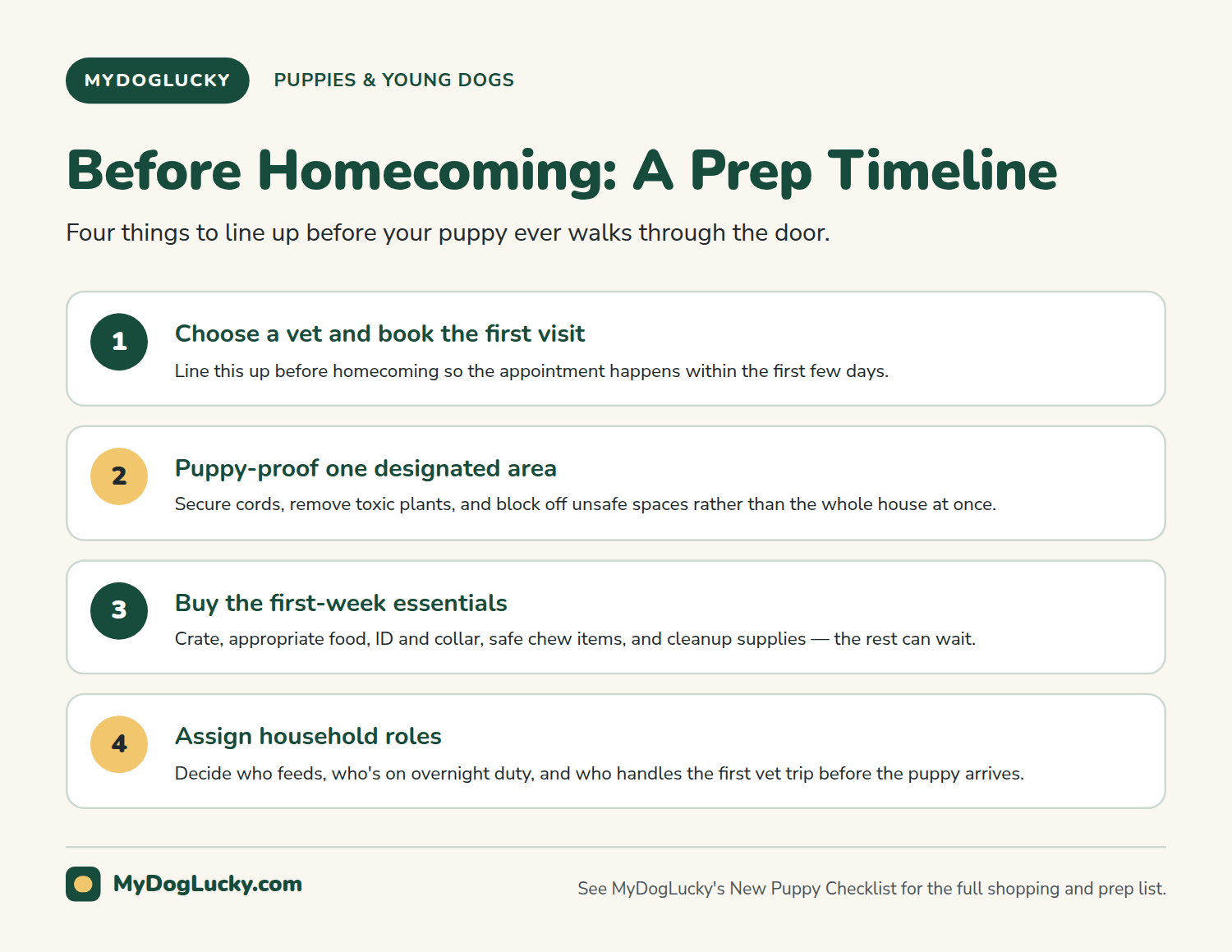
The week before a puppy arrives is when most of the expensive mistakes happen — not because people are careless, but because pet-store aisles and online “starter kits” are designed to make you buy far more than you need. Good preparation is less about volume and more about getting a small number of things right: a safe space, the essentials, a vet lined up, and a household that agrees on who does what.
Deciding You’re Actually Ready
“Ready” doesn’t mean perfect timing. It means being honest about a few practical questions before you commit. Who is home during the day for the first couple of weeks, even if it’s just checking in every few hours? Who covers the puppy if someone is sick, traveling, or working late? Is there a real budget for food, supplies, and the first round of vet visits, not just the adoption or purchase fee? Does your housing situation actually allow a dog, and does that include any size or breed restrictions?
None of these questions have a single right answer. A working household with a good midday dog walker or a doggy daycare plan can absolutely make puppy care work. A retired household with all the time in the world can still struggle if nobody’s done this in twenty years and forgotten how relentless week one actually is. The honest version of “ready” is having a real plan for the gaps, not a perfect starting position.
Evaluating a Breeder, Shelter, or Rescue
Puppy care starts before homecoming in another sense too: where a puppy comes from shapes a lot of what you’ll be managing later. A responsible breeder should let you meet at least the mother, show you clean, appropriate housing, provide health clearances relevant to the breed, and answer questions openly instead of rushing you toward a deposit. A shelter or rescue should be able to tell you what they know about a puppy’s health, any behavior notes from foster care, and what support (medical records, a return policy, post-adoption advice) comes with the adoption.
Red flags look similar across both routes: pressure to decide immediately, no willingness to answer questions, puppies that seem too young to be away from their mother and littermates (generally not before 8 weeks), or an inability to explain basic care the puppy has already received. Trust your read of the situation. A source that makes you uneasy before you’ve even brought a puppy home usually isn’t worth the discount or the convenience.
Puppy-Proofing the Home
Puppies investigate the world mouth-first, and a curious young dog treats your home like an unsupervised buffet of chew toys you didn’t intend to offer. Puppy-proofing is mostly about removing temptation and danger before it becomes an emergency room story.
Walk through each room at puppy height — literally get down low — and look for what a mouth could reach. Common hazards include electrical cords, dangling blind cords, small objects that could be swallowed, medications, cleaning supplies, certain houseplants, trash cans, and anything left within reach on low tables. Secure cabinets with childproof latches if your puppy is the persistent type. Block off stairs with baby gates until your puppy is coordinated enough to handle them safely, and keep exterior doors and gates checked for gaps a small body could squeeze through.
- Kitchen: secure trash, move human food and cords out of reach, and know which foods are unsafe for dogs before the first “can I have a bite” moment happens.
- Living areas: tuck away cords, remove small chewable decor, and check for houseplants that are toxic to dogs.
- Bathrooms: keep medications, razors, and cleaning products behind a closed door or latched cabinet.
- Yard: check fence gaps, remove toxic plants and mulch types, and secure any chemicals, tools, or pool areas.
- Garage: antifreeze, fertilizer, and rodent bait are among the most dangerous household toxins for dogs — store them somewhere a puppy can never reach.
Our dedicated New Puppy Checklist article walks through a room-by-room version of this with a full shopping list. Use it as a companion to this overview if you want the exhaustive version.
Buying the Essentials, Not Everything
It’s easy to leave a pet store with a cart full of things that sound necessary and aren’t. A short list actually earns its keep in the first weeks:
- A crate sized for your puppy’s adult size (with a divider panel to shrink the space while they’re small), used for sleeping, safe confinement, and eventual crate training.
- An age- and size-appropriate puppy food, ideally the same one your breeder, shelter, or foster used at first, so you can transition slowly if you switch.
- A flat collar with ID and a separate well-fitted harness for walks, plus a standard leash — skip retractable leashes for a puppy who’s still learning leash manners.
- Safe, appropriately sized chew items that match your puppy’s current jaw strength, since teething makes chewing a biological need, not a bad habit.
- Food and water bowls, ideally non-tip and easy to clean.
- Cleanup supplies: an enzymatic cleaner for accidents (regular cleaners don’t fully remove the scent that draws a puppy back to the same spot), puppy pads if you’re using them, and poop bags.
- A comfortable bed your puppy can’t destroy immediately — something inexpensive is fine until you know their chewing habits.
That’s genuinely most of it. Toys, grooming tools, and specialty gear can wait until you know your specific puppy’s preferences and needs. A puppy who ignores every plush toy but loses their mind over a flirt pole is a real, common outcome, and there’s no way to predict it from a catalog page.
Choosing a Vet in Advance
Line up a veterinarian before the puppy arrives, not after something goes wrong. Ask friends, neighbors, or your breeder or rescue for recommendations, then call a couple of clinics directly. Ask about their availability for new-puppy appointments, whether they see puppies same-day or next-day for urgent concerns, what their after-hours and emergency plan looks like, and roughly what a typical puppy visit costs at that practice. If you’re relocating soon or splitting time between two homes, ask how records transfer.
Book the first appointment for within a few days of homecoming, even if your puppy already had shots at the breeder or shelter. That visit establishes your puppy’s baseline and lets the vet review whatever records came with them. The dedicated Puppy’s First Vet Visit article covers exactly what to expect and how to prepare.
Household Role-Planning
Most puppy care conflicts aren’t about the puppy — they’re about who assumed the other person would handle the 6 a.m. potty break. A short conversation before homecoming saves a lot of resentment later. Sit down as a household and actually assign: morning and evening potty duty, feeding times, who handles vet appointments and prevention doses, who’s the default person during the workday, and how you’ll split nighttime wake-ups during the first few sleep-deprived weeks.
If kids are part of the plan, decide in advance which tasks are age-appropriate for them to own versus which ones need adult supervision every time. A ten-year-old can absolutely help with feeding under supervision. Overnight potty breaks and anything involving a nervous or mouthy puppy usually shouldn’t rest on a child alone.
Setting a Realistic First-Year Budget
The first year of puppy care tends to cost more than the years that follow, because it front-loads spaying or neutering, the full vaccine series, a crate and basic gear, and often some kind of early training class. Build a rough budget that separates the recurring costs (food, monthly parasite prevention, routine vet visits) from the one-time costs (spay/neuter, initial supplies, microchipping) so you’re not blindsided when several bills land in the same month.
If money is tight, prioritize with your vet’s input rather than skipping categories entirely. Core vaccines and parasite prevention are not the place to cut corners; a cheaper collar or a secondhand crate is. Ask about low-cost vaccine clinics run by local shelters or humane societies, and ask your clinic directly about payment plans or wellness packages. A puppy raised on a tight but honest budget, with the essentials covered, does just fine.
| Cost category | Type | What it usually includes |
|---|---|---|
| Initial supplies | One-time | Crate, bed, collar, harness, leash, bowls, initial toys and chews |
| Spay/neuter surgery | One-time | Timing and cost vary by clinic, region, and your dog’s size — ask for an estimate at an early visit |
| Microchipping | One-time | Often bundled with another procedure; a small separate registration fee usually applies |
| Vaccine series | Front-loaded, first year | Several visits over the first few months, more visit-dense than any later year |
| Food | Recurring | Puppy-appropriate food, with amounts that scale up as your dog grows |
| Parasite prevention | Recurring, monthly | Heartworm, flea, and tick prevention once your puppy reaches the minimum age or weight |
| Training | Optional but common | A puppy class or a handful of private sessions, especially useful for first-time owners |
| Daycare or pet sitting | Ongoing, if needed | Midday coverage for working households; costs vary widely by area |
First Days & Routines
The gap between the puppy-care plan you imagined and the first 72 hours you actually live through is almost always wider than people expect. That gap is normal. This section covers what those first days really look like, how to help a new puppy settle, and how to build a daily rhythm that survives contact with a real household.
The First 48 to 72 Hours
Your puppy just lost their littermates, their familiar smells, and everything predictable about their world, all in one afternoon. Some puppies bounce back within hours. Others take a couple of quiet days to find their footing. Both are normal parts of early puppy care, and neither one predicts how confident or social your dog will end up being long-term.
Keep the first day or two low-key on purpose. Skip the parade of visitors, the trip to three different stores, and the “let’s show them off at the park” plan, tempting as it is. Let your puppy explore one puppy-proofed room at a time, meet the immediate household calmly, and start learning where the water bowl, the bed, and the door to the yard are. A boring first two days is a good sign, not a wasted opportunity.
Decompression: Why the Quiet Days Matter
Decompression is the industry term for that deliberate settling-in period, and it’s worth taking seriously even though it feels like doing less than you could. A puppy who’s overwhelmed in the first few days doesn’t usually show it by hiding — more often, they show it as being clingy, unable to settle, or surprisingly bitey, which owners sometimes misread as a behavior problem instead of exhaustion and overstimulation.
Give your puppy predictable, quiet stretches between the exciting stuff. Naps in the crate or a pen, away from constant handling, aren’t neglect; young puppies sleep a huge amount, and a puppy who never gets real downtime tends to get crankier, not calmer. If your puppy seems like a different, more settled animal by day four or five, that’s decompression working as intended.
Resist the urge to narrate every wobble to friends and family as a crisis. A puppy who won’t eat their first meal in a strange new house, who cries the first night, or who seems subdued for a day is usually just adjusting, not sick or traumatized. Watch for the things that would matter in any puppy — no interest in food or water for more than a day, lethargy that doesn’t lift, vomiting or diarrhea — and give the ordinary nervousness room to pass on its own.
Building a Realistic Daily Rhythm
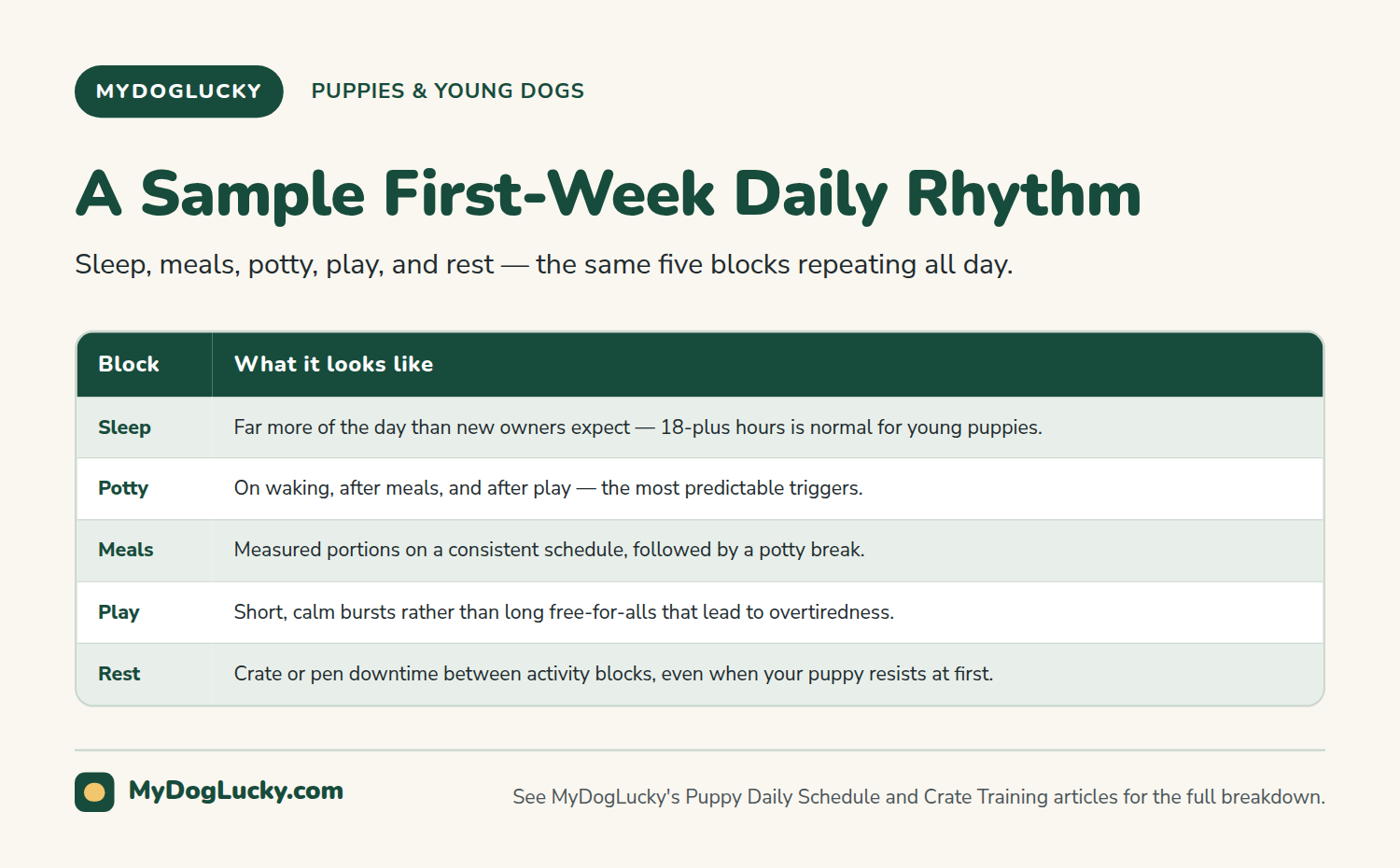
Puppies do best with predictable blocks of sleep, meals, potty breaks, play, and rest repeating through the day — not a rigid minute-by-minute schedule, but a rhythm your household can actually hold onto. A very young puppy needs a potty opportunity after every meal, nap, and play session, plus roughly every couple of hours in between, because their bladder control genuinely hasn’t caught up to their enthusiasm yet.
A workable shape for a young puppy’s day usually alternates short wake windows (play, a training minute or two, a potty break) with a nap, repeated in a loop, plus three or four small meals spaced through the day. As your puppy ages toward four to six months, wake windows stretch, naps shorten, and meals typically drop to two or three a day. The exact numbers matter less than the pattern: never too much awake time without a rest, and never too long between potty chances.
| Block | What it usually looks like | Why it’s there |
|---|---|---|
| Wake + potty | Straight outside (or to the designated spot) the moment your puppy wakes up, before anything else | Puppies almost always need to go immediately after sleep. |
| Meal | A measured portion, at a consistent spot, several times a day for a young puppy | Regular meals make bathroom timing far more predictable. |
| Potty after eating | Within 10 to 20 minutes of finishing a meal | Eating triggers the gut, so this window is a highly reliable opportunity. |
| Short play or training | A few minutes of gentle play, a short leash walk, or a handful of easy training reps | Puppies tire out fast; short bursts prevent overstimulation and overtired meltdowns. |
| Rest or nap | Crate, pen, or a quiet spot, often more sleep than owners expect | Growing puppies need a large amount of sleep to process the day and physically develop. |
Introducing the Crate
A crate isn’t a punishment tool, and treating it like one is the fastest way to make a puppy hate it. Introduced well, it becomes a den-like space your puppy chooses to nap in on their own. Start by tossing treats inside with the door open, feeding meals near and then inside the crate, and letting your puppy wander in and out freely before you ever close the door.
Build up alone time gradually: a few minutes with the door closed while you’re in the room, then a few minutes while you step away, then longer stretches. Cover a portion of the crate to make it feel more den-like if your puppy seems to prefer that, and never use the crate as a place to send a puppy for something they did wrong. Our dedicated Crate Training a Puppy article goes step by step through troubleshooting whining, accidents in the crate, and building up to overnight and workday stretches.
Setting Routines That Survive a Real Household
A schedule that only works if every family member cooperates perfectly, every day, is a schedule that’s going to fail by week two. Build in slack on purpose. If mornings are chaotic before work or school, have a simple, non-negotiable version of the routine that anyone in the house can execute in five minutes: outside, quick play, breakfast, crate. Save the longer walks and training sessions for when there’s actually time.
Write the routine down somewhere visible — a whiteboard, a shared note — especially if more than one person shares puppy duties. It keeps feeding times consistent (important for both digestion and potty predictability) and prevents the classic mistake of two people each feeding breakfast because nobody checked. The dedicated Puppy Daily Schedule article has sample schedules broken out by age and by working versus at-home households, if you want a more detailed starting template than the overview here.
Growth & Development
Puppies change fast, and a lot of what looks alarming in the moment is just a normal stage passing through. This section walks through physical and behavioral development from around 8 weeks through adolescence, so you have a general sense of what’s typical at each stage and when something’s actually worth a call to your vet.
Physical Development, in General Terms
Puppies grow in uneven bursts, not a smooth line, and small and giant breeds are on very different clocks. Small breeds often reach most of their adult size and physical maturity by around 9 to 12 months. Large and giant breeds keep growing much longer, sometimes not finishing until 18 to 24 months, and they tend to go through a gangly, uncoordinated “all legs” phase somewhere in the middle that owners often mistake for clumsiness or injury. It’s usually neither — bodies growing at different rates just take practice to coordinate.
Coat changes are common too. Many puppies lose a soft puppy coat and grow in a coarser adult coat somewhere between 4 and 12 months, and coat color can shift subtly as this happens. None of this is puppy care you need to manage directly. It’s mostly useful to know so an ordinary developmental stage doesn’t read as a problem.
| Rough size category | Typical approach to adult size | Typical approach to physical maturity |
|---|---|---|
| Small breeds (roughly under 25 lbs adult) | Often close to adult height by 6 to 9 months | Frequently physically mature by around 9 to 12 months |
| Medium breeds (roughly 25 to 50 lbs adult) | Continues growing into the 9 to 12 month range | Often mature by around 12 to 15 months |
| Large breeds (roughly 50 to 90 lbs adult) | Growth commonly continues to 12 to 15 months | Frequently not fully mature until 15 to 18 months |
| Giant breeds (roughly 90+ lbs adult) | Growth can continue well past a year | Sometimes not fully mature until 18 to 24 months |
These are general tendencies, not a precise chart for your individual puppy — mixed-breed dogs in particular can be harder to predict, especially before their adult size becomes obvious. Ask your vet for a rough sense of your specific puppy’s expected size and timeline once growth patterns start to show.
The Teething Timeline
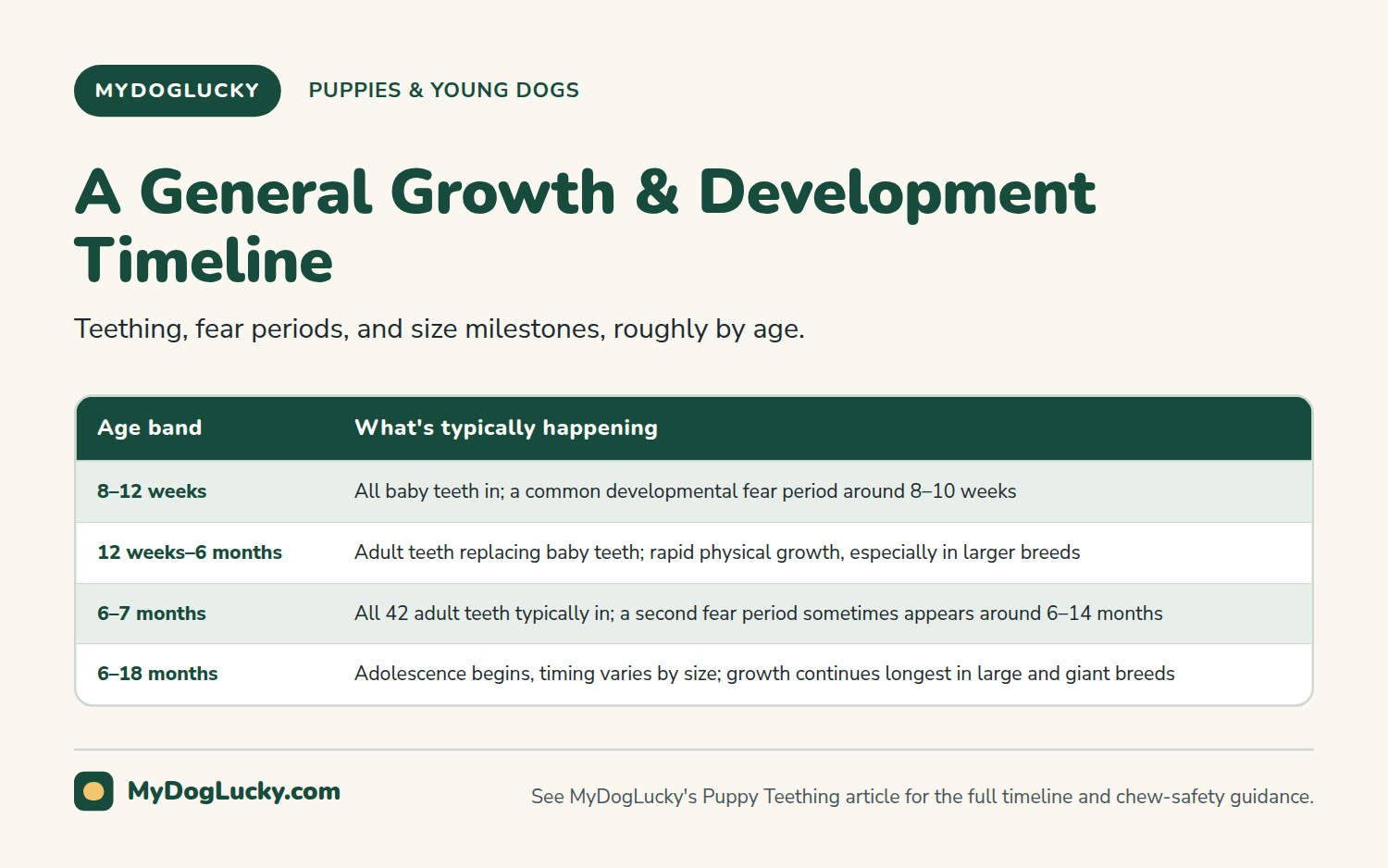
Puppies are born without visible teeth. Baby (deciduous) teeth begin erupting around 2 to 4 weeks of age and are usually all in — about 28 of them — by 5 to 6 weeks, well before most puppies go to their new home. The part owners actually live through starts later: baby teeth begin falling out and adult teeth start pushing through around 12 to 16 weeks, right in the thick of early puppy care.
By around 6 months, most puppies have their full set of roughly 42 adult teeth in place, though the exact timing varies by breed and individual dog. During the shedding phase, expect increased chewing, some blood-tinged drool, and the occasional tiny tooth turning up on the floor — all normal. What’s worth a vet visit is a baby tooth that hasn’t fallen out once the adult tooth beside it is clearly in (called a retained deciduous tooth), which can cause crowding and dental problems if left alone. Our dedicated Puppy Teething article covers safe chew options and how to manage the biting surge that comes with it.
Growth Plates and Exercise, in General Terms
Growth plates are areas of developing cartilage near the ends of a young dog’s long bones. They gradually harden into solid bone as a puppy matures — a process that finishes earlier in small breeds and considerably later in large and giant ones. Until they close, those areas are more vulnerable to injury from repetitive high-impact stress: hard forced runs on pavement, jumping down from heights, or long structured hikes well beyond what a puppy’s body is ready for.
This doesn’t mean a young puppy should be kept inactive — under-exercised puppies have their own problems, from excess energy turning into destructive behavior to under-conditioned muscles and joints. It means matching activity to your puppy’s current stage: plenty of free play, gentle exploration, and short leash walks, while holding off on forced long-distance running, repeated jumping, or intense structured exercise until your dog is further along in development. Because the right amount varies enormously by breed and individual dog, this is a conversation for your veterinarian, not a formula from an article. Ask at a wellness visit what’s reasonable for your specific puppy’s age, breed, and body type.
Behavioral Development at a Glance
Behaviorally, the first year tends to move through recognizable, if loosely defined, stages. The earliest weeks (before most puppies come home) are about learning bite inhibition and social skills from littermates. From roughly 8 weeks through 3 to 4 months, puppies are highly impressionable and absorb new experiences quickly — this is the heart of the socialization window covered in its own section below. From around 4 to 6 months, many puppies go through a confident, exploratory phase paired with the physical discomfort of teething. Past 6 months, hormonal changes associated with puberty begin, kicking off the gradual slide into adolescence.
None of these stages have hard start and end dates. They’re a rough map, useful for setting expectations rather than a test your puppy needs to pass on schedule.
Fear Periods: Normal, Temporary, and Not a Setback
Most puppies pass through at least one, and often two, short stretches when ordinary things suddenly seem scarier than they did the week before — a vacuum cleaner they used to ignore, a stranger in a hat, a new surface underfoot. The first commonly shows up somewhere around 8 to 11 weeks, often right when a puppy has just moved to a new home. A second, more variable one can appear anywhere from roughly 6 to 14 months, sometimes overlapping with the early stretch of adolescence, and tends to arrive earlier in small breeds than large ones.
The right response is patience, not pressure. Don’t force your puppy toward whatever scared them, and don’t make a big, sympathetic fuss over it either, since both can accidentally reinforce the fear. Let your puppy investigate at their own pace, reward calm curiosity when it happens, and keep exposures short and positive. If a fear response seems extreme, doesn’t fade with a gentle approach, or starts generalizing to lots of unrelated things, that’s worth a conversation with your vet or a qualified trainer rather than something to wait out alone.
Early Health & Prevention
This section covers the medical side of puppy care: the first vet visit, the general shape of the vaccine series, parasite prevention, the spay/neuter conversation, and microchipping. We’ll keep the tone here deliberately plain and calm, because health content deserves precision over personality — and because the exact schedule for your puppy is a conversation with your veterinarian, not something this page can hand you.
The First Vet Visit
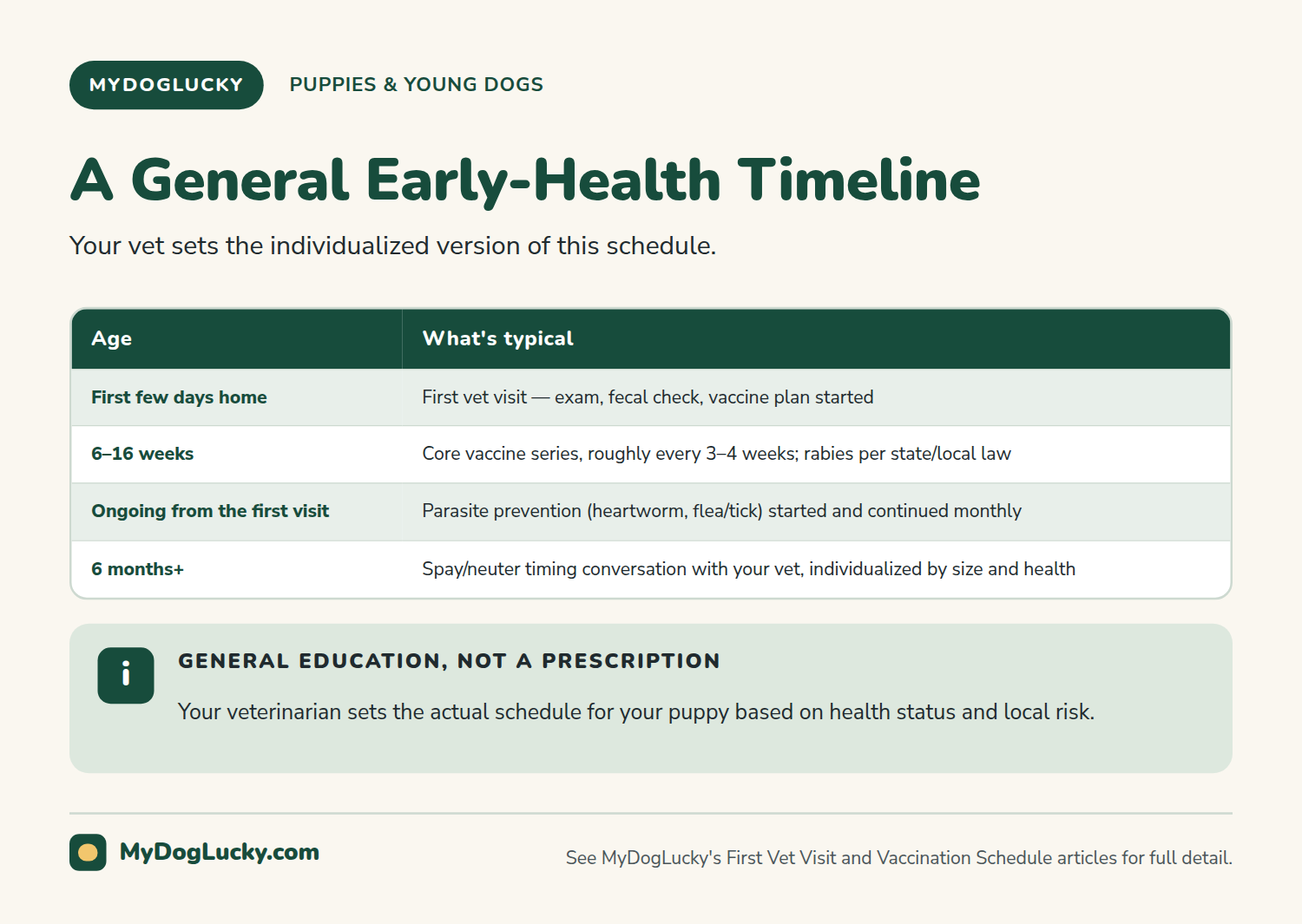
Most puppies see a veterinarian for the first time around 6 to 8 weeks of age, often within the first few days of coming home if they haven’t already been seen by a breeder or shelter vet. This visit typically includes a nose-to-tail physical exam, a weight check, a discussion of any vaccines or deworming already given, and the start (or continuation) of the vaccine and parasite-prevention series. It’s also your first real chance to ask questions: about feeding amounts, normal behavior for this age, and what to watch for at home.
Bring whatever records came with your puppy, even partial ones — a single dated vaccine or deworming record can prevent an unnecessary repeat. Write down your questions beforehand, because appointments move fast and it’s easy to forget the thing you actually wanted to ask. Our dedicated Puppy’s First Vet Visit article covers exactly what to bring and what typically happens at this appointment in more depth.
The General Shape of the Vaccine Series
Puppy vaccines fall into two broad categories, and understanding the difference clears up most of the confusion. Core vaccines are recommended for essentially every puppy because the diseases involved are severe, common, or a risk to people. Lifestyle (noncore) vaccines depend on exposure — daycare, boarding, hiking, or your region.
Under the 2022 AAHA Canine Vaccination Guidelines (updated in 2024), the core puppy series generally looks like this, though the exact number of doses and timing for your puppy is something your vet decides based on age at the first visit, breed, and local disease risk:
| Vaccine | General puppy series shape | Why the timing varies |
|---|---|---|
| DAPP (distemper, adenovirus, parvovirus, ± parainfluenza; sometimes written DA2PP or DHPP) | A series starting around 6 to 8 weeks, with boosters roughly every 2 to 4 weeks until the puppy is past 16 weeks old — sometimes extended to 18 to 20 weeks in areas with higher distemper or parvovirus risk | Antibodies a puppy receives from their mother fade at an unpredictable time for each individual puppy, which is why the series repeats rather than relying on one dose. |
| Leptospirosis | An initial dose recommended at or after 12 weeks of age, then following the standard core adult schedule going forward | Starting slightly later reduces the risk of reaction in very young or small puppies; it’s now considered core for most dogs. |
| Rabies | Licensed products are labeled for puppies 3 months of age and older; exact timing follows your state’s law | Rabies vaccination is legally required in most U.S. states, and the required age and interval are set locally, not just by veterinary guidelines. |
Lifestyle vaccines like Bordetella (kennel cough) are often added earlier if your puppy will attend daycare or puppy classes that require it, since some facilities set their own vaccination requirements. Your vet will walk you through which lifestyle vaccines make sense given where your puppy will actually spend time. The individualized schedule — exact ages, which vaccines, and the interval between doses — comes from your veterinarian, not from this article or any general chart online. Our dedicated Puppy Vaccination Schedule article goes deeper into each vaccine and what to expect after a dose.
Parasite Prevention: Deworming, Heartworm, Flea, and Tick
Puppies pick up intestinal parasites easily, often before they even leave their mother, which is why deworming typically starts young and repeats several times. The Companion Animal Parasite Council (CAPC) recommends starting anthelmintic treatment around 2 weeks of age and repeating it roughly every 2 weeks until regular, year-round broad-spectrum parasite control takes over. CAPC also recommends at least four fecal exams during a puppy’s first year, more than the twice-yearly minimum recommended for adult dogs, because young puppies are more vulnerable to picking up new parasites and more likely to be shedding them.
Heartworm, flea, and tick prevention typically start once a puppy reaches the minimum age and weight listed on a given product, which your vet will confirm at an early visit. The American Heartworm Society recommends year-round monthly prevention rather than a seasonal approach, since gaps in coverage are how infections slip through. As with vaccines, the exact products and start dates depend on your puppy’s weight, health, and your region, so this is a conversation to have directly with your veterinary team rather than a fixed schedule to copy.
A few practical notes make this easier to keep up with. Pick a monthly date — the first of the month, or whatever date already anchors another recurring bill — and give prevention on the same day every time, so it becomes a habit rather than something you try to remember. If your puppy spits out a chewable dose, watch closely to confirm the full dose went down; if you’re not sure, call the clinic before re-dosing rather than guessing. And because puppies are more likely than adults to pick up something new, don’t skip a scheduled fecal exam just because your puppy “seems fine” — many intestinal parasites don’t cause obvious symptoms even while present.
The Spay/Neuter Timing Conversation
Spay and neuter timing used to have one standard answer for every dog. It doesn’t anymore. The American Veterinary Medical Association is explicit that there’s no one-size-fits-all recommendation for dogs: the right timing depends on breed, size, sex, individual health, and how the dog lives, and it’s a decision made with your veterinarian rather than a fixed age. For some larger and giant breeds, current evidence has raised questions about joint development and certain cancer risks if surgery happens very early, which is part of why vets increasingly individualize the timing rather than defaulting to a single age for every dog.
One common myth is worth addressing directly: there’s no established medical benefit to letting a female dog go through a heat cycle before spaying. Bring this up at an early wellness visit rather than waiting until it feels urgent, since the conversation benefits from time to consider your specific dog’s growth trajectory, breed-related risk factors, and your household’s ability to manage an intact dog safely in the meantime.
Microchipping
A microchip is a small, inactive electronic device, about the size of a grain of rice, implanted just under the skin — usually between the shoulder blades — in a quick procedure that’s often done at the same visit as spay/neuter surgery, though it can be done separately at any age. It carries no battery and does nothing on its own; a scanner passing over it reads a unique ID number, which shelters and vet clinics check against a registry to find the owner’s contact information. Unlike a collar or tag, it can’t fall off or be removed.
The American Veterinary Medical Association recommends microchipping as a reliable, permanent form of identification and notes it’s required for international travel to many countries. Getting the chip implanted is only half the job — register it with the manufacturer’s database (or update the registration if your puppy came pre-chipped) and keep your contact information current, especially after a move or a new phone number. A chip that’s never registered, or registered with an old address, doesn’t help much if your dog gets loose.
- Vaccination-series and first-vet-visit timing guidance — needs veterinary reviewer sign-off
- Socialization-window vs. vaccine-status guidance — needs veterinary reviewer sign-off
Socialization & Foundations
This section covers the developmental window that shapes a lot of a dog’s adult temperament, how to balance it against real infectious-disease risk, and the training and house-skill basics that go hand in hand with it. It’s the section most readers come back to more than once.
The Critical Socialization Window
Puppies are unusually open to new experiences during roughly the first three months of life — the stretch when curiosity and sociability outweigh caution, and new things are more likely to be filed away as “fine” rather than “scary.” This window narrows gradually rather than slamming shut on a specific day, but the general consensus among veterinary behaviorists is that the bulk of the opportunity has passed by around 3 to 4 months of age. What happens (or doesn’t happen) during this stretch has an outsized influence on how comfortable a dog is with new people, animals, and situations for the rest of their life.
That’s a lot of pressure to put on a few months, and it’s worth saying plainly: missing the ideal window doesn’t doom a puppy. Continued, careful exposure throughout adolescence and into adulthood still helps. But the early window is genuinely the most efficient time to do this work, which is why it gets so much attention in puppy care content.
Balancing Exposure Against Infectious-Disease Risk
The socialization window overlaps almost exactly with the period when a puppy’s vaccine series isn’t yet complete, which creates a real tension: waiting until every shot is done to start socializing means starting after the most sensitive window has largely closed. The American Veterinary Society of Animal Behavior (AVSAB) has taken a clear public position on this trade-off, stating that behavioral problems, not infectious diseases, are the leading cause of death in dogs under three years old, and recommending that puppies can and should begin socialization classes as early as 7 to 8 weeks of age, provided they’ve had at least one round of vaccines and an initial deworming at least seven days prior.
The practical answer isn’t “wait” or “expose to everything” — it’s choosing lower-risk settings deliberately. Puppy classes that require proof of vaccination and deworming before enrollment, one-on-one time with healthy, fully vaccinated adult dogs you know, your own yard, and carrying your puppy (rather than letting them walk) through higher-traffic public areas all let socialization happen without unnecessary exposure to places where an unvaccinated puppy’s risk is highest, like dog parks or pet-store floors with unknown foot traffic. Ask your veterinarian what’s reasonable in your specific area, since local disease prevalence varies and they’ll know what’s actually circulating nearby.
A Condensed Socialization Checklist
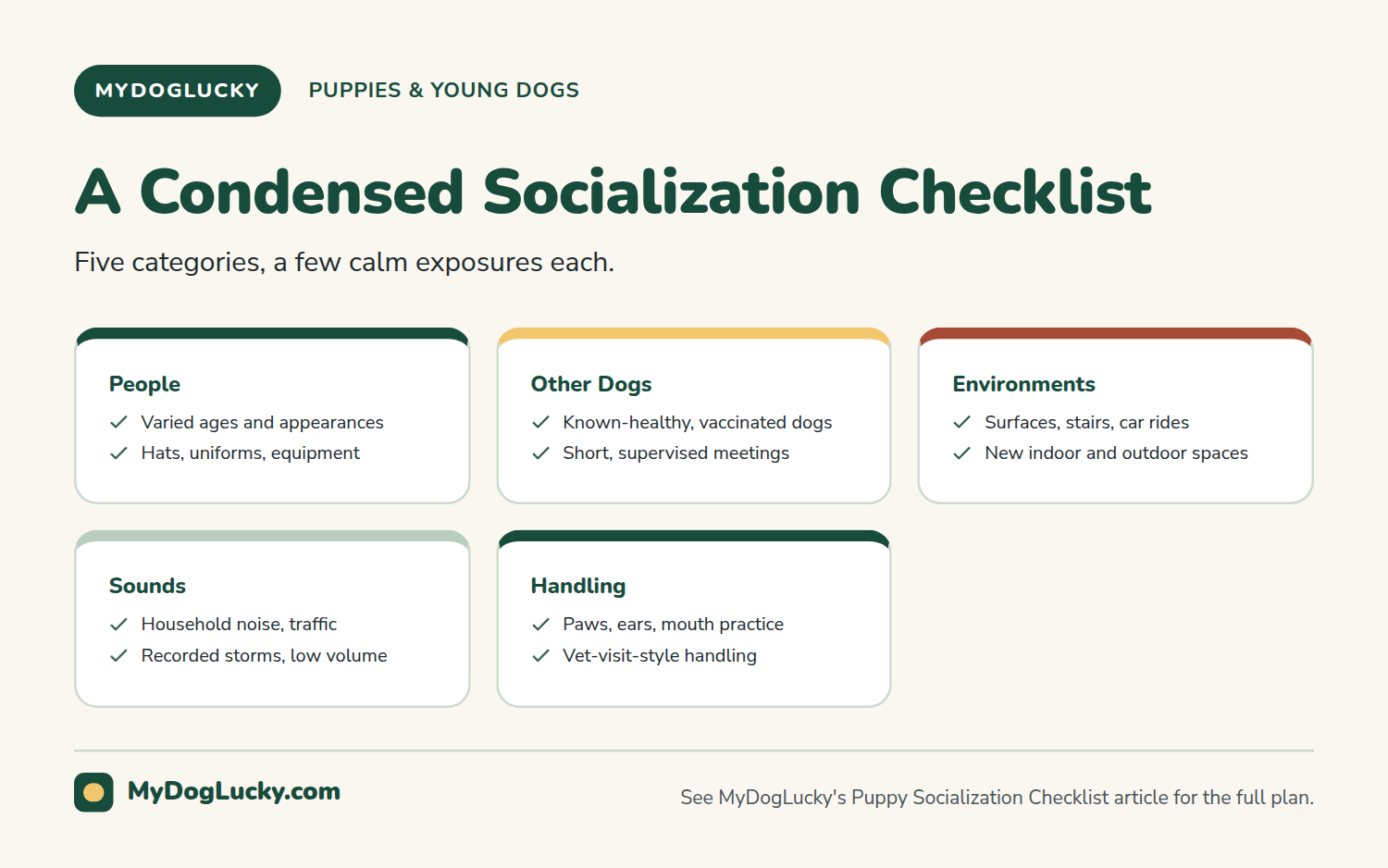
A full socialization plan touches five broad categories. You don’t need to check off an exhaustive list — the goal is calm, positive exposure spread across categories, not a marathon of new experiences crammed into a single weekend.
- People: different ages, heights, appearances, clothing (hats, sunglasses, uniforms), and ways of moving (a person using a cane or a wheelchair, someone jogging past).
- Other animals: calm, healthy, vaccinated dogs of different sizes and ages, and — carefully, if relevant — other household species like cats.
- Environments and surfaces: different floor textures (tile, grass, gravel, metal grates), car rides, elevators, and varied indoor and outdoor spaces.
- Sounds: vacuum cleaners, doorbells, traffic, thunder recordings played quietly, kids playing, other dogs barking at a distance.
- Handling: gentle practice with paws, ears, mouth, and nails, so grooming and vet exams don’t come as a surprise later.
Keep every session short and end on a good note — a few calm minutes of a new experience paired with treats beats twenty overwhelming ones. Watch your puppy’s body language throughout; a puppy who’s stiff, backing away, or trying to hide is telling you to slow down, not push through.
| Category | A few starting examples | What to watch for |
|---|---|---|
| People | Adults and children of different ages, people in hats or sunglasses, delivery workers, someone using a cane | Loose, curious body language rather than freezing, backing away, or barking |
| Other dogs and animals | Calm, healthy, vaccinated adult dogs; puppy-appropriate playgroups; household cats if applicable | Relaxed play with breaks, not one-sided pursuit or a puppy who can’t disengage |
| Environments and surfaces | Grass, tile, gravel, metal grates, car rides, elevators, different rooms and buildings | Willingness to walk forward rather than freezing or refusing to move |
| Sounds | Vacuum, doorbell, traffic, kids playing, distant dogs barking, a quiet thunder recording | A brief startle that recovers quickly, not prolonged panic or hiding |
| Handling | Touching paws, ears, mouth, and tail gently; brief nail-clipper contact; a pretend “exam” | Tolerating brief handling for a reward, without escalating struggle |
Our dedicated Puppy Socialization Checklist article gives a fuller, printable version of this matrix with more examples in each category.
Foundational Training Concepts
Before specific skills, a few underlying concepts make almost everything else in puppy training click faster. Reinforcement means rewarding the behavior you want so your puppy is more likely to offer it again — treats, praise, play, or access to something they want all count. Timing matters more than most new owners expect; a reward that arrives even a couple of seconds late can accidentally mark the wrong behavior. Cues are the words or signals you’ll eventually attach to a behavior once your puppy is already offering it reliably, not before.
Management is the quiet workhorse of early puppy care: setting up the environment so your puppy simply can’t rehearse unwanted behavior in the first place, rather than relying on catching and correcting it after the fact. A baby gate that keeps a puppy from raiding the trash prevents the habit from ever forming, which is a lot more effective than repeatedly interrupting it once it has.
Housetraining Basics
Housetraining is mostly a management and consistency problem, not an intelligence problem. Take your puppy out first thing in the morning, after every meal, after naps, after play sessions, and every couple of hours in between for a very young puppy. Go to the same spot each time, use a consistent word or phrase right as they go, and reward immediately afterward — not back inside a minute later, when the connection has already faded.
Supervise closely indoors, or use a crate or exercise pen when you can’t watch directly, since accidents mostly happen during the gaps in supervision. If an accident happens, clean it thoroughly with an enzymatic cleaner rather than a standard household cleaner, since residual scent invites a repeat visit to the same spot. Never punish a puppy for an accident you didn’t catch in the act; it teaches them to hide from you when they need to go, not to hold it. The dedicated How to Potty Train a Puppy article covers troubleshooting for regression, apartment-specific setups, and overnight strategies in much more depth.
Bite Inhibition and Mouthing as Normal Development
Puppies explore the world with their mouths, and mouthing — soft, exploratory biting during play — is a normal part of how young dogs interact, not a sign of aggression or a “bad” temperament. Littermates start teaching bite inhibition (how hard is too hard) before a puppy ever comes home, through yelps and withdrawn play when bites land too hard. That lesson continues with you.
When a bite lands too hard, a short, calm pause in play — not a dramatic reaction, and not physical correction — teaches the same lesson without confusion or fear. Redirect toward an appropriate chew toy consistently, and avoid rough hand-wrestling games that encourage mouthing on skin in the first place. Teething makes this phase more intense, not more concerning; it usually fades as adult teeth finish coming in and consistent redirection sinks in. Our dedicated How to Stop Puppy Biting article walks through redirection techniques and troubleshooting for puppies who seem to bite more than most.
Adolescence & Transition
Somewhere past the six-month mark, a lot of owners report the same experience: the puppy who was finally getting the hang of things suddenly seems to have forgotten it all. This section covers what’s actually changing, why the “regression” owners notice is normal rather than a training failure, and how to adjust your approach through this stretch.
What Actually Changes in Adolescence
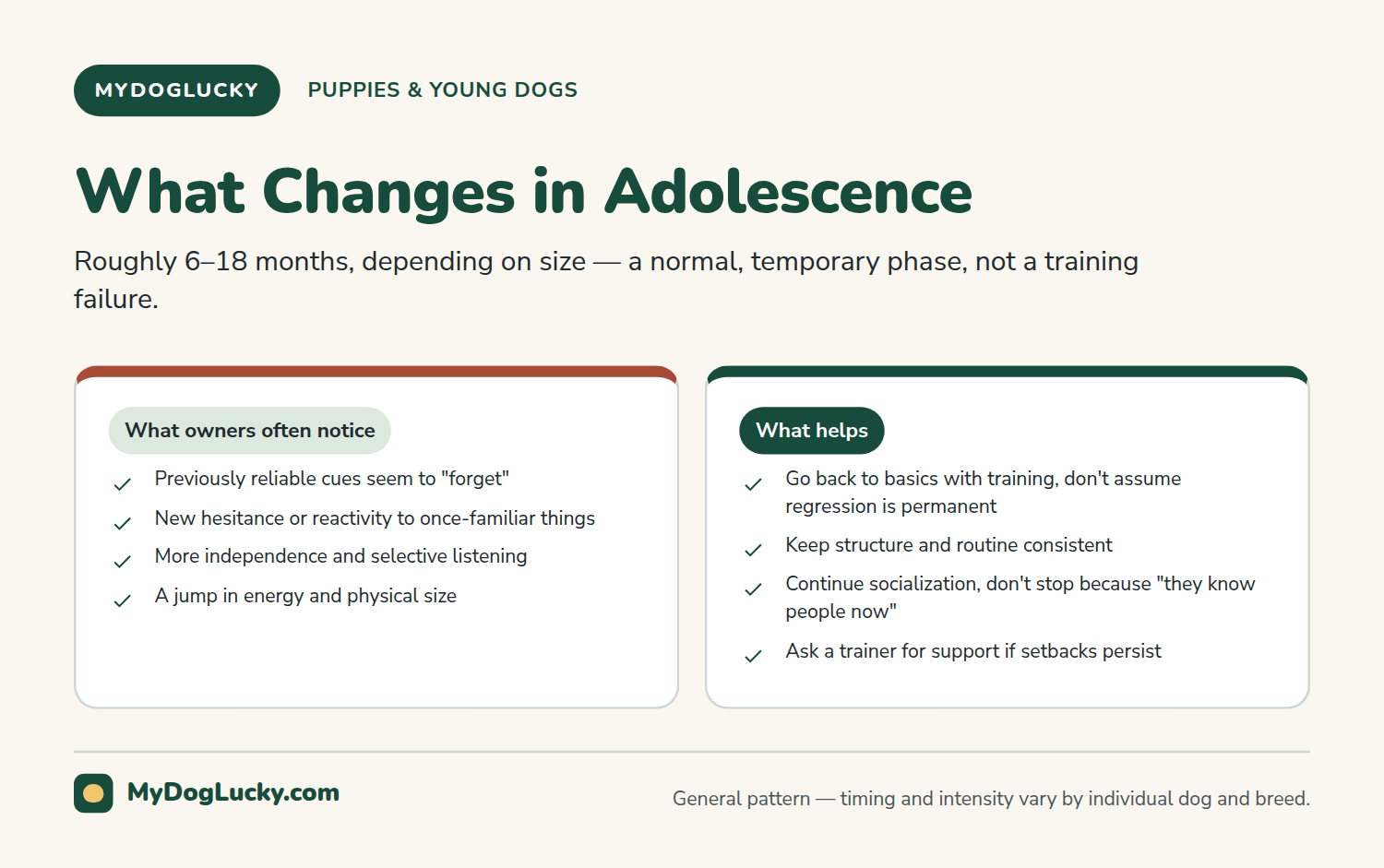
Canine adolescence generally spans somewhere between 6 and 18 months, arriving and resolving earlier in small breeds and stretching later in large and giant ones. Hormonally, it overlaps with puberty. Behaviorally, it often brings a puppy who seems bolder, more independent, more reactive to novelty, and noticeably more selective about which cues they respond to — especially around distractions that didn’t used to register at all.
This isn’t just anecdotal. A 2020 study published in Biology Letters by researchers including Lucy Asher and colleagues found that dogs around eight months old — during the hormonal shift of puberty — were more likely to ignore known cues specifically from their own caregiver, while responding normally to the same cues from an unfamiliar person. The researchers also found that dogs with less secure attachment to their owner tended to show more pronounced behavioral changes during this stage. The study’s authors framed the whole pattern as a temporary, biologically normal developmental phase, similar in shape to adolescence in other social mammals — not a sign that something has gone wrong with the dog or the training.
The “Regression” Owners Notice
A dog who reliably sat for months suddenly stares at you like the word means nothing. A housetrained dog has an accident out of nowhere. A puppy who used to greet strangers calmly starts barking at them instead. Owners often describe this as their dog “forgetting” everything, and it can feel discouraging after months of consistent work.
It isn’t forgetting. It’s a combination of hormonal changes, a shifting relationship with novelty and independence, and — often — cues that were never as rock-solid as they seemed once distractions got more interesting. The skill is usually still in there. What’s changed is the dog’s motivation to perform it in the moment, which responds to the same tools that built the skill in the first place: management, reinforcement, and patience, applied again at a higher level of distraction.
Adjusting Routines and Training Expectations
Treat adolescence as a season to adjust for, not a problem to fix. Go back to easier versions of cues in lower-distraction settings and rebuild reliability gradually, rather than assuming your dog “knows better” and getting frustrated when they don’t perform under pressure. Increase structured exercise and mental engagement if your dog is suddenly more restless or destructive — adolescent dogs often need more outlets than they did as young puppies, not fewer.
Management still matters as much as it did in the early months. A dog who’s counter-surfing or bolting out the door during adolescence isn’t defying you on purpose; they’re testing a world that’s gotten more interesting to them, with impulse control that’s still under construction. Keep the environment set up so unwanted behavior can’t rehearse itself, and keep training sessions short, upbeat, and frequent rather than long and frustrated.
| What often changes | How to adjust |
|---|---|
| Cues that were reliable suddenly get ignored, especially around distractions | Drop back to easier reps in low-distraction settings and rebuild gradually, rather than repeating the cue louder |
| More restlessness, chewing, or general destructiveness | Increase structured exercise and enrichment; a bored adolescent dog finds their own outlets |
| New wariness of something previously ordinary (a possible second fear period) | Don’t force interaction; let your dog approach at their own pace and reward calm curiosity |
| Testing boundaries — counter-surfing, door-bolting, pulling harder on leash | Reinforce management (gates, leashes, closed doors) rather than assuming your dog “should know better” by now |
| Increased independence or selective attention to people outside the household | Make yourself more interesting during outings — more reinforcement, more engagement, especially in new environments |
Continuing Socialization and Structure Through This Period
Socialization doesn’t end when the early window closes — it just gets less efficient and needs more intention. Adolescent dogs benefit from continued, varied, positive exposure to people, other dogs, and new environments, partly because some dogs go through a second fear period sometime in this same stretch (roughly 6 to 14 months), when a previously confident dog can suddenly react warily to something familiar.
Keep structure consistent even as your dog’s personality becomes more assertive: consistent house rules, consistent handling of greetings and leash walks, and continued positive experiences with the categories covered in the socialization checklist above. A dog who gets clear, patient structure through adolescence tends to come out the other side considerably easier to live with than one who was given a training break during exactly the stretch when reinforcement mattered most.
Signs Professional Support Would Help
Most adolescent behavior, even the frustrating stretches, resolves with time, consistency, and patience. A few signs suggest it’s worth bringing in a certified trainer or veterinary behaviorist rather than waiting it out alone: aggression toward people or other animals, fear or reactivity that’s intensifying rather than fading, resource guarding that seems to be escalating, separation-related distress that disrupts daily life, or a household that’s genuinely struggling to cope and starting to consider rehoming.
None of these mean you’ve failed. Adolescence is hard on a lot of households, and getting support early tends to produce much better outcomes than waiting until frustration or fear has calcified into a bigger problem. A good trainer or behaviorist can also simply confirm that what you’re seeing is within the normal range, which is often exactly the reassurance an exhausted owner needs.
Adapting Puppy Care to Your Situation
The overview above describes a fairly average puppy in a fairly average household. Very few situations are actually average. This section covers the adjustments that come up most often.
First-Time Owners
If this is your first puppy, expect a steep learning curve and give yourself room for it. Everything feels higher-stakes the first time — is this cry normal, is that much sleep normal, is this bite too hard — because you don’t yet have a library of “we went through this before and it was fine” to draw on. Lean on your vet for medical questions and a certified trainer for behavior questions rather than trying to diagnose everything from forums, where advice quality varies wildly and confident-sounding answers aren’t always correct.
Consider a puppy class specifically designed for first-time owners; the structure and the built-in support from an instructor and other new owners in the same boat are often worth more than the specific skills taught. Give yourself permission to make mistakes. Nearly every experienced dog owner has a story about the thing they’d do differently with their first puppy.
Households With Kids
Puppies and children can absolutely thrive together, and supervision is the piece that makes it work. Never leave a young puppy and a young child unsupervised together, in either direction — puppies mouth and nip during normal play, and young kids don’t reliably read a puppy’s warning signals or moderate their own excitement around a small, wiggly animal. Teach kids what calm, gentle interaction looks like, and teach them to recognize when a puppy wants space (walking away, hiding, a stiff body) rather than continuing to engage.
Give your puppy a reliable retreat spot — a crate or pen in a low-traffic area — that’s established as off-limits to kids, so your puppy always has somewhere to decompress. Involve kids in age-appropriate puppy care tasks under supervision; it builds a real relationship and teaches responsibility, as long as the heavier logistics (overnight care, medical decisions, handling a scared or overstimulated puppy) stay with an adult.
Apartment and Small-Space Households
Apartment living doesn’t rule out good puppy care, but it does change a few logistics. Potty training takes extra planning if there’s no yard: factor elevator or stairwell time into how fast you can get outside, and consider whether a balcony or an indoor potty-training option makes sense as a bridge while your puppy is very young and needs frequent breaks. Noise matters more with shared walls — a puppy left alone and barking or crying can become a neighbor issue fast, so build up alone-time tolerance gradually and deliberately rather than assuming it’ll sort itself out.
Exercise and enrichment need more creativity in a small space: structured hallway or stairwell walks, trips to a nearby park, and mentally engaging games (scent work, puzzle feeders, short training sessions) that tire a puppy out without needing a yard to run in. Check your lease for breed or size restrictions and pet deposits before you’re surprised by them later.
Working Households Needing Daytime Coverage
A young puppy generally can’t hold their bladder through a full workday, which means a plan for daytime coverage isn’t optional in most working households — it’s part of the basic setup, alongside the crate and the food. Options include a midday dog walker, a trusted neighbor or family member, in-home pet sitting, or a puppy daycare that requires appropriate vaccination for enrollment.
If nobody can realistically provide a midday break for the first several months, be honest about that before bringing a puppy home rather than after, and consider whether the timing works better once your schedule shifts, or whether a slightly older puppy or adult dog might be a better fit for right now. A puppy left alone for stretches that exceed their physical capacity ends up with more accidents, more separation-related stress, and a harder start than one whose schedule was planned around realistically.
Multi-Pet Households
Introducing a puppy to resident dogs or cats works best slowly and on neutral ground when possible, rather than a sudden face-to-face in the new pet’s established territory. Watch body language closely during early interactions and separate calmly if either animal seems overwhelmed rather than letting a tense interaction play out. Give resident pets a retreat space the puppy can’t access, and don’t assume an older, patient dog will tolerate unlimited puppy pestering just because they haven’t reacted yet — most dogs have a limit, and it’s kinder to manage the puppy’s access than to wait for a correction.
Feed and give high-value chews separately at first to avoid resource guarding conflicts between animals who don’t know each other’s habits yet. Multi-pet households also mean parasite prevention needs to cover every animal in the home, not just the newest one — an untreated resident cat, for instance, can keep a flea problem going indefinitely even with the puppy fully protected.
Budget-Conscious Households
A tight budget doesn’t have to mean lower-quality puppy care. It means prioritizing deliberately instead of buying everything a checklist suggests. Core vaccines, parasite prevention, and spay/neuter aren’t optional line items — they’re the categories with the clearest, most immediate payoff for your dog’s health. Gear, toys, and training extras are where you have real room to spend less: secondhand crates and beds work fine, and a puppy rarely cares whether a toy came from a discount bin or a boutique.
Ask your vet directly about lower-cost options rather than assuming there aren’t any — many clinics offer puppy wellness packages that bundle the first-year visits and vaccines at a lower combined price, and local shelters or humane societies often run reduced-cost vaccine and microchip clinics open to the public. Free and low-cost training resources exist too; a well-run public library puppy class or a reputable online program can cover the same fundamentals as a pricier private course.
Where to Start This Week
You don’t need to execute every section of this guide simultaneously. Pick the piece that matches where you actually are right now.
If the puppy isn’t home yet, spend this week on three things: puppy-proof one main room, call two vet clinics to compare availability, and have the household-roles conversation before you’re all improvising in real time. If the puppy already arrived, pick one piece of the daily rhythm — probably the potty schedule — and make it consistent before adding anything else. And if you’re deep in adolescence right now, wondering what happened to your good dog: nothing happened to them. Go back to easier training reps in a boring setting, add a bit more structured exercise, and give it a few weeks before judging how it’s going.
Puppy care doesn’t get finished. It changes shape as your dog grows, and the six areas above will keep being useful at different points over the first year or two, not just once at the start. Our dedicated articles under each area — the New Puppy Checklist, Puppy Daily Schedule, Crate Training a Puppy, Puppy Teething, Puppy’s First Vet Visit, Puppy Vaccination Schedule, How to Potty Train a Puppy, How to Stop Puppy Biting, and Puppy Socialization Checklist — go much deeper into any one piece whenever you need it.
Sources and Review Notes
Frameworks and facts in this puppy care guide were checked against the following sources on September 20, 2026. Guidelines change; this page is scheduled for review every six months.
- American Veterinary Society of Animal Behavior. AVSAB Position Statement on Puppy Socialization.
- American Animal Hospital Association. 2022 AAHA Canine Vaccination Guidelines (2024 update).
- American Animal Hospital Association. 2022 AAHA Canine Vaccination Guidelines, full guideline PDF (puppy series timing tables).
- American Animal Hospital Association. How Often Should My Dog Go to the Vet? A Dog Life Stage Guide.
- American Animal Hospital Association. 2019 AAHA Canine Life Stage Guidelines.
- American Veterinary Medical Association. Spaying and Neutering.
- American Veterinary Medical Association. Microchipping of Animals.
- American Veterinary Medical Association. Microchipping: FAQs for Pet Owners.
- Companion Animal Parasite Council. General Guidelines for Dogs and Cats (puppy deworming and fecal testing recommendations).
- American Heartworm Society. Heartworm Basics.
- American Kennel Club. Puppy Teething Timeline.
- VCA Animal Hospitals. Teeth, Teething and Chewing in Puppies.
- American Kennel Club. Puppy Fear Periods: Why Is My Puppy Suddenly Afraid?
- Asher, L., England, G. C. W., Sommerville, R., & Harvey, N. D. (2020). Teenage dogs? Evidence for adolescent-phase conflict behaviour and an association between attachment to humans and pubertal timing in the domestic dog. Biology Letters, Royal Society Publishing.
- ASPCA Animal Poison Control Center, (888) 426-4435; Pet Poison Helpline, (855) 764-7661. Both charge a consultation fee.
This article is general education for U.S. dog owners preparing for or raising a puppy. It is not veterinary or professional training advice for an individual dog, and it doesn’t replace an exam or a hands-on consult. Vaccine, parasite-prevention, and spay/neuter timing for your puppy should come from your veterinarian, who can account for your dog’s breed, health history, and local disease risk. If you’re worried about your puppy right now, call your veterinarian or an emergency clinic.






Trackbacks/Pingbacks