

Here’s the honest answer before anything else: there’s no single “best puppy food” that wins for every dog, every budget, and every household. What actually exists is a set of criteria that separate an appropriate puppy food from an inappropriate one — and once you know those criteria, picking between the options in front of you gets a lot less overwhelming.
A puppy food that’s right for the job carries an AAFCO “growth” or “all life stages” nutritional adequacy statement, has a calorie density and calcium level that fit your puppy’s expected adult size, comes from a manufacturer that can show real quality-control practices, and is one you can actually afford to feed consistently for the next several months. Get those four things right, and you’re in genuinely good shape. Everything else — kibble shape, marketing language, which animal is on the bag — matters far less than most packaging wants you to believe.
This article walks through how to evaluate any puppy food using those criteria, rather than ranking specific products or brands. That’s deliberate: brand reputations shift, formulas change, and recall histories update, so a “top five” list goes stale the moment it’s published. A framework you can apply yourself doesn’t.
What’s in this guide
- The short answer: what “best puppy food” actually means
- The AAFCO statement: the label detail that matters most
- Why growing puppies need different nutrition than adult dogs
- Size matters: standard vs. large-breed puppy formulas
- A practical checklist for evaluating any puppy food
- Wet vs. dry puppy food: does the format matter?
- When and how to switch from puppy food to adult food
- Common mistakes that undermine a good food choice
- Red flags on a puppy food label
- Budget tiers: what price actually tells you
- Frequently asked questions about best puppy food
- Sources
The Short Answer: What “Best Puppy Food” Actually Means
Search “best puppy food” and you’ll land on dozens of ranked lists, most of them written by affiliate marketers with a financial stake in which bag you click. That’s not a knock on the concept of a buying guide — it’s just worth knowing going in, so you can weigh a “top pick” against what actually matters for your specific puppy.
What actually matters is narrower and more useful than a ranked list: does this food carry an AAFCO growth or all-life-stages statement, is its calorie density appropriate for how big your puppy is going to get, does the manufacturer behave like a company that takes nutrition seriously, and can you keep feeding it without straining your budget partway through the year? A food that checks those four boxes is a legitimate candidate for “best puppy food” in your household, regardless of what’s trending on social media or which bag has the prettiest photography.
Why This Article Doesn’t Name Products
We’re not going to recommend specific commercial puppy foods by brand or rank one product over another here. Formulas get reformulated, ownership changes hands, and recall histories update — sometimes within months of a “best of” list going live. A criteria-based approach ages better, and it hands you something more durable: the ability to evaluate whatever’s on the shelf at your local store, five years from now, without needing to re-Google “best puppy food 2026” every time a new bag catches your eye.
It also puts you in a stronger position when you’re standing in the pet store aisle or scrolling a retailer’s site at 11 p.m., trying to compare three bags with three different marketing pitches. Instead of hunting for a brand name you half-remember from a list, you’ll know exactly what to check on the bag in front of you.
The four-part test for any puppy food
- AAFCO statement: “growth” or “all life stages” — never “maintenance” alone.
- Calorie and calcium fit: matched to your puppy’s expected adult size.
- Manufacturer transparency: real answers about formulation, testing, and recalls.
- Feedability: a price and availability you can sustain for months, not weeks.
How We Chose These Criteria
Worth stating plainly, since so many “best puppy food” pieces don’t: this article doesn’t rank, test, or endorse specific commercial products. Nobody on the MyDogLucky team fed a controlled panel of puppies three competing bags and measured outcomes — that kind of testing is exactly what AAFCO feeding trials and board-certified veterinary nutritionists actually do, and claiming otherwise would be dishonest.
Instead, the four criteria above were pulled directly from published veterinary and regulatory guidance — AAFCO’s own labeling standards, the World Small Animal Veterinary Association’s manufacturer questionnaire, and clinical nutrition guidance from Tufts and VCA, all cited in the sources section below. That’s a narrower, more verifiable basis than a ranked list built on unnamed “testing,” and it’s a method you can apply yourself to any bag on any shelf, not just the ones a particular article happened to review.
The AAFCO Statement: The Label Detail That Matters Most
Of everything on a puppy food bag, one sentence does more work than the rest of the packaging combined: the AAFCO nutritional adequacy statement. It’s usually printed in small type near the guaranteed analysis, and it’s easy to skip past in favor of the bigger, bolder claims above it. That’s a mistake, because this is the one line that tells you whether the food was actually built for a growing puppy.
Growth or All Life Stages vs. Maintenance
The Association of American Feed Control Officials, generally known as AAFCO, sets the nutrient profiles that pet food manufacturers use to formulate complete and balanced diets in the United States. According to AAFCO’s own consumer guidance, a compliant label states that the food is “formulated to meet the nutritional levels established by the AAFCO Dog Food Nutrient Profiles” for a specific life stage — and for a puppy, that life stage needs to say growth or all life stages, not maintenance alone.
A “maintenance” formula is built for adult dogs whose bodies have already finished growing. It’s calibrated for a lower protein and mineral target than a growing puppy actually needs, and it isn’t tested or formulated to support the calcium, phosphorus, and calorie demands of active bone and tissue development. Feeding a maintenance-only food to a growing puppy isn’t a minor mismatch — it’s feeding the wrong nutrient profile for the job the food actually has to do.
An “all life stages” statement sounds like it should be interchangeable with “growth,” and functionally, it largely is: AAFCO’s all-life-stages profile is built to meet the higher nutrient minimums that growth requires, since it has to satisfy the most demanding life stage it covers. Either label — growth, or all life stages — clears the bar for a puppy. A plain maintenance statement does not.
Feeding-Trial-Substantiated vs. Formulation-Only
Look closely at the adequacy statement and you’ll usually find one of two supporting phrases: the food was substantiated through a feeding trial, or it meets the standard through formulation — sometimes worded as “formulated to meet” the nutrient profiles, based on laboratory analysis rather than a live feeding study.
Both routes are legitimate under AAFCO’s framework, and the Cummings School Clinical Nutrition Service at Tufts University notes that a properly formulated diet meeting the growth standard is an acceptable choice even without a completed feeding trial. That said, a feeding-trial-substantiated product has cleared an extra layer of real-world verification: puppies were actually fed the diet under AAFCO protocol and monitored for normal growth and health markers over the trial period, rather than the food’s adequacy being inferred purely from a nutrient analysis on paper.
In practice, that makes a feeding-trial statement a modest plus, not a strict requirement. If two products both carry a valid growth statement, the one with feeding-trial substantiation has a slightly stronger evidence base behind it — useful as a tiebreaker between two food options, less useful as a reason to dismiss an otherwise well-formulated diet that skipped that specific step.
Where to actually find this on the bag
The nutritional adequacy statement usually sits in small print on the back or side panel, near the guaranteed analysis and ingredient list — not on the front, where the marketing language lives. If you can’t find a life-stage statement anywhere on the packaging, that’s worth treating as a real red flag rather than an oversight; we’ll come back to that in the red-flags section below.
Why Growing Puppies Need Different Nutrition Than Adult Dogs
It’s worth explaining why the growth-versus-maintenance distinction matters this much, because “just check the label” lands better once you understand what’s actually at stake behind that one sentence.
Calorie Density and Growth Rate
Puppies need meaningfully more energy per pound of body weight than adult dogs of the same breed, because they’re building new tissue — bone, muscle, organs — on top of ordinary daily activity. Puppy foods reflect that with a higher calorie density, and according to the Tufts Clinical Nutrition Service, dry puppy foods commonly run somewhere in the range of 300 to 500-plus calories per cup, depending on the formula.
More calories sounds straightforwardly good for a growing animal, and up to a point, it is. But growth rate itself is a variable worth controlling, not maximizing. A puppy who grows unusually fast, fueled by a food that’s more calorie-dense than his frame needs, puts more mechanical stress on developing joints and growth plates than a puppy growing at a moderate, genetically appropriate pace. That’s a big part of why calorie density gets matched to expected adult size rather than treated as “more is better” across the board — a theme we’ll expand on in the large-breed section below.
Calcium and Phosphorus Balance
Calcium and phosphorus are essential for building bone, and puppies need more of both, proportionally, than adult dogs. What makes this trickier than it sounds is that puppies — especially large-breed puppies — can’t regulate how much dietary calcium they absorb the way an adult dog can. VCA Animal Hospitals’ guidance on large and giant breed puppy nutrition explains that young, growing dogs absorb calcium in something closer to a direct relationship with how much is in the diet, rather than tightly regulating absorption based on need.
That matters because more calcium isn’t simply “extra insurance” for strong bones. Excess dietary calcium in a growing puppy, particularly a large-breed one, has been linked to skeletal malformation and abnormal bone mineralization, according to VCA’s veterinary guidance. A well-formulated growth diet controls calcium within a specific range — enough to support development, not so much that it overwhelms a puppy’s limited ability to regulate absorption. This is precisely why “just add a calcium supplement to be safe” is one of the more common and more avoidable mistakes new puppy owners make, and we’ll flag it again in the mistakes section.
Growth-Related Orthopedic Problems in Large Breeds
The stakes around calorie density and calcium control climb noticeably for puppies expected to grow into large or giant adult dogs. VCA’s guidance notes that controlling calorie intake during the growth period is especially important for these puppies, since carrying excess weight during a rapid growth phase adds mechanical stress to joints and bones that are still developing — a contributing factor in orthopedic problems that can affect a dog for life.
VCA identifies calcium, phosphorus, vitamin D, vitamin A, copper, zinc, and manganese as nutrients directly tied to healthy bone development in growing puppies, noting that either a deficiency or an excess of these nutrients can contribute to abnormal orthopedic development. That’s a fairly technical way of saying: this isn’t a category where “more nutrients equals better outcomes.” It’s a category where hitting a controlled range, on both the low end and the high end, is what actually protects a growing skeleton.
None of this means large-breed puppies need an exotic specialty diet nobody can find. It means the AAFCO large-size growth category exists specifically to address this risk, and choosing a food that carries that specific label — covered in detail in the next section — is one of the more consequential decisions you’ll make in a large-breed puppy’s first year.
Protein, Fat, and DHA for Development
Calcium and calories get most of the attention in large-breed conversations, but a growth diet’s protein and fat levels matter too, just less dramatically. Growing puppies need a higher proportion of dietary protein than adult dogs to support developing muscle, skin, coat, and organ tissue, which is part of why AAFCO’s growth nutrient profile sets a higher minimum protein percentage than its maintenance profile. Fat serves as a concentrated energy source and carries fat-soluble vitamins, and it’s part of what drives that higher calorie density puppy foods generally carry.
You’ll also see DHA — an omega-3 fatty acid — called out on some puppy food labels, often tied to neurological and visual development, particularly in very young puppies. It’s a reasonable ingredient to see included, but it isn’t a substitute for the core criteria in this article; a food heavy on DHA marketing that fails the AAFCO growth statement is still the wrong choice. Treat ingredient-specific claims like this as a secondary detail once the fundamentals — life stage, calorie density, calcium control — are already confirmed.
Size Matters: Standard vs. Large-Breed Puppy Formulas
Not every puppy food labeled “puppy” is built the same way, and the split that matters most is between standard growth formulas and large-breed growth formulas.
What “Large Breed” Means on a Label
A large-breed puppy formula is deliberately formulated with a lower calorie density and a more tightly controlled calcium level than a standard puppy formula, specifically to slow growth rate to a safer pace for a puppy who’s going to end up big. According to guidance from the Tufts Clinical Nutrition Service, this distinction becomes relevant for puppies expected to weigh roughly 50 pounds or more as adults, and the label language to look for is a statement that the food meets AAFCO’s growth standard “including growth of large size dogs.”
VCA’s guidance points to a similar threshold, describing the large-size growth category as covering puppies expected to exceed around 70 pounds at maturity, and recommends tracking a large-breed puppy’s weight against a growth curve — similar in concept to a pediatric growth chart — to catch a growth rate that’s running faster than ideal.
The exact cutoff varies a bit by source and by individual manufacturer, which is exactly why this is a conversation worth having with your veterinarian if you’re not sure whether your specific puppy’s expected adult size puts him in large-breed territory. As a practical rule of thumb, if your puppy’s breed or mixed-breed build suggests an adult weight anywhere in the 50-to-70-pound range or higher, it’s worth asking the question rather than assuming a standard formula is automatically fine.
Why Large-Breed Formulas Slow Growth on Purpose
This is the part that surprises a lot of new owners: a large-breed puppy formula isn’t trying to help your puppy grow as fast as possible. It’s doing close to the opposite — providing enough energy and nutrients for healthy development while deliberately avoiding the excess calorie density and calcium load that would push growth faster than a large frame can safely handle. VCA’s guidance frames this directly around orthopedic disease prevention: unnecessarily rapid growth in a large or giant breed puppy is a real risk factor, not just a cosmetic concern about a puppy filling out too quickly.
MyDogLucky has a separate, dedicated Large-Breed Puppy Food article that goes deeper into this topic — covering breed-by-breed expected weight ranges, how to read a growth curve, and how long a large-breed puppy typically needs to stay on a growth formula before transitioning. If your puppy is on track to be a big dog, that article is worth a closer read alongside this one.
| Factor | Standard puppy formula | Large-breed puppy formula |
|---|---|---|
| Typical target | Expected adult weight under ~50 lb | Expected adult weight ~50–70+ lb |
| Calorie density | Higher, supports faster growth typical of smaller breeds | Deliberately moderated to slow growth rate |
| Calcium control | Formulated within standard growth ranges | More tightly controlled, narrower range |
| AAFCO label wording | “Growth” or “all life stages” | “Growth … including growth of large size dogs” |
| Typical time on formula | Roughly until 9–12 months | Often 12–24 months, breed-dependent |
If you’re genuinely unsure which category fits — a mixed-breed puppy from the shelter with no clear size prediction, for instance — your veterinarian can help estimate a likely adult weight from paw size, current growth pattern, and breed guesses, and that estimate is a reasonable enough basis to choose between a standard and large-breed formula.
A Practical Checklist for Evaluating Any Puppy Food
With the background out of the way, here’s the actual evaluation process — the same five checks whether you’re standing in a pet store aisle, comparing options online, or trying to make sense of a recommendation from a breeder or shelter.
Step 1: Check the AAFCO Statement
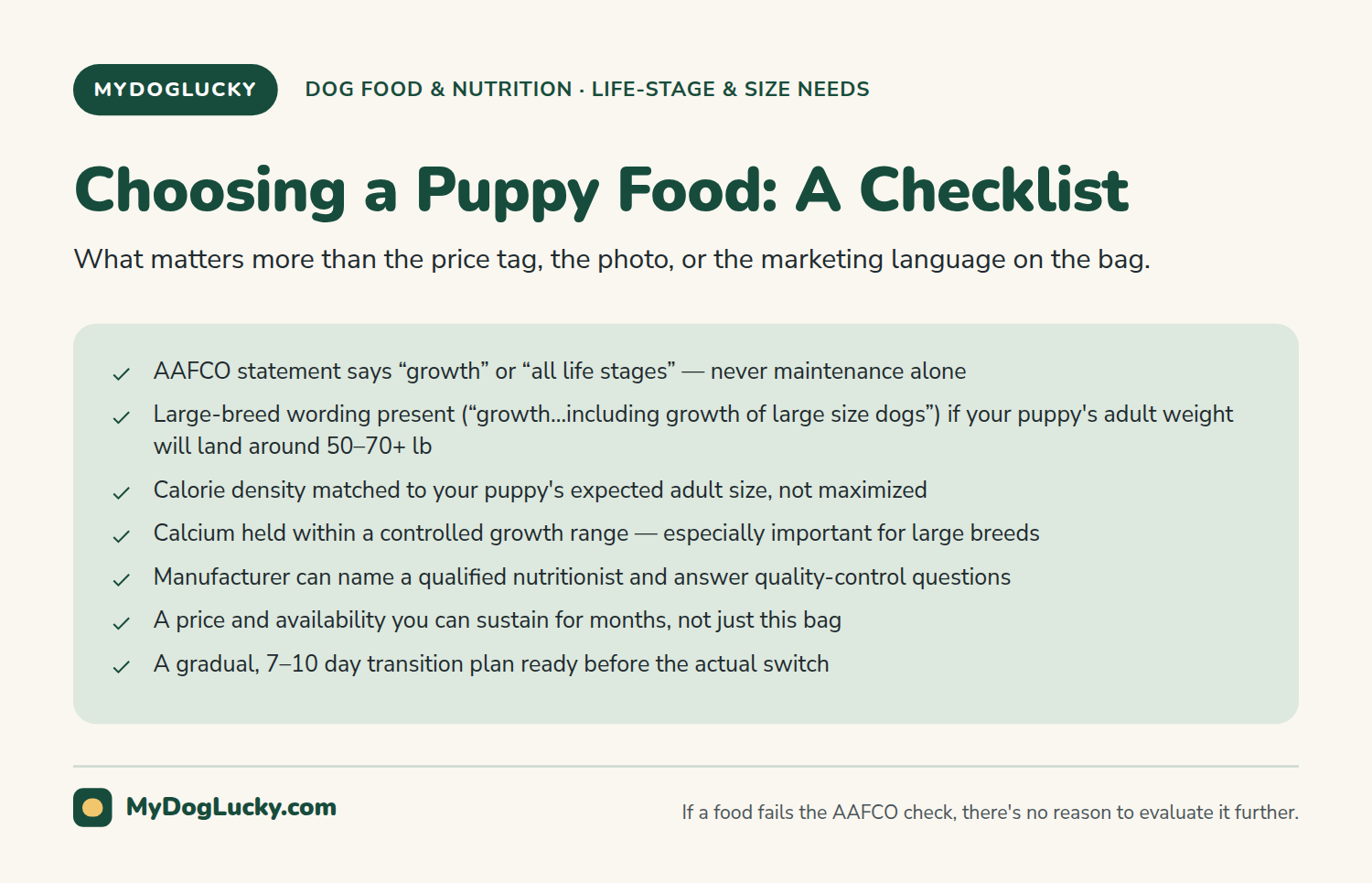
Find the nutritional adequacy statement and confirm it says growth or all life stages, not maintenance. This is the non-negotiable first filter — if a product fails here, there’s no reason to evaluate it further, no matter how appealing the rest of the packaging looks.
Step 2: Match Calorie Density to Your Puppy’s Size Trajectory
Check the calories-per-cup or calories-per-can figure, usually listed near the guaranteed analysis or available on the manufacturer’s website, and weigh it against what you know or suspect about your puppy’s expected adult size. A standard-calorie growth formula is appropriate for most small and medium puppies; a large-breed formula’s more moderate calorie density is the safer choice once a puppy’s expected adult weight climbs into large or giant territory.
Step 3: Look at Ingredient-Quality Signals
Ingredient lists are genuinely harder to interpret than most marketing suggests, and a full breakdown of how to read one — named ingredients versus vague categories, how to think about byproducts, what “natural” and “premium” do and don’t legally guarantee — lives in MyDogLucky’s dedicated How to Read Dog Food Labels article. The short version for puppy food specifically: look for named protein sources, a nutrient profile that matches the AAFCO growth standard rather than an unusually skewed macro ratio, and be skeptical of a front-of-bag claim that isn’t backed up by anything specific on the ingredient panel.
One puppy-specific wrinkle worth adding to that framework: kibble size and texture matter more for a puppy than for an adult dog. A kibble sized for a large adult dog can be genuinely difficult for an eight-week-old puppy of any breed to chew and swallow comfortably. Most reputable puppy formulas account for this with a smaller kibble size, but it’s worth a quick look at the actual pieces, not just the bag, before committing to a large bag your puppy might struggle with.
Step 4: Ask About Manufacturer Transparency
This is the step most owners skip, and it’s one of the more genuinely useful ones. The World Small Animal Veterinary Association’s Global Nutrition Committee publishes a practical set of questions worth asking any pet food manufacturer, including: does the company employ a qualified nutritionist — specifically someone with a PhD in animal nutrition or board certification through the American College of Veterinary Nutrition or its European counterpart — and can they name that person?
Who formulates the diets, and does that person hold an advanced degree in animal nutrition or food science? What quality-control testing does the company run, covering things like ingredient validation, finished-product nutrient analysis, and screening for contamination? Has the company conducted or published any peer-reviewed nutritional research? And can a customer reach the company by phone or email with a real question and get a substantive answer?
A manufacturer with nothing to hide can usually answer most of these without much friction — sometimes directly on their website, sometimes through a quick email. A company that goes vague, dodges the question, or simply can’t be reached at all is telling you something useful about how seriously they take the product, independent of anything printed on the bag.
It’s worth doing this once per brand, not once per bag — the answers rarely change bag to bag, but they’re worth revisiting if a company changes ownership or you notice a formula update on the packaging. A five-minute email now can save you from a much longer research session later, especially if a recall or reformulation ever prompts you to double-check a food you’ve been feeding for months.
Step 5: Calculate Price Per Feeding, Not Price Per Bag
A cheaper bag isn’t automatically a cheaper food once you account for calorie density and how much of it your puppy actually needs to eat. A calorie-dense food fed in smaller daily portions can cost roughly the same per day as a bulkier bag of a less calorie-dense food, even if the sticker price on the shelf looks very different. Divide the bag price by the number of days it’ll realistically last at your puppy’s current feeding amount, and you’ll get a far more useful number than the price tag alone — one that also makes it easier to compare fairly across brands and package sizes.
Wet vs. Dry Puppy Food: Does the Format Matter?
Both wet and dry puppy food can be completely appropriate choices, as long as whichever one you pick carries that growth or all-life-stages AAFCO statement. Format is a separate question from nutritional adequacy, and it’s worth treating it that way instead of assuming one format is inherently healthier than the other.
Dry kibble tends to be the more budget-friendly option per calorie, keeps well without refrigeration once opened, and according to AKC feeding guidance, is generally the most economical way to feed a growing puppy over the course of a year. Some owners moisten kibble with water or a small amount of broth for very young puppies still transitioning off nursing, though that’s a texture preference rather than a nutritional requirement.
Wet, canned puppy food is typically the more expensive option per calorie, and many puppies find it highly palatable, which can be useful for a picky eater or a puppy recovering appetite after illness. It needs the same scrutiny as dry food, though: confirm it’s labeled complete and balanced for growth, not just a “topper” or “mixer” product meant to be fed alongside a base diet rather than as a puppy’s whole nutrition.
The practical tradeoffs come down to a short list: dry food is generally cheaper per feeding and better for ongoing dental abrasion during chewing, though it isn’t a substitute for actual dental care. Wet food is pricier, spoils faster once opened, and can be easier for a puppy with a smaller appetite or recovering from a rough patch to eat enough of. Plenty of owners split the difference and feed a mix of both, which is fine as long as the overall daily calorie total stays appropriate and both components are AAFCO-compliant for growth. MyDogLucky covers this comparison in more depth, including specific situations where one format has a clearer edge, in a dedicated Wet vs. Dry Dog Food article.
A few real-life scenarios where the choice tends to lean one way: a multi-puppy litter or a household feeding several dogs of different sizes often finds dry food simpler to portion and store in bulk. A puppy recovering from a stomach bug, coming off antibiotics, or just a notoriously slow eater sometimes does better with wet food’s stronger aroma and softer texture in the short term. And a puppy prone to bloating quickly on kibble and water might do better with a food that’s already got moisture built in, though that’s worth a quick chat with your veterinarian rather than a guess if it’s happening regularly.
What About Homemade or Vet-Formulated Diets?
A small number of owners go a different route entirely and feed a homemade diet, sometimes for a puppy with a specific medical need, sometimes out of a general preference for more control over ingredients. This is a legitimate path, but it comes with a real catch: a homemade diet needs to be formulated by a board-certified veterinary nutritionist, not assembled from a recipe found online, to reliably meet the same growth-stage nutrient targets a commercial AAFCO-compliant food is required to hit.
Without that formulation, homemade diets frequently fall short on calcium, trace minerals, or overall balance in ways that aren’t obvious from watching a puppy eat and seem happy. If you’re considering this route, ask your veterinarian for a referral to a veterinary nutritionist rather than building a plan from a general recipe.
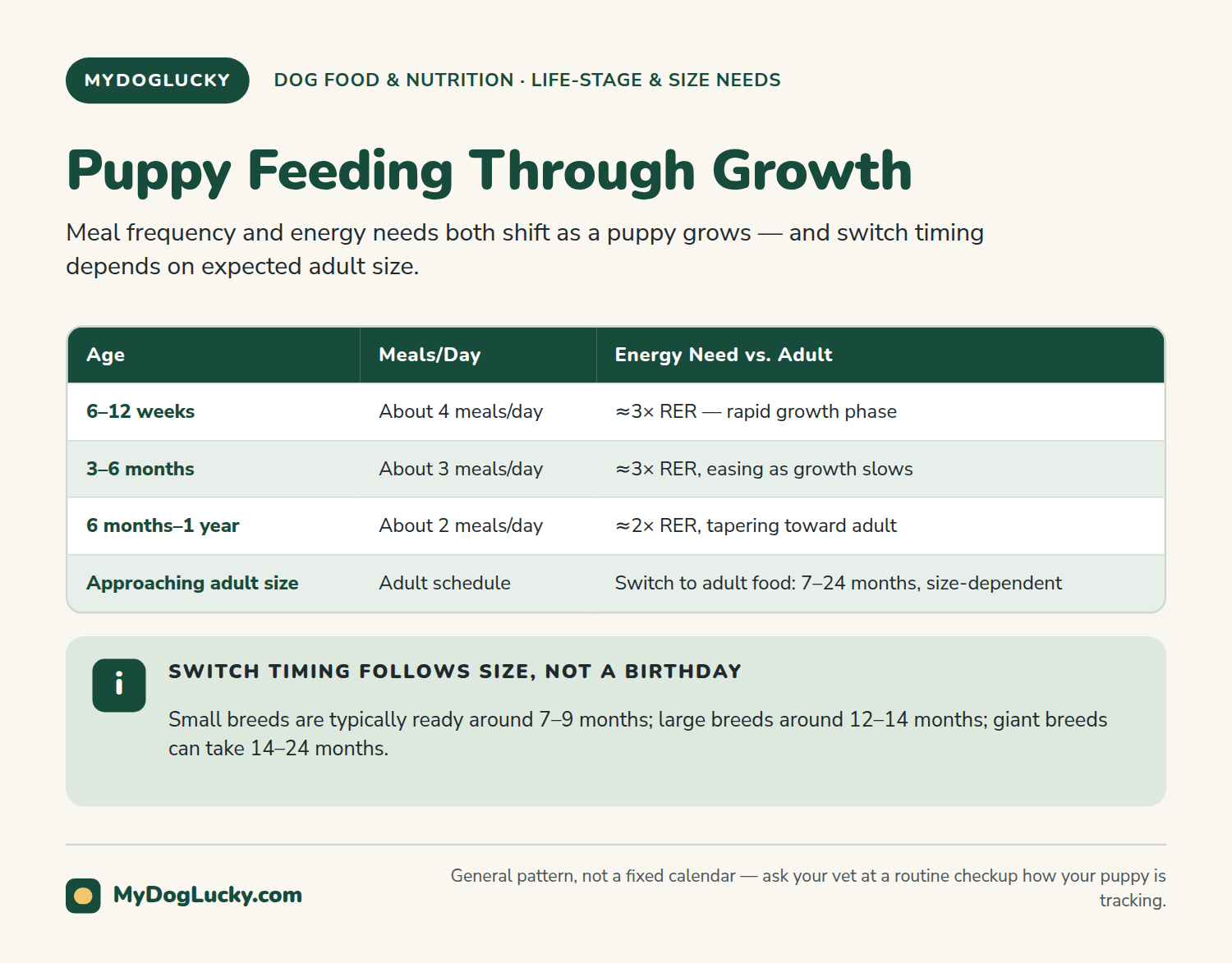
When and How to Switch From Puppy Food to Adult Food
The general rule is to keep feeding a puppy formula until a puppy is at or near his expected adult size and skeletal maturity — not a fixed calendar date that applies the same way to every dog. Because that maturity point varies enormously by breed size, the right switch date for a Chihuahua and the right switch date for a Great Dane can be nearly a year apart.
According to AKC guidance, small-breed dogs typically reach adult size and can transition to adult food somewhere around 7 to 9 months old, while large-breed dogs commonly need to stay on a growth formula until roughly 12 to 14 months, and some giant breeds take even longer to finish developing. The AKC’s practical advice on the borderline cases is straightforward: when in doubt, it’s better to stay on puppy food a little too long than to switch too early, since the downside of a few extra weeks on a growth formula is minor compared to the downside of switching a still-growing large-breed puppy onto a lower-calcium, lower-calorie maintenance diet before his skeleton has finished developing.
One exception worth flagging: a puppy who’s been spayed or neutered typically has somewhat lower energy needs afterward, per AKC guidance, which is sometimes a reason to transition a little earlier than the general size-based timeline — a good topic to bring up at that surgery’s follow-up appointment rather than deciding alone.
| Expected adult size | Typical age at skeletal maturity | Rough switch window |
|---|---|---|
| Small (under ~20 lb) | ~9–10 months | 7–9 months |
| Medium (~20–50 lb) | ~10–12 months | 9–12 months |
| Large (~50–90 lb) | ~12–18 months | 12–14 months |
| Giant (90+ lb) | ~18–24 months | 14–24 months, per your vet |
Whatever the timing, the mechanics of the switch matter as much as the calendar date. A puppy’s digestive system generally handles a gradual transition far better than an abrupt one — mixing increasing amounts of the new food into decreasing amounts of the old food over roughly a week, rather than swapping bowls overnight. MyDogLucky’s dedicated How to Switch Dog Food article walks through that gradual transition process step by step, including what to do if your puppy’s stomach reacts poorly partway through, which is common enough to plan for rather than treat as a crisis.
A simple way to think about timing
Ask your veterinarian, at a routine checkup somewhere in your puppy’s second half of his first year, whether he’s approaching skeletal maturity for his expected size. That single question, asked in person by someone who’s actually seen your puppy’s growth pattern, will give you a more accurate switch date than any general chart — including the one above.
Common Mistakes That Undermine a Good Food Choice
Feeding an Adult-Formula Food to a Growing Puppy
Covered in detail above, and worth repeating here because it’s genuinely one of the most common label-reading slips: an adult maintenance food doesn’t provide the calorie density or the calcium and phosphorus levels a growing puppy needs, no matter how good the brand’s reputation is otherwise. Always check the life-stage statement specifically, every single bag, even from a brand you’ve fed before — formulas do occasionally change.
Over-Supplementing Calcium or Vitamins on Top of a Complete Diet
A complete and balanced growth food has already been formulated to hit an appropriate calcium and vitamin range for a developing puppy. Adding a calcium supplement, a multivitamin, or an extra bone-and-joint product on top of that — usually with good intentions, aimed at “extra support” — risks pushing calcium or vitamin D above the range a growing skeleton can safely handle, particularly in large and giant breeds where VCA’s guidance specifically ties excess calcium to skeletal malformation risk. If you’re considering any supplement for a growing puppy, that’s a conversation to have with your veterinarian first, not a decision to make from a product review online.
Choosing Based on Packaging Alone
Front-of-bag language — “premium,” “natural,” images of fresh vegetables and cuts of meat — isn’t regulated the same way the nutritional adequacy statement is, and it tells you very little about whether a food is actually appropriate for a growing puppy. The information that matters is smaller, plainer, and further down the bag: the life-stage statement, the calorie density, and the ingredient list. A beautifully designed bag and a well-formulated food aren’t mutually exclusive, but one doesn’t guarantee the other.
Assuming a Higher Price Always Means Better Nutrition
Price and quality correlate loosely at best, and not always in the direction you’d expect. As Dr. Lisa Freeman, a board-certified veterinary nutritionist affiliated with the Tufts Clinical Nutrition Service, has noted in the school’s published guidance, the nutritional value and quality of a pet food isn’t necessarily tied to its cost, and genuinely solid options exist even at grocery-store price points. That doesn’t mean price is meaningless — see the budget section below — but it does mean price alone is a weak substitute for actually checking the criteria that matter.
Skipping the Transition Period When Switching Foods
Whether you’re switching between two puppy foods or moving toward adult food later, an abrupt swap is one of the more common causes of a few rough days of loose stool or an upset stomach. A gradual transition over roughly a week solves most of this, and it’s a small enough step that skipping it usually isn’t worth whatever time it saves.
Ignoring Body Condition in Favor of the Bag’s Feeding Chart
The feeding amounts printed on a bag are general estimates based on average puppies at a given weight, not a personalized calculation for your specific puppy’s metabolism and activity level. Following the chart exactly, without ever checking whether your puppy is trending toward lean, ideal, or heavy body condition, can mean overfeeding or underfeeding for months without noticing. A quick body-condition check at home, backed up by your veterinarian’s assessment at routine visits, is a better guide than the printed chart alone.
Red Flags on a Puppy Food Label
Most of this article is about what to look for. It’s just as useful to know what should make you put a bag back on the shelf.
Walk away from a puppy food if you see any of these
- No AAFCO nutritional adequacy statement anywhere on the packaging. This is a baseline requirement for a complete and balanced diet, and its absence is a genuine gap, not an oversight to overlook.
- A vague or missing life-stage claim. “For dogs” or “all dogs” without a clear growth, all-life-stages, or maintenance designation leaves you guessing about whether it’s appropriate for a puppy at all.
- No way to reach the manufacturer with a nutrition question. If there’s no phone number, email, or working website where you can ask about formulation, sourcing, or quality control, that’s a transparency gap worth taking seriously.
- Claims that sound too specific to be true without any explanation of the evidence behind them — a “clinically proven” claim with no study named, or a guarantee that a dog will never develop a health issue.
None of these red flags, on their own, definitively prove a food is unsafe. What they do is shift the burden of proof: a food missing one or more of these basics deserves more scrutiny before you commit to it, not less, and there’s rarely a good reason to choose it over an alternative that clears these baseline checks cleanly.
Worth adding one more, less obvious flag: a recall history the manufacturer doesn’t acknowledge or explain when asked directly. Recalls themselves aren’t automatically disqualifying — even well-run companies occasionally recall a product out of caution, and a transparent, prompt recall response is arguably a good sign of quality control working as intended. What’s concerning is a company that’s evasive about its own recall history when you ask, or one with a pattern of repeated recalls tied to the same underlying quality-control gap.
Budget Tiers: What Price Actually Tells You
Real quality options exist at multiple price points, and the honest answer is that price alone isn’t a reliable signal of nutritional adequacy in either direction — a higher price doesn’t guarantee a better-formulated food, and a lower price doesn’t automatically mean a worse one. What price does reliably tell you is something about the ingredients sourced, the packaging, and the marketing budget behind a product, which correlates only loosely with the nutrient profile itself.
| Price tier | What it often includes | What to verify anyway |
|---|---|---|
| Value / budget | Widely available, often grocery or big-box retail, larger bag sizes | AAFCO growth statement, calorie density, manufacturer contact info |
| Mid-range | Broader ingredient variety, more formula options by size or breed | Same checklist — a mid-tier price doesn’t exempt a food from the checks |
| Premium / specialty | Novel proteins, boutique branding, higher-end packaging | Whether the higher price reflects better formulation or just marketing and packaging costs |
The practical move is to run the same five-step checklist from earlier in this article against a food regardless of its price tier. A budget food that clears every check is a genuinely reasonable choice. A premium food that’s vague about its nutritionist, its quality-control process, or its AAFCO statement doesn’t earn a pass just because it costs more — the price alone isn’t doing the work of proving adequacy.
It’s also worth remembering the price-per-feeding math from the checklist section: a pricier bag with a higher calorie density, fed in smaller daily portions, can end up costing about the same per day as a cheaper, bulkier bag. Compare actual daily cost, not shelf price, before assuming one option is clearly more affordable than another.
Ongoing Costs Beyond the Bag
The bag price is the biggest line item, but it isn’t the only cost worth budgeting for over a puppy’s first year. Treats and training rewards add up faster than most new owners expect, especially during the early months when frequent, small rewards are doing a lot of the training work. A puppy who outgrows an early bag size every few weeks also means buying in smaller, less economical quantities for a while, until his adult size — and adult appetite — stabilizes. And if your veterinarian ever recommends a therapeutic or prescription diet for a specific medical reason, that’s typically priced well above standard commercial puppy food, which is worth knowing about in advance rather than discovering at the register.
None of this is a reason to avoid budgeting properly for food from the start. It’s a reason to build in some flexibility rather than assuming the first bag’s price is what you’ll be paying, unchanged, for the next twelve months.
Frequently Asked Questions About Best Puppy Food
Is there really no single best puppy food for every puppy?
Correct — and that’s not a dodge, it’s how AAFCO’s own framework is built. A food formulated for growth or all life stages, matched to your puppy’s expected adult size and fed consistently, is a legitimate “best puppy food” choice for your household, even if it’s a completely different product than what works for your neighbor’s puppy of a different breed and budget.
How do I know if my puppy needs a large-breed formula?
The general guidance points to puppies expected to weigh somewhere around 50 to 70 pounds or more as adults, though the exact threshold varies a bit by source and by manufacturer. If you’re unsure of your puppy’s likely adult size — common with mixed-breed puppies — your veterinarian can help estimate it from current growth pattern, paw size, and breed guesses.
Can I just feed my puppy the same food as my adult dog?
Not if that food carries a maintenance-only AAFCO statement. Adult maintenance food is formulated for a body that’s finished growing, and it doesn’t provide the calorie density or calcium and phosphorus levels a developing puppy needs. If your adult dog’s food happens to carry an all-life-stages statement, it may be appropriate for both, but that’s worth confirming on the label rather than assuming.
Is grain-free puppy food better or safer?
Not inherently, and “grain-free” isn’t one of the criteria that determines whether a food is appropriate for a growing puppy. What matters is the AAFCO growth statement, calorie density, and calcium control — a food’s grain content, on its own, doesn’t speak to any of those. Choose based on the criteria in this article rather than on whether a bag says grain-free.
Do I need to add a vitamin or calcium supplement to my puppy’s diet?
Generally no, and it can genuinely backfire. A complete and balanced growth food has already been formulated to an appropriate nutrient range, and adding supplements on top risks pushing calcium or vitamin D higher than a growing skeleton, especially a large-breed one, can safely handle. Talk with your veterinarian before adding anything beyond a complete diet.
How much should I feed my puppy each day?
Start with the feeding guide on the bag as a rough baseline, then adjust based on your puppy’s actual body condition and your veterinarian’s input at routine checkups, since printed feeding charts are general estimates rather than individualized amounts. Puppies typically eat several smaller meals a day in the early months, tapering to one or two meals by adulthood.
What if my puppy won’t eat the food I chose?
A puppy who consistently refuses food, seems uninterested in meals, or is losing weight is worth a call to your veterinarian rather than a series of food swaps on your own, since appetite changes can occasionally signal something beyond pickiness. For an otherwise healthy puppy who’s just a slow or picky eater, a gradual transition to a new AAFCO-compliant option, or trying a wet-food component, are both reasonable next steps.
Are fresh, freeze-dried, or raw puppy diets a good option?
These formats can be part of a nutritionally adequate diet, but they need the same scrutiny as any other puppy food — a genuine growth or all-life-stages AAFCO statement, calorie density appropriate to your puppy’s size, and a transparent manufacturer. Raw diets specifically carry additional handling and food-safety considerations worth discussing with your veterinarian before starting one with a young, developing immune system.
My breeder recommended a specific food. Should I just go with that?
A breeder’s recommendation is useful context, especially if it reflects what your puppy has already been eating, since continuing a familiar food for the first stretch at home can ease the transition. It’s still worth running that specific product through the same checklist in this article rather than treating the recommendation as automatically settling the question — a good breeder generally won’t mind the extra scrutiny.
How often should I re-evaluate my puppy’s food as he grows?
Revisit it at major transition points: when your veterinarian confirms he’s approaching skeletal maturity and it’s time to consider adult food, if his growth rate or body condition changes noticeably, or if the specific product’s formulation or recall history changes. Outside of those triggers, a food that’s working well — good stool quality, steady growth, no digestive issues — doesn’t need to be second-guessed on a fixed schedule.
Does “human-grade” or “veterinarian-formulated” on the label mean a food is automatically better?
Not automatically. Both phrases can describe a genuinely well-made food, but neither one is a regulated substitute for the AAFCO life-stage statement, and “veterinarian-formulated” doesn’t specify which veterinarian, with what nutrition training, or how involved they actually were. Treat these as claims worth a follow-up question to the manufacturer, using the transparency criteria above, rather than as a shortcut that skips the rest of the checklist.
My puppy seems to be growing faster than his littermates. Is that a food problem?
Not necessarily — individual puppies within the same litter can grow at somewhat different rates, and plenty of that variation is normal. That said, if you’re feeding a standard formula to a puppy whose growth is noticeably outpacing what you’d expect for his likely adult size, it’s worth a conversation with your veterinarian about whether a large-breed formula, or a portion adjustment, makes sense. Growth rate is one of the more useful things a vet can actually assess in person, since it depends on more than just what’s in the bowl.
Where This Leaves You
The best puppy food for your dog isn’t a product you’ll find at the top of somebody else’s ranked list. It’s whatever food, on the shelf in front of you right now, carries a genuine growth or all-life-stages AAFCO statement, matches its calorie density and calcium level to how big your puppy is going to get, comes from a manufacturer willing to answer real questions, and fits into your budget well enough that you’ll actually keep feeding it.
Run any candidate through the checklist in this article before the packaging or the price tag gets to make the decision for you. And if your puppy’s expected adult size, a specific health concern, or anything about his growth pattern has you second-guessing a choice, that’s exactly the kind of question worth bringing to your veterinarian at his next checkup — they’ve seen your puppy’s actual growth curve, and this article hasn’t.
A quick note on limitations
This guide covers general criteria for healthy puppies without a diagnosed medical condition. It doesn’t account for prescription or therapeutic diets, individual food allergies or sensitivities, or breed-specific health conditions your veterinarian may want to factor into a food decision — those situations call for guidance tailored to your specific dog, not a general framework. Specific prices, formulas, and manufacturer practices referenced generally in this article can change; confirm current details directly with a manufacturer or retailer before purchasing, and treat this article’s last-reviewed date above as the point through which its guidance was current.
Sources
- Association of American Feed Control Officials (AAFCO). Reading Labels
- WSAVA Global Nutrition Committee. Guidelines on Selecting Pet Foods (WSAVA Global Nutrition Toolkit)
- Tufts University Cummings School of Veterinary Medicine, Clinical Nutrition Service. What’s the Best Food for Your New Puppy? (Petfoodology)
- VCA Animal Hospitals. Nutritional Requirements of Large and Giant Breed Puppies
- American Kennel Club. Feeding Your Puppy: Full Guide and Timeline
- Merck Veterinary Manual. Puppy Care
- American Veterinary Medical Association (AVMA). Pet Nutrition Matters
This article is general education for U.S. dog owners about evaluating puppy food, not an individualized feeding plan or veterinary recommendation. It does not name, rank, or endorse specific commercial puppy food brands or products. Nutritional needs vary by individual puppy, breed, and health status — talk with your veterinarian before choosing or changing your puppy’s diet, and always sooner rather than later if you notice a change in appetite, growth, or digestion.




Trackbacks/Pingbacks