Fresh dog food vs. kibble is one of those debates that sounds like it should have a clean answer. It doesn’t. Both formats can meet a dog’s nutritional needs. Both can also fall short. That depends on the specific product, not the category it belongs to. What actually separates fresh dog food vs. kibble isn’t some hidden nutritional secret one side has and the other lacks. It comes down to moisture content, processing method, price per calorie, and how much work you’re willing to put into the routine.
This guide walks through what “fresh” and “kibble” actually mean as categories. It shows how to compare their nutrition on a fair basis, not a misleading one. It covers what the research does and doesn’t support about digestibility and palatability. And it walks through the real math behind why fresh subscriptions usually cost more. Beyond that, you’ll find freezer space, delivery reliability, and the questions worth asking before you trust a manufacturer’s transparency claims. By the end, you’ll have a framework for deciding what fits your dog and your household. This isn’t a verdict declaring one format the winner for everyone.
One scope note before we start. This article covers commercial fresh food and commercial kibble. It doesn’t cover homemade diets or raw feeding, which carry their own separate safety considerations. It also isn’t the same comparison as wet vs. dry dog food. Some fresh products are refrigerated or frozen rather than shelf-stable canned goods. If you want a deeper walk-through of every line on a pet food label, that’s covered in a separate MyDogLucky guide on how to read dog food labels.
What’s in this guide
- What “fresh” dog food and kibble actually mean
- The AAFCO adequacy statement is what actually matters
- Comparing fresh dog food vs. kibble nutrition fairly
- What the evidence actually shows about digestibility and palatability
- The real cost of fresh dog food vs. kibble
- Convenience and logistics: freezer space, delivery, and travel
- Evaluating manufacturer claims and transparency
- Who might reasonably choose each format
- A decision framework for choosing between formats
- Common mistakes when comparing fresh food and kibble
- Frequently asked questions
- Sources
What “Fresh” Dog Food and Kibble Actually Mean
Before comparing anything, it helps to know what each word is actually doing. “Kibble” and “fresh” describe processing and packaging, not a fixed level of quality. A given kibble can be excellent or mediocre. So can a given fresh product. Neither word tells you that on its own.
Kibble: Extrusion and Shelf Stability
Dry dog food, commonly called kibble, makes up the large majority of what’s sold as dry pet food. It’s produced almost entirely through a process called extrusion. According to the Merck Veterinary Manual, roughly 95% of dry pet food is made this way. Ingredients like grains or grain alternatives, meat and meat by-products, fats, minerals, and vitamins get combined and cooked. The mixture is then forced through a die that shapes it into the familiar kibble pieces.
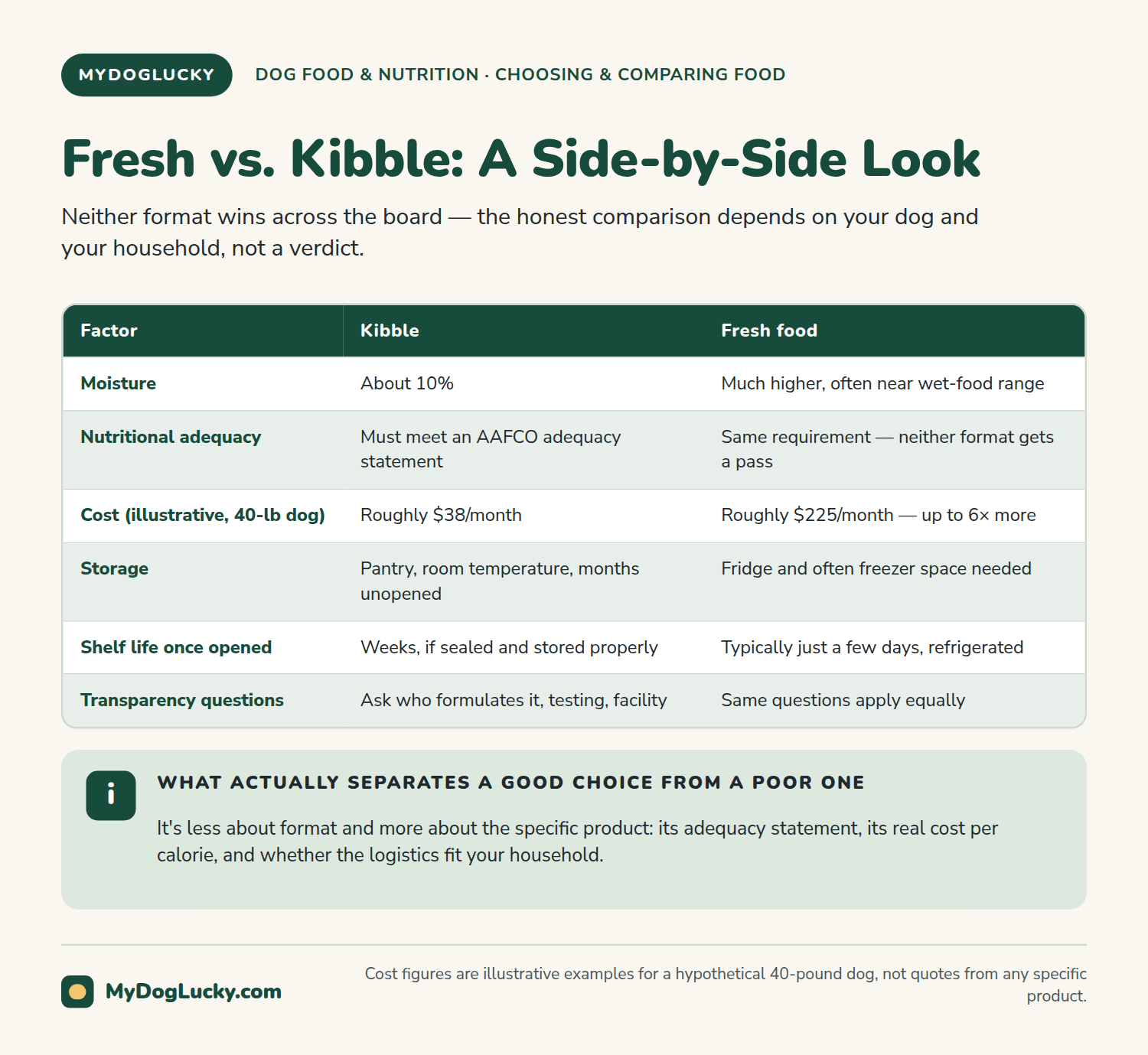
Extrusion cooking runs at meaningful heat, typically somewhere between 80°C and 200°C. Merck’s description of small-animal nutrition puts the minimum around 130°C, a level considered necessary to reduce microbial risk. That heat, combined with drying, is what gives kibble its long, shelf-stable life. Finished dry food generally lands around 10% moisture and 90% dry matter. That number matters more than most people realize, and we’ll come back to it in the next two sections.
“Fresh” Food: A Category, Not One Product
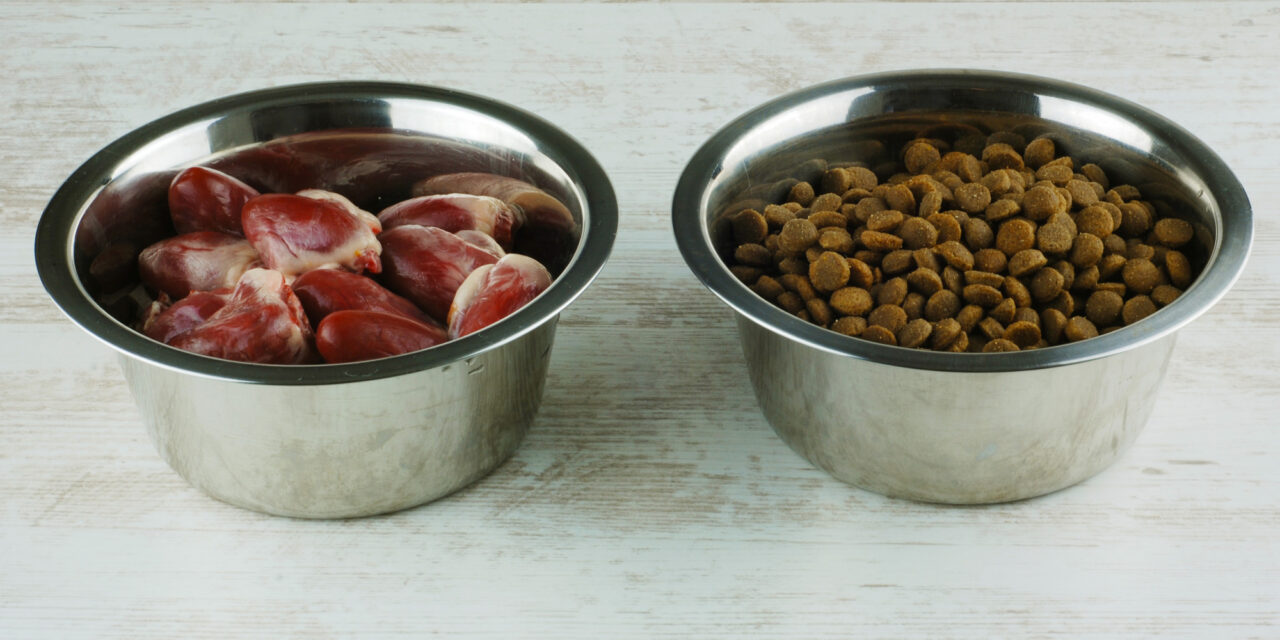
“Fresh” dog food isn’t a regulated category with one fixed definition the way “human-grade” technically is. In practice, it usually describes food that’s gently cooked at lower temperatures than extrusion. It tends to use whole-food ingredients recognizable as meat, vegetables, and grains, rather than heavily processed meal or by-product forms. It’s typically sold refrigerated or frozen instead of shelf-stable. Many fresh products come through subscription or delivery models, pre-portioned for a specific dog’s estimated calorie needs, rather than in a one-size-fits-all bag.
That combination — gentler cooking, higher moisture, and a subscription delivery model — is what most owners mean when they say “fresh” in this comparison. It’s a different animal from raw feeding, too. Raw diets skip cooking almost entirely. That introduces pathogen risks that gently cooked fresh food is specifically designed to reduce. The American Veterinary Medical Association’s policy on raw and undercooked animal-source protein is clear on this point. It supports diets processed to reduce or eliminate the risk of illness from pathogens like Salmonella, Campylobacter, E. coli, and Listeria monocytogenes. Cooked fresh food is built to meet that standard. Raw food, by definition, is not.
Where Canned and Wet Food Fit In
It’s worth separating this comparison from the older wet vs. dry dog food debate. Fresh food isn’t simply modern canned food with better branding. Canned food is also high in moisture, typically 68% to 78% water according to Merck’s veterinary reference. But it’s processed differently: sealed and heat-sterilized through a retort process, rather than gently cooked and refrigerated. Fresh food tends to sit in its own middle ground. It carries higher moisture than kibble and lower processing intensity than a canned retort cycle. Its shelf life is measured in days once opened, rather than the months a sealed can offers.
The three formats, side by side
- Kibble: extruded, roughly 10% moisture, shelf-stable for months unopened.
- Canned/wet: retort-processed, roughly 68–78% moisture, shelf-stable for months unopened, short shelf life once opened.
- Fresh: gently cooked, higher moisture than kibble, refrigerated or frozen, short shelf life once thawed or opened.
The AAFCO Adequacy Statement Is What Actually Matters
Here’s the part that gets buried under marketing language. Whether a dog food is fresh or kibble, the single most important line on the label is the same for both. It isn’t the ingredient list. It’s the nutritional adequacy statement, regulated by the Association of American Feed Control Officials, commonly known as AAFCO.
What AAFCO Actually Does
AAFCO doesn’t manufacture, test, or sell pet food. It also doesn’t “approve” products the way that phrase gets used in marketing copy. According to AAFCO’s own consumer guidance, the organization sets science-based nutrient standards and model regulations. State feed-control agencies then adopt those into law. The FDA partners with those state officials rather than replacing them, since AAFCO itself has no independent regulatory authority. A bag or package claiming to be “AAFCO-approved” is using language AAFCO doesn’t actually issue.
Two Ways to Earn “Complete and Balanced”
For a product, fresh or kibble, to legitimately claim it’s complete and balanced, the FDA says it has to satisfy one of two paths. Either the recipe is formulated to meet AAFCO’s Dog Food Nutrient Profiles, or the specific product has passed an AAFCO feeding trial. AAFCO created those nutrient profiles in 1991, with the most recent major update in 2016. It maintains separate profiles for growth and reproduction versus adult maintenance. Puppies and pregnant or nursing dogs simply have different needs than adult dogs at rest.
This applies identically to a bag of extruded kibble and a refrigerated tray of gently cooked fresh food. Neither format gets a pass. A fresh product formulated by a qualified nutritionist to meet AAFCO’s growth profile is doing the same underlying job as a kibble bag making that claim. And a fresh product that skips this step, marketed on ingredient photography alone, has the same gap a cheap kibble would have if it skipped the step too.
What to actually look for on the label
- A specific life-stage statement: growth, reproduction, adult maintenance, or all life stages — not a vague “complete nutrition” claim with no statement attached.
- Language indicating the recipe meets AAFCO Dog Food Nutrient Profiles, or that the product itself passed an AAFCO feeding trial.
- The name of the species and life stage the product is formulated for, matching your dog’s actual stage of life.
If a product, fresh or kibble, doesn’t carry a clear adequacy statement, that’s worth a direct question to the manufacturer before you buy. Don’t assume it’s fine just because the ingredients look good.
Human-Grade Is a Real Term, But It Answers a Different Question
“Human-grade” sounds like a nutrition claim, but it’s actually a facility and ingredient-sourcing claim. AAFCO does define requirements around the term. It’s not simply marketing fluff the way “premium” is. AAFCO’s own FAQ page notes that “premium” has no defined standard at all, unlike terms such as “natural” or “organic,” which do carry specific guidelines. Still, human-grade status speaks to how ingredients were sourced and handled. It doesn’t automatically mean the finished recipe is nutritionally complete for a dog. A human-grade product still needs its own adequacy statement to back up a complete-and-balanced claim. One doesn’t substitute for the other.
Comparing Fresh Dog Food vs. Kibble Nutrition Fairly
This is where a lot of side-by-side comparisons go wrong. It’s an honest mistake, not a conspiracy. Comparing the guaranteed analysis on a fresh food label directly against a kibble label, percentage for percentage, produces a comparison that looks dramatic. It also means almost nothing.
What to Watch in Your Own Dog, Not Just the Research
A systematic review tells you what tends to be true across large groups of dogs and studies. It can’t tell you how your specific dog will respond to a specific product. That gap is exactly where owner observation earns its keep. A few weeks on any new food, fresh or kibble, is usually enough time to notice the signals that matter most.
Watch stool consistency and frequency. Digestive tolerance shows up there faster than almost anywhere else. Watch body condition, too: can you feel ribs with light pressure, and is a waist visible from above? That matters more than the number on a bag, since calorie needs vary dog to dog even at the same weight. Watch coat quality, energy level, and appetite over the full trial period, not just the first few days. Some dogs take a week or two to settle into a new routine, even when the food itself is a good fit.
Why Moisture Skews the Numbers
Guaranteed analysis percentages, like “26% protein” or “14% fat,” are calculated on an as-fed basis. That means the water in the food is counted as part of the total. Kibble sits around 10% moisture. Fresh food sits much higher, often in a similar range to wet or canned food. That difference alone makes a fresh product’s protein percentage look artificially low next to kibble’s. The fresh product can still deliver more protein per calorie once the water is factored out.
Because of this, a fair comparison requires converting both foods to a dry-matter basis. That means stripping out the water, so you’re comparing the actual nutrient content of the food itself. You’re not comparing the food plus however much water happens to be in it.
A Worked Example
Here’s how the math works, using illustrative numbers rather than any specific product’s real label. Say a kibble lists 24% crude protein at 10% moisture, and a fresh food lists 10% crude protein at 72% moisture.
The dry-matter basis formula is: nutrient percentage ÷ (100 − moisture percentage) × 100.
- Kibble: 24 ÷ (100 − 10) × 100 = 24 ÷ 90 × 100 ≈ 26.7% protein on a dry-matter basis.
- Fresh food: 10 ÷ (100 − 72) × 100 = 10 ÷ 28 × 100 ≈ 35.7% protein on a dry-matter basis.
Read as-fed, the fresh food looks like it has less than half the protein of the kibble. Once you strip out the water, it actually has notably more protein per unit of actual food. Neither number is “wrong.” They’re answering different questions. Mixing them up is the single most common way owners misjudge one format against the other.
| Metric | Kibble (illustrative) | Fresh food (illustrative) |
|---|---|---|
| Moisture | 10% | 72% |
| Protein, as-fed | 24% | 10% |
| Protein, dry-matter basis | ≈26.7% | ≈35.7% |
Dry-Matter Basis Isn’t the Whole Story Either
Converting to dry matter fixes the moisture problem, but it doesn’t tell you everything. It doesn’t reveal ingredient quality, digestibility, or how well a dog actually absorbs and uses those nutrients. It only shows how concentrated they are on paper. A dry-matter comparison is a fair starting point for reading two labels against each other. It isn’t a substitute for the adequacy statement covered above. And it isn’t a substitute for watching how your own dog does on a given food. Coat condition, stool quality, energy, and weight over several weeks tell you things a label calculation can’t.
What the Evidence Actually Shows About Digestibility and Palatability
Marketing copy for fresh food often implies that gentler processing automatically means better digestibility and a happier gut. Marketing copy for kibble, when it addresses the comparison at all, sometimes implies the opposite. It suggests extrusion’s heat locks in nutrition and stability that “raw-style” formats can’t match. Neither blanket claim holds up cleanly against the actual research.
A Recent Systematic Review Found Genuinely Mixed Results
A 2025 systematic review and meta-analysis published in the journal Animals pulled together the available comparative research on fresh pet food quality claims. Researchers at Middle Tennessee State University led the work. Two findings stand out. First, the pooled analysis looked at 60 studies on food additives and 39 on preservatives. It found essentially no measurable harm from additives and preservatives used within regulatory guidelines. That’s a useful, evidence-based counterpoint to marketing that frames “no preservatives” as inherently safer.
Second, and more relevant to the digestibility question directly, the review looked at 102 digestibility comparisons and 137 nutrient-content comparisons. It found significant heterogeneity. In plain terms, outcomes depended heavily on the specific ingredients and processing methods used, not on processing intensity as a single variable. Some processing steps improved digestibility for certain ingredients. Others reduced it. There was no consistent pattern showing that less-processed automatically means more digestible, or that more-processed automatically means less digestible.
Processing Parameters, Not Just “Processed vs. Unprocessed,” Drive the Outcome
A separate study on large-scale extrusion examined how specific processing modifications affect starch availability in kibble. It reinforces the same point: adjusting extrusion parameters changes how much starch becomes available for enzymatic digestion. That’s a useful, specific finding. It shows processing details matter. But it doesn’t translate into a simple rule that any one format beats another across the board. Extrusion done one way behaves differently than extrusion done another way. The same logic likely applies within the fresh-food category, too, since gentle-cooking methods vary by manufacturer.
Where the Evidence Runs Thin: Human-Grade vs. Feed-Grade
One area where owners often expect strong evidence simply doesn’t have much yet. The same 2025 review found only six comparative studies directly examining human-grade versus feed-grade ingredients. All six carried methodological limitations and a meaningful risk of bias. The researchers’ honest conclusion: current evidence doesn’t substantiate superiority claims for human-grade ingredients over feed-grade ones in finished nutritional outcomes. That doesn’t mean human-grade sourcing is meaningless. It speaks to ingredient handling and safety standards, discussed above. But “human-grade” shouldn’t be read as a stand-in for “nutritionally superior.” The comparative research to support that specific leap isn’t there yet.
Palatability: Real, but Individual
Palatability, meaning whether a dog is actually eager to eat the food, is where fresh food’s advocates often have a genuinely fair point. It’s one the research base doesn’t dismiss. Higher moisture, stronger aroma, and whole-food ingredients frequently make fresh food more appealing to dogs who are picky, recovering from illness, or reluctant eaters generally. This is real, and it’s worth factoring in. It’s also individual. Some dogs show a strong preference. Others don’t show much difference at all between a well-formulated kibble and a well-formulated fresh option. Treat palatability as one input among several, not the deciding factor on its own, unless you’re specifically dealing with a dog who won’t reliably eat otherwise.
The Real Cost of Fresh Dog Food vs. Kibble
This is usually where the comparison stops being abstract. Cost is the single biggest practical difference between the two formats for most households. It’s worth walking through the actual math, instead of relying on a vague sense that “fresh is pricier.”
Finding the Calorie Density on the Label
You’ll need one number from the label before you can run any of this math: calorie density. It’s usually printed as kilocalories per kilogram (kcal/kg) and kilocalories per common household measure, like a cup or a specific portion pouch. AAFCO’s model regulations now require a calorie content statement on every complete-and-balanced pet food, according to AAFCO’s own consumer FAQ. That statement is required on all products now, not just ones making a low-calorie claim. That means the figure you need has to be on the package, fresh or kibble. It’s sometimes printed in small type near the feeding guidelines rather than featured on the front, but it’s there.
If you genuinely can’t find it, that’s a fair question to put directly to the manufacturer. How quickly and clearly they answer says something on its own.
Why Comparing Bag Price Alone Misleads You
A $65 bag of kibble and a $65 week of fresh food aren’t the same purchase. They don’t deliver the same number of calories. Kibble is calorie-dense. With roughly 10% moisture, a given weight of kibble packs in far more usable energy than the same weight of a higher-moisture fresh product. A fair cost comparison has to be done per calorie, not per pound or per bag. It’s the same fix the nutrition comparison in the last section needed.
A Worked Example, With Illustrative Numbers
Say a 40-pound, moderately active adult dog needs roughly 1,000 calories a day. That’s a hypothetical, illustrative figure for demonstrating the math. Your dog’s actual calorie need depends on age, activity, body condition, and metabolism. Your veterinarian can help refine a real number.
A typical extruded kibble might run somewhere in the neighborhood of 3,800 calories per kilogram, a reasonable illustrative figure for a standard dry formula. At $65 for a 13.6-kilogram (30-pound) bag, that works out to about $4.78 per kilogram.
- Daily amount needed: 1,000 ÷ 3,800 × 1,000g ≈ 263 grams
- Daily cost: 0.263 kg × $4.78 ≈ $1.26 per day
- Monthly cost: roughly $38
A fresh food, by contrast, might run closer to 1,150 calories per kilogram, once its higher moisture content is factored in. Again, that’s an illustrative figure representative of the category, not a specific product. A typical subscription pre-portions daily servings. Say that service prices out to $7.50 per day for a dog this size.
- Daily amount needed: 1,000 ÷ 1,150 × 1,000g ≈ 870 grams (just under 2 pounds)
- Daily cost: roughly $7.50 per day at illustrative subscription pricing
- Monthly cost: roughly $225
In this illustrative example, fresh food runs close to six times the monthly cost of kibble for the same dog. Two factors compound to create that gap. Fresh food’s lower calorie density means the dog physically eats more of it by weight. And the per-kilogram price of a subscription format tends to run well above bulk-bagged kibble to begin with. Real prices vary by brand, region, and dog size. Treat this as a method to apply to your own numbers, not as a universal figure to quote.
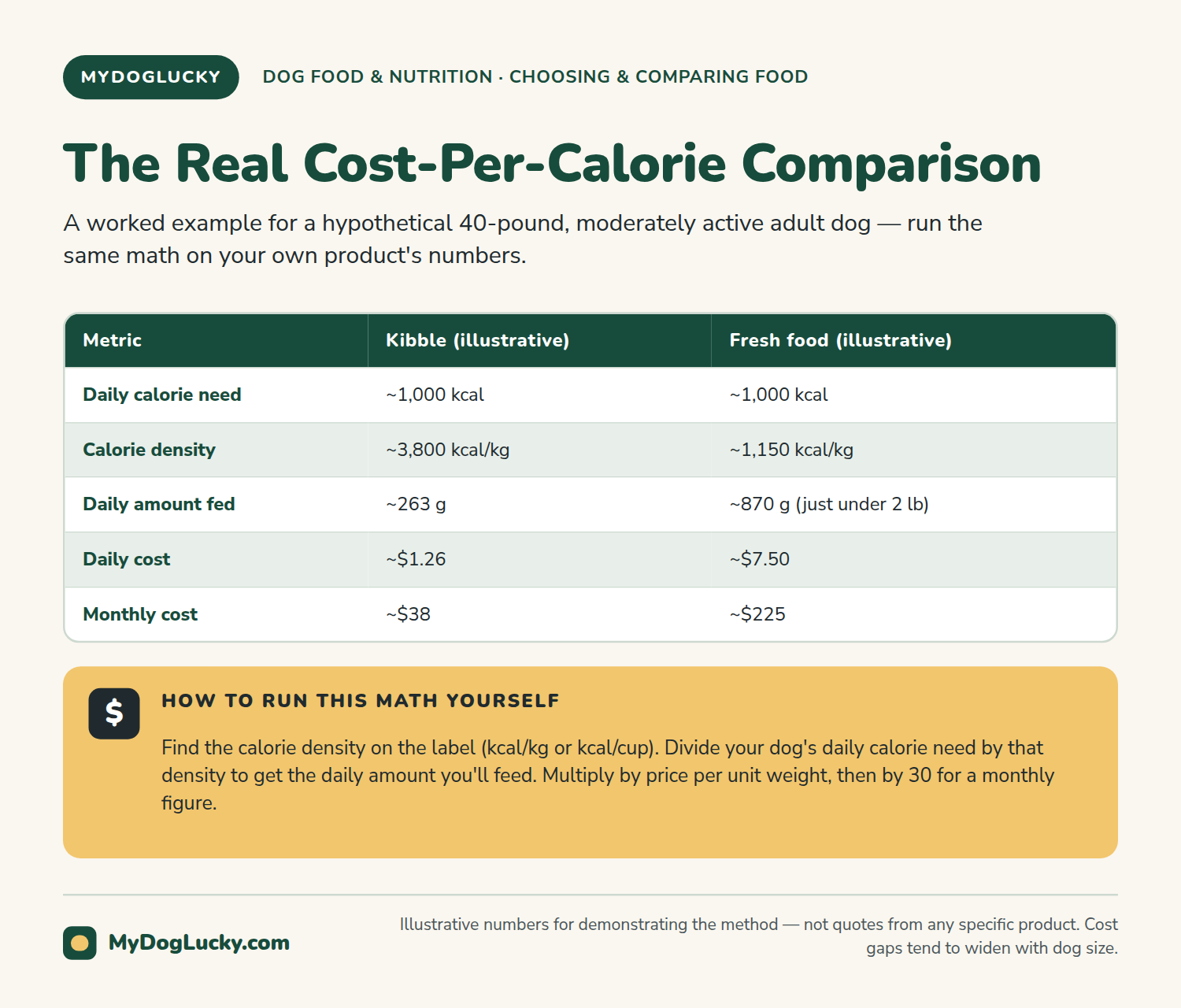
How to run this math yourself
- Find the calorie density on the label, usually listed as kcal/kg or kcal/cup.
- Divide your dog’s estimated daily calorie need by that density to get the daily amount, in weight, you’ll actually feed.
- Multiply that daily weight by the product’s price per unit weight to get a true daily cost.
- Multiply by 30 for a monthly figure you can actually compare across formats and brands.
Cost Scales With Dog Size
The gap between formats tends to widen, not narrow, as a dog gets bigger. A larger dog simply needs more total calories every day. A fresh subscription for a 10-pound dog might feel like a manageable indulgence. The same subscription model for an 80-pound dog can represent a genuinely significant monthly line item. It’s worth running the actual math before committing, rather than assuming cost scales gently.
Convenience and Logistics: Freezer Space, Delivery, and Travel
Cost gets most of the attention in this comparison. Day-to-day logistics quietly matter just as much for whether a format is sustainable in your actual household.
Storage: Freezer and Fridge Space
Kibble asks very little of your storage. A sealed bag stores at room temperature in a pantry, closet, or bin for months. Fresh food asks considerably more. It needs refrigerator space for what’s currently thawed and in use, and often freezer space for a backlog of future portions. Most fresh products ship frozen and are meant to thaw gradually.
For a small apartment kitchen, a household already running a full chest freezer, or a multi-dog home where portions multiply fast, this is a real practical constraint. It isn’t a minor inconvenience. It’s worth measuring your actual available freezer space before committing to a fresh subscription, especially for a larger dog whose weekly portions take up meaningfully more volume.
Delivery Reliability
Subscription-based fresh food depends on a delivery actually arriving on schedule. Most households handle an occasional delay fine, especially with a few days of buffer stock on hand. But a missed or significantly delayed delivery with no backup plan can leave you scrambling. That’s especially true if your dog isn’t used to kibble as a fallback, since a sudden diet change on short notice risks stomach upset. Keeping a small bag of backup food on hand, even if you feed fresh most of the time, is a reasonable hedge against exactly this scenario.
Travel and Time Away From Home
Kibble travels easily. Scoop some into a container, and you’re set for a weekend trip or a stay with a pet sitter. Fresh food requires more planning: cooler transport, access to a fridge or freezer at your destination, and clear instructions for anyone else feeding your dog while you’re away. None of this is disqualifying. It is a real factor worth weighing if your household travels often or relies on varied caregivers. That topic is covered in more depth in a separate MyDogLucky guide on choosing sitters, walkers, and boarding.
Multi-Dog and Multi-Pet Households Multiply Every Tradeoff
Everything in this section scales with the number of dogs you’re feeding. It’s worth thinking through before committing, not after. Freezer space that comfortably holds one dog’s weekly fresh portions can run out fast with two or three. Delivery reliability matters more, not less, when a missed shipment means multiple dogs short a meal instead of one. And the cost math from the previous section multiplies directly. A household with two 40-pound dogs on the same fresh subscription is looking at roughly double the monthly figure calculated there. There’s no bulk discount that changes the underlying per-calorie math.
None of that rules fresh food out for a multi-dog household. It does mean the planning has to be more deliberate. Confirm freezer capacity for the whole group. Budget for the actual combined cost, not just one dog’s portion. Have a backup plan sized for everyone, not just one bowl.
Shelf Life Once Opened
This is one of the more underrated differences between the formats. An opened bag of kibble generally stays usable for weeks, if it’s sealed properly and kept cool and dry. An opened package of fresh food typically needs to be used within a matter of days, even refrigerated. Its higher moisture content and gentler processing make it more hospitable to spoilage. That shorter window works fine for a household with a predictable routine and reliable portion control. It’s a genuine liability for an unpredictable schedule, a dog who eats inconsistently, or a household where food sometimes sits out longer than planned.
| Factor | Kibble | Fresh food |
|---|---|---|
| Unopened shelf life | Months, room temperature | Days to weeks, refrigerated or frozen |
| Opened shelf life | Weeks, if sealed and stored properly | Typically a few days, refrigerated |
| Storage space needed | Pantry or bin, room temperature | Fridge and often freezer space |
| Travel-friendliness | Straightforward | Needs cooler transport or fridge access |
| Backup-plan risk if delivery slips | Low; buy more anywhere | Higher; worth keeping a backup food on hand |
Evaluating Manufacturer Claims and Transparency
Both formats are sold by companies with a financial interest in sounding trustworthy. The useful skill here isn’t picking a side; it’s knowing which questions actually reveal something and which just sound good on packaging.
Ingredient Lists Don’t Tell You What You Think They Do
The World Small Animal Veterinary Association’s nutrition guidance makes a point worth repeating. An ingredient list shows what’s present, not how good the quality of those ingredients is. Read in isolation, it can be genuinely misleading about a food’s overall quality. A short, recognizable ingredient list feels reassuring. It isn’t, by itself, evidence of anything about nutritional completeness, sourcing standards, or safety testing. The adequacy statement and manufacturer transparency matter more than ingredient-list aesthetics.
Questions Worth Asking Any Manufacturer, Fresh or Kibble
WSAVA’s broader nutrition guidelines point toward a handful of questions. They apply equally to a kibble brand and a fresh-food subscription service. Asking them directly is more useful than trusting a marketing page’s tone:
- Who formulates the recipe? Is a board-certified veterinary nutritionist, or an equivalent qualified professional, actually involved in formulation, not just quoted in marketing copy?
- What quality-control testing happens, and how often? Does the company run nutrient analysis on finished batches, not just raw ingredients, and test for pathogens before product ships?
- Where is the food actually manufactured? Does the company own its production facility, or does it co-pack through a third-party manufacturer — and if so, can it speak to that facility’s inspection history and safety record?
- Will the company answer these questions directly? A company confident in its process usually answers plainly. Vague deflection, or answers that pivot to marketing language instead of specifics, is itself useful information.
Co-Packing Isn’t Automatically a Red Flag
It’s worth correcting a common assumption here. A product made in a co-packing facility, shared with other brands, isn’t automatically a sign of lower quality. Plenty of well-regarded pet food, in both the fresh and kibble categories, is produced this way. And plenty of poor-quality food is made in a company’s own dedicated plant. What matters is the facility’s actual safety record, testing practices, and inspection history, not simply who owns the building. Be skeptical of marketing that implies “owns its own kitchen” automatically equals “safer” without backing that up with specifics.
Unregulated Marketing Language to Read Skeptically
AAFCO’s own consumer guidance flags an important asymmetry. Some label terms, like “natural” and “organic,” have defined regulatory guidelines behind them. Others, like “premium,” “gourmet,” or “holistic,” don’t have any regulated meaning at all. A company can print them on packaging regardless of whether the product is actually different from a competitor’s. Treat unregulated terms as marketing flavor, not as evidence. Look instead for the adequacy statement, transparent sourcing information, and direct answers to the quality-control questions above.
When to loop your veterinarian in before switching formats
- Your dog is on a prescription or therapeutic diet for a specific medical condition.
- Your dog is a puppy, senior, pregnant, or nursing, where nutrient needs are more sensitive to formulation gaps.
- Your dog has a known food allergy or sensitivity, since switching formats often means switching protein or ingredient sources too.
- You’re comparing two products and neither one’s adequacy statement or formulation background is clear after checking the label and asking the company directly.
None of these situations mean fresh or kibble is off the table. They mean a professional should be part of the decision, not the label alone.
Who Might Reasonably Choose Each Format
Given everything above, the honest answer to “which is better” is that it depends on which tradeoffs fit your actual life. Here’s a more useful way to think through it than a straight up-or-down comparison.
Kibble Tends to Fit Well When
- Budget is a primary constraint. Kibble’s lower cost per calorie makes it more sustainable for many households, especially with larger dogs, multiple dogs, or a tight monthly budget.
- Storage space is limited. A small apartment, a shared fridge, or a household without freezer space to spare fits kibble’s room-temperature storage far more easily.
- Routines are unpredictable. Frequent travel, inconsistent schedules, or a household where deliveries sometimes go unanswered favors a format with a long shelf life and no delivery dependency.
- A dog does well on it. If a dog maintains a healthy weight, good energy, and normal digestion on a well-formulated kibble, there’s no evidence-based reason that dog needs to switch formats.
Fresh Food Tends to Fit Well When
- Palatability is a real, ongoing problem. A dog who’s a genuinely reluctant eater, recovering from illness, or losing interest in food generally may eat more reliably with a higher-moisture, more aromatic option.
- Budget comfortably absorbs the difference. If the monthly cost gap between formats, run through the math in the cost section above, doesn’t strain the household budget, that constraint drops out of the decision.
- Storage and delivery logistics genuinely work. Reliable delivery service in your area, adequate freezer space, and a consistent routine make the logistics manageable rather than a recurring source of stress.
- A specific, veterinarian-discussed reason exists. Some dogs with certain digestive sensitivities or strong food preferences do better on a specific fresh formulation — something worth evaluating with your vet rather than assuming applies universally.
Senior Dogs and Dogs With a Reduced Appetite
Some older dogs eat less reliably than they used to. That can come from dental discomfort, a diminished sense of smell, or an underlying health condition that needs veterinary attention rather than a food swap alone. In that specific situation, fresh food’s stronger aroma and softer texture can genuinely help some dogs eat more consistently. It’s a reasonable option to discuss with your veterinarian if appetite has become a real concern.
That’s different from saying every senior dog needs to switch. A senior dog who’s eating well, maintaining weight, and doing fine on kibble doesn’t need a format change just because of age alone. Any noticeable, ongoing drop in appetite in an older dog is worth a veterinary visit first. It can signal something that a food-format change won’t fix on its own.
A Mixed Approach Is Also Reasonable
Plenty of households feed a base of kibble with fresh food used as a topper, a rotation, or an option during a specific life stage or recovery period. This isn’t a compromise to feel guilty about. It’s a legitimate way to capture some of each format’s advantages. Just make sure the overall diet, or each component if fed separately, still meets a complete-and-balanced standard for your dog’s life stage. If you’re combining formats, do the math on total daily calories across both, so treats and toppers don’t quietly push a dog into a calorie surplus.
A Decision Framework for Choosing Between Formats
Rather than trying to declare an absolute winner, here’s a structured way to work through the decision for your specific dog and household.
- Check the adequacy statement on any product you’re considering. Confirm it’s formulated for your dog’s actual life stage, fresh or kibble, before comparing anything else.
- Run the dry-matter and cost-per-calorie math on the specific products you’re weighing, using the methods from the nutrition and cost sections above, rather than relying on gut impressions from the packaging.
- Be honest about storage, delivery reliability, and travel patterns in your actual household, not an idealized version of it.
- Ask the manufacturer the transparency questions from the section above, and pay attention to how directly they answer.
- Loop in your veterinarian if your dog has a medical condition, is a puppy or senior, or if anything about the comparison remains unclear after steps one through four.
- Trial it and watch your dog over several weeks — coat, stool quality, energy, and weight tell you more than any label calculation can, once you’ve confirmed the food itself is a legitimate, complete option.
| Your situation | Worth weighing toward |
|---|---|
| Tight monthly budget, larger or multiple dogs | Kibble, or a fresh topper in smaller amounts |
| Small kitchen, no spare freezer space | Kibble or canned food over a fresh subscription |
| Frequent travel, unpredictable schedule | Kibble, for shelf life and no delivery dependency |
| Picky eater or reluctant appetite, budget allows | Fresh food, or a fresh topper on kibble |
| Prescription or therapeutic diet needed | Whatever format your veterinarian’s specific recommendation is available in |
Common Mistakes When Comparing Fresh Food and Kibble
Comparing Labels As-Fed Instead of on a Dry-Matter Basis
This is the single most common error. It makes fresh food’s protein and fat numbers look far lower than they actually are, once moisture is accounted for. Always convert before comparing two products with different moisture levels.
Treating “Human-Grade” as a Nutrition Claim
Human-grade speaks to ingredient sourcing and facility standards, not automatically to whether a recipe is complete and balanced for a dog. Check the adequacy statement separately, every time.
Assuming Less Processing Always Means Better Digestibility
The research doesn’t support a blanket rule here. Outcomes depend on specific ingredients and processing parameters, not on a simple more-processed-versus-less-processed scale.
Comparing Bag or Package Price Instead of Cost Per Calorie
A cheaper-looking price tag on a smaller, less calorie-dense package can still cost more per day than it appears to. Run the actual math from the cost section before deciding a format is or isn’t affordable.
Switching Formats Abruptly
A sudden change from kibble to fresh, or the reverse, can cause temporary stomach upset in some dogs, regardless of either format’s quality. A gradual transition over a week or more reduces that risk. The specific day-by-day approach is covered in a separate MyDogLucky guide on how to switch dog food.
Assuming Co-Packed Food Is Lower Quality
Shared manufacturing facilities are common across both categories and aren’t a reliable quality signal on their own. Ask about testing and safety record instead of ruling out a product based on where it’s made.
Committing to a Full Month Before a Short Trial
Many fresh subscriptions and kibble bags both come in smaller trial sizes or short initial commitments. Start there. Watch your dog’s response over a couple of weeks, and confirm the logistics actually work before locking into a larger order or longer subscription. That sequence avoids an expensive mismatch.
Overlooking the Calorie Statement When It’s Right There on the Label
Every legitimately labeled complete-and-balanced food is now required to carry a calorie content statement. It’s often printed in small type near the feeding guidelines, not on the front panel. Skipping past it means guessing at the cost-per-calorie math instead of calculating it. That’s how owners end up surprised by a bill that didn’t match their expectations.
Frequently Asked Questions About Fresh Dog Food vs. Kibble
Is fresh dog food actually better than kibble?
Not as a blanket rule. Both formats can be nutritionally sound when they carry a legitimate AAFCO adequacy statement for your dog’s life stage. The research on digestibility shows mixed, ingredient-specific results, not a consistent advantage for either format. The real differences that matter most in daily life are usually cost, convenience, and how a specific dog does on a specific product.
Why is fresh dog food so much more expensive than kibble?
Mostly because of moisture content and delivery model. Fresh food’s higher water content means a dog needs to eat more of it by weight to get the same calories. Subscription-based, pre-portioned delivery also typically costs more per calorie than bulk-bagged kibble. The worked example in the cost section above shows this can add up to several times the monthly cost for the same dog.
Does “human-grade” mean a food is more nutritionally complete?
Not automatically. Human-grade is a claim about ingredient sourcing and facility standards, regulated by AAFCO. It’s separate from the nutritional adequacy statement, which confirms a recipe meets a dog’s actual nutrient needs. Check both, not just one.
Is fresh dog food the same thing as raw dog food?
No, and this distinction matters for safety. Commercial fresh food is typically gently cooked, which reduces pathogen risk. Raw diets skip cooking. The AVMA’s policy specifically flags that as a health risk for both pets and the humans handling their food. That’s particularly true in households with young children, older adults, or anyone immunocompromised.
Can I mix fresh food and kibble in the same bowl or the same day?
Generally yes, as long as the overall combination still meets your dog’s nutritional needs. Just account for total daily calories across both. Plenty of owners feed a kibble base with a fresh topper, or rotate formats. If you’re unsure whether the combination adds up to complete nutrition, your veterinarian can help you check.
What does the AAFCO adequacy statement actually guarantee?
It confirms the product was either formulated to meet AAFCO’s published nutrient profiles for a specific life stage, or that the specific product passed an AAFCO feeding trial. It doesn’t guarantee ingredient quality or digestibility. It also doesn’t guarantee a specific dog will do well on it. Those depend on more than the statement alone covers.
Is kibble bad for dogs because of how it’s processed?
The evidence doesn’t support that as a general claim. Extrusion is a heat-based process, and processing parameters do affect nutrient availability. But current research shows mixed, ingredient-specific outcomes, not kibble being categorically worse. Millions of dogs maintain good health on well-formulated kibble.
Do veterinarians recommend fresh food over kibble?
Most veterinary nutrition guidance doesn’t recommend one format universally. Instead, it points owners toward checking the adequacy statement and evaluating the manufacturer’s formulation and quality-control practices. It also points toward the individual dog’s needs, budget, and household logistics, regardless of which format is under consideration.
What happens to fresh dog food if a delivery is late or the power goes out?
This is a real logistical risk worth planning for. Keeping a small backup supply of shelf-stable food on hand covers both scenarios without forcing an abrupt, unplanned diet switch. A chest freezer without backup power is also worth a second thought if you live somewhere with frequent outages.
Is fresh food available for dogs on a prescription or medical diet?
Therapeutic diet options vary by condition and by manufacturer. Availability in a fresh format specifically isn’t universal. This is a conversation for your veterinarian. A prescription diet is formulated around a specific medical need that a general fresh or kibble comparison doesn’t address.
How do I switch my dog from kibble to fresh food, or the reverse, without stomach upset?
A gradual transition reduces the risk of digestive upset compared to an abrupt switch. Mix increasing amounts of the new food with decreasing amounts of the old one over a week or more. The specific day-by-day approach is covered in a separate MyDogLucky guide on how to switch dog food.
Does a bigger dog make fresh food even more expensive?
Generally yes. Larger dogs need more total daily calories, and fresh food’s cost is calculated per calorie. That means the monthly cost gap between fresh and kibble tends to widen as a dog’s size and calorie needs increase. It’s worth running the actual math for your dog’s specific weight and activity level, rather than assuming the cost scales evenly.
Is fresh food better for weight management than kibble?
Not inherently. Weight management comes down to total daily calories matched to your dog’s actual needs, not to the food format itself. Both fresh and kibble can support or undermine a healthy weight, depending on how much is fed. A vet-guided weight-management plan, including accurate portioning and regular weigh-ins, matters far more than which format supplies the calories. This is general education, not an individual feeding plan. Your veterinarian can help set an actual target for your dog.
Is one format clearly better for senior dogs?
No single format is the universal answer for senior dogs. Some older dogs eat more reliably on a softer, more aromatic fresh option, particularly if dental comfort or appetite has become an issue. Plenty of other senior dogs do perfectly fine continuing on a well-formulated kibble. A genuine, ongoing appetite change in an older dog is worth a veterinary visit before any food switch. It can point to something a format change alone won’t address.
Where This Leaves You
Fresh dog food vs. kibble isn’t a contest with one correct answer. Any source that promises you one is skipping past the parts that actually matter for your dog. Both formats can meet a dog’s nutritional needs, when the adequacy statement backs it up and a qualified professional formulated the recipe. Both can also fall short when that step gets skipped, regardless of how good the marketing sounds.
What actually separates a good choice from a poor one is less about the format and more about the specific product. Look at its adequacy statement, its manufacturer’s transparency, its real cost per calorie for your dog’s size, and whether the logistics fit your household. Run the dry-matter math before trusting a label comparison. Run the cost-per-calorie math before assuming a price feels reasonable. Ask the manufacturer the questions that actually reveal something. Loop in your veterinarian when your dog’s situation calls for it. That process, not a verdict handed down from a blog post, is what gets you to the right answer for your dog.
Sources
- Association of American Feed Control Officials (AAFCO). Reading Labels
- Association of American Feed Control Officials (AAFCO). Frequently Asked Questions
- U.S. Food and Drug Administration. “Complete and Balanced” Pet Food
- U.S. Food and Drug Administration. FDA’s Regulation of Pet Food
- Merck Veterinary Manual. Dog and Cat Foods
- World Small Animal Veterinary Association (WSAVA). Global Nutrition Guidelines
- American Veterinary Medical Association (AVMA). Raw or Undercooked Animal-Source Protein in Cat and Dog Diets
- American Kennel Club (AKC). Fresh vs. Raw Dog Food vs. Kibble: Which Diet Is Best for Your Dog?
- Tufts University Cummings School of Veterinary Medicine, Clinical Nutrition Service. Nutrition Service and Petfoodology Resources
- Jobe, M.T., Downs, K.M. Systematic Review and Meta-Analysis of Quality Claims Associated with Fresh Pet Food. Animals, Vol. 16, Issue 1 (2025)
This article is general education for U.S. dog owners comparing dog food formats. It is not an individualized feeding plan, a product recommendation, or veterinary nutrition advice for your specific dog. Prices, calorie densities, and product formulations mentioned here are illustrative examples used to demonstrate a comparison method. They aren’t quotes from any specific manufacturer. Current pricing should always be verified directly with a company before you budget around it. Any change to a therapeutic or prescription diet, or a diet change for a puppy, senior, pregnant, or medically vulnerable dog, should be discussed with your veterinarian first.