

Search “best dog food” and you’ll land on ten different lists with ten different winners, and most of them are trying to sell you something along the way. Here’s the honest answer: there’s no single best dog food. There’s a food that’s complete and balanced for your dog’s life stage, fits his individual health needs, and one you can actually afford to feed consistently, without skipping meals or switching brands out of financial necessity. That combination looks different for every dog and every household, which is exactly why a ranked list can’t actually answer the question.
This guide won’t crown a winner or name names. We haven’t run a hands-on product test, and “best” genuinely depends on your dog’s size, age, activity, and health history, plus what your budget can sustain for years, not just this bag. What we can hand you is the same evaluation process a careful shopper (or a veterinary nutritionist) would use, plus the math most owners skip entirely: comparing cost per feeding instead of the price tag on the shelf.
Ahead, you’ll find a four-step framework for evaluating any dog food, a way to match calories to your dog’s real needs, a cost breakdown that often flips the “expensive versus cheap” assumption, a worksheet for comparing your own finalists, mistakes worth skipping, and a plain rundown of when this becomes a conversation for your veterinarian instead of a label. Standing in the pet food aisle facing forty bags labeled “premium,” “natural,” or “vet recommended” is genuinely overwhelming, and none of those words are regulated the way you’d hope. You don’t need to memorize ingredient chemistry to make a solid call. You need a repeatable process, and that’s what follows.
One more thing worth naming up front: searching for the best dog food often turns into an exhausting side hobby, complete with spreadsheets, forum threads, and a browser tab count that would embarrass anyone. That’s a reasonable response to a genuinely confusing category, but it’s also more effort than the decision requires once you have a working process. The goal here isn’t to turn you into an amateur pet nutritionist. It’s to give you four checks, two calculations, and a short list of red flags, so you can make a confident call this week and get back to actually enjoying your dog instead of refreshing ingredient forums at midnight.
What’s in this guide
- Why there’s no single “best dog food”
- A 4-step framework for finding the best dog food for your dog
- Matching portions and calories to your dog’s actual needs
- Cost-per-feeding vs. cost-per-bag: the math that actually matters
- Build your own dog food comparison table
- Common mistakes when comparing dog foods
- When to loop in your veterinarian
- Frequently asked questions about choosing the best dog food
- Sources
Why There’s No Single “Best Dog Food”
It’s worth saying plainly before anything else: this article will not tell you the best dog food, because that product doesn’t exist in any meaningful sense. What exists is a category of foods that clear a nutritional baseline, and within that category, the right pick depends on facts specific to your dog that no ranked list could possibly account for.
What “Complete and Balanced” Actually Means
The Association of American Feed Control Officials, generally known as AAFCO, sets nutrient profiles that define the regulatory floor for dog food in the United States. A food that’s “complete and balanced” contains the required minimums (and, for some nutrients, maximums) across roughly forty nutrients, calibrated to a specific life stage: growth, maintenance, or all life stages.
Here’s the part that matters for a “best food” question: every legitimately complete-and-balanced food clears that same baseline math. Comparing two foods that both meet AAFCO’s growth profile isn’t like comparing a compact car to a luxury sedan. It’s closer to comparing two cars that both passed the same safety inspection. The inspection tells you they’re both roadworthy. It doesn’t tell you which one fits your commute, your garage, or your budget.
What This Guide Will (and Won’t) Do
This article won’t recommend or rank specific brands or products. It won’t claim any single food is guaranteed to suit your dog, and it won’t replace your veterinarian’s judgment for a dog with an existing health condition. Nutrition claims drift, recall histories change, and a formula that’s a good fit for your neighbor’s dog isn’t automatically a good fit for yours.
What this guide will do is walk through a transparent, repeatable evaluation process: a four-step framework for judging any food on its own merits, a way to calculate what your dog actually needs calorically, a cost comparison most shoppers never run, and a worksheet for lining up your own finalists side by side. That process works whether you’re comparing two bags at the grocery store or narrowing a list of ten options pulled from a search result.
The short version
The best dog food for your dog is one that (1) carries a valid AAFCO nutritional adequacy statement for his life stage, (2) comes from a manufacturer with a transparent, trustworthy track record, (3) fits his individual size, age, activity level, and health needs, and (4) you can afford to feed at the correct portion, every day, without financial strain. Everything below unpacks how to check each piece.
Why “Best” Is Still a Useful Question, Even Without a Ranking
None of this means the question is pointless. Asking what the best dog food looks like for your specific dog is a genuinely useful exercise; it just needs to be aimed at your dog rather than at a universal winner. A senior dog managing early kidney values, a growing Great Dane puppy, and a scrappy terrier mix who needs zero encouragement to finish a bowl are not competing for the same “best” title. They’re each looking for a food that fits a different set of facts.
Reframing the question this way also protects you from a common trap: assuming that because a food worked beautifully for a friend’s dog, or a forum full of strangers swears by a particular type of formula, it will automatically work the same way for yours. Individual response to a food — coat quality, stool consistency, energy, and how a dog’s weight trends over time — is information a ranked list simply can’t have about your dog before you’ve fed it to him.
A 4-Step Framework for Finding the Best Dog Food for Your Dog
Think of this as the same sequence a careful shopper works through before price ever enters the conversation. Each step is a checkpoint: if a food fails one, you can generally move on to the next candidate without wasting time comparing ingredients or cost.
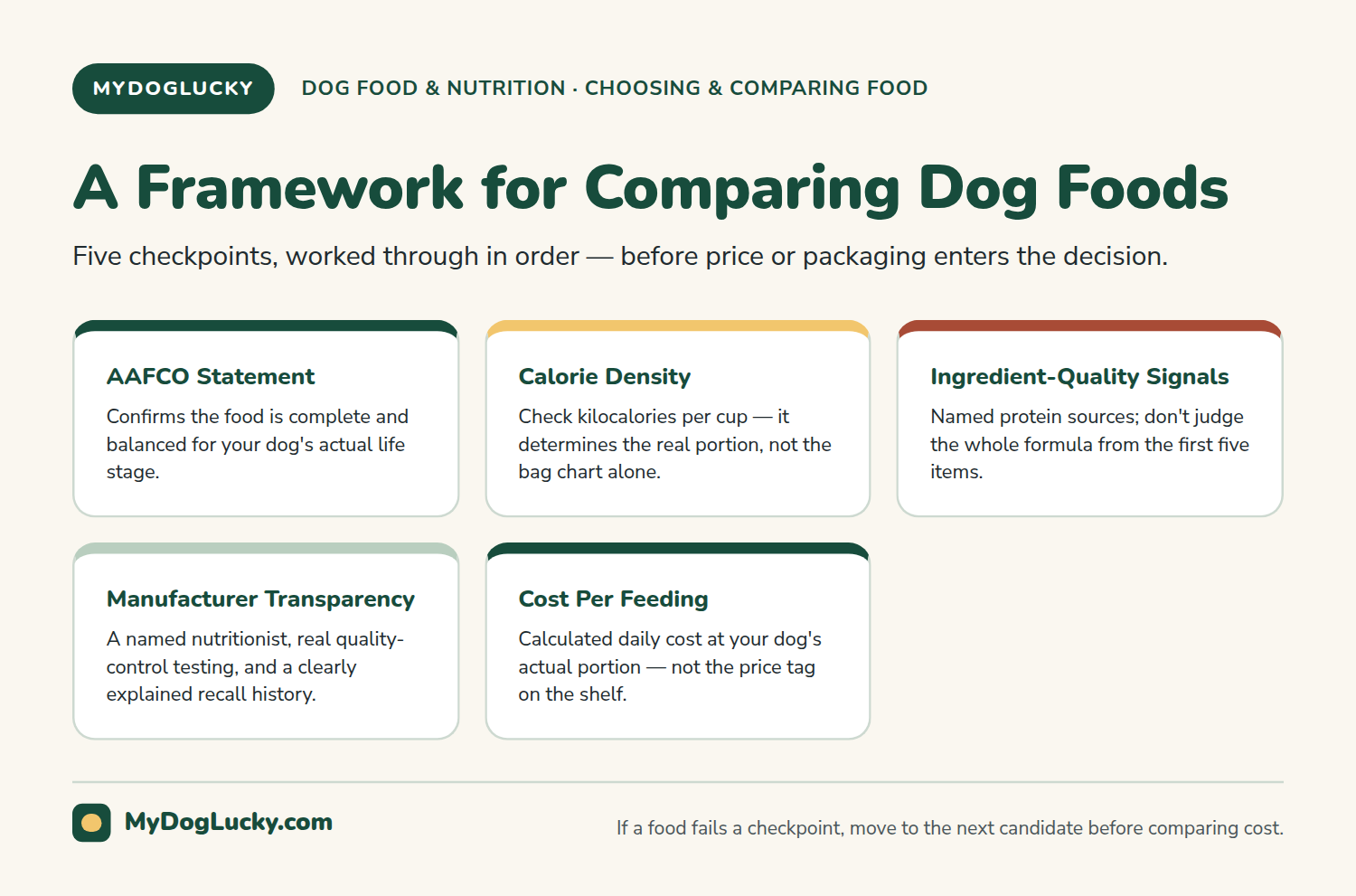
Step 1: Start With the AAFCO Nutritional Adequacy Statement
This is the single most important line on any dog food label, and it’s usually printed in small type near the guaranteed analysis panel. It tells you two things: which life stage the food is formulated for, and how that claim was substantiated.
Life stage falls into one of three categories. “Growth” foods are formulated for puppies. “Maintenance” foods are formulated for healthy adult dogs. “All life stages” foods meet the more demanding growth profile, so they technically cover puppies and adults alike, though that doesn’t automatically make an all-life-stages food the right calorie load for a sedentary senior.
Substantiation comes in two common forms. A formulation statement means the recipe was calculated on paper to meet AAFCO’s published nutrient profiles for that life stage. A feeding trial statement means the food was also fed to a group of dogs under AAFCO’s testing protocol and shown to support normal health markers over that trial. Both are legitimate paths to “complete and balanced.” Feeding-trial substantiation is generally considered the stronger form of real-world evidence, because it demonstrates the food performed adequately in actual dogs, not only on a nutrient spreadsheet — but a formulation-based food that meets AAFCO’s profiles isn’t disqualifying on its own.
If a bag has no nutritional adequacy statement at all, or the statement says the food is intended for “intermittent or supplemental feeding only,” treat that as a hard stop. That product isn’t meant to be a dog’s whole diet, whatever the front-of-bag marketing implies.
One label detail worth watching for: terms like “senior,” “weight management,” or “large breed” often appear on the front of a bag without changing the underlying nutritional adequacy statement at all. A “senior” formula, for example, is frequently just a maintenance-adequacy food with a lower calorie count and a different marketing wrapper, not a separately regulated life stage under AAFCO’s current categories. That’s not necessarily a problem — a lower-calorie maintenance food can be exactly right for a less active older dog — but it’s worth knowing that the word “senior” on the front doesn’t carry the same regulatory weight as the adequacy statement itself.
A third, less common substantiation path exists too: a comparative statement, where a manufacturer shows a product is nutritionally similar to another formula that’s already been feeding-trial tested. It’s used less often than formulation or feeding-trial statements, but it’s still a legitimate AAFCO pathway if you come across it.
Step 2: Read the Ingredient List Like a Label, Not a Marketing Pitch
Ingredients are listed by weight before cooking, which is a detail that trips up a lot of shoppers. A wet ingredient like fresh chicken can list first by sheer water weight, even if a drier ingredient further down the list contributes more actual protein once moisture is removed during processing. That’s not necessarily deceptive; it’s just how the rule works, and it means ingredient order alone is a weaker signal than most shoppers assume.
A related trick worth knowing: some formulas “split” a single ingredient category — peas, for instance — into pea protein, pea starch, and pea fiber, each listed separately. Splitting can push a meat ingredient higher on the list than the food’s actual protein balance would suggest if all the pea-derived ingredients were combined into one line. Neither practice is automatically a red flag, but both are reasons to read past the first three ingredients rather than judging a whole formula on them.
For the full breakdown of how to parse a label line by line — named proteins versus vague “meat by-products,” what AAFCO ingredient definitions actually require, and how to spot filler versus functional ingredients — see the companion MyDogLucky article, “How to Read Dog Food Labels.” The short version for this step: look for named, identifiable protein and fat sources, be skeptical of a formula that leans on “grain-free” or “no [ingredient]” as its main quality claim rather than on what’s actually in the bag, and treat an ingredient list you genuinely can’t parse as a reason to ask more questions, not a reason to assume the worst or the best.
The ingredient list works alongside another panel on the bag, the guaranteed analysis, which lists minimum crude protein and fat and maximum crude fiber and moisture as percentages. It’s a useful cross-check, not a replacement for the ingredient list: two foods can show similar guaranteed-analysis percentages while sourcing those nutrients from very different ingredients, and the ingredient list is where that difference actually shows up.
It’s also worth separating two different concerns that often get blurred together: ingredient quality and ingredient fear. A named ingredient you don’t recognize by name isn’t automatically inferior to one you do; plenty of nutritionally sound ingredients have unfamiliar or clinical-sounding names. The literacy skill worth building is asking what an ingredient contributes to the diet, not whether it sounds appealing on a label.
Step 3: Check the Manufacturer’s Track Record
The recipe on the bag only tells part of the story. Who makes it, and how consistently, matters just as much for a food you’ll be feeding for months or years.
Start with recall history. The FDA maintains a public recalls and withdrawals database that lists current and past pet food recalls along with the stated reason and the responsible company. A single past recall isn’t automatically disqualifying — it can reflect a company that caught and reported its own problem, which is the system working as intended. A pattern of repeated recalls, or a company that’s slow and vague in its public communication when something does go wrong, is a meaningfully bigger flag than one isolated event years ago.
Next, look at who actually develops the recipe. The World Small Animal Veterinary Association’s Global Nutrition Committee recommends checking whether a manufacturer employs a nutritionist with a PhD in animal nutrition, or one who’s board-certified through the American College of Veterinary Nutrition or the European College of Veterinary and Comparative Nutrition, rather than an unspecified “team of experts.” That’s not a guarantee of superior nutrition by itself, but it’s a meaningful transparency signal.
Finally, look for what WSAVA describes as quality-practice signals: whether the company conducts its own ingredient and nutrient testing, toxicology and bacteriology screening, whether it has published research in peer-reviewed journals, and whether its contact information is easy to find if you have a specific nutrient question.
A useful test
Call or email the manufacturer and ask a specific question: the calorie content per cup, the exact source of a named ingredient, or whether a board-certified nutritionist reviewed the formula. A company that answers clearly is showing you something real. A company that dodges, or that can’t produce a straight answer, is also showing you something real.
A manufacturer’s track record matters because a recipe that looks like the best dog food on paper can still come from a company whose quality control, communication, or recall response record makes it a poor long-term bet. Company size isn’t a reliable shortcut here in either direction. A large, established manufacturer isn’t automatically more trustworthy just because it’s been around for decades, and a smaller or newer company isn’t automatically riskier just because it hasn’t. What matters is whether the specific company, regardless of size, can answer the questions above with real substance rather than vague reassurance.
Step 4: Match the Food to Your Individual Dog
This is the step that makes “best” a genuinely individual question, and it’s where a lot of otherwise-solid foods get ruled in or out.
Breed size and life stage. Large- and giant-breed puppies need growth formulas with controlled calcium and calorie levels to support steadier skeletal development; feeding a standard growth formula sized for a small-breed puppy can deliver more calcium and calories than a big, fast-growing frame needs. Small-breed adults, by contrast, often do better on calorie-dense kibble sized small enough for a smaller jaw.
Activity level. A dog who runs trails most days and a dog who naps most of the day can weigh exactly the same and still need meaningfully different calorie and protein levels. The “maintenance” life stage on a label doesn’t distinguish between them; your dog’s actual daily activity does.
Health conditions. Kidney disease, a history of urinary crystals, pancreatitis, diabetes, and several other conditions shift what “right” nutrition looks like, sometimes substantially. A dog with a diagnosed medical condition needs a food chosen with, not independently of, a veterinarian’s input — this is one area where the framework above sets the floor, but doesn’t replace professional guidance.
Known allergies or sensitivities. True food allergies are less common than most owners assume, and confirming one usually requires a structured process rather than an ingredient-avoidance guess. More on that in the FAQ section below.
It helps to write these four factors down for your specific dog before you start comparing bags — his current life stage, his rough activity level on a normal week, any diagnosed conditions, and any confirmed sensitivities. Shopping with that short list in hand, rather than trying to hold it all in your head while standing in a noisy aisle, makes Step 4 dramatically faster and less prone to impulse decisions driven by whichever bag has the most appealing photo of a dog on the front.
Once a food clears all four checkpoints — adequacy statement, ingredient literacy, manufacturer track record, and individual fit — you’ve got a legitimate finalist. That’s the moment to bring in the numbers that decide between finalists: calories and cost.
Matching Portions and Calories to Your Dog’s Actual Needs
Even a well-chosen food can cause problems if the portion is wrong. Overfeeding a genuinely good food is still overfeeding, and gradual weight gain is one of the more common nutrition-related issues veterinarians see in everyday practice.
Why the Feeding Chart on the Bag Is Just a Starting Point
The feeding chart printed on most bags assumes an average dog at a given weight. Real dogs vary. Activity level, spay or neuter status, metabolism, and age can all shift actual calorie needs well outside that printed average, in either direction. A neutered dog, for instance, generally needs somewhat fewer calories than an intact dog at the same body weight, and the bag chart usually doesn’t distinguish between them.
For the full calculation — how to estimate your dog’s daily energy needs using his weight and activity level, and how to translate that into an actual cup or gram measurement for a specific food — see the companion article “How Much Should I Feed My Dog.” The chart on the bag is a reasonable starting point. It isn’t a substitute for calculating your own dog’s number and adjusting from there.
Treats and toppers count too, and they’re the piece most owners forget to track. A handful of training treats during a practice session, a spoonful of a food topper, and a “just a taste” of whatever’s on the counter can add up to a meaningful share of a small dog’s daily calories without ever showing up in the math from the feeding chart. As a rough guideline, treats and extras are generally kept to around ten percent or less of total daily calories, with the base food adjusted down slightly to make room for them rather than stacked on top of a full portion.
Puppies add another layer: their calorie needs per pound of body weight are meaningfully higher than an adult dog’s, and that need shifts again as growth slows heading toward adulthood. A growth-formula feeding chart, adjusted over time as your puppy grows, matters more here than it does for a weight-stable adult, which is one more reason the adequacy statement from Step 1 and the actual growth chart on a puppy formula deserve real attention rather than a quick glance.
Body Condition, Not the Bag, Is Your Reality Check
Whatever number a calculator or bag chart gives you, your dog’s actual body condition is the tiebreaker. With a hand on his ribs, you should be able to feel them easily under a slight layer of fat, without heavy pressure. Looking from above, most dogs should show a visible waist behind the ribs. From the side, most dogs should show some abdominal tuck up toward the hind legs.
Recheck body condition every couple of weeks after starting a new food or adjusting a portion, rather than waiting months to notice a trend. Adjust the amount in small increments — around ten percent up or down — instead of making dramatic swings, and give any change a few weeks to show a real trend before adjusting again. If your dog’s weight isn’t responding the way you’d expect after a reasonable trial, loop in your veterinarian rather than continuing to guess.
A calculator gets you in the right neighborhood. Body condition, watched consistently over time, is what fine-tunes it for your actual dog.
Cost-Per-Feeding vs. Cost-Per-Bag: The Math That Actually Matters
Here’s where a lot of otherwise-careful comparisons go wrong: shoppers compare the price tag on the shelf, not what it actually costs to feed a dog for a day or a month. Those two numbers can tell very different stories, because price per bag depends on two things — the price itself, and how calorie-dense the food is, meaning how much of it you actually need to feed.
A Worked Example (Illustrative Numbers, Not Real Brands or Prices)
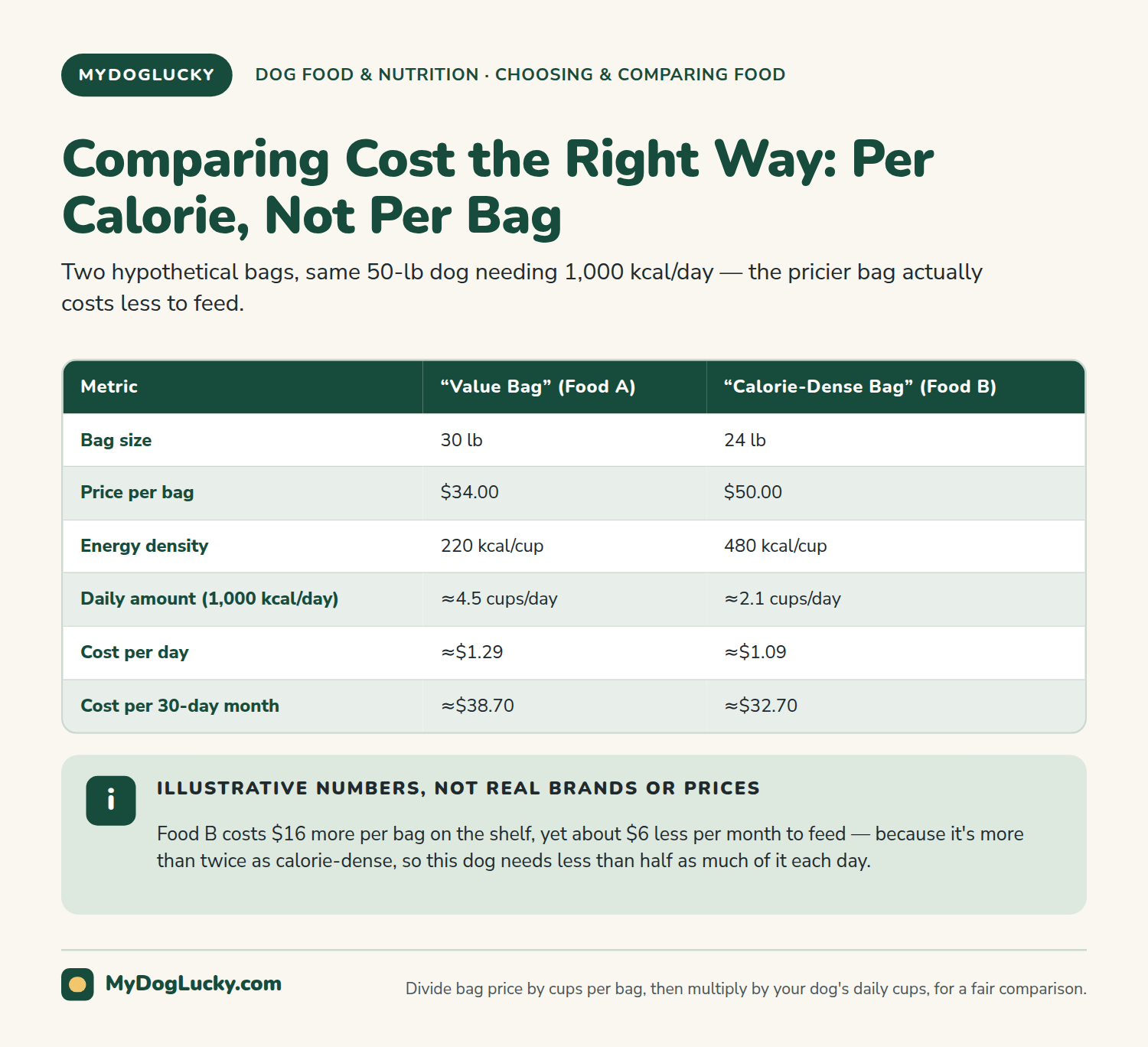
The numbers below are made up for illustration only — they don’t represent any real product, brand, or current price. Picture two bags, both complete and balanced for adult maintenance, both feeding the same 50-pound, moderately active dog who needs roughly 1,000 calories a day.
| Metric | “Value Bag” (Food A) | “Calorie-Dense Bag” (Food B) |
|---|---|---|
| Bag size | 30 lb | 24 lb |
| Price per bag | $34.00 | $50.00 |
| Energy density | 220 kcal/cup | 480 kcal/cup |
| Approx. cups per bag | ~120 cups | ~96 cups |
| Cost per cup | ~$0.28 | ~$0.52 |
| Dog’s daily amount (1,000 kcal/day) | ~4.5 cups/day | ~2.1 cups/day |
| Cost per day | ~$1.29 | ~$1.09 |
| Cost per 30-day month | ~$38.70 | ~$32.70 |
Notice what happened. Food B costs $16 more per bag on the shelf, and most shoppers would walk past it for that reason alone. But because it’s more than twice as calorie-dense, this dog needs less than half as much of it per day. Once you do the math, Food B actually costs about six dollars less per month to feed, despite the higher sticker price. A cheaper bag that requires a bigger daily portion can genuinely cost more to feed than a pricier, calorie-denser one — that’s the whole lesson, and it’s easy to miss if you only glance at the shelf tag.
Where the Sticker Price Can Mislead You
The reusable version of the math above is simple: divide the bag price by the number of cups in the bag to get cost per cup, then multiply by your dog’s actual daily cups (from the calorie step above) to get cost per day. Do that for every finalist before deciding based on price alone.
Price per pound alone doesn’t tell you cost per day either, for the same reason — it ignores calorie density. A more calorie-dense formula often costs more per pound but less per day, because you feed less of it. That relationship isn’t universal, though; some calorie-dense foods are priced high enough per pound that they cost more per day too, which is exactly why running your own numbers beats assuming a pattern always holds.
One caution worth flagging here: if you switch to a more calorie-dense food and keep using your old scoop or cup measurement out of habit, you’ll likely overfeed. A calorie-dense food needs a smaller portion, not the same portion as before. That’s a common, easy-to-miss cause of gradual weight gain after a food switch, and it connects directly back to the body-condition check covered above.
A few other real-world cost factors are worth folding into your comparison, even though they didn’t show up in the illustrative table. Buying a larger bag size usually lowers the cost per pound somewhat, but only if your household can realistically use it before it goes stale — a giant bag that sits open for months isn’t a bargain if the fat in the food oxidizes and the food loses palatability before you’re halfway through it. Auto-ship or subscription discounts offered by many retailers can meaningfully lower the effective price per bag as well, and they’re worth checking once you’ve settled on a finalist, though they shouldn’t be the deciding factor while you’re still comparing options on nutritional merit.
Build Your Own Dog Food Comparison Table
With the framework, the calorie math, and the cost math in hand, the last piece in narrowing down the best dog food for your household is putting your actual finalists side by side. Below is a worksheet structure, not a populated ranking — fill it in yourself with the real foods and real numbers you’re comparing, since those specifics are exactly what make a food the right or wrong fit for your dog.
| Criterion | What “Good” Typically Looks Like | Your Notes |
|---|---|---|
| Life-Stage Match | AAFCO statement names your dog’s actual life stage (growth, maintenance, or all life stages) and, for puppies, matches expected adult size | Fill in what you find |
| Ingredient-Quality Signals | Named, identifiable protein and fat sources; a list you can actually parse; no reliance on a single “free-from” claim as the main quality pitch | Fill in what you find |
| Manufacturer Transparency | Clean or well-explained recall history on FDA’s recall page; clear answers about nutritionist involvement and formulation vs. feeding-trial substantiation | Fill in what you find |
| Price Tier (cost per feeding, not per bag) | Calculated cost per day at your dog’s actual portion, using the formula above, not the shelf price alone | Fill in what you find |
Run two or three real finalists through this table before deciding. If two foods tie on every row, the practical tiebreaker isn’t a marketing claim — it’s how your own dog does on it. Stool quality, coat condition, energy level, and steady body condition over several weeks of consistent feeding tell you more about real-world fit than any label ever will. Give a new food a fair trial of several weeks before judging it, and change only one variable at a time so you can tell what actually caused a change.
Keep a simple record as you go, even something as basic as a note on your phone: the date you started a food, the portion you settled on, and anything you noticed. That small habit pays off twice over — it gives your veterinarian something concrete to look at during a wellness visit, and it saves you from re-litigating the same comparison from memory the next time a bag runs low.
Common Mistakes When Comparing Dog Foods
A few patterns show up again and again once owners start seriously searching for the best dog food for their situation. Most are easy to avoid once you know to watch for them.
Chasing Ingredient Trends Without Evidence: The Grain-Free and DCM Story
This is the clearest real-world example of why trend-chasing without evidence carries genuine risk, and it’s worth walking through accurately rather than as a scare story or a dismissal.
In 2018, the FDA opened an investigation into a possible association between certain diets — most often labeled grain-free — and dilated cardiomyopathy, a disease in which the heart muscle weakens and struggles to pump blood effectively. What caught the agency’s attention was that dogs from breeds without a typical genetic predisposition to DCM, including Golden Retrievers, were showing up in reports. Between January 2014 and April 2019, the FDA received 524 reports of DCM in dogs and cats, with 119 documented canine deaths. Over 91% of the reported diets were grain-free, roughly 93% contained peas or lentils, and about 42% contained potatoes as a listed ingredient.
The FDA has been careful about what those numbers do and don’t prove. In its own words, “adverse event numbers can be a potential signal of an issue with an FDA regulated product, but by themselves, they do not supply sufficient data to establish a causal relationship.” In December 2022, the agency paused its regular public updates on the investigation, stating it wouldn’t release further updates “until there is meaningful new scientific information to share.” That means the investigation remains technically open, just without a steady drumbeat of new agency announcements since then — worth knowing if you’ve seen headlines that sound more settled than the science actually is.
Research has continued outside the FDA’s own updates, though. According to a June 2026 update from Tufts University’s Cummings School Clinical Nutrition Service, the accumulating evidence — more than thirty published studies at this point — points toward diets high in pulse ingredients (peas, lentils, chickpeas, and beans) as the sharper common factor, rather than the simple absence of grain. That distinction matters: some grain-inclusive diets are also high in pulses, and the concern isn’t unique to grain-free formulas specifically.
The Tufts update also notes the condition doesn’t appear to be caused by a lack of grain itself or by taurine deficiency, and that researchers have identified a urine biomarker suggesting phospholipidosis — an abnormal type of fat metabolism — as a possible underlying mechanism, an active area of ongoing research. Importantly, diet-associated DCM can improve, sometimes significantly, once the diet is changed, especially when it’s caught early.
What this means in practice, not in panic
This doesn’t mean every grain-free diet is dangerous, or that a dog eating one will develop heart disease. It means “grain-free” alone isn’t a meaningful nutritional quality signal, and choosing a diet based mainly on the absence of a single ingredient category — without evidence that the substitution benefits your specific dog — carries a real, if still not fully defined, risk. If your dog already eats a grain-free or high-legume diet and you’re concerned, talk with your veterinarian rather than switching cold based on a label claim. And any dog showing unusual tiredness, weakness, a new cough, or labored breathing deserves a prompt veterinary visit, not an internet self-diagnosis.
You may also see this category of diets described in veterinary cardiology discussions under the informal shorthand “BEG diets” — boutique companies, exotic ingredients, or grain-free formulas — a term that predates the more precise pulse-ingredient research described above. The shift from that broader shorthand toward pulse ingredients specifically is a good example of how nutrition science tends to move: an early, broad signal gets narrowed and refined as more data comes in, and the responsible response is to update the guidance, not to declare the original concern either fully confirmed or fully debunked.
The broader lesson extends past grain-free specifically. Any ingredient trend — a new “superfood” addition, a novel protein fad, an aggressive “free-from” marketing claim — deserves the same question: what’s the actual evidence that this change benefits dogs in general, or your dog specifically, rather than just following a consumer trend that outran the research behind it?
Assuming “Expensive” Means Better or “Cheap” Means Worse
Price reflects a lot of things beyond nutritional quality: ingredient sourcing costs, packaging, marketing spend, and retail markup all factor into a shelf price. None of those guarantee superior nutrition on their own, and a high price tag doesn’t automatically mean a food is a better metabolic fit for your dog.
The reverse assumption is just as shaky. A lower-cost food that clears AAFCO’s adequacy statement, has a clean or well-explained recall history, and fits your dog’s life stage isn’t automatically inferior just because it’s inexpensive. Cost becomes a meaningful comparison point only after a food has already cleared the four framework steps above — not before. The cost-per-feeding example earlier in this guide is proof of how unreliable a raw price tag can be, in either direction, once you actually run the numbers.
Switching Foods Too Fast
A sudden, full switch from one food to another commonly causes loose stool or GI upset, even between two perfectly good foods. The standard approach is a gradual transition over roughly a week: mixing in a small amount of the new food alongside the old one, then gradually increasing that ratio day by day. Dogs with a history of sensitive digestion often do better with an even slower transition. Watch stool consistency and energy level during the switch, and slow down further if you see ongoing upset rather than pushing through on the original schedule.
Trusting Marketing Words Without Follow-Up Questions
Words like “premium,” “natural,” “holistic,” and “human-grade” carry very different levels of actual regulatory meaning. Some have loose definitions under AAFCO guidance; “human-grade” carries specific requirements involving the entire production facility, not just the ingredients; others carry essentially no enforced meaning at all. The useful response isn’t blanket distrust of every such word — it’s treating each one as a claim worth verifying against the framework above (adequacy statement, ingredients, manufacturer transparency) rather than accepting it as the whole answer.
Letting a Single Online Review Make the Decision
A glowing review, or a horror-story review, about a particular food tells you about one dog’s experience, not a reliable pattern. Dogs vary enormously in how they respond to a given formula, and a single account — however dramatic or however sincere — carries less evidence weight than the four-step framework above, run carefully against your own dog. Reviews can be a useful prompt to investigate further (a recurring complaint about the same issue across many unrelated reviewers is worth noting), but they’re a starting point for questions, not a substitute for checking the adequacy statement, the ingredient list, and the manufacturer’s actual track record yourself.
When to Loop In Your Veterinarian
The framework above is built for a healthy dog without complications, where the biggest risk of picking “wrong” is a mediocre fit rather than a medical setback. Several situations call for a veterinarian’s involvement before or during any diet decision, not just the framework alone, because the best dog food for a medically complicated dog is a clinical decision as much as a shopping one.
Bring your vet in for these
- Any diagnosed health condition — kidney disease, liver disease, pancreatitis history, heart disease, diabetes, or a history of urinary crystals or stones.
- A suspected food allergy or intolerance, rather than just trying an “allergy-friendly” formula speculatively.
- Before a major diet change for a puppy, a senior dog, or a dog with a complex medical history.
- Unexplained weight change, GI signs lasting more than a day or two, or new signs like unusual tiredness, weakness, coughing, or labored breathing.
- Multi-pet households where a therapeutic diet needs to be fed exclusively, without another pet’s food being accessible.
A quick way to make that conversation more useful: bring the current food’s label (or a photo of it), the amount you’re actually feeding, how long your dog has been on it, and a timeline of any recent changes or new symptoms. That gives your veterinarian a fuller, more accurate picture in a few minutes than a memory-based recap usually manages in the exam room.
None of this means a healthy adult dog needs veterinary sign-off on every bag purchase. It means the stakes go up, and the framework above stops being sufficient on its own, once a specific health condition, a suspected allergy, or a major life-stage transition enters the picture.
It’s also worth mentioning at your dog’s regular wellness visit, even without a specific concern prompting it, whenever you’ve changed foods since the last appointment. A quick note in your dog’s record and a look at his current body condition gives your veterinarian a chance to catch a mismatch early, long before it turns into a bigger problem, and it costs you nothing beyond a sentence at the start of the appointment.
Frequently Asked Questions About Choosing the Best Dog Food
Is the most expensive dog food always the best choice?
No. Price reflects ingredient sourcing, packaging, marketing spend, and retail markup, not just nutritional quality. A higher price doesn’t guarantee a food is complete and balanced for your dog, free of recall history, or a better metabolic fit than a less expensive option. Run any food through the four-step framework above regardless of price tier, and compare actual cost per feeding — not the number on the shelf tag — once you’ve narrowed to finalists that already clear the basics. A mid-priced or budget-tier food that passes every step of the framework is a genuinely sound choice, not a compromise you should feel apologetic about.
What does “complete and balanced” mean on a dog food label?
It means the food meets AAFCO’s nutrient minimums, and in some cases maximums, for a specific stated life stage, either through formulation to published nutrient profiles or through feeding trials using AAFCO’s testing procedures. Look for the nutritional adequacy statement, usually printed in small type near the guaranteed analysis panel, and confirm the life stage it names actually matches your dog.
Should I choose grain-free dog food to avoid DCM?
Not automatically. The FDA’s ongoing investigation into diet-associated DCM hasn’t established that grain-free food itself causes the disease, and current research points more specifically toward diets high in peas, lentils, and other pulse ingredients — a category that includes some grain-inclusive diets too — as the sharper common factor. If your dog already eats a grain-free or legume-heavy diet and you’re concerned, talk with your veterinarian rather than switching foods based on the label claim alone. If your dog has no digestive or allergy-related reason to avoid grain in the first place, there’s no strong evidence-based reason to seek out a grain-free formula purely on the assumption that it’s a healthier default.
How do I know if a dog food has had a recall?
Check the FDA’s recalls and withdrawals page directly. It lists current and archived pet food recalls with the stated reason and the responsible company. A single past recall isn’t automatically disqualifying — it can reflect a company catching and reporting its own problem — but a pattern of repeated recalls, or vague public communication when something does go wrong, is a meaningfully bigger flag worth weighing in Step 3 of the framework above.
Is wet food better than dry food, or vice versa?
Neither format is inherently superior. The real tradeoffs — moisture content, cost per calorie, dental effects, convenience, and palatability — depend on your dog and your household routine. That comparison gets its own full breakdown in “Wet vs. Dry Dog Food.” For the purposes of choosing a best-fit food, the same four-step framework applies to either format equally.
Do I need a prescription or veterinary diet if my dog doesn’t have a diagnosed condition?
Generally, no. Therapeutic diets are formulated for specific medical conditions and aren’t automatically a nutritional upgrade for a healthy dog. Feeding one without a diagnosed need can under- or over-deliver certain nutrients relative to what a healthy dog actually requires. Reserve that category of food for a dog whose veterinarian has recommended it for a specific medical reason.
How often should I switch or rotate my dog’s food?
There’s no fixed schedule that fits every dog. Some dogs do fine with an occasional planned change; others, especially dogs prone to GI sensitivity, do better staying on one well-matched food for extended stretches. When you do switch, transition gradually over about a week rather than all at once, and treat frequent unplanned switching — chasing whatever’s newest or on sale — as a mistake worth avoiding, covered earlier in this guide.
What’s the difference between a feeding trial and a formulated diet?
A formulated diet is calculated on paper to meet AAFCO’s published nutrient profiles for a given life stage. A feeding-trial diet has additionally been fed to a group of dogs under AAFCO’s testing protocol and shown to support normal health markers over that trial period. Both paths can produce a legitimately complete and balanced food; a feeding trial is generally considered the stronger form of real-world substantiation, since it demonstrates the formula performed adequately in actual dogs.
Is homemade or fresh dog food automatically healthier than kibble?
Not automatically. Fresh and homemade diets can be excellent when properly formulated, but “fresh” isn’t itself a nutrient guarantee, and a homemade recipe pulled from the internet without a board-certified nutritionist’s input frequently falls short on key nutrients over time. “Fresh Dog Food vs. Kibble” covers that comparison in more depth. The same four-step framework — adequacy statement, ingredients, source transparency, and individual fit — still applies to fresh and homemade options. If you’re set on a homemade approach, a consultation with a board-certified veterinary nutritionist to formulate or review the recipe is a worthwhile investment, since even well-intentioned homemade diets commonly run short on calcium, specific vitamins, or overall calorie balance.
How do I choose food for a dog with a suspected food allergy?
Start with your veterinarian rather than guessing your way through ingredient avoidance at the pet store. True food allergies are less common than most owners assume, and confirming one typically requires a structured elimination diet using a novel or hydrolyzed protein source under veterinary guidance, not a bag that simply advertises “limited ingredient” or excludes a popular allergen.
The Bottom Line on Choosing a Dog Food
There’s no single best dog food, and any list that claims otherwise is selling certainty it can’t actually back up. What you can do is run any candidate through a real process: check the AAFCO nutritional adequacy statement, read the ingredient list with a critical eye rather than a fearful one, look into the manufacturer’s track record, and match the formula to your dog’s actual size, age, activity, and health needs.
Once a food clears those checkpoints, calculate what it really costs to feed — cost per day, not price per bag — and compare your real finalists using the worksheet above. Give your veterinarian a seat at the table for anything involving a diagnosed condition, a suspected allergy, or a major change for a medically complex dog.
It’s fair to feel a little skeptical of an article that refuses to just hand you an answer. That skepticism is healthy, and it’s exactly the instinct this framework is built to reward: question the claim, check the source, do the math yourself. A shortcut that skips those steps might save you twenty minutes today, but it’s the same shortcut that leaves owners feeding a mismatched food for months, or paying more than necessary, without ever realizing it.
Pick two or three finalists this week, run them through that process, and give your veterinarian the chance to weigh in before the current bag runs out. That’s a more useful outcome than any ranked list could ever hand you.
Sources
- Association of American Feed Control Officials (AAFCO). Reading Labels
- World Small Animal Veterinary Association (WSAVA) Global Nutrition Committee. Guidelines on Selecting Pet Foods, Global Nutrition Toolkit (updated 2021)
- U.S. Food and Drug Administration, Center for Veterinary Medicine. FDA Investigation into Potential Link Between Certain Diets and Canine Dilated Cardiomyopathy
- U.S. Food and Drug Administration. Recalls & Withdrawals
- Tufts University Cummings School of Veterinary Medicine, Clinical Nutrition Service. Update on Diet-Associated Dilated Cardiomyopathy: June 2026, Petfoodology
- American Kennel Club. What Dog Owners Need to Know About the FDA’s Grain-Free Diet Alert and DCM
This article is general education for U.S. dog owners and does not recommend, rank, or endorse any specific commercial dog food brand or product. It is not individualized nutrition or veterinary advice for your dog. Any diagnosed health condition, suspected food allergy, or major diet change for a puppy, senior, or medically complex dog should be discussed with your veterinarian before you switch foods.






Trackbacks/Pingbacks