
The best dog toys aren’t the ones with the most five-star reviews. They’re the ones matched to your specific dog: his chewer type, his play style, and his actual size. A toy that thrills a Labrador who reduces a stuffed toy to fluff in seconds would bore a senior Chihuahua. She just wants a soft squeaker to carry around.
This guide skips the ranked “top 10” list. Instead, it gives you a repeatable method. Figure out your dog’s chewer type and play style. Run a quick safety test on anything before it goes unsupervised. Then size it correctly, and build a small rotation that actually holds up.
You’ll get a matrix to match toy categories to your dog. You’ll also get a five-minute test you can run on anything you buy, plus budget-friendly options at every price point.
What’s in this guide
- What are the best dog toys? The quick answer
- Why “best” depends on your dog, not the packaging
- Find your dog’s chewer type
- Find your dog’s play style
- Matching toy categories to chewer type and play style
- The five-minute toy safety test
- How to read a toy’s durability claims
- Getting the size right
- Materials worth understanding
- Rawhide and edible chews: what to know
- Choosing a puzzle toy by difficulty level
- Toy categories by chewer type
- Dog toys on a budget
- Introducing and testing a new toy at home
- Rotating and retiring toys
- Traveling and crating with toys
- What to do with a toy you no longer trust
- Toys for specific situations
- Red flags that mean walk away
- Common dog toy buying mistakes
- Signs a toy has done its job
- Your dog toy buying checklist
- Common questions about choosing dog toys
- Sources
What are the best dog toys? The quick answer
The best dog toys match three things. How hard your dog chews, how he likes to play, and his actual mouth and body size all factor in. There’s no single winner that works for every dog. A rope-tug lover and a solo chewer need completely different toys, even if they’re the same breed and size.
Start by identifying your dog’s chewer type and play style below. Then use the safety test before anything goes unsupervised, and size it correctly. Rotate a small set rather than buying one of everything.
Why “best” depends on your dog, not the packaging
A label that says “indestructible” or “vet recommended” isn’t independently verified before that toy reaches a shelf. Unlike children’s toys, pet toys in the US have no mandatory federal safety standard of their own. The American Pet Products Association puts it plainly. “There are virtually no federal or state laws which expressly apply solely to the manufacture and sale of pet toys.” The Consumer Product Safety Commission has said it lacks the mandate to regulate pet products routinely. It only steps in once someone is actually injured.
The label isn’t a safety guarantee
Some manufacturers do voluntarily test against children’s-toy standards for things like lead content, mostly because retailers ask for it. But there’s no equivalent of a car seat’s crash rating for dog toys. That gap is exactly why the selection and testing method in this guide matters more than any packaging claim.
That doesn’t mean every toy on the market is dangerous. It means the responsibility for matching a toy to your dog sits with you, not a regulator. So does checking it before you trust it.
That’s also why a ranked “best dog toys” list can mislead more than it helps. The toy that tops a review roundup may have been tested on a completely different chewer type than yours. The method in this guide travels with you to any store or listing, which a fixed ranking never can.
Find your dog’s chewer type
Veterinary professionals generally sort dogs into three chewing styles. Most dogs fall clearly into one type. Some shift depending on mood, boredom level, or the specific toy in front of them.
Passive chewers
He mouths, carries, and gently gnaws a toy without much destructive intent. Stuffed toys can survive weeks or months. This dog rarely needs the toughest materials on the market.
Moderate chewers
He chews with real enthusiasm and will eventually wear down or destroy a soft toy. He usually stops short of swallowing large pieces, but supervision still matters for anything new.
Aggressive or power chewers
He can reduce a standard toy to pieces within minutes and will attempt to swallow chunks. This dog needs the most durable materials and the closest supervision. Size the toy one step up from what the packaging suggests.
Not sure which type your dog is?
Treat him as a moderate-to-aggressive chewer until a few supervised sessions tell you otherwise. It costs a little more upfront and prevents a nasty surprise with a cheaper, softer toy.
A quick self-assessment
Give a passive chewer’s toy to your dog and watch one short session. Check off whatever applies.
- He carries the toy around more than he chews it.
- A soft toy has survived more than a week without damage.
- He works at a toy steadily rather than attacking it in bursts.
- He’s tried to swallow a piece he tore off before.
- He’s destroyed a “durable” toy within a single session.
Mostly the first three: you likely have a passive-to-moderate chewer. Either of the last two, even once: treat him as a power chewer from here on.
Find your dog’s play style
Chewer type tells you what a toy needs to survive. Play style tells you what kind of toy your dog actually wants. Most dogs are a blend of two or three.
- Fetch and retrieve. Motivated by chasing and bringing something back. Balls, flying discs, and launchable toys fit here.
- Tug and wrestle. Wants a toy he can grip and pull against resistance, ideally with you on the other end.
- Plush and comfort. Carries a soft toy around, sleeps near it, or treats it like a security object rather than something to destroy.
- Puzzle and forage. Motivated by working for a reward. Food puzzles and treat-dispensing toys hold his attention longest.
- Chew and settle. Wants something to gnaw on independently, often as a calming activity rather than active play.
Watch your dog with whatever toys he already owns for a week. The pattern that emerges is usually more reliable than guessing from his breed or age alone. It often surprises owners who assumed their dog was a “fetch dog” simply because that’s what they’d always offered.
Matching toy categories to chewer type and play style
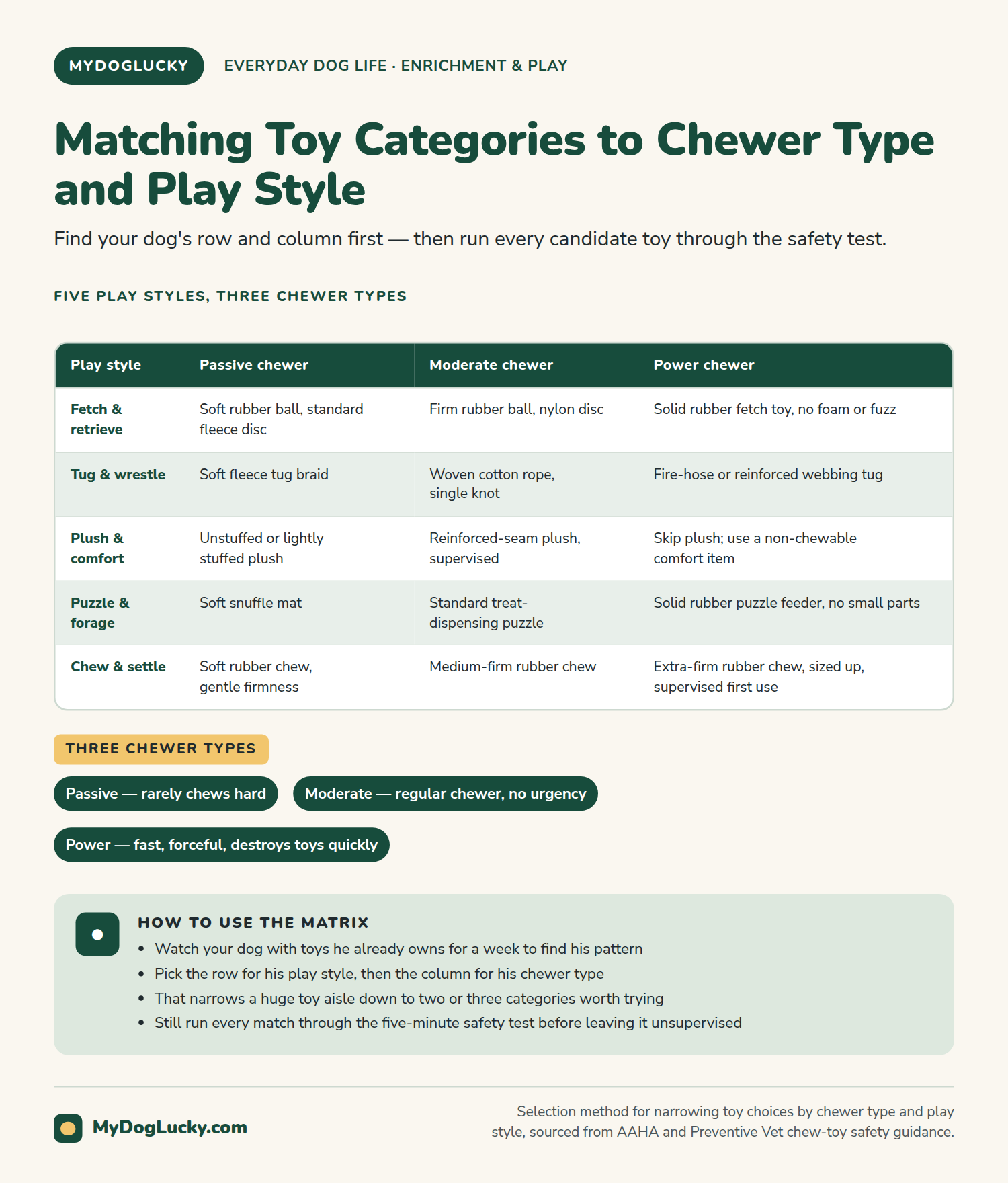
Here’s where chewer type and play style come together. Use this table to narrow a huge toy aisle down to the two or three categories worth trying first. That beats scrolling through hundreds of options with no clear filter.
| Play style | Passive chewer | Moderate chewer | Power chewer |
|---|---|---|---|
| Fetch & retrieve | Soft rubber ball, standard fleece disc | Firm rubber ball, nylon disc | Solid rubber fetch toy, no foam or fuzz |
| Tug & wrestle | Soft fleece tug braid | Woven cotton rope, single knot | Fire-hose or reinforced webbing tug |
| Plush & comfort | Unstuffed or lightly stuffed plush | Reinforced-seam plush, supervised | Skip plush; use a comfort item that isn’t chewable |
| Puzzle & forage | Soft snuffle mat | Standard treat-dispensing puzzle | Solid rubber puzzle feeder, no small parts |
| Chew & settle | Soft rubber chew, gentle firmness | Medium-firm rubber chew | Extra-firm rubber chew, sized up, supervised first use |
Pick your dog’s row and column first. Then run every candidate toy through the safety test below before you trust it unsupervised.
Putting it together: three example dogs
A worked example beats an abstract table. Here’s how the method plays out for three different dogs.
A two-year-old Labrador, power chewer, fetch-and-retrieve
Row: fetch and retrieve. Column: power chewer. That points to a solid rubber fetch toy with no foam or fuzz. A standard tennis ball fails here twice over. It’s a choking risk once worn, and the abrasive nap wears down enamel with this much use.
A ten-year-old Chihuahua mix, passive chewer, plush-and-comfort
Row: plush and comfort. Column: passive chewer. A lightly stuffed plush toy is a reasonable match here. It’s still worth the safety test and a few supervised sessions before trusting it unattended.
A one-year-old terrier mix, moderate chewer, puzzle-and-forage
Row: puzzle and forage. Column: moderate chewer. A standard treat-dispensing puzzle at the easiest difficulty setting fits well. There’s room to increase the challenge once he’s solving it with ease.
The five-minute toy safety test
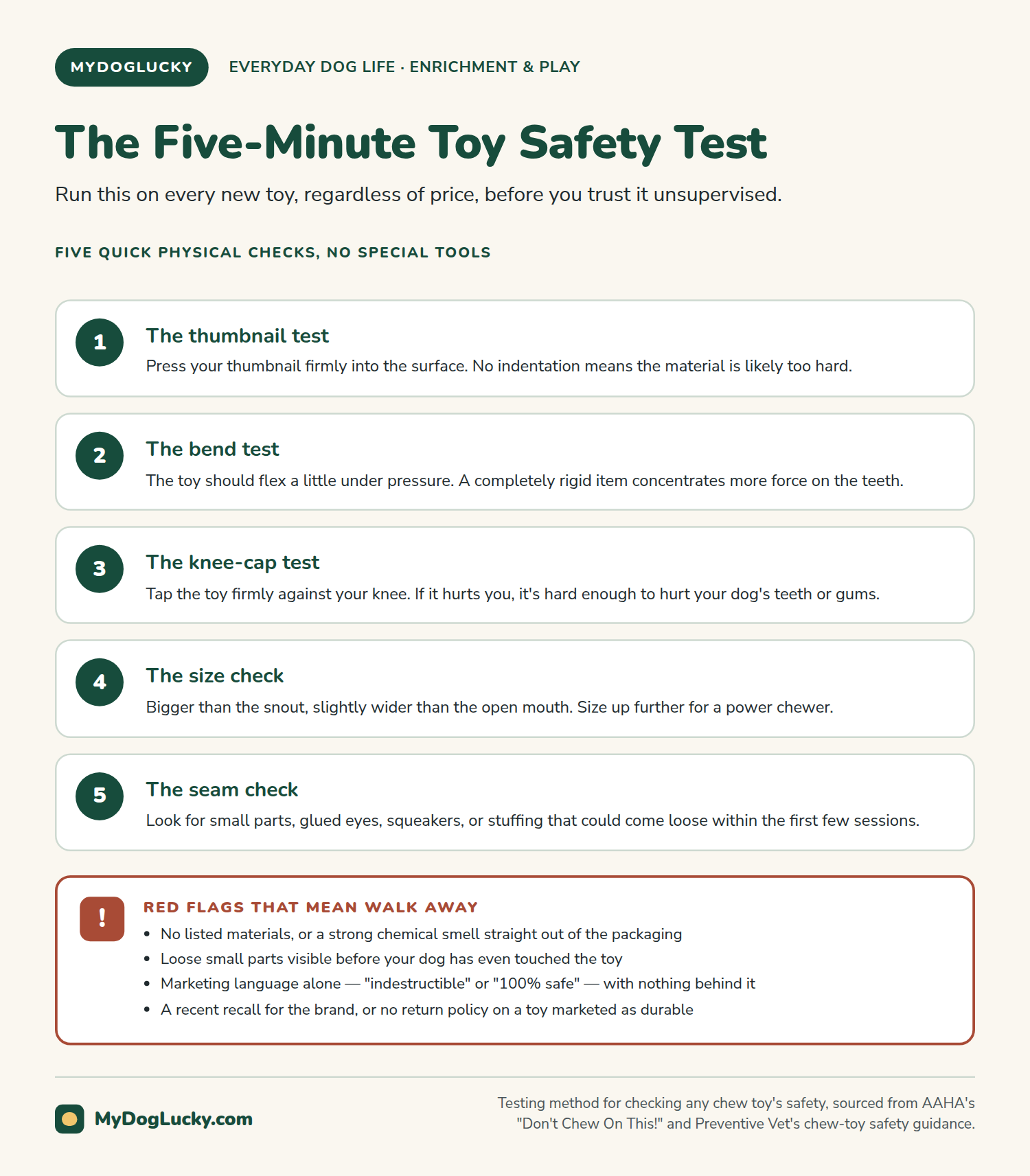
Veterinary sources describe a handful of quick physical checks. You can run them on almost any chew toy before handing it over. None require special tools, and the whole sequence takes less time than reading the product listing did.
- The thumbnail test. Press your thumbnail firmly into the toy’s surface. If it doesn’t leave any indentation, the material is likely too hard and risks a tooth fracture.
- The bend test. The toy should flex a little under pressure. A completely rigid item concentrates more force on your dog’s teeth.
- The knee-cap test. Tap the toy firmly against your knee. If it hurts you, it’s hard enough to hurt your dog’s teeth or gums too.
- The size check. The toy should be bigger than your dog’s snout and slightly wider than his open mouth. For a power chewer, size up from whatever the packaging recommends.
- The seam check. Look for small parts, glued eyes, squeakers, or stuffing that could come loose within the first few sessions.
Run this on every new toy, regardless of price
An expensive toy can fail the thumbnail or knee-cap test just as easily as a cheap one. Test first. Then decide whether it’s safe to leave with your dog unsupervised.
How to read a toy’s durability claims
Words like “tough,” “heavy duty,” and “chew-proof” aren’t standardized terms. Two brands can use the same word for very different levels of actual durability, since nothing forces a shared definition.
- “Indestructible” or “chew-proof” means nothing on its own. Run the safety test and judge for yourself.
- A hardness or difficulty rating, when a brand offers one, is more useful than a marketing adjective. It’s still self-reported by the manufacturer, though.
- Reviews mentioning your dog’s actual size and chewing style tell you more than an average star rating. That rating covers every dog that ever bought it.
- A written material list is worth more than a glossy photo. If you can’t find one, that’s itself a red flag, covered further down.
None of this replaces the physical test. A confident claim and a genuinely durable toy aren’t always the same thing. The five minutes it takes to check are cheaper than a vet visit either way.
Getting the size right
Size mistakes cause more toy-related injuries than almost anything else. Too small risks choking or swallowing. Too large can strain your dog’s jaw over repeated use.
For balls specifically, a rough starting point is about 1.75 inches across for small dogs. Medium and large breeds do better around 2.5 inches or larger. Always err larger rather than smaller if your dog sits between sizes.
| Dog size | Rough weight range | Starting ball diameter |
|---|---|---|
| Small | Under 25 lbs | About 1.75 in |
| Medium | 25–60 lbs | About 2.5 in |
| Large | Over 60 lbs | 2.5 in or larger, sized up further for a power chewer |
Treat this table as a starting point, not a rule. A dog between two sizes, or with an unusual mouth width, may need the next size up. That’s true regardless of what the chart suggests.
Bigger isn’t always safer either
An oversized, overly rigid toy can strain your dog’s jaw muscles with repeated hard chewing. Vets have linked that strain to jaw discomfort over time. Size up for safety, but keep the hardness test in mind too.
Materials worth understanding
Rubber and rigid plastic
Run the thumbnail and bend tests above. Firmness that suits a power chewer can be too hard for a passive one, and vice versa. A single “one hardness fits all dogs” product rarely exists, whatever the packaging implies.
Tennis balls
The fuzzy “nap” on a standard tennis ball is genuinely abrasive. Vets have documented visibly worn, flattened tooth enamel in dogs who chew tennis balls often. A fuzz-less tennis-style ball avoids the abrasion while keeping the bounce and chase your dog likely loves. Worn or torn tennis balls also break apart easily and become a choking risk, so inspect them often.
Rope and woven toys
Loose fibers can be swallowed during vigorous tugging. Trim any fraying strings promptly, and retire a rope toy once it starts shedding more than the occasional thread.
Plush and stuffed toys
Squeakers and stuffing are the two things most likely to end up in your dog’s stomach. A plush toy is rarely a good match for a moderate-to-aggressive chewer without close supervision.
Nylon toys
Nylon chews are firm and long-lasting for many dogs, but they’re rigid enough to fail the thumbnail test for some. Try the test before assuming a nylon toy suits your specific dog’s jaw strength. A passive chewer may simply lose interest in something this firm, while a power chewer can genuinely benefit from it.
Canvas and fabric
Canvas holds up reasonably well for tug and fetch, though a determined power chewer can still tear through it. Watch the seams especially, since that’s usually where it fails first. A double-stitched seam tends to outlast a single row of stitching by a wide margin.
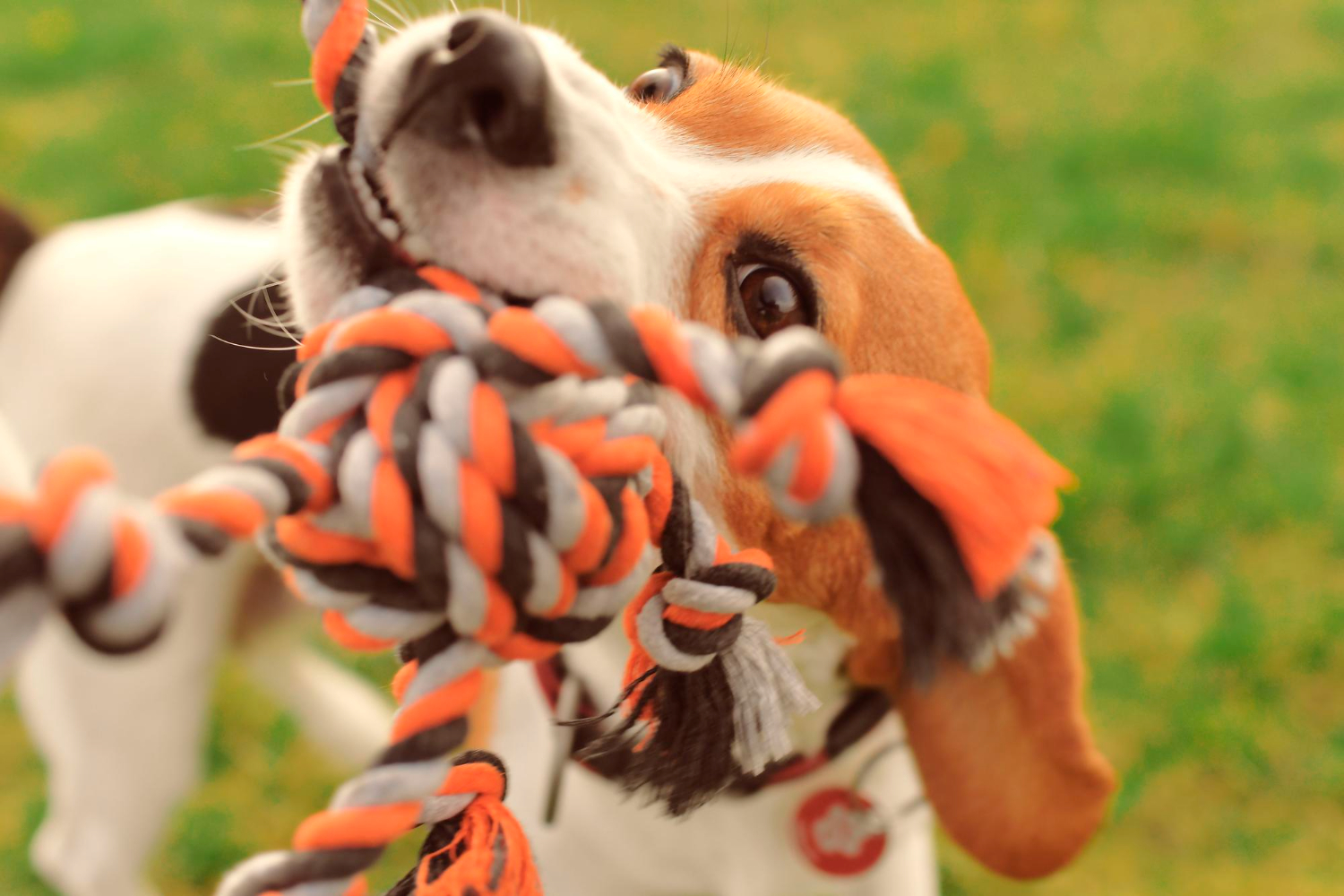
Rawhide and edible chews: what to know
Rawhide and similar edible chews come with real, well-documented risks. A strong chewer can break off large chunks, which can cause choking or an intestinal blockage. Rawhide is also poorly digestible. A swallowed piece can sit in the stomach for a long time and cause ongoing discomfort.
Many rawhide products are processed with high-salt brines during manufacturing. Rinsing thoroughly before giving one to your dog can reduce residue from that processing.
Supervision is non-negotiable here
Stay in the room for the entire time your dog has an edible chew. Remove any piece small enough to swallow whole before that happens. If you’d rather skip the risk entirely, ask your vet about alternatives. A Veterinary Oral Health Council-approved dental chew is one reasonable option.
Bones, antlers, and other hard edible chews
Genuinely hard chews like bones and antlers carry a real risk of cracking a tooth. That’s the same concern the thumbnail test above is built to catch. Run that test on an edible chew too, not just rubber and plastic toys.
Bully sticks and other flavored chews
Flavor-coated chews, including bully sticks and pig ears, can carry more bacterial contamination risk than plain options. Wash your hands after handling them, and supervise the same way you would any rawhide.
Choosing a puzzle toy by difficulty level
Most puzzle-feeder lines are labeled by difficulty, similar to a ski slope’s beginner-to-advanced system. Matching the level to your dog matters more than picking the flashiest option on the shelf.
Start at the easiest level available, even for a smart dog. The first few sessions should build confidence, not frustration. Our full guide to indoor dog enrichment covers the complete rotation. It also has a one-week method for finding what your dog genuinely enjoys. This section is just the buying decision.
Sizing a puzzle to your dog
Check the opening size and compartment depth against your dog’s nose and paw dexterity, not just his body size. A large dog with a blunt, eager nose can still struggle with small, fiddly compartments. Those are usually built for a terrier’s narrow snout.
Buy one level, not the whole line
It’s tempting to buy an entire difficulty range at once. Start with a single beginner puzzle instead. Only buy the next level up once your dog is genuinely solving the first one with ease.
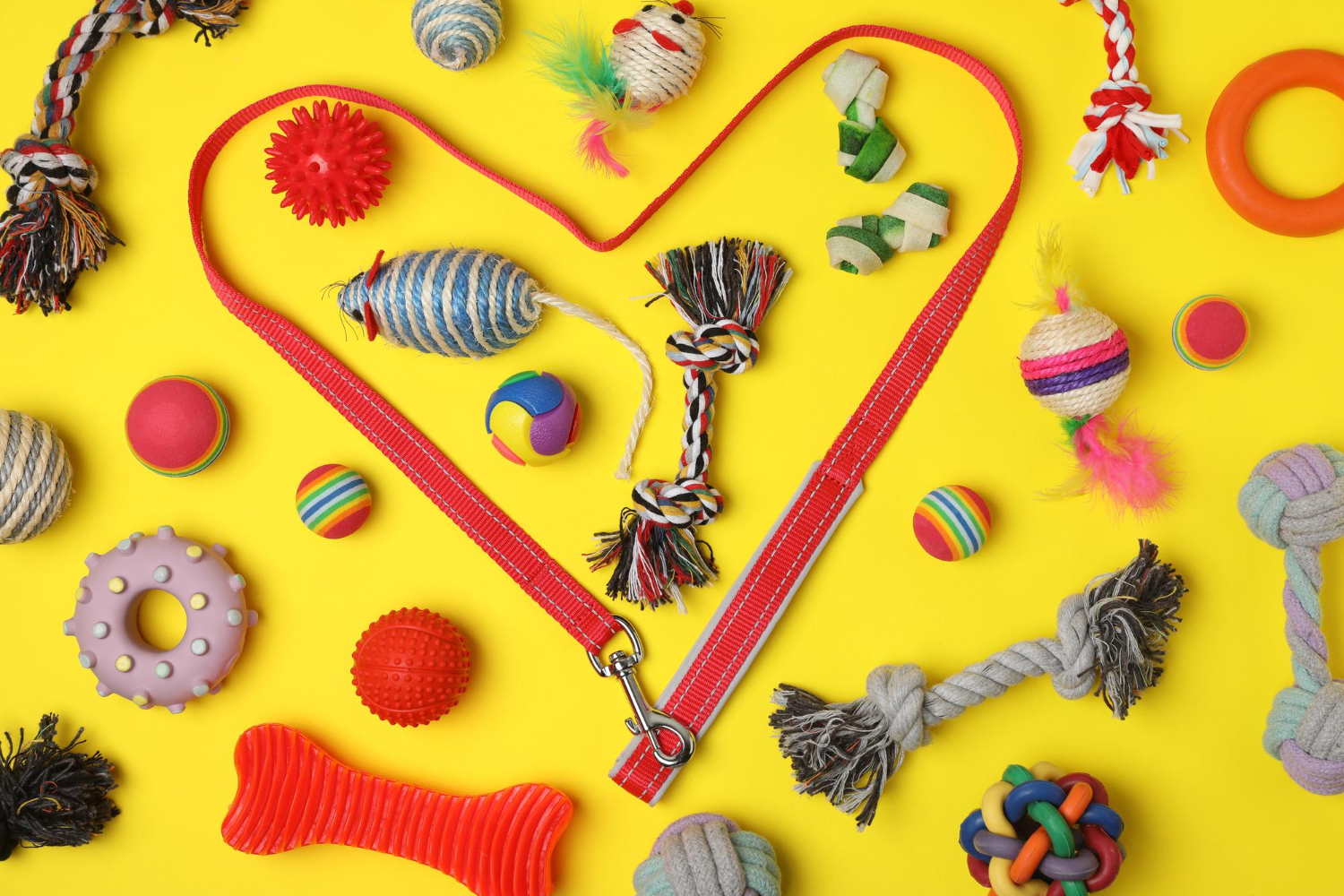
The best dog toys by chewer type
The best dog toys for passive chewers
Soft plush, lightly-filled squeaky toys, and gentle rubber chews all work well here. You have the widest selection to choose from, since durability matters less.
The best dog toys for moderate chewers
Look for reinforced seams, medium-firm rubber, and woven rope over loosely braided versions. Most mainstream “durable” toys are built for this middle group.
The best dog toys for power chewers
Solid rubber, minimal seams, and nothing with small removable parts. Skip stuffed toys entirely unless you’re supervising the whole session. Size up, and expect to replace items more often than owners of gentler chewers do.
The best dog toys on a budget
A safe, well-matched toy doesn’t have to be expensive. Most of what matters is fit, not price.
| Budget tier | What it looks like |
|---|---|
| Free | A knotted old t-shirt for gentle tug, a clean sock with a knot for a passive chewer |
| Low-cost | A basic rubber ball or chew, a simple woven rope toy |
| Worth investing in | A genuinely durable rubber toy for a power chewer, a well-made puzzle feeder |
A DIY, no-cost approach to enrichment activities more broadly, including cardboard and towel games, lives in our indoor enrichment guide. This section is just the toy-buying piece of that picture.
Are multi-packs and value bundles worth it?
Sometimes. A bundle of near-identical soft toys suits a passive chewer who likes variety. The same bundle is a poor value for a power chewer. He’ll destroy every piece within a week regardless of the discount. Match the bundle to your dog’s chewer type before the price tag sways you.
Introducing and testing a new toy at home
Passing the five-minute test doesn’t mean a toy is cleared for unsupervised time right away. Every new toy needs a real-world trial first.
- First session, full attention. Watch the entire first use. Note how fast your dog works at it and whether he tries to bite off pieces.
- Check it after ten minutes. Look for early cracks, loosening seams, or any piece that’s come free.
- Repeat for two or three sessions. A single calm session doesn’t prove much. Consistency across a few sessions tells you more.
- Only then, consider unsupervised time. Even after passing the trial, periodic spot checks matter, since wear accumulates gradually.
What a passed trial looks like
Three sessions, no swallowed pieces, no new cracks or loose seams. Your dog still shows interest rather than losing enthusiasm. That combination is a reasonable green light for limited unsupervised time.
Rotating and retiring toys
Our indoor enrichment guide covers the rule of thirds for rotating activities generally. The same idea applies to toys specifically: keep a portion out, a portion resting, and retire anything worn.
Check every toy in active rotation on a regular basis, not just when you first buy it. Wear happens gradually, and a toy that passed its first inspection can fail three weeks later.
A simple weekly habit
Pick one day to glance over every toy currently in rotation. Choose a day you’d already be doing something routine, like vacuuming. A thirty-second check per toy catches most problems before they become a real hazard.
Traveling and crating with toys
A crate or a car is a confined, often unsupervised space. It deserves a more conservative toy choice than your living room does. Stick to whatever’s already passed a full supervised trial at home, not something untested.
Skip anything with loose parts, a squeaker, or heavy stuffing for crate time specifically. That’s true even for a dog who handles those toys fine while you’re watching. A simple, well-tested chew is the safer choice when you can’t intervene quickly. That covers a long car ride or an afternoon in his crate while you’re out.
What to do with a toy you no longer trust
Once a toy fails the wear check, throw it away rather than donating it or passing it to another dog. A crack or exposed squeaker that’s a hazard for your dog is a hazard for any dog.
If a toy is recalled, follow the manufacturer’s disposal or return instructions rather than tossing it out. Some recalls include a refund or replacement. Check the manufacturer’s website or a general product-recall search before assuming there’s nothing to do about it.
Toys for specific situations
The chewer-type and play-style method above works as a solid default. Some situations still benefit from a more specific approach layered on top.
Puppies
Teething puppies need softer, appropriately-sized chews, and their mouths grow quickly. Expect to size up more often than you would for an adult dog. Sometimes that means every few weeks during a growth spurt.
Senior dogs
Softer materials protect aging teeth and sensitive gums. Look for toys that are easy to grip if arthritis affects his paws or jaw. Don’t assume he’s lost interest in play just because his pace has slowed.
Multi-dog households
Provide enough toys that dogs aren’t forced to compete for a single item. Separate anything food-scented during use to reduce resource-guarding risk.
Households with kids
A dog’s toy and a child’s toy can look similar, and both can end up in the wrong hands. Store dog chews and small toy parts somewhere a toddler can’t reach. Treat a child’s small toys the same way around a dog who mouths objects. Either direction can end in a swallowed piece.
When toy possessiveness needs professional help
Occasional mild guarding, like a stiff posture over a fresh chew, is common and manageable with separated feeding and enrichment. Growling, snapping, or biting over a toy is different. That calls for a qualified trainer or behaviorist, not a toy swap.
Anxious or destructive chewers
A dog who chews out of stress needs a genuinely durable, always-available outlet. Address the underlying anxiety too, with your vet or a qualified trainer.
Dogs with dental disease or missing teeth
Skip anything that requires firm, repeated biting. Soft rubber, gentle lick-based toys, and easy puzzle feeders let him keep playing. Nothing here adds strain on compromised teeth or gums. Ask your vet which activities fit his specific dental situation.
Dogs recovering from surgery or injury
Vigorous tug and hard chewing are usually off the table during recovery. A soft, low-effort toy or a lick mat can fill the gap without risking the healing area. Confirm any new activity against your vet’s specific restrictions first.
Red flags that mean walk away
A few warning signs are worth checking before you even get to the physical safety test.
- No listed materials. If a listing can’t tell you what the toy is made of, that’s a reason for caution.
- A strong chemical smell straight out of the packaging, which can indicate leftover manufacturing residue.
- Recently recalled products. A quick search for the brand and “recall” takes a minute and can save a vet visit.
- Loose small parts visible before your dog has even touched the toy.
- Marketing language alone, like “indestructible” or “100% safe,” with no material or testing information behind it.
- A price that seems too low for the described materials, which sometimes signals a cheaper substitute than advertised.
- No return policy on a product marketed specifically as durable, which suggests the seller doesn’t stand behind that claim either.
Common dog toy buying mistakes
A few habits show up again and again, even among owners who genuinely want to get this right.
Buying for the toy’s looks, not your dog’s needs
A toy that appeals to you in a store aisle may not match your dog at all. His actual chewer type and play style are what count.
Skipping the safety test on an expensive toy
Price has no relationship to whether a toy passes the thumbnail or knee-cap test. Test everything.
Leaving every toy out at once
A toy that’s always available stops feeling special. Rotation keeps the whole collection more engaging.
Ignoring the supervision level a toy actually needs
Some toys are genuinely safe alone once tested. Others never are, regardless of how many sessions they’ve survived.
Waiting too long to replace a worn toy
A toy doesn’t need to fully break apart before it’s a hazard. Retire it at the first sign of real wear, not the last.
Assuming one toy will satisfy every play style
A single toy rarely covers fetch, tug, and puzzle-solving all at once. A small, varied rotation across your dog’s actual play styles works better than one do-everything purchase.
Signs a toy has done its job
A few clear signs mean it’s time to retire a toy, not stretch its life further. None of these require guesswork, and most take only a moment to check.
- Cracks or punctures anywhere on a hard or rubber toy.
- An exposed squeaker on any plush toy.
- Visible stuffing coming through a seam.
- Fraying beyond a few loose threads on a rope toy.
- Sharp or jagged edges where a piece has broken off.
- Genuine disinterest over several sessions, which usually means it’s time for something new rather than something wrong.
Your dog toy buying checklist
Bookmark this section for your next trip down the toy aisle or online cart. It condenses this entire guide into one quick pass.
- Chewer type identified: passive, moderate, or power.
- Play style identified: fetch, tug, plush, puzzle, or chew.
- Matrix row and column checked for a matching category.
- Thumbnail, bend, knee-cap, and size checks passed.
- Material list available, with no vague marketing claims standing in for it.
- A supervised trial planned before any unsupervised time.
Six checks, and most of the guesswork disappears. That’s the whole method behind finding the best dog toys for your specific dog. It beats chasing the best dog toys in general.
Common questions about choosing dog toys
Are more expensive dog toys always the best dog toys for my dog?
No. Price doesn’t predict whether a toy passes the safety test or fits your dog’s chewer type. A well-matched five-dollar toy beats a mismatched thirty-dollar one.
How many toys does my dog actually need?
Fewer than most owners assume. Two or three in active rotation usually beats a toy box overflowing with options. Match them to his chewer type and play style.
Can I trust a toy labeled “indestructible”?
Treat that word as marketing, not a guarantee. Run the safety test yourself, and supervise the first few sessions regardless of the label.
What should I do if my dog swallows a piece of a toy?
Call your vet right away, even if your dog seems fine. Watch closely for vomiting, lethargy, loss of appetite, or straining, and seek emergency care immediately if any of those appear.
Are natural-rubber toys safer than synthetic ones?
Not automatically. Run the same thumbnail, bend, and size checks either way. Material origin matters less than firmness and fit for your specific dog.
How often should I replace my dog’s toys?
There’s no fixed schedule. Inspect regularly and replace at the first sign of real wear, whether that happens after two weeks or two years.
Can puppies and adult dogs safely share the same toys?
Sometimes, but size and firmness needs usually differ enough that dedicated toys work better. A puppy’s smaller mouth also needs smaller, softer options an adult toy may not offer.
What are the best dog toys to leave with my dog completely unsupervised?
Only a toy that’s passed the safety test and several supervised trial sessions with zero issues. Even then, periodic spot checks are worth keeping up.
Do I need different toys for indoors and outdoors?
Not necessarily, but outdoor toys pick up dirt and get chewed against harder surfaces like concrete. Check outdoor toys for wear a little more often than indoor-only ones.
Is it safe to buy secondhand dog toys?
Generally, no, for anything chewable. You can’t verify a used toy’s material history, how it was cleaned, or whether it’s been recalled. A secondhand toy box or crate is usually fine; a secondhand chew is not.
Can I make my own version of the best dog toys instead of buying them?
Often, yes, for lower-risk categories like plush comfort items or simple tug toys made from clean fabric. Stick to store-bought options for anything a power chewer will bite down on hard. Homemade versions rarely pass the same safety tests.
My dog ignores every toy I buy. What am I missing?
Revisit his chewer type and play style rather than buying another random option. A dog who’s a puzzle-and-forage type genuinely may not care about a plush toy, no matter how many you try.
Should I match toys to my dog’s breed?
Breed can hint at tendencies, but individual chewer type and play style matter more day to day. Two dogs of the same breed can need very different toys.
Do puzzle toys count as one of the best dog toys for a bored dog?
Often, yes, especially for a puzzle-and-forage dog. Pair it with the rest of your enrichment routine rather than treating it as a complete solution on its own.
What’s the single best dog toy if I can only buy one?
There isn’t one. A chew-and-settle toy and a fetch toy serve completely different needs. Even a minimal rotation benefits from at least two categories.
Does a toy need a brand name to be trustworthy?
No. A well-made generic toy that passes the safety test can be just as reliable as an expensive branded one. Focus on the test results, not the logo on the packaging or the price tag next to it.
How do I introduce toys to a dog who’s never really had any?
Start with one toy from your dog’s most likely play style, and run the safety test. Give him time alone with it under supervision before adding a second one. Overwhelming a toy-naive dog with a full bin at once tends to backfire.
Choosing the best dog toys for your dog doesn’t require guesswork or an expensive haul. Identify his chewer type and play style, and run the five-minute safety test on anything new. Size it correctly, and keep a small rotation instead of an overflowing bin.
Sources
- American Animal Hospital Association (AAHA). Don’t Chew On This!
- American Kennel Club (AKC). Are Rawhide Chews Dangerous for Dogs?
- Preventive Vet. How to Choose Safe Dog Chew Toys
- Animal Medical Center (AMC). Dogs and Tennis Balls: It’s Not Always a Match
- American Pet Products Association (APPA). Are Pet Toys Regulated?
This article is general education for U.S. dog owners. It is not individualized veterinary advice. Ask your veterinarian about anything specific to your dog.



Trackbacks/Pingbacks