

A good puppy schedule isn’t a script you follow to the minute. It’s a loose rhythm of meals, potty breaks, naps, and play that repeats often enough for your puppy’s body and brain to predict what’s coming next. At 8 to 10 weeks old, that usually means roughly four meals, frequent bathroom breaks, and naps stacked through most of the day. By 5 to 6 months, it thins out to two or three meals, longer stretches between potty trips, and more consolidated blocks of activity and rest.
The exact numbers shift with your puppy’s age, size, and how your household actually runs. A solo owner working from a kitchen table has a different day than a family with two kids and a dog walker on call. Neither one is doing it wrong. What matters is the shape underneath: eat, go outside, do something, rest, repeat, with the gaps growing wider as your puppy grows up.
This guide walks through sample schedules for three age bands, explains why puppies need more structure than adult dogs to begin with, and covers the real-life stuff that trips people up: working schedules, weekends, overtired meltdowns, and the moment you realize the current plan just isn’t working anymore.
What’s in this guide
- A puppy schedule, the quick answer
- Why puppies need more structure than adult dogs
- Three age bands: how the schedule shifts as your puppy grows
- Sample schedule: 8 to 10 weeks old
- Sample schedule: 3 to 4 months old
- Sample schedule: 5 to 6 months old
- Meal frequency and timing by age
- Potty breaks and the meal-nap-play connection
- How much sleep does a puppy actually need
- The puppy witching hour: overtired zoomies explained
- Signs of an overtired puppy vs. a well-rested one
- Quick steps to calm an overstimulated puppy
- Multi-dog households and kids in the schedule
- Building a schedule around a working household
- Daycare, walkers, and other midday support
- What’s realistic for a solo owner without backup
- Weekend vs. weekday: how much consistency actually matters
- Keeping the schedule loose enough to survive real life
- Growth spurts, teething, and temporary schedule bumps
- Signs your current schedule isn’t working
- How to adjust when something’s off
- Common puppy scheduling mistakes
- Your puppy schedule checklist
- Common questions about puppy schedules
- Sources
A puppy schedule, the quick answer
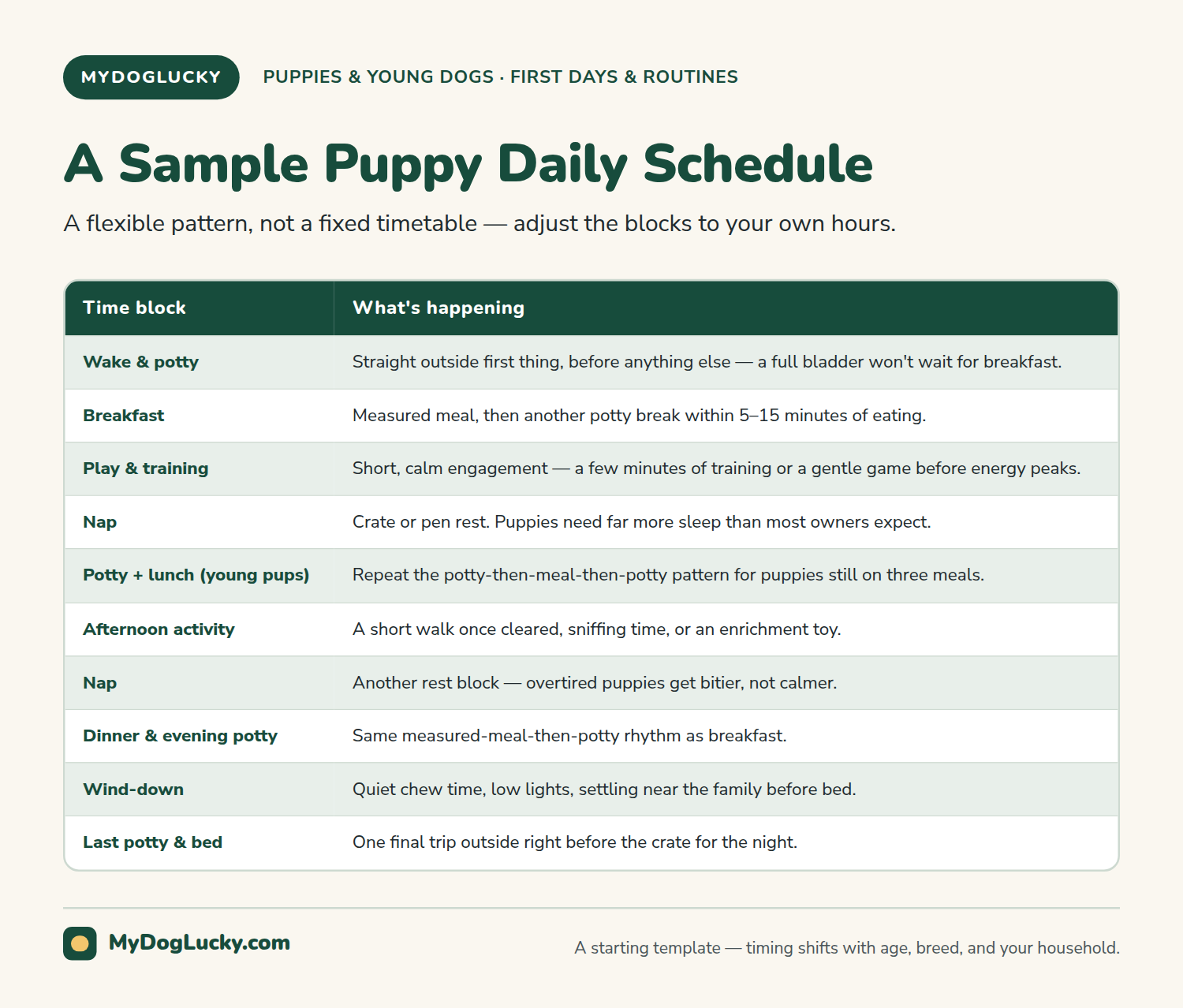
A workable puppy schedule repeats the same basic sequence all day: wake up, go outside, eat or play, rest, go outside again. The frequency of each piece changes with age. A very young puppy, 8 to 10 weeks old, typically needs about four meals a day, a bathroom break every one to three hours, and naps that add up to most of the daylight hours. By 5 to 6 months, that same puppy usually manages on two or three meals, a potty break every four to five hours, and longer stretches of both activity and rest.
Age is the biggest factor, but it isn’t the only one. Breed size, your puppy’s individual temperament, your household’s actual hours, and whether anyone’s home during the day all shift the specifics. A giant-breed puppy and a toy-breed puppy of the same age don’t always run on identical clocks, and a puppy who naps hard after ten minutes of play behaves differently than one who needs thirty.
What this guide gives you
Three sample schedules, one per age band, built as adjustable starting points rather than rules. Real days won’t look exactly like any of them, and that’s fine. The goal is a repeatable rhythm your household can actually follow, not a chart you fail by 9 a.m.
Why puppies need more structure than adult dogs
A three-year-old dog can often go eight hours between bathroom breaks, eat twice a day, and nap when he feels like it. A young puppy can’t do any of that yet, and it isn’t a training failure. It’s biology still catching up.
Bladder control takes months to develop
A puppy’s bladder is small, and the muscle control needed to hold it develops gradually over the first several months. Veterinary and training sources commonly describe a rough guideline: take your puppy’s age in months, add one, and that’s roughly the maximum number of hours he can comfortably hold it, according to the American Kennel Club. A 3-month-old puppy, by that rule, tops out around four hours, and even that’s optimistic for some puppies. It’s a ceiling to plan around, not a target to aim for.
Small bodies need fuel more often
Puppies are growing fast, and their blood sugar can dip lower and faster than an adult dog’s between meals, especially in toy and small breeds. Frequent, smaller meals keep energy more stable through the day than two large ones would at this stage.
The nervous system is still under construction
A young puppy’s brain is doing an enormous amount of work: processing new sights, sounds, smells, and social experiences for the first time, while also building the neural pathways that will eventually let him regulate his own emotions and impulses. That system tires out fast, and it needs real downtime to consolidate everything it just took in.
And that system runs on a lot of sleep
Very young puppies often sleep somewhere around 18 to 20 hours a day, factoring in both nighttime rest and the many naps scattered through daytime hours, according to VCA Animal Hospitals. That’s not laziness. It’s the primary way a young brain and body get the recovery time growth and learning both require.
Put those four pieces together and you get the case for structure. A predictable rhythm of meals, bathroom breaks, and rest isn’t about controlling your puppy. It’s about working with a body and brain that genuinely can’t handle the free-for-all an adult dog manages just fine.
Three age bands: how the schedule shifts as your puppy grows
Rather than one puppy schedule for the whole first six months, it helps to think in three loose age bands. Each one calls for a slightly different rhythm as bladder control, stamina, and attention span all mature.
| Age band | Meals per day | Potty breaks | Awake stretch between naps |
|---|---|---|---|
| 8–10 weeks | About 4 | Roughly every 1–3 hours | 30–60 minutes |
| 3–4 months | 3 | Roughly every 3–4 hours | 1–2 hours |
| 5–6 months | 2–3 | Roughly every 4–5 hours | 2–3 hours |
Treat these ranges as a planning tool, not a countdown timer. A small-breed puppy may still need frequent meals past 4 months, while a large-breed puppy sometimes settles into three meals a day for longer. Watch your individual puppy’s cues, not just the calendar, and check anything specific to his breed, size, or health with your vet.
Sample schedule: 8 to 10 weeks old
This is the newest, sleepiest stage. Most puppies come home somewhere in this window, and the first couple of weeks are as much about adjusting to a new environment as they are about following any particular clock. Expect frequent everything: meals, potty breaks, and naps that eat up most of the day.
| Time | What’s happening |
|---|---|
| 6:30 a.m. | Wake up, straight outside for a potty break |
| 6:45 a.m. | Breakfast (meal 1) |
| 7:00 a.m. | Potty break after eating, then a short, low-key play or sniff session |
| 8:00–9:30 a.m. | Nap |
| 9:30 a.m. | Potty break, brief awake window |
| 10:00 a.m. | Lunch (meal 2), potty break after eating |
| 10:30 a.m.–12:00 p.m. | Nap |
| 12:00 p.m. | Potty break, short play |
| 1:00 p.m. | Meal 3, potty break after eating |
| 1:30–3:00 p.m. | Nap |
| 3:00 p.m. | Potty break, short play or gentle exploring |
| 4:30 p.m. | Dinner (meal 4), potty break after eating |
| 5:00–6:30 p.m. | Nap |
| 6:30 p.m. | Potty break, calm evening play (watch for the witching hour below) |
| 8:00 p.m. | Potty break, wind-down time |
| 9:00 p.m. | Last potty break of the night, then bedtime |
Most puppies this young still need at least one overnight potty break too, sometimes two, especially in the first week or so home. That’s normal, not a sign anything’s going wrong. It usually tapers off within a few weeks as bladder control and sleep consolidation both improve.
Sample schedule: 3 to 4 months old
By this age, most puppies are down to three meals, awake windows have stretched out, and naps, while still frequent, take up a smaller share of the day. Teething is often ramping up here too, which can make chew-friendly downtime especially valuable.
| Time | What’s happening |
|---|---|
| 6:30 a.m. | Wake up, potty break |
| 6:45 a.m. | Breakfast (meal 1), potty break after |
| 7:15–8:15 a.m. | Play, short training session, or a brief walk |
| 8:15–9:45 a.m. | Nap |
| 9:45 a.m. | Potty break, awake window with an enrichment activity |
| 11:30 a.m. | Potty break, then nap |
| 1:00 p.m. | Lunch (meal 2), potty break after |
| 1:30–3:00 p.m. | Play, training, or a walk suited to his age and vaccination status |
| 3:00–4:30 p.m. | Nap |
| 4:30 p.m. | Potty break, calm play |
| 6:00 p.m. | Dinner (meal 3), potty break after |
| 6:30–7:30 p.m. | Evening play (watch the clock for overtiredness) |
| 8:00 p.m. | Wind-down, quiet chew or settle practice |
| 9:00 p.m. | Last potty break, then bedtime |
Many puppies at this age can make it through most nights without a bathroom break, though plenty still need one occasionally, especially after a big drink of water close to bedtime. Cutting off water access an hour or so before bed, while still offering it freely earlier in the day, can help without leaving him actually thirsty.
Sample schedule: 5 to 6 months old
This band often overlaps with the start of adolescence, when hormones shift, confidence grows, and some puppies get noticeably more independent, occasionally in ways that test your patience. Meals typically drop to two or three, potty breaks stretch further apart, and activity blocks get longer and more structured.
| Time | What’s happening |
|---|---|
| 7:00 a.m. | Wake up, potty break |
| 7:15 a.m. | Breakfast (meal 1), potty break after |
| 7:45–9:00 a.m. | Walk, training session, or active play |
| 9:00–11:00 a.m. | Rest or independent chew time |
| 11:00 a.m. | Potty break, midday check-in or short play |
| 1:00 p.m. | Optional lunch (meal 2, or skip if he’s down to two meals), potty break |
| 1:30–3:30 p.m. | Rest, ideally including an actual nap and not just quiet time |
| 3:30 p.m. | Potty break, afternoon activity or training |
| 5:30 p.m. | Dinner (final or second-to-last meal), potty break after |
| 6:00–7:30 p.m. | Evening walk or play, keeping an eye on energy versus overtiredness |
| 8:00 p.m. | Wind-down time, settle practice |
| 9:30 p.m. | Last potty break, bedtime |
Some households keep three smaller meals well past 6 months for a small-breed puppy, while others move to two meals earlier for a large-breed puppy who’s eating substantial portions already. Either can be appropriate. It’s worth asking your vet what fits your specific puppy’s size, breed, and growth curve rather than defaulting to a fixed number because a chart said so.
Meal frequency and timing by age
Meal frequency is one of the clearest ways a puppy schedule changes over time. Very young puppies generally do best on about four meals a day, spaced roughly every four to five hours during waking hours, according to American Kennel Club feeding guidance. That frequency helps keep blood sugar steady in a small, fast-growing body and gives a young puppy more chances to succeed at eating a full portion without getting overwhelmed by one large meal.
Around 3 to 4 months, many puppies transition down to three meals a day. By roughly 6 months, a lot of puppies move to twice-daily feeding, a pattern that typically carries into adulthood. That said, exact timing varies. Toy and small breeds sometimes stay on more frequent meals a bit longer because of their higher risk of blood sugar dips between feedings, while some large and giant breeds shift to fewer, larger meals earlier. Your vet can help you time the transition around your specific puppy’s size, breed, and body condition, rather than switching on a fixed calendar date because a chart says so.
Why timing matters as much as frequency
Feeding at roughly the same times each day, not just the same number of times, helps keep your puppy’s digestion and bathroom habits predictable. Most puppies need to go outside within a fairly short window after eating, often within thirty minutes for a younger puppy, according to AKC housetraining guidance. A consistent feeding clock makes that follow-up potty break easier to plan for, instead of guessing when the urge is going to hit.
A note on free-feeding
Leaving food out all day, sometimes called free-feeding, makes it much harder to predict when your puppy needs a bathroom break, since you lose track of exactly when and how much he ate. Scheduled meals at set times give you a far more reliable potty-break rhythm to work from, especially during the early housetraining months.
Potty breaks and the meal-nap-play connection
Potty breaks don’t happen on their own internal clock so much as they follow everything else in the day. Eating, drinking, waking from a nap, and even a burst of excited play all tend to trigger the urge to go, often within minutes. That’s why a good puppy schedule builds potty breaks around those trigger points instead of just picking round numbers on a clock.
The reliable trigger points
- First thing after waking, whether that’s morning wake-up or the end of a daytime nap.
- Within about 5 to 30 minutes after eating, with younger puppies typically needing to go sooner after a meal than older ones, according to AKC guidance.
- After a drink of water, especially a big one.
- After a burst of active play, which can trigger an urge to go almost as reliably as eating does.
- Before being left alone or crated, even for a short stretch.
- Right before bedtime, as the last stop of the day.
Beyond those trigger points, the “age in months plus one hour” guideline gives a rough ceiling for how long a puppy might comfortably hold it between breaks, though the practical, real-world interval is often shorter than that formula suggests, particularly for very young puppies. A 2-month-old puppy may genuinely need to go every one to three hours even accounting for triggers, and pushing past that ceiling regularly sets up accidents that aren’t really his fault.
This guide focuses on the rhythm and frequency side of potty breaks, not the training method itself. If you’re working on the mechanics of housetraining, crate use, and building a reliable “ask to go out” signal, MyDogLucky’s dedicated first-time dog owner guide covers that method in more depth. Consider this section the schedule your training method runs on top of.
How much sleep does a puppy actually need
It’s a lot more than most new owners expect. Very young puppies often sleep somewhere in the range of 18 to 20 hours out of every 24, counting both nighttime rest and the many naps stacked through the day, according to VCA Animal Hospitals. That number gradually comes down as a puppy matures, though even older puppies and adult dogs typically still sleep at least half the day.
That sleep isn’t wasted time. A young puppy’s brain is processing an enormous amount of new information, from house rules to social experiences to basic body coordination, and sleep is when a lot of that processing and consolidation actually happens. Puppies also appear to need proportionally more of the deep, restorative stage of sleep than adult dogs do, which lines up with how much developmental work is happening behind the scenes.
What that means for your daily schedule
In practice, it means nap time isn’t optional or something to skip because your puppy “doesn’t seem tired.” An 8-to-10-week-old puppy who’s been awake and stimulated for an hour is often well past due for a nap, even if he’s still bouncing around the living room. Learning to recognize that gap between “still moving” and “actually needs rest” is one of the more useful skills a new puppy owner develops in the first few weeks.
A separate room or crate helps naps actually happen
A puppy surrounded by activity, noise, or an interesting sibling dog often won’t settle into real sleep even when he’s exhausted. A quiet crate, pen, or separate room for scheduled naps gives him an easier path to the rest his body actually needs, rather than fighting through overstimulation to get there.
The puppy witching hour: overtired zoomies explained
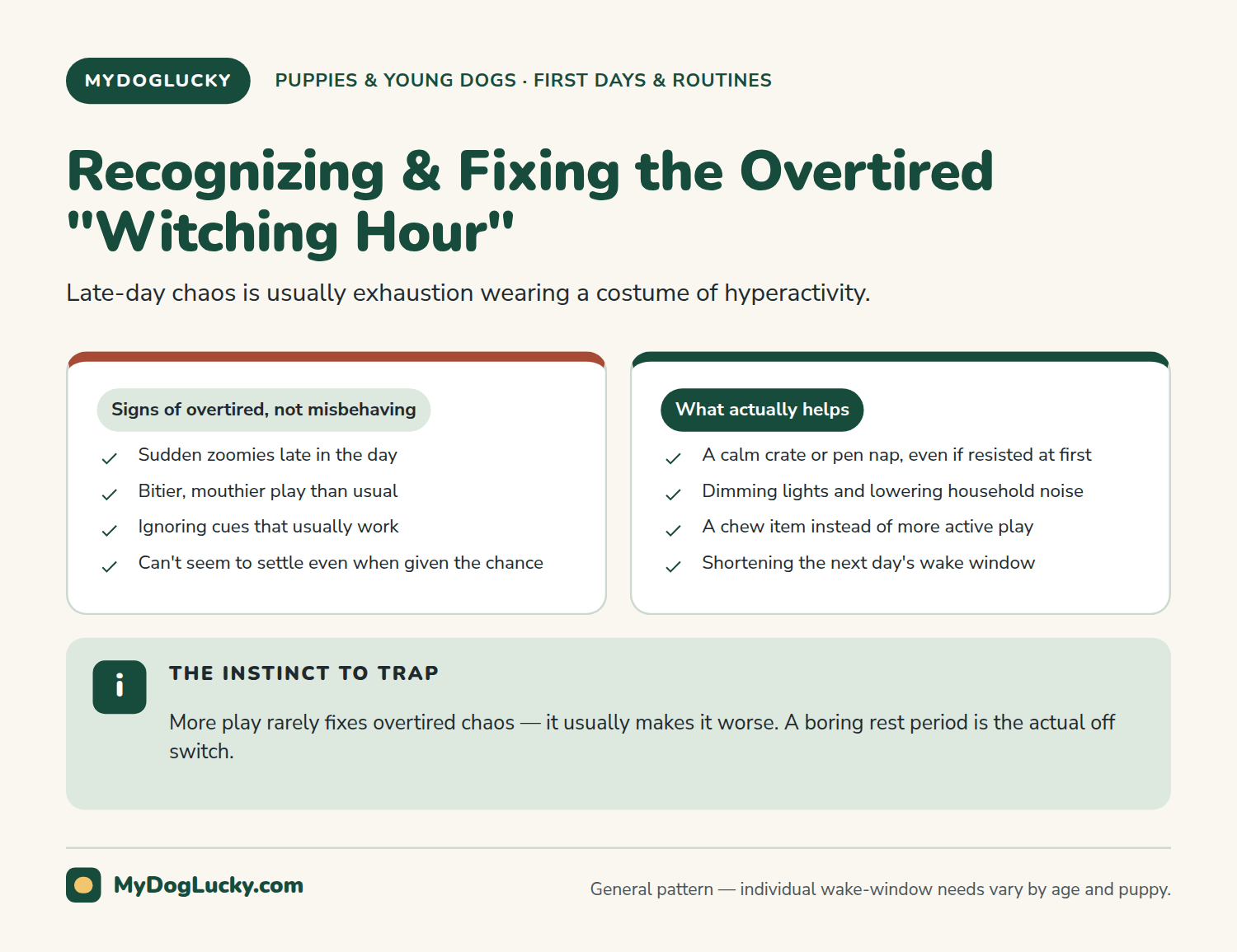
If your puppy turns into a genuinely different animal most evenings, mouthing harder, stealing socks, tearing around the house in circles, and generally ignoring every cue he knows perfectly well in the morning, you’ve met the puppy witching hour. It’s an extremely common pattern, and it’s almost always about fatigue rather than defiance.
Young dogs experiencing insufficient sleep show behavior that looks strikingly similar to an overtired toddler: increased mouthing, taking and running off with objects, difficulty settling, and general chaos, according to AAHA. Sleep debt appears to build cumulatively across the day. Without enough recovery rest, arousal keeps climbing rather than settling, which is exactly the pattern behind a puppy who seems to get more wound up the longer he stays awake, not less.
Why this often peaks in the evening specifically
By early evening, many puppies have had a full day of new sights, sounds, and activity, plus the household itself often gets busier around dinner and family return-home time. That combination of accumulated sleep debt and rising household stimulation is a common recipe for the witching hour to show up right when everyone’s least prepared to deal with it.
Here’s the part worth remembering when your puppy is doing his best impression of a caffeinated raccoon at 6:45 p.m.: more play almost never fixes this. It’s tempting to try to burn off the energy, but an overtired puppy usually needs a nap far more than he needs another round of fetch, however counterintuitive that feels while he’s bouncing off the couch.
Signs of an overtired puppy vs. a well-rested one
Telling the difference between “excited and playful” and “overtired and losing it” gets easier with practice, but it helps to know what to actually look for.
| Overtired puppy | Well-rested puppy |
|---|---|
| Bites and mouths harder than usual, including on hands, clothing, or furniture | Mouths softly during play and stops easily when redirected |
| Runs in wild, seemingly aimless bursts (“zoomies”) that are hard to interrupt | Plays energetically but can pause, check in, or settle when asked |
| Ignores well-known cues he normally responds to | Responds to familiar cues most of the time, with normal lapses |
| Escalates rather than calms with more attention or play | Calms down within a few minutes once activity slows |
| Seems unable to settle even in a quiet space | Can lie down and rest once given the chance |
None of this means your puppy is broken or badly behaved. It means his nervous system has more arousal in it than he currently knows how to manage on his own, and your job shifts from “entertain him” to “help him come down.”
Quick steps to calm an overstimulated puppy
Once you recognize the overtired pattern, the response is fairly simple, even if it takes some repetition before it becomes a habit.
- Move to a low-stimulation space. A quiet room, crate, or pen away from the main action removes some of the input his brain is currently struggling to process.
- Offer a calm activity instead of an exciting one. A stuffed chew toy or a slow, low-key sniffing activity gives him something to do that doesn’t add more arousal to the pile.
- Dim the lights and lower the noise where you reasonably can. Reducing sensory input helps an overstimulated nervous system come down faster than adding more input ever will.
- Let him actually settle, even if he resists at first. Some puppies fight sleep the way overtired toddlers do, fussing for a few minutes before finally crashing. That’s normal, not a sign the plan isn’t working.
- Skip the extra play, however tempting. It’s the single most common mistake at this stage, and it usually makes the next twenty minutes worse, not better.
A confession about the puppy witching hour
We used to assume a tired puppy just needed one more good romp to wear himself all the way out. What actually happened was a puppy who got more wound up, not less, followed by an owner wondering why the “burn it off” plan kept backfiring at 7 p.m. sharp. A crate, a chew, and a dim room did more in ten quiet minutes than another twenty of fetch ever managed.
Multi-dog households and kids in the schedule
A schedule built for a puppy as the only animal in the house doesn’t automatically transfer to a home with a resident dog, a cat, or a couple of kids underfoot, and that’s worth planning around rather than discovering the hard way.
With another dog in the house
A resident adult dog can be a huge help with a puppy’s socialization and stamina-burning, but he also can’t be your puppy’s only source of naps and downtime. Puppies often struggle to self-regulate around an exciting playmate, so scheduled separate rest, in a crate or a different room, still matters even when there’s a built-in playmate around. Watch the resident dog’s body language too; not every adult dog wants to be climbed on all day, and he’s allowed breaks from puppy enthusiasm just as much as your puppy needs breaks from his.
With kids in the house
Kids and puppies both tend to escalate each other’s energy fast, which can turn an ordinary afternoon into an accidental witching-hour trigger well before evening. Supervised, time-limited play sessions work better than open-ended free time together, especially with younger children who may not read an overtired puppy’s warning signs. Building a puppy’s nap schedule around a kid’s own school or activity schedule, rather than assuming the two will naturally sync up, usually heads off a lot of frustration on both sides.
Building a schedule around a working household
Not every home has someone available all day, and a puppy schedule built around a stay-at-home ideal isn’t much use if that’s not your actual life. The good news is that a workable version exists for most working schedules, it just takes more deliberate planning around the gaps.
The core problem to solve
A young puppy generally can’t be left alone for a full eight- or nine-hour workday without a bathroom break and some kind of interaction, especially in the 8-to-10-week and 3-to-4-month bands. The solution isn’t usually “don’t get a puppy while working full time.” It’s building coverage into the middle of the day through one or more of the options below.
A rough framework for the workday gap
- Morning routine before work: potty, meal, a short play or walk session, and a final potty break before you leave.
- Midday coverage: a walker, daycare, a family member, or a longer break you take yourself if your job allows it.
- Evening routine after work: potty first thing at the door, then meal, activity, and the wind-down sequence toward bedtime.
The exact hours matter less than making sure no single stretch alone exceeds what your puppy’s age and bladder control can realistically handle, and that his total daily sleep, meals, and enrichment still add up across the whole day, even if they’re spread across morning, midday coverage, and evening rather than one continuous owner-led schedule.
Daycare, walkers, and other midday support
Several options can fill the midday gap, and most households end up mixing more than one depending on the day of the week.
- Doggy daycare. Some facilities accept puppies once they’ve completed enough of their vaccine series, and a good one provides both a bathroom schedule and appropriately matched play. Ask about group sizes, staff-to-dog ratios, and how they separate puppies from larger or more boisterous adult dogs.
- A midday dog walker. A 20-to-30-minute visit that includes a potty break and some light activity can cover a lot of ground for a puppy who otherwise has a long solo stretch. Ask any walker specifically about their comfort and experience with young puppies, not just adult dogs.
- A neighbor or family member. An informal arrangement, even just a quick midday visit, can work well if someone nearby is willing and reliable. Write out a simple care sheet so the routine stays consistent even when you’re not the one running it.
- A longer-format morning and evening routine. Some households compensate for a shorter midday break by extending both the morning and evening routines, front-loading extra potty time, play, and enrichment on either end of the workday.
- A hybrid week. Daycare two or three days, a walker on the others, or a rotating combination with family, is common and entirely reasonable. Consistency in the overall rhythm matters more than using the exact same option every single day.
Whatever combination you land on, share the actual schedule you’re using with anyone helping out, including approximate feeding times and any specific cues or house rules you’re trying to keep consistent. A puppy who gets a different routine from every caregiver takes longer to settle into any of them.
What’s realistic for a solo owner without backup
If you’re managing a puppy schedule solo, without a partner, roommate, or nearby family to split coverage, it’s worth being honest about what’s actually sustainable rather than what looks good on paper.
A single midday option, whether that’s a daycare drop-off, a walker, or a flexible enough job to slip home for twenty minutes, usually does more for a solo owner’s sanity and a puppy’s schedule than trying to white-knuckle a full workday with no coverage at all. If a paid option isn’t in the budget right now, a rotating favor system with a neighbor, a coworker who works from home nearby, or a local college student looking for pet-sitting work can sometimes fill the same gap for less.
It’s also reasonable to lean harder on the morning and evening ends of the day when you’re the only coverage available. A longer, more thorough morning routine, potty, meal, real activity, and a final potty break before you head out, buys your puppy a better shot at settling through a longer alone stretch than a rushed five minutes would. The same goes for the evening: a puppy who gets a proper decompression and activity window when you get home tends to handle the workday gap better than one whose whole day is compressed into a frantic hour before bed.
You’re allowed to ask for help
Solo puppy-raising during a full work schedule is genuinely hard, and it’s common to feel like you’re falling short even when you’re doing everything reasonably available to you. Asking a neighbor for a favor, paying for even occasional daycare, or adjusting your own schedule temporarily isn’t a failure. It’s part of building a sustainable plan for a stage that, realistically, doesn’t last forever.
Weekend vs. weekday: how much consistency actually matters
Puppies generally do better with consistent wake times, meal times, and bedtime across the whole week, weekends included, rather than a schedule that shifts by hours depending on the day. That said, “consistent” doesn’t have to mean “identical down to the minute.”
A weekend that starts an hour later than a weekday, with a correspondingly later bedtime, usually causes far less disruption than a schedule that swings wildly, sleeping in until 10 one day and being up at 6 the next. The overall rhythm, roughly the same order and roughly the same spacing between meals, potty breaks, and naps, matters more than hitting an exact clock time every single day.
Where weekend inconsistency tends to cause real problems is around meal timing and the last potty break before bed. A puppy who’s fed at wildly different times, or who misses his usual pre-bedtime bathroom trip because everyone stayed out later than planned, is more likely to have an accident or a rough night than one whose overall structure holds steady even with some flexibility in the exact hour.
Keeping the schedule loose enough to survive real life
A schedule that only works if absolutely nothing goes sideways isn’t actually a schedule you can use. Real days include traffic, sick days, a meeting that runs long, and a puppy who decided 4 a.m. was an excellent time to be awake. Building in some slack from the start makes the whole plan more durable.
Build around anchor points, not exact times
Instead of “breakfast at 6:45 a.m. exactly,” think “breakfast shortly after waking, most days.” Instead of “nap from 1:30 to 3:00 p.m.,” think “a real rest period sometime in the early afternoon.” Anchor points give you the structure your puppy needs without turning a fifteen-minute delay into a crisis.
Have a backup plan for the predictable disruptions
A pee pad or a designated indoor spot for a genuinely unavoidable delay, a stash of a slightly different but acceptable food for the day you forget to restock, and a general sense of which parts of the day can shift versus which really can’t (the last potty break before bed, usually) all make the occasional off day much less stressful.
A schedule that bends without breaking beats a rigid one that works perfectly right up until the first bad day, and then collapses. Most households end up somewhere comfortably in between the extremes: predictable enough for the puppy to settle into, loose enough for the humans to actually keep up with.
Growth spurts, teething, and temporary schedule bumps
Even a well-established puppy schedule doesn’t stay perfectly static through the first six months. Growth spurts, teething, and new experiences all tend to throw temporary wrinkles into an otherwise settled routine.
Growth spurts and appetite changes
Some puppies go through stretches where they seem hungrier than usual, or occasionally less interested in food for a day or two, as their growth rate shifts. A short-term appetite change usually isn’t cause for alarm on its own, but a real drop in eating that lasts more than a day, or any sign of lethargy alongside it, is worth a call to your vet rather than assuming it’s just a phase.
Teething and increased need for rest and chewing
Teething tends to ramp up somewhere in the 3-to-6-month range as adult teeth come in, and it can genuinely tire a puppy out more than usual, alongside an increased drive to chew on everything within reach. Building extra appropriate chew time and slightly more generous rest into the schedule during a heavy teething stretch tends to help more than trying to power through the normal routine unchanged.
New experiences temporarily increase the need for sleep
A big day, a first car ride, meeting a lot of new people, a trip to a new place, often leaves a puppy more tired than the physical activity alone would explain, simply because there was so much new information to process. It’s common and reasonable to build in extra rest time on and immediately after an unusually eventful day, rather than sticking rigidly to the normal schedule regardless of how full the day actually was.
Signs your current schedule isn’t working
Sometimes a schedule that looked reasonable on paper just doesn’t fit your actual puppy, or it worked fine last month and has quietly stopped working as he’s grown. A few patterns are worth paying attention to.
- Frequent accidents despite a consistent potty schedule. If breaks are happening on time and accidents are still common, the gap between breaks may simply be too long for this puppy right now, or something else, like a urinary issue, may be worth ruling out with your vet.
- A noticeable spike in biting or mouthing, especially by evening. This often points back to insufficient rest during the day rather than a training gap, particularly if it consistently shows up around the same time each day.
- Increasing reactivity or crankiness as the day goes on. A puppy who’s calm and cooperative in the morning but seems to fall apart emotionally by dinnertime is frequently telling you his rest isn’t keeping pace with his stimulation.
- Difficulty settling at bedtime. An overtired puppy sometimes has a harder time actually falling asleep than a well-rested one, which can look counterintuitive until you recognize the pattern.
- A caregiver reporting a very different puppy than you see at home. If a walker, daycare, or family member describes behavior that doesn’t match what you experience, comparing notes on timing and routine differences can reveal a scheduling mismatch rather than an inconsistency in the puppy himself.
How to adjust when something’s off
Adjusting a puppy schedule works best as a one-variable-at-a-time process rather than a full overhaul, so you can actually tell what helped.
- Add rest before adding more activity. If evening behavior is the problem, try inserting an earlier nap or a quieter afternoon before assuming the fix is more exercise.
- Shorten the gap between potty breaks first. If accidents are the main issue, tightening the interval by even thirty minutes often solves more than switching training methods.
- Check the last few hours before the problem shows up. Evening meltdowns and bedtime accidents both usually trace back to something earlier in the day, not the moment they actually happen.
- Give a change a few days before judging it. A single rough evening doesn’t necessarily mean the whole schedule needs an overhaul. A pattern across four or five days is more informative than one bad night.
- Loop in your vet if physical causes seem possible. A sudden change in appetite, bathroom habits, or energy that doesn’t track with an obvious schedule gap deserves a professional look rather than more schedule tweaking.
Common puppy scheduling mistakes
Overscheduling structured activity with no real downtime
A packed day of training sessions, walks, and play sounds productive, but a puppy without enough genuine rest between them tends to become harder to manage, not easier. Downtime isn’t wasted time in a puppy’s day. It’s part of the job the schedule is supposed to do.
Feeding on an inconsistent clock
Meals scattered across wildly different times each day make bathroom timing far harder to predict, which increases accidents even when you’re diligent about taking your puppy outside. A rough, repeatable feeding rhythm matters more than hitting an exact minute.
Skipping the last potty break before bed
It’s an easy one to let slide on a tired night, but it’s also one of the most reliable predictors of an overnight accident or a middle-of-the-night wake-up. Treat it as non-negotiable, even on the nights you’d rather just collapse onto the couch.
Assuming an 8-week-old puppy can “hold it” like an adult
A very young puppy’s bladder control simply isn’t there yet, no matter how good his training is otherwise. Setting an interval that matches his actual physical capability, not an adult dog’s, prevents a lot of frustration and a lot of unfair blame landing on a puppy who genuinely couldn’t have held it any longer.
Treating the schedule as a rigid script instead of a starting point
A chart is a planning tool, not a contract. A puppy who’s clearly still tired at the “scheduled” wake-up time, or hungry twenty minutes before the “scheduled” meal, is giving you more useful information than the clock is.
Trying to fix evening chaos with more play
It’s the single most common reaction to the witching hour, and it usually makes things worse rather than better. An overtired puppy needs rest, not a second wind you helped create.
Your puppy schedule checklist
A quick reference for building or adjusting your own puppy schedule, whatever age band you’re currently in.
- Age-appropriate meal count and roughly consistent meal times identified.
- Potty breaks planned around trigger points: waking, eating, drinking, and active play.
- Naps built into the day as non-negotiable, not optional if he “seems fine.”
- A plan for the midday gap if your household works outside the home.
- A recognizable overtired pattern identified, with a calming-down plan ready to use.
- Weekend routine roughly aligned with weekday structure, especially meals and the last potty break.
- Some built-in flexibility for a genuinely off day, rather than a schedule that only works when nothing goes wrong.
- A plan to revisit and loosen the schedule as your puppy grows into the next age band.
Schedules grow up too
Revisit this checklist every few weeks during the first six months. A rhythm that fit your puppy at 9 weeks often needs real adjustment by 4 months, and again by 6, as sleep needs, bladder control, and attention span all keep shifting underneath him.
Common questions about puppy schedules
How many naps does a puppy need?
It varies by age, but a very young puppy often needs several naps a day, sometimes one after every 45 to 60 minutes of awake time. By 5 to 6 months, that usually consolidates into fewer, longer rest periods rather than constant short naps.
What if my puppy won’t settle for naps?
Try moving him to a quieter, lower-stimulation space, like a crate or a separate room, rather than expecting him to settle in the middle of household activity. Some puppies also fight sleep when they’re already overtired, similar to a cranky toddler, so a slightly earlier nap attempt sometimes works better than a later one.
Can I leave a puppy on a schedule while I work a full shift?
It depends heavily on his age and your specific shift length. A young puppy generally needs midday coverage, whether that’s a walker, daycare, or a family member, rather than being left alone for a full eight-or-nine-hour workday with no break at all.
Does the schedule change on weekends?
The exact hours can shift a bit, but keeping the overall rhythm consistent, especially meal timing and the last potty break before bed, tends to prevent more accidents and behavior issues than letting the whole schedule drift.
How do I know if my puppy is overtired instead of just being wild?
Overtired behavior tends to escalate rather than calm down with more attention or play, and often includes harder mouthing, uninterruptible zoomies, and trouble settling even in a quiet space. If more activity makes things worse, not better, overtiredness is a likely culprit.
What’s the fastest way to calm an overstimulated puppy?
Move him to a quiet, low-stimulation space, offer a calm activity like a stuffed chew, and let him settle without adding more play or excitement. It usually takes longer than you’d expect and shorter than you fear.
Should I wake my puppy up from a nap to stick to the schedule?
Generally, no. A puppy who’s genuinely asleep is doing something his body needs. Treat scheduled nap times as when rest should start, not a fixed window he has to wake up from on cue.
How long can an 8-week-old puppy really go between potty breaks?
Often as little as one to two hours while awake, even accounting for the general “age in months plus one” guideline, which tends to be optimistic for very young puppies in practice. Overnight, with less activity and a slower metabolism, some puppies stretch a bit longer.
My puppy seems fine all day and then loses it every evening. Is that normal?
Very. It’s the classic witching-hour pattern, usually driven by accumulated tiredness meeting a busier, more stimulating part of the day. An earlier or additional rest period in the late afternoon often takes the edge off.
When can I drop down to fewer meals a day?
Many puppies move from four meals to three somewhere around 3 to 4 months, and from three to two somewhere around 6 months, though the exact timing varies by breed size and individual puppy. Ask your vet what makes sense for your specific dog rather than switching on a fixed date.
Is it bad to change the schedule from weekday to weekday depending on my calendar?
Some day-to-day variation is unavoidable and generally fine. What causes more trouble is a schedule with no consistent anchor points at all, especially around meals and the last potty break before bed.
What should I do if my puppy wakes up crying in the crate overnight?
Rule out a genuine potty need first, especially in a younger puppy, and take him out calmly without a lot of exciting interaction if that’s the case. If it happens repeatedly outside of a bathroom need, it’s worth discussing with your vet or a qualified trainer, since ongoing distress in the crate is a different problem than a straightforward bathroom trip.
How much daytime sleep is actually necessary versus just nice to have?
For a very young puppy, it’s closer to necessary than optional. The high total sleep numbers reported for young puppies, often 18 to 20 hours a day, reflect real developmental needs, not a preference that can be skipped without consequence.
Can too much structure actually be a bad thing?
A schedule that’s so rigid it causes stress when it inevitably gets disrupted isn’t doing its job. The goal is a predictable rhythm your puppy and household can actually sustain, not a perfect chart that falls apart the first time real life intervenes.
Does the schedule need to change if I get a second puppy or dog?
Often, yes, at least temporarily. Two young dogs together can escalate each other’s energy quickly, so scheduled separate rest for each of them, even briefly, tends to matter more in a multi-dog household than a single-puppy one.
What’s a reasonable bedtime for a puppy?
Whatever time reliably lines up with your own household’s routine and allows for a proper last potty break beforehand. Consistency matters more than any specific clock time, and most households do best picking a bedtime they can actually maintain most nights.
How do I build a schedule if my work hours change week to week?
Focus on the anchor points that matter most, morning routine, an arranged midday break, evening routine, and the last potty break before bed, and let the exact clock times shift with your calendar. A flexible-but-structured approach tends to work better for irregular schedules than trying to force a fixed chart onto a changing week.
Is it normal for the schedule to feel exhausting for the first few weeks?
Yes, very. The early puppy schedule genuinely is demanding, with frequent meals, potty breaks, and supervision needs stacked close together. It does get noticeably easier as bladder control, sleep consolidation, and attention span all mature over the following months.
Sources
- American Kennel Club (AKC). Puppy Feeding Fundamentals: Timeline for Puppy Feeding
- American Kennel Club (AKC). Puppy Potty Training Schedule: A Timeline for Housebreaking Your Puppy
- VCA Animal Hospitals. How Much Sleep Do Puppies Need
- PetMD. How To Stop a Puppy From Peeing in the House (Brittany Grenus, DVM)
- American Animal Hospital Association (AAHA). Canine Life Stage: Puppy
- American Animal Hospital Association (AAHA) Trends Magazine. How Sleep Shapes Canine Behavior
This article is general education for U.S. dog owners. It is not individualized veterinary advice. Ask your veterinarian about anything specific to your dog.




Trackbacks/Pingbacks