
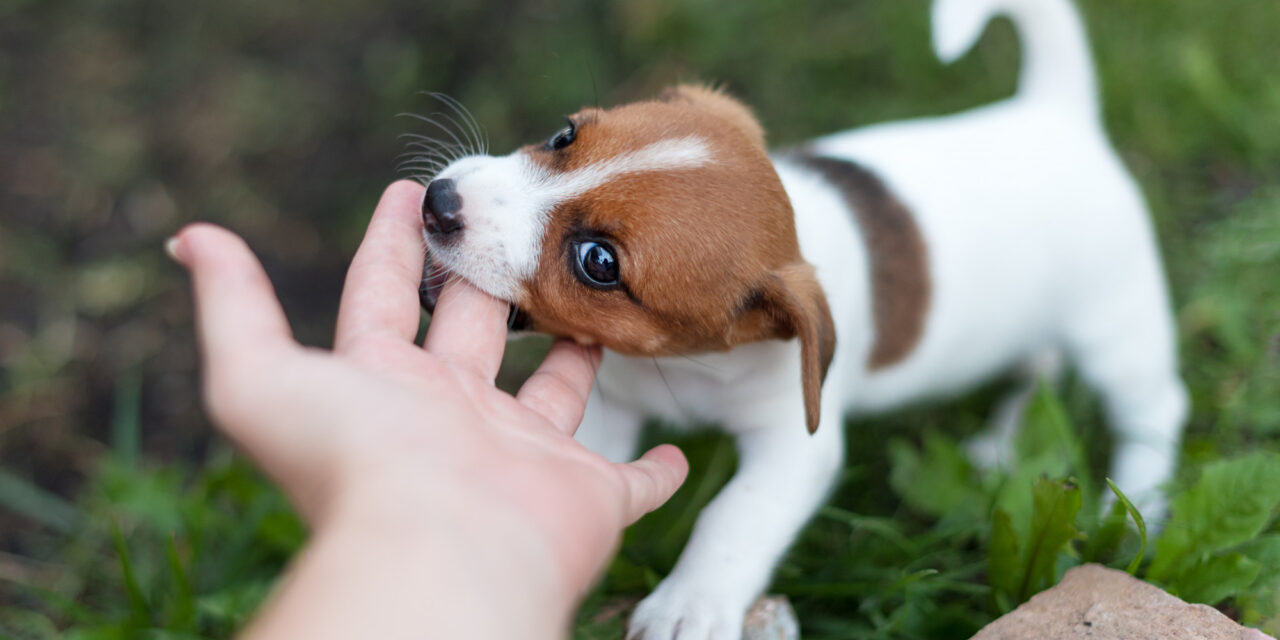
Puppy biting is the number one thing new owners search for at 11 p.m., usually right after a set of needle-sharp teeth has found bare ankle. If that’s you tonight: you’re not doing anything wrong, and your puppy isn’t turning into an aggressive dog. Puppy biting is close to universal in young puppies, and it’s one of the most normal, predictable, and fixable parts of raising one.
That doesn’t make it painless, and it doesn’t mean you should just wait it out and hope. This guide walks through why puppies mouth and bite in the first place, how to tell ordinary play mouthing from something that needs a closer look, and the specific techniques — redirection, an alternative behavior, consistent household rules, smarter toy rotation — that actually move the needle over the coming weeks.
One note on scope: this article covers the behavior and training side of puppy biting. The biology of exactly when baby teeth loosen and adult teeth come in lives in a separate MyDogLucky article on puppy teething. Here, the focus stays on what you can actually do this week.
What’s in this guide
- Why puppy biting happens: normal development, not aggression
- Normal play mouthing vs. something more concerning
- Bite inhibition: how puppies learn to soften their mouths
- The redirect-and-reward technique, step by step
- The puppy “witching hour”: overtired and overstimulated biting
- Teaching an alternative behavior for excited energy
- Getting everyone in the house on the same page
- Puppy biting around kids: extra precautions
- Chew toy rotation and texture variety
- What not to do when a puppy bites
- Common biting triggers and when to get professional help
- Common mistakes that slow progress
- A realistic one-week plan to start on
- Frequently asked questions about puppy biting
- Sources
Why Puppy Biting Happens: Normal Development, Not Aggression
Here’s the framing that matters most, and the one worth saying plainly before anything else: puppy biting is a normal, near-universal part of development. It is not aggression, and it does not mean your puppy is going to grow up mean. Puppies explore the world mouth-first. They don’t have hands, so their mouths do the job hands would do for a human toddler — picking things up, testing textures, figuring out what’s food, what’s furniture, and what’s a sibling who’ll yelp if you bite too hard.
Mouthing and play biting show up in essentially every litter, across every breed, well before a puppy ever meets a human family. That instinct doesn’t disappear the day he comes home with you. He just doesn’t yet know that human skin isn’t a chew toy or a littermate, and teaching him that distinction is most of what this article is about.
Exploring the World, One Bite at a Time
Watch a litter of puppies for ten minutes and you’ll see it constantly: wrestling, chasing, mouth-grabbing, tug-of-war over a stick, ear-nibbling. That’s not misbehavior. It’s how puppies practice the physical and social skills they’ll rely on for the rest of their lives, according to veterinary behavior guidance from VCA Animal Hospitals. When a puppy comes home to a human family, he brings that same instinct with him.
That’s the gap you’re closing over the next several weeks: not eliminating the instinct to mouth, but teaching your puppy where that instinct is welcome and where it isn’t.
How Common Is Puppy Biting, Really?
Extremely common. If your puppy is mouthing your hands, nipping at your sleeves, or treating your shoelaces like prey, you are not doing anything wrong and your puppy is not unusually difficult. The ASPCA’s behavior guidance describes mouthing, nipping, and biting as normal puppy activities tied to play, chewing, and investigating the world — not to malice or dominance. Most puppies bite the most between roughly eight and eighteen weeks old, then gradually taper off as they mature and as consistent redirection teaches them a better option.
That taper isn’t automatic, though. Puppies who get consistent, calm redirection tend to soften faster than puppies who get inconsistent reactions — sometimes ignored, sometimes squealed at, sometimes swatted away — because inconsistency confuses a puppy instead of teaching him anything. We’ll come back to that later, because it’s one of the biggest levers you actually control.
It Isn’t a Power Struggle
Some older training advice frames a mouthy puppy as testing who’s “boss.” That framing doesn’t hold up. Puppy biting during play isn’t an attempt to establish rank over you — it’s a puppy doing what puppies have always done with anything soft, warm, and within reach. Reading dominance into it tends to push owners toward confrontational responses, like scruffing or pinning a puppy down, that professional guidance advises against, and that can make a puppy more anxious or more likely to bite defensively, not less.
It’s more useful, and more accurate, to describe what you’re actually seeing — a puppy mouthing, nipping, or grabbing during play or excitement — than to assign it a motive it probably doesn’t have. That description points you toward management and redirection instead of a standoff.
A Word on Those Teeth
Puppy teeth are needle-sharp for reasons that have nothing to do with temperament and everything to do with anatomy. The biology of exactly when those teeth come in and fall out belongs in its own article. For this one, what matters is simpler: those teeth are genuinely painful even in gentle, well-intentioned play, and that’s worth acknowledging instead of pretending it doesn’t hurt. Ask any puppy owner about the state of their ankles by week three, and you’ll get a very specific, very pained laugh.
Normal Play Mouthing vs. Something More Concerning
Most puppy biting is exactly what the last section described: exploratory, play-driven, and something that softens with consistent redirection over several weeks. But “most” isn’t “all,” and it helps to know what normal looks like next to what warrants a closer look — not to panic over ordinary puppy behavior, but to notice a genuinely different pattern if one shows up.
What Normal Play Mouthing Looks Like
Normal puppy mouthing tends to share a few features:
- A loose, wiggly body. Tail relaxed or wagging, ears in a neutral or forward position, weight shifting playfully rather than braced.
- It happens during play, greetings, or excitement. Tug games, chasing, being picked up, visitors arriving — contexts where arousal is naturally higher.
- It responds, even a little, to interruption. Not perfectly and not instantly, but over days and weeks, consistent redirection produces a puppy who bites a bit softer and a bit less often.
- Intensity tracks with excitement, not fear. A tired, calm puppy mouths less. An overstimulated puppy mouths more. That’s a pattern, and patterns are useful information.
When Intensity Isn’t Softening Over Weeks
Give redirection and management a real trial — several weeks of consistent practice, not three days. If bite intensity isn’t gradually easing during that window, or if it’s getting harder despite consistent handling from everyone in the house, that’s worth a closer look rather than more of the same approach. The ASPCA’s guidance is direct about this: repeated bouts of hard, frustrated biting are not something a puppy simply grows out of on his own timeline. A pattern that isn’t moving in the right direction needs a change in the plan, ideally with a professional’s input, not just more patience.
Fear- or Guarding-Driven Biting Looks Different
Biting that comes from fear or resource guarding reads differently than play biting, and the difference matters because the fix is different too. The ASPCA’s guidance on aggression describes a progression of warning signals — a still, rigid body, a low guttural bark, growling, showing teeth — that often precedes a bite motivated by fear or guarding. A fearful puppy’s bites tend to be fast, sharp, and aimed at creating distance or escape, rather than the sustained, bouncy mouthing of play. Guarding shows up around specific things: a food bowl, a stolen sock, a favorite resting spot, and it’s usually absent everywhere else.
Signs that warrant a professional evaluation, not just more redirection
- Biting paired with a stiff, still body or growling outside of normal play.
- Bites that seem aimed at making something — a person, a hand, an object — go away, rather than continuing play.
- Guarding behavior around food, toys, or resting spots.
- Bite intensity that’s climbing week over week despite consistent redirection.
- Bites that repeatedly break skin, especially past the age when softening is expected.
None of these automatically mean something is seriously wrong. They mean it’s time for a qualified trainer or veterinary behaviorist to look at the specific pattern, because a plan built for ordinary play mouthing isn’t the right tool for a fear- or guarding-driven bite.
A quick side-by-side, for the moments when you’re not sure which you’re looking at:
| Signal | Play mouthing | Fear- or guarding-driven |
|---|---|---|
| Body language | Loose, wiggly, weight shifting | Stiff, still, braced |
| Context | Games, greetings, excitement | Handling, reaching, approach to a resource |
| Sound | Silent or a loose play-growl | Low growl or guttural bark, stillness before contact |
| Bite pattern | Repeated, bouncy, continues the game | Fast, sharp, aimed at creating distance |
| Trend over weeks | Gradually softens with redirection | Stays the same or escalates despite redirection |
Bite Inhibition: How Puppies Learn to Soften Their Mouths
“Bite inhibition” is one of those terms that sounds clinical but describes something intuitive: a dog’s ability to control how much pressure he uses with his mouth. A puppy with good bite inhibition might still mouth you during play, but he does it softly, without real force behind it. That’s the skill you’re building, more than you’re trying to eliminate mouthing outright in the earliest weeks.
What Littermates Teach
Puppies start learning bite inhibition before they ever meet you. VCA’s veterinary behavior guidance describes the mechanism plainly: when one puppy bites a littermate too hard during play, the littermate yelps and often stops playing. That sudden, unpleasant consequence teaches the biting puppy that hard bites end the fun, and that play resumes once the bite softens. Do that hundreds of times across a litter, and puppies build a working sense of how much pressure is too much — feedback from another mouth that felt exactly what that bite felt like.
That’s part of why keeping puppies with their mother and littermates until at least seven to eight weeks old matters so much. A puppy separated too early misses weeks of that particular kind of feedback, and it can show up later as a harder mouth than his littermates who stayed the full stretch.
What You Can (and Can’t) Replicate at Home
You aren’t a littermate, and that’s worth being honest about. A human hand doesn’t feel a bite the way another puppy’s skin does, and human reactions don’t automatically register the same way. Still, you can approximate the same basic lesson: hard bites make the good thing — play, attention, contact — stop, and soft mouthing or no mouthing keeps it going.
The mechanism people usually reach for first is a sharp “ouch” or yelp, mimicking a littermate’s response. It works for plenty of puppies. It does not work for all of them — some puppies read a yelp as play escalating, not play ending, and bite harder and faster in response. We’ll cover that inconsistency directly in the “what not to do” section below, because it trips up a lot of well-meaning owners who assume the yelp trick is universal.
What’s more reliable across most puppies is the pattern underneath the yelp, not the yelp itself: a bite that’s too hard makes the fun stop, calmly and predictably, every time. That consistency is worth committing to regardless of which specific interruption you use.
Why This Takes Weeks, Not Days
Bite inhibition is a gradual skill, not a switch you flip. Expect incremental softening over a period of weeks, not a clean before-and-after. Some days will look like real progress; a session an hour later might look like the bad old days, especially when your puppy is tired, teething, or just had an exciting outing. That’s not backsliding in any meaningful sense — it’s a normal, uneven learning curve, and it’s worth measuring in weeks and months rather than judging session to session.
The Redirect-and-Reward Technique, Step by Step
Redirection is the single most useful daily tool for puppy biting, and it’s simpler than most owners expect once you see it broken into steps. The idea: the instant your puppy’s teeth touch skin, you calmly interrupt, then immediately offer something he’s allowed to bite instead, and reward him for engaging with that instead.
The Instant Teeth Touch Skin
Timing matters more than intensity here. The moment mouthing turns into teeth-on-skin, stop moving the hand or foot he’s grabbing — jerking away tends to trigger a chase-and-grab reflex, which makes things worse, not better — and calmly withdraw contact. No yelling, no big reaction. Just a clear, boring stop.
Keep a Toy Within Reach, Before You Need It
Here’s the part that actually determines whether redirection works day to day: having the toy ready before the bite happens, not scrambling to find one after. AKC trainers recommend keeping toys or a treat pouch in every room your puppy spends time in, precisely so you’re never caught empty-handed mid-nip. A pocket, a basket by the couch, one clipped to a belt loop during active play — wherever it lives, it needs to be within arm’s reach at the moment you need it, which is usually about one second after you realize you need it.
Owners who chase after a toy from across the room tend to lose the redirection window entirely. By the time the tug rope shows up, the puppy’s already moved on to the shoelace, and the connection between “teeth touched skin” and “here’s what to bite instead” is gone.
Reward the Toy, Not Just the Stopping
Offer the toy, and when your puppy engages with it — grabs it, tugs it, chews it — mark that with praise or a scattered treat. You’re not just interrupting the bad option; you’re actively paying the good one, so your puppy learns which choice reliably pays off. A redirection that only removes the hand and never rewards the toy teaches half a lesson.
A simple four-step version to practice
- Teeth touch skin. Stop moving. No jerking away, no yelling.
- Calm interruption. Withdraw contact, say a neutral word (“ah-ah” or similar) once, without drama.
- Offer the toy. Immediately — ideally within a second or two, from somewhere already within reach.
- Reward engagement. Praise, a treat, or continued play once your puppy’s mouth is on the toy instead.
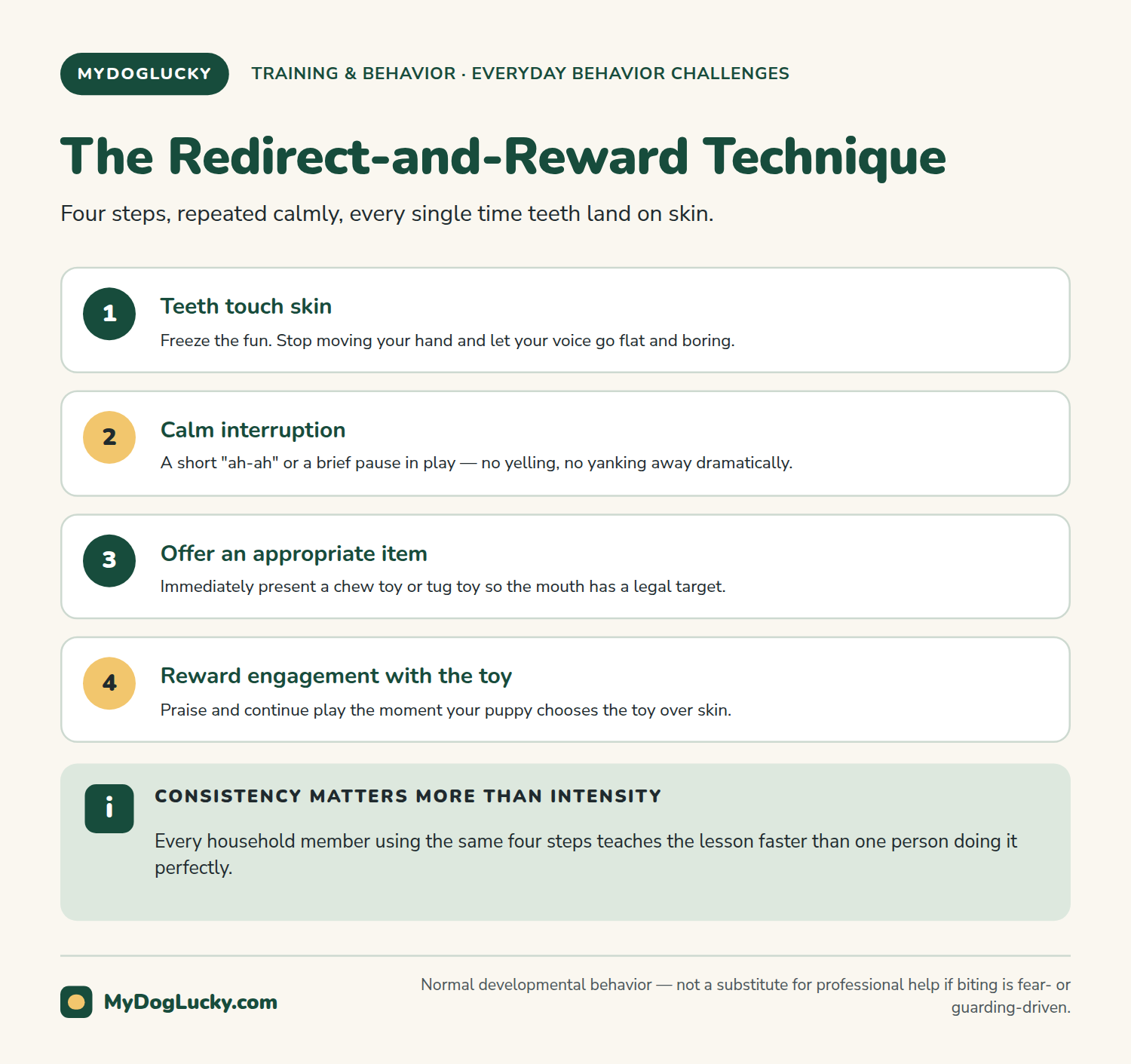
None of this works as a single dramatic correction. It works as dozens of small, boring repetitions across a normal week — every play session, every time your puppy grabs a cuff instead of the tug toy, every single time, for weeks. Consistency does more of the work here than any individual technique.
The Puppy “Witching Hour”: Overtired and Overstimulated Biting
If your puppy turns into a genuinely different animal most evenings — wild-eyed, zooming laps around the living room, biting harder and more relentlessly than any other time of day — you’ve met the witching hour. It’s extremely common, and it isn’t a training failure on your part.
Recognizing the Spike
The pattern usually looks the same across puppies: a burst of manic energy, often in the early evening, with biting that’s more frequent and more intense than the rest of the day. Puppies at this stage need an enormous amount of sleep — often close to 18 hours in 24, according to AKC guidance — and a puppy who hasn’t gotten enough of it tends to get wired instead of tired, the same way an overtired toddler melts down instead of settling.
Overstimulation compounds it. A long walk, a busy household, a visit from the neighbor’s kids, a full day of new sights and sounds — all of that adds up over the course of a day, and biting is often the first place the overflow shows up.
Sometimes the Fix Is a Nap, Not a Training Rep
This is the part worth saying clearly: redirection alone will not fix witching-hour biting, because redirection addresses the behavior, not the underlying fatigue driving it. An overtired puppy who keeps getting handed a new toy every ninety seconds isn’t learning bite inhibition. He’s getting more wound up, because you’re still engaging with him.
The more effective move, especially once biting has clearly crossed from playful into frantic, is to end the interaction and get your puppy into a quiet space — a crate, a gated pen, a calm room — with something low-key to chew, and let him crash. Most witching-hour puppies are asleep within minutes of being given the chance. It isn’t a punishment. It’s meeting the actual need, which happens to be rest, not another round of tug.
Building a Predictable Wind-Down
You can get ahead of a lot of witching-hour biting by building a consistent pre-nap routine into the part of the day where it tends to happen. A short, calm settling ritual — a stuffed chew in the crate, dim lighting, no new stimulation — signals that this is winding-down time, not another activity to get amped up about.
A rough rule of thumb
If your puppy has been awake and active for roughly an hour and a half to two hours and biting is escalating, sleep is worth trying before any other technique. It’s a low-cost experiment: if a nap fixes it, you’ve learned something useful about your puppy’s actual limits, not just his behavior in that moment.
One more thing worth normalizing: a puppy in full witching-hour mode, all needle teeth and zero impulse control, is objectively ridiculous to watch even while you’re peeling him off your sleeve for the fourth time. It’s one of the more universal puppy experiences there is, and it passes.
Teaching an Alternative Behavior for Excited Energy
Redirection handles the moment biting happens. It helps just as much to give your puppy something else to actively do with excited energy before it turns into biting in the first place. Two simple options cover most situations: a reliable “sit for attention” and a hand-targeting game.
Sit for Attention
Teach your puppy that a sit is what gets attention started, rather than jumping, grabbing, or mouthing. In practice: whenever you’re about to greet your puppy, clip on a leash, or start a play session, wait for a sit — or even just four paws briefly still on the floor — before you engage. AKC’s mouthing guidance describes exactly this pattern, rewarding a sit after calm play, then using another round of play as the reward for holding it, which turns “sit” into a genuinely useful on-ramp to the thing your puppy actually wants.
This works especially well at greeting moments, which is often when mouthing spikes hardest. You walk in the door, your puppy is thrilled, and thrilled puppies use their mouths. A sit-to-greet habit, practiced consistently, gives that excitement somewhere to go besides your sleeve.
The Hand-Target Game
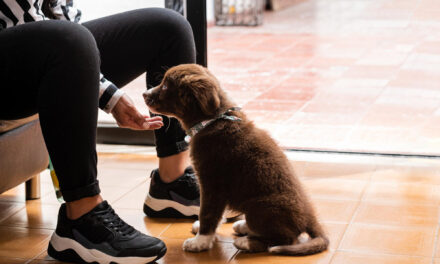
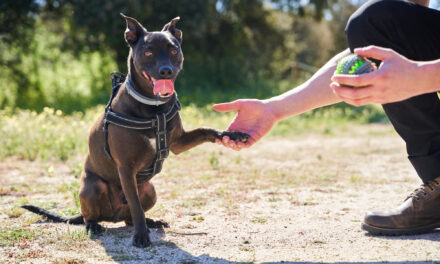
Hand-targeting is a simple, fast skill: your puppy touches his nose to your open palm on cue, and gets rewarded for it. It’s useful here because it gives an excited puppy an explicit, rewarding job for his mouth and nose that isn’t your skin. Hold your palm a few inches from his nose; the instant he touches it, mark and reward. Repeat until he’s offering the touch readily, then start using it in moments when mouthing tends to ramp up — right after you sit down on the couch, right when you pick up his leash, right when a visitor walks in.
A puppy who’s been taught to target your palm has a productive answer to “what do I do with all this excitement,” instead of defaulting to whatever’s closest and softest, which is usually your hand.
Practicing Before You Need It
Both of these work best rehearsed in calm moments, not introduced for the first time mid-meltdown. Practice sit-for-attention and hand-targeting during quiet five-minute sessions, several times a day, so the skill is already fluent by the time your puppy’s excitement level is high. Asking for a brand-new skill in the middle of a biting spiral is setting your puppy up to fail a test he was never taught to pass.
Once either skill is solid at home, practice it in a couple of different rooms and with a couple of different people. A puppy who only offers a hand-target to you, in the kitchen, hasn’t fully learned the skill yet — he’s learned a kitchen-specific, you-specific version of it. A few minutes of practice in the entryway, the yard, or with another household member usually closes that gap quickly.
Getting Everyone in the House on the Same Page
Puppy biting plans fail for a boring, fixable reason more often than a complicated one: not everyone in the house is doing the same thing. One family member redirects consistently. Another thinks rough hand-wrestling is harmless fun. Your puppy, who is not confused about which approach feels better, learns exactly which person to test.
One Rule-Breaker Undoes Everyone Else’s Work
This is worth taking seriously, not as a minor inconsistency but as an active obstacle. If one person regularly lets your puppy mouth hands during rough play, your puppy isn’t learning “hands are off-limits with some exceptions.” He’s learning that hands are sometimes a great toy, and it’s worth testing which person, which mood, and which moment will get him access to that game again. Dogs are quick studies at figuring out which behaviors pay off with which people.
The fix isn’t complicated, even if it takes an actual conversation: everyone in the household needs to redirect the same way, every time, including the family member who insists their puppy “only bites gently with them.” Gentle mouthing that’s allowed with one person and redirected with everyone else is still a mixed message your puppy has to sort out on his own, and puppies generally don’t sort it out in your favor.
Briefing Guests Before They Walk In
Visitors are the other major leak in an otherwise consistent plan. Most people, meeting an adorable mouthy puppy for the first time, will encourage exactly the rough hand-play you’ve been working to redirect — wiggling fingers, letting him gnaw on a sleeve, laughing it off as cute. It usually is cute. It’s also actively undoing the last two weeks of consistent redirection in about ninety seconds.
A short heads-up before anyone walks in the door solves most of this: “He’s working on not mouthing hands, so if he goes for yours, just stand still and offer this toy instead,” handed over along with an actual toy, gets most guests on board without much friction. People are generally happy to help once they understand there’s a plan, rather than being left to guess.
A One-Page Household Agreement
For households with several people involved in puppy care, it can help to write the plan down somewhere visible — the fridge, a shared note, a sign by the door. A few lines covering what to do the instant teeth touch skin, where the toys live, and what to say to visitors keeps the plan consistent even on days when everyone’s tired and it would be easier to let a bite slide.
Puppy Biting Around Kids: Extra Precautions
Puppy biting around children deserves its own section, not because it’s a different behavior, but because the stakes and the dynamics are genuinely different. Kids move differently than adults, sound different, and often can’t read or respond to a puppy’s body language the way an adult can. That combination needs a more deliberate approach than “let them play together and see how it goes.”
Never Leave Them Unsupervised Together
This is the single non-negotiable rule: young children and a mouthy puppy should never be left to play unsupervised, including with a puppy the family already knows and trusts. A 2017 study in Frontiers in Veterinary Science, surveying caregivers of children up to age six living with a family dog, found that supervision tended to get less attentive as children got older — even as their interactions with the dog grew riskier. Around 16% of the dogs in that study had injured the child they lived with at some point, most often around food or during games like fetch, where an object was taken from the dog mid-play.
Active supervision means within arm’s reach and actually watching, not technically in the same room with a phone in hand. That’s a genuinely high bar on a busy day, and it’s still the standard worth aiming for, per guidance from the AVMA and VCA’s veterinary behaviorists on child-dog safety.
Teach Kids Not to Run or Scream
Puppies chase movement and react to noise, and running-and-screaming is, from a puppy’s point of view, an outstanding game that ends in a mouthful of pant leg. It isn’t willful disobedience on the puppy’s part — it’s chase-and-grab instinct meeting exactly the trigger it’s built to respond to.
Coach kids ahead of time, in calm moments, not mid-chase: move slowly around the puppy, use a quiet voice, and if the puppy starts getting mouthy, stand still like a tree rather than running away. Standing still removes the exact stimulus — fast movement — that fuels the chase. It’s a hard habit for an excited kid to build, which is exactly why adult supervision stays essential rather than optional once the rules have been explained.
Calm Handling and Appropriate Distance
Beyond the chase dynamic, teach kids the same consent-based handling that’s good practice with any dog: let the puppy approach rather than reaching for him, keep petting brief and gentle, and give him a clear way to leave the interaction if he wants space. A puppy who has an obvious exit is far less likely to resort to his mouth to create one.
Feed the puppy and give him chews somewhere kids can’t reach, since food and possessions are common flashpoints for bites in general, not just puppy nipping specifically. And build in a “puppy’s own space” — a crate or a gated area kids don’t follow him into — so an overtired or overstimulated puppy always has somewhere to retreat that isn’t contested.
A short script for kids
- Walk, don’t run, around the puppy.
- Use a quiet voice instead of squealing when he gets excited.
- Stand still like a tree if he starts mouthing at clothes or hands.
- Let the puppy come to you rather than chasing him down for pets.
- Tell a grown-up if the puppy won’t stop, instead of trying to handle it alone.
Chew Toy Rotation and Texture Variety
Redirection only works as well as the toy you’re redirecting to. A puppy who’s bored of the “approved” chew toy will go right back to your hand — not because the plan failed, but because the alternative stopped being interesting.
Why Your Puppy Gets Bored of the “Approved” Toy
Puppies, like most young animals, habituate to things that never change. The rope toy that was thrilling on day one becomes background furniture by day ten if it’s always sitting in the same basket, unchanged. That’s not pickiness. It’s a completely normal response to a static environment, and it’s fixable with almost no cost.
Building a Rotation
Keep more toys in your closet than in active circulation, and swap what’s available every few days rather than leaving the whole collection out permanently. A toy that’s been “gone” for a week and reappears often gets treated like something brand-new. This costs nothing beyond a little organization, and it keeps redirection genuinely appealing instead of a stale substitute your puppy tolerates for two seconds before wandering back to your shoelaces.
Matching Textures to the Moment
Different textures serve different needs, and having a few types on hand covers more situations than one favorite toy ever will:
- Rubber chews (solid or stuffable) hold up to serious gnawing and work well for a puppy in a determined chewing mood.
- Rope and fabric tug toys are ideal for the redirect-and-reward moments described earlier — they invite the same grab-and-pull motion your puppy was aiming at your sleeve.
- Softer plush toys suit gentler mouthing and carrying-around behavior, though they need swapping out once they start coming apart.
- Frozen options — a wet washcloth, or a stuffed chew toy frozen overnight — can feel soothing on sore gums during heavier teething stretches. The tooth-eruption details behind that are covered in a separate MyDogLucky article on puppy teething; the practical takeaway here is simpler: cold can help, and it’s worth keeping a couple of freezable chews in rotation.
Supervise anything your puppy is actively working to destroy, and retire toys once pieces start coming loose. A chew that’s fallen apart stops being an approved outlet and starts being a choking risk, which defeats the entire point of offering it in the first place.
Size matters as much as texture. A toy too small for your puppy’s current mouth is a swallowing risk; one that’s needlessly oversized just isn’t satisfying to chew on. Sizing up as your puppy grows is a normal, ongoing part of the rotation — not a one-time purchase you make during the first week home.
What Not to Do When a Puppy Bites
A lot of outdated puppy-biting advice circulates because it sounds decisive, even when it doesn’t work or actively makes things worse. It’s worth naming clearly, since a well-meaning relative or an old training book will eventually suggest one of these.
No Hitting, No Physical Punishment
Hitting, scruff-shaking, or nose-whacking a puppy for mouthing doesn’t teach gentleness. The ASPCA’s guidance is direct about this: physical punishment tends to make puppies bite harder, not softer, and it can introduce fear into what was previously a normal social behavior. A puppy who gets hit for mouthing doesn’t necessarily learn “don’t bite.” He may learn “hands near my face are unpredictable and sometimes hurt,” which is a considerably worse lesson, and one that can show up later as defensive or fear-based biting rather than ordinary play mouthing.
No Holding the Muzzle Shut
Holding a puppy’s mouth closed as a correction is another technique that sounds like it should work and generally backfires. It’s confrontational, it can frighten a puppy without teaching him anything useful about bite pressure, and for a puppy who’s already anxious or guarding-prone, physical restraint around the face and mouth is exactly the kind of handling that can provoke a defensive response rather than resolve one.
The Yelp Technique Is Inconsistent, Not a Universal Fix
A sharp “ouch” or yelp, mimicking a littermate’s response, works well for a lot of puppies. It is not a guaranteed fix, and it’s worth going in with that expectation rather than assuming it’ll work the same way for every puppy. VCA’s veterinary behavior guidance notes that the yelp method tends to work best with the household members who are most immediate, consistent, and clear in their response — and some puppies interpret the sudden sound as play escalating rather than play ending, biting harder and faster instead of softer.
If you try yelping and your puppy gets more amped up rather than less, that’s useful information, not a sign you’re doing it wrong. Switch to a silent approach instead: calmly withdraw contact, stand up, turn away, or end the interaction for a short, boring pause, then try again once your puppy has settled. There’s no single interruption method proven to work for every puppy, which is exactly why “try one thing, watch what happens, adjust” beats committing hard to any single trick.
No Punishing a Growl
One more, worth including even though it’s technically outside biting: don’t punish a growl. A growl is information — your puppy telling you he’s uncomfortable before doing anything more serious about it. Punish the warning often enough and some dogs stop giving it, not because the discomfort went away, but because the warning itself got them in trouble. That trades a useful signal for a puppy who goes straight to biting with no warning at all, which is a considerably worse outcome for everyone involved.
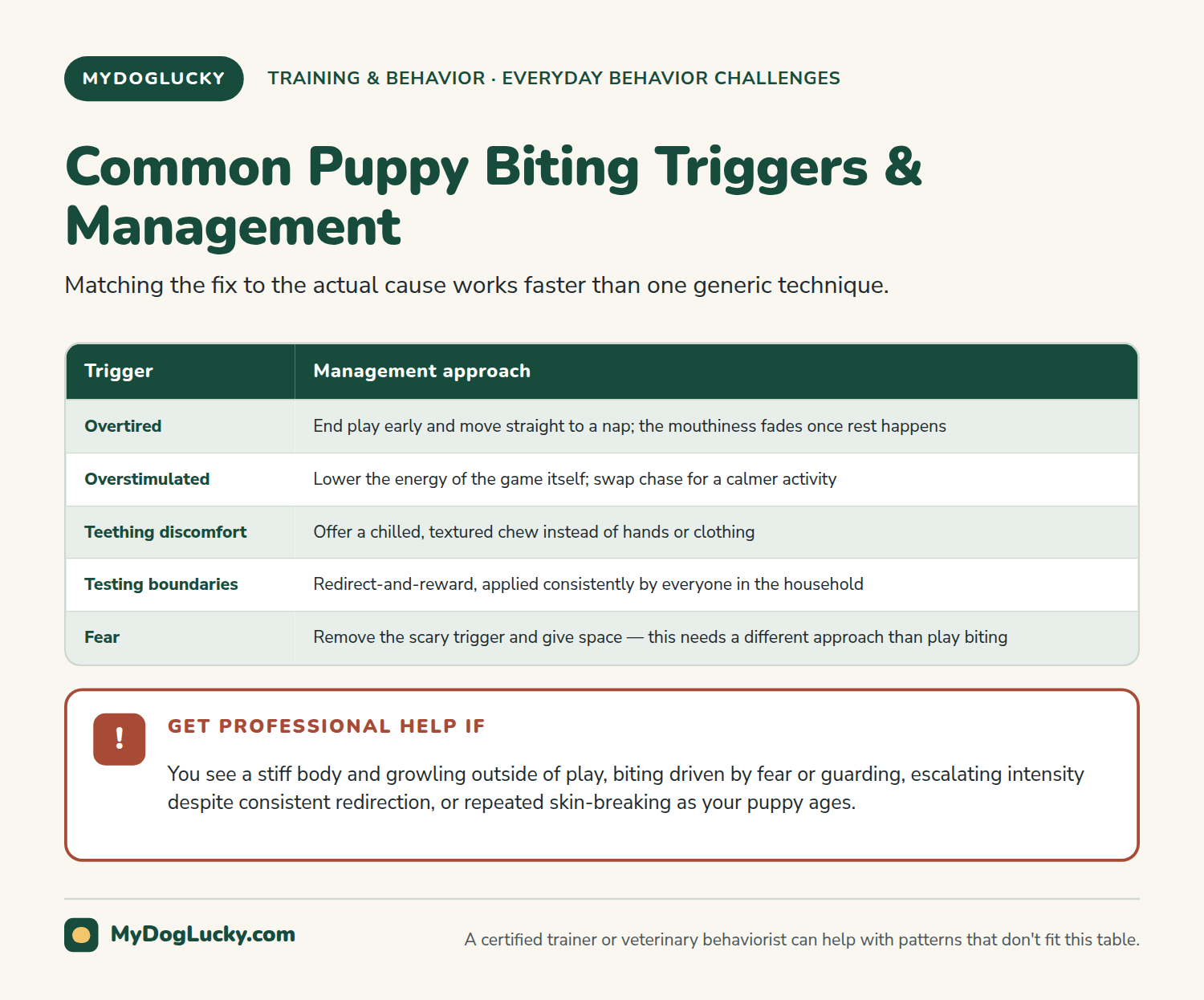
Common Biting Triggers and When to Get Professional Help
Most puppy biting traces back to one of a handful of recurring triggers, and figuring out which one you’re dealing with in the moment points you toward the right response faster than a one-size-fits-all fix.
| Trigger | What it often looks like | What usually helps |
|---|---|---|
| Overtired | Manic energy, harder bites, often evenings (“witching hour”) | A nap or quiet crate time, not more play |
| Overstimulated | Escalating mouthiness after a busy day or lots of new stimulation | A calm-down break, reduced input, quiet space |
| Teething discomfort | Increased chewing and mouthing, often in a specific age window | Appropriate chew toys, cold options for sore gums |
| Testing boundaries | Mouthing that increases with one person or in one context | Consistent redirection from everyone, every time |
| Fear | Stiff body, retreat, bites aimed at creating distance | Reduce the scary trigger; professional evaluation |
When Redirection Alone Isn’t Enough
Redirection, management, and consistency solve the large majority of puppy biting cases over a period of weeks. They are not the right tool for every case, and it’s worth naming when to step outside this article’s scope and bring in a professional:
- Biting that keeps intensifying despite genuinely consistent redirection from everyone in the household, given several weeks to work.
- Bites paired with stiff body language, growling, or guarding outside normal play contexts.
- Biting that seems driven by fear rather than excitement — aimed at making something go away rather than continuing a game.
- Bites that repeatedly break skin, particularly as your puppy gets older and bite inhibition should be improving, not staying the same.
- Any bite involving a child, regardless of how minor it seemed.
Who to Call
Start with your veterinarian if anything about the pattern seems off, since pain or a medical issue can occasionally show up as increased irritability or mouthiness, and it’s worth ruling that out first. From there, a certified trainer experienced with puppies, or — for anything involving fear, guarding, or aggression — a Certified Applied Animal Behaviorist or a veterinary behaviorist (a veterinarian board-certified in behavioral medicine) is the right next call. None of these professionals expect you to have already fixed the problem before you reach out; catching a concerning pattern early tends to make treatment faster and more successful than waiting to see if it resolves on its own.
Common Mistakes That Slow Progress
Inconsistent Household Response
Covered above, and worth repeating here because it’s the single biggest driver of “we’ve tried everything and nothing works.” If even one person in the house handles mouthing differently, your puppy has a live experiment running on which approach gets him what he wants.
Waiting Too Long to Redirect
Redirection loses most of its value if it happens ten seconds after the bite, once your puppy’s already moved on to something else. The window that matters is the instant teeth touch skin — not “eventually,” not “once I find the toy.”
Removing All Mouth-Appropriate Toys Instead of Substituting One
Some owners, frustrated, pull every chew toy away as a consequence for biting. That removes the one outlet your puppy actually needs. The goal isn’t fewer things to chew; it’s the right things to chew, offered consistently and immediately.
Escalating to Punishment When Redirection Doesn’t Work Right Away
Redirection takes weeks of repetition, not one session, to show results. A common mistake is giving it three days, deciding it “isn’t working,” and reaching for something harsher. That’s usually a patience problem, not a technique problem — and the harsher approach tends to introduce new problems, like fear or defensive biting, without solving the original one.
Treating Every Bite the Same Way
Play mouthing, overtired biting, and fear-driven biting all call for different responses, as the sections above laid out. Applying one blanket technique to all three means it’ll work for some situations and completely miss the mark for others.
Skipping the Conversation With Visitors
It’s easy to forget to brief a guest until the puppy’s already mouthing their sleeve. A thirty-second heads-up before anyone walks in the door prevents most of this particular setback.
A Realistic One-Week Plan to Start On
If all of this feels like a lot at once, here’s a scaled-down version to start with this week rather than trying to implement everything simultaneously.
- Day 1–2: Stock two or three toys in every room your puppy spends time in. Do nothing else differently yet — just get the tools within reach.
- Day 3–4: Practice the four-step redirect-and-reward sequence consistently, every single time teeth touch skin. Brief every household member on exactly what to do.
- Day 5: Add the sit-for-attention habit at greetings and before play sessions. Keep sessions short — a few minutes, several times a day.
- Day 6: Pay attention to timing. Note when biting spikes — right after a nap, evenings, after visitors leave — and build in a nap or quiet break before that window next time.
- Day 7: Brief any regular visitors or caregivers on the plan, and rotate in a “new” toy from storage to keep redirection interesting.
Expect gradual softening over the following weeks, not a finished result by day seven. If bite intensity hasn’t budged at all after several weeks of genuinely consistent practice, that’s the point to loop in a trainer rather than keep running the same week on repeat.
Frequently Asked Questions About Puppy Biting
Is it normal for an 8-week-old puppy to bite this much?
Yes. Eight weeks old is right in the thick of the most mouthy stretch most puppies go through, typically somewhere between about eight and eighteen weeks. Frequent mouthing and nipping at this age reflects normal exploration and play, not a behavior problem, and it should gradually improve with consistent redirection over the coming weeks.
Does saying “ouch” loudly actually work?
Sometimes. A sharp yelp mimics the response a littermate would give, and plenty of puppies do soften their mouth in response. It’s not universal, though — some puppies get more excited by the sudden sound and bite harder. If that’s what you’re seeing, switch to a quiet, calm withdrawal instead of the yelp.
My puppy only bites certain family members. Why?
This usually comes down to how each person responds. If one person’s reaction — laughing, squealing, wrestling back — reads as more fun or more rewarding than another’s calm redirection, your puppy will naturally test the person who gives the more interesting reaction. It’s a strong sign the household needs to align on one consistent response, discussed above.
When should I worry this isn’t just puppy behavior?
Watch for biting intensity that isn’t gradually softening despite weeks of consistent redirection, bites paired with stiff body language or growling outside of play, biting that seems aimed at creating distance rather than continuing a game, or guarding around food or objects. Any of those patterns is a reason to bring in a trainer or veterinary behaviorist rather than continuing to wait it out.
How long does puppy biting usually last?
Most puppies show a noticeable decline in mouthing intensity and frequency somewhere between four and six months old, as bite inhibition develops and adult teeth come in, though the exact timeline varies by individual puppy and by how consistent the redirection has been. Occasional gentle mouthing during excited play can persist longer in some dogs unless it’s specifically discouraged.
Should I use a spray bottle or citronella collar to stop puppy biting?
These fall into the same category as other punishment-based tools: they can suppress the behavior in the moment without addressing why it’s happening, and for some puppies they introduce fear or anxiety that shows up as a different problem later. Redirection paired with management and rest addresses the actual cause more reliably.
Is it okay to let my puppy mouth me gently but not let him mouth anyone else?
It’s simpler and more effective to pick one rule and apply it everywhere: either gentle mouthing is allowed with everyone, or it isn’t allowed with anyone. A puppy who’s allowed to mouth one person’s hands and redirected away from everyone else’s has a genuinely harder time learning a clear rule.
My puppy bites much harder when he’s excited during play. Is that normal?
Yes, and it’s a useful pattern to notice. Arousal and bite intensity are closely linked in puppies — the more excited he gets, the less control he tends to have over his mouth. That’s exactly why ending a game the instant a bite gets too hard, rather than continuing at high energy, is part of teaching a softer mouth.
Can teething explain why biting seems to get worse around four months?
It’s a common and reasonable question, and teething discomfort can genuinely increase chewing and mouthing around that age. The specific timeline of tooth eruption and loss is covered in a separate MyDogLucky article on puppy teething; for behavior purposes, the practical response is the same either way — offer appropriate chew outlets and keep redirection consistent.
Will getting a second puppy or dog fix the biting?
Not reliably, and it can complicate things. A second puppy adds its own training needs and doesn’t replace consistent human-directed redirection; two mouthy puppies can also reinforce rough play with each other in ways that make gentleness with people slower to build, not faster.
My puppy draws blood sometimes. Is that automatically a red flag?
Not automatically, especially in very young puppies with needle-sharp teeth — a light nip can break skin even during ordinary, well-intentioned play. What matters more is the trend: an occasional light nick that’s gradually becoming rarer as redirection continues is different from bites that keep breaking skin with real force as your puppy gets older. The second pattern is worth a professional evaluation.
Where to Start This Week
If you take one thing from this article, make it the opening point: puppy biting is normal, it is not aggression, and it responds to consistent, boring, unglamorous repetition far more than to any single trick. Stock toys where you’ll actually need them. Redirect the instant teeth touch skin, every time, from everyone in the house. Watch for the overtired spike and answer it with a nap instead of another round of tug.
And if the pattern you’re seeing doesn’t match ordinary play — stiff body language, guarding, bites that keep escalating instead of softening — treat that as useful information, not a personal failure, and bring in a trainer or veterinary behaviorist who can look at your specific puppy. Most puppy biting is a phase you’ll look back on fondly, scarred ankles and all. The cases that aren’t just get better faster with the right help, and sooner is better than later.
Sources
- ASPCA. Mouthing, Nipping and Biting in Puppies
- ASPCA. Aggression
- VCA Animal Hospitals. Play Biting in Puppies
- American Kennel Club. How to Stop Puppy Biting and Train Bite Inhibition
- American Kennel Club. Tips on How to Stop Puppy Mouthing and Nipping
- American Veterinary Society of Animal Behavior. Humane Dog Training Position Statement (2021)
- American Veterinary Society of Animal Behavior. Position Statement on Puppy Socialization (2008)
- Arhant, C., Beetz, A., Troxler, J. Caregiver reports of interactions between children up to 6 years and their family dog. Frontiers in Veterinary Science (2017)
- Centers for Disease Control and Prevention. Healthy Pets, Healthy People: Dogs
- American Veterinary Medical Association. Dog Bite Prevention
This article is general education for U.S. dog owners. It is not individualized training or veterinary advice for your puppy. Biting that involves guarding, fear, or escalating intensity should be evaluated by a qualified trainer, Certified Applied Animal Behaviorist, or veterinary behaviorist. Any sudden change in a puppy’s behavior, or a bite that breaks skin repeatedly, is a reason to talk with your veterinarian.


Trackbacks/Pingbacks