

“How much should I feed my dog?” It’s one of those questions that sounds simple, until you’re standing in the kitchen, scoop in hand. You’re staring at a bag chart that lists weight ranges, not your actual dog. The number on the label is a reasonable place to start. It is not a prescription. And it definitely isn’t the last word on your dog’s portions.
That chart was built from population averages. It matches a range of body weights to a range of calorie estimates. The dog behind those numbers is a hypothetical reference dog. He may be more active, more intact, and more food-motivated than the one currently staring at you from the kitchen floor.
Your dog is an individual. His metabolism, activity level, age, and spay or neuter status all shift how many calories he actually burns each day. Sometimes by a wide margin.
This guide walks through what vets actually do when they calculate a dog’s calorie needs. It explains why the bag’s guide tends to run high for a lot of pet dogs. And it shows how body condition becomes the real feedback loop for getting portions right over time. Not a chart. Not a scale reading on its own.
We’ll also cover treats, kitchen scales, puppies, and multi-dog households. And we’ll cover when a feeding question is worth a call to your veterinarian, instead of another lap around the internet.
One thing worth saying upfront: this article covers general nutrition education, not an individualized feeding plan for your dog. Your veterinarian can examine your dog and factor in bloodwork, breed, and health history. That’s the professional who can turn any of this into a specific number for your specific dog.
What’s in this guide
- How much should I feed my dog? Start with the bag, then look closer
- How vets calculate calorie needs: RER and MER explained
- Why feeding charts on bags tend to run high
- Body condition score: the feedback loop that actually works
- How to adjust portions without guessing
- Why treats and other extras count toward the total
- Why a kitchen scale beats a scoop or cup
- Special feeding situations
- Common feeding mistakes that add up
- When to loop in your veterinarian
- Frequently asked questions about feeding your dog
- How much should I feed my dog? The bottom line
- Sources
How Much Should I Feed My Dog? Start With the Bag, Then Look Closer
So, how much should I feed my dog, in practice? Start with the feeding chart printed on the bag. It’s not useless. It’s a reasonable first estimate, built from real nutritional science, and it beats guessing entirely from scratch. Use it to land on a starting portion. Then treat that number as a hypothesis — one you’re going to test against your own dog over the next several weeks.
What the Chart Is Actually Measuring
Feeding charts group dogs into weight bands, say 25 to 50 pounds. Each band gets a daily cup or gram range. That range comes from calorie estimates for a population of dogs at that weight. It doesn’t come from your particular dog’s activity level, breed, coat, metabolism, or personality. Two 40-pound dogs can have meaningfully different calorie needs. That’s true even if they land on the exact same line of the same chart.
That’s not really a flaw in the chart. It’s a structural limit of any one-size-fits-all number. A chart has to describe an average, and your dog probably isn’t the average. Nobody’s dog really is, because “average” is a statistical construct, not a real animal standing in your kitchen.
Why This Article Exists
Because the honest answer to how much you should feed your dog has two parts. The first part is the number on the bag, which gets you into the right neighborhood. The second part is a feedback loop: body condition, weight trend, energy level. It tells you whether that number is actually working, and how to adjust it if it isn’t.
We’ll walk through both halves in detail. First, how the chart’s number gets calculated in the first place — useful background, even if you’ll never do the math yourself. Second, how to read your dog’s body to figure out whether it’s too much, too little, or just right. Two related articles are worth knowing about, if you haven’t already read them. “How to Read Dog Food Labels” covers how to make sense of the calorie and nutrient information printed on the bag itself. “How Often Should You Feed a Dog” digs into meal timing and frequency specifically.
How Vets Calculate Calorie Needs: RER and MER Explained
Veterinary nutritionists don’t eyeball calorie needs. Neither should you. They start with a formula, then adjust it using factors specific to the individual dog in front of them. Understanding the basic math explains why the bag’s chart is a starting point rather than gospel. It also explains why two dogs who look similar on paper can need noticeably different amounts of food.
What Resting Energy Requirement (RER) Means
Resting Energy Requirement, or RER, is the number of calories a dog’s body burns at complete rest. Think of it as the baseline metabolic cost of just being alive: digesting, breathing, keeping organs running. No activity factored in yet. It’s the foundation every other calculation builds on.
The standard formula, used across veterinary nutrition references including the Merck Veterinary Manual, is:
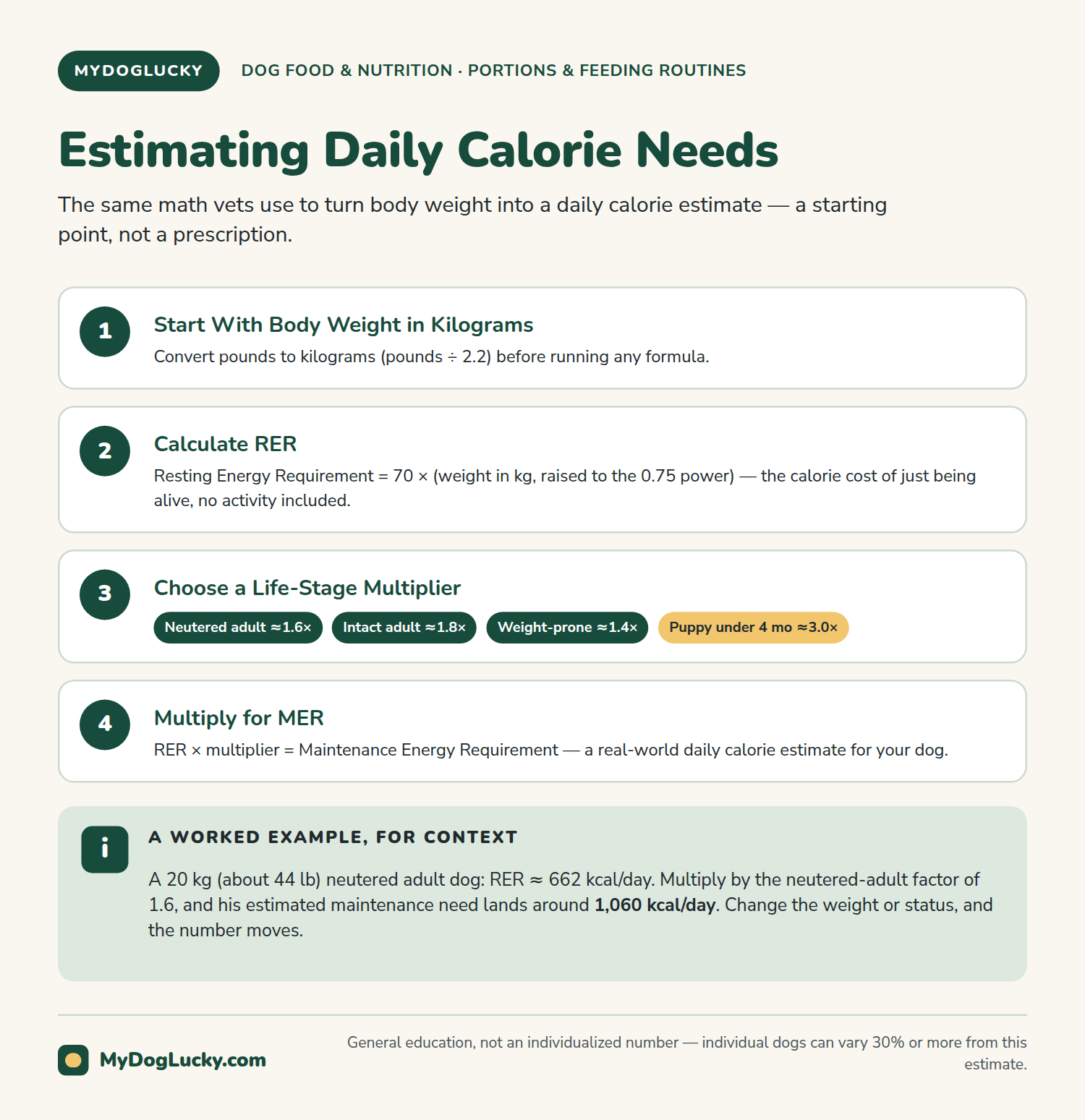
RER = 70 × (body weight in kilograms)0.75
For dogs in the roughly 2 to 45 kg range — about 4.5 to 99 pounds — a simpler linear approximation gets close enough for most pet dogs. It reads: RER = (30 × body weight in kg) + 70. Both formulas describe the same basic relationship between weight and baseline calorie burn. They just trade a little precision for simpler math.
Neither formula requires much: just your dog’s weight in kilograms and a calculator. Still, this is background math, not a step you need to do yourself before dinner. Your veterinary team runs these numbers routinely, and most online calculators from veterinary nutrition programs handle the arithmetic automatically.
From RER to Daily Calories: the Activity Multiplier
RER on its own understates what a living, moving dog actually needs, because it assumes zero activity. Vets get to a real-world number — called Maintenance Energy Requirement, or MER — by multiplying RER by a factor. That factor accounts for life stage, activity, and reproductive status.
Typical multipliers used in veterinary nutrition guidance look roughly like this:
| Dog category | Typical multiplier | What it reflects |
|---|---|---|
| Intact adult | ≈1.8 × RER | Not spayed or neutered; hormonal status raises baseline needs |
| Neutered or spayed adult | ≈1.6 × RER | Most companion dogs in the U.S. fall here |
| Prone to weight gain | ≈1.4 × RER | Lower-activity dogs, or dogs already trending heavier |
| Puppies under 4 months | ≈3.0 × RER | Rapid growth demands a lot of extra energy |
| Puppies 4 months and older | ≈2.0 × RER | Growth continues, though more slowly |
Highly active working and sporting dogs can need multipliers well above these ranges. Think search-and-rescue dogs, sled dogs in training, or dogs doing serious field work most days. The increase can be dramatic, depending on the intensity and duration of the work. That end of the spectrum is individual enough that it’s worth working out directly with a veterinarian or veterinary nutritionist. A general table won’t cut it.
A Worked Example, for Context
Take a 20 kg (about 44 lb) neutered adult dog, purely as an illustration. His RER comes out to roughly 662 calories a day using the exponential formula. The linear approximation gets you to about 670 — close enough for practical purposes. Multiply 662 by the neutered-adult factor of 1.6, and his estimated maintenance need lands around 1,060 calories a day.
That’s a single example, not a number to copy for your own dog. Change the weight, the spay or neuter status, the activity level, or the life stage, and the number moves. Sometimes by a few hundred calories in either direction.
A Second Example, to Show How Fast the Number Moves
Compare that 20 kg neutered dog to a smaller, intact adult dog weighing 6 kg (about 13 lb). His RER works out to roughly 268 calories a day. Multiply by the intact-adult factor of 1.8 instead of 1.6, and his estimated maintenance need lands around 483 calories a day. That’s a very different number, driven by both his smaller size and his reproductive status.
Line the two examples up side by side, and the point becomes obvious. Body weight alone doesn’t determine calorie needs. Life stage and reproductive status shift the multiplier meaningfully. That’s exactly why two dogs on the same weight-based line of a bag chart can need noticeably different actual amounts.
This Is General Education, Not an Individualized Prescription
Here’s the part worth underlining: RER and MER formulas give you a reasonable estimate, not a guaranteed number. Veterinary nutrition references such as WSAVA’s Global Nutrition Toolkit are explicit about this. Calculated calorie needs are a starting point. Individual dogs of the same weight can vary in actual energy requirements by a significant margin. Sometimes 30% or more in either direction, according to clinical nutrition guidance.
That variation is exactly why the next several sections matter as much as the formula itself. The math gets you a reasonable first number. Your dog’s actual body condition, over time, tells you whether that number needs to move.
Why Feeding Charts on Bags Tend to Run High
Have you ever fed the exact amount listed on the bag and watched your dog slowly thicken around the middle over a few months? You’re not imagining it. And you’re not doing anything wrong. Feeding guide charts have a well-documented tendency to run higher than what a lot of pet dogs actually need.
The “Reference Dog” Behind the Chart
Bag charts are typically built around a reference population. That population skews more active, and often more likely to be intact. Compare that to the typical companion dog, snoozing on a couch most of the day. The 2021 AAHA Nutrition and Weight Management Guidelines are direct about this risk. They caution that commercial feeding recommendation labels “may overestimate energy requirements, causing overfeeding.”
That’s a meaningful gap for a huge share of pet dogs. Most companion dogs in the U.S. are spayed or neutered. They live mostly indoor lives, and get a walk or two rather than hours of daily field work. A chart calibrated toward a more active reference dog is going to overshoot for that population. Sometimes by a noticeable margin, over months of consistent overfeeding.
Spaying and Neutering Changes the Math
Spay and neuter surgery measurably lowers a dog’s baseline energy needs. AAHA’s guidelines note plainly that after the procedure, “energy requirements decrease and feeding amounts change.” That tracks with the MER multipliers above. Neutered adults get a noticeably lower multiplier (1.6×) than intact adults (1.8×).
Spay and neuter surgery often happens early in a dog’s life, right around the transition from puppy food to adult food. That’s exactly the window where feeding amounts frequently need a downward adjustment — one a lot of owners never make. The bag’s chart doesn’t know your dog was neutered six months ago. Your dog’s body condition will tell you, if you’re paying attention to it.
Breed, Coat, and Individual Metabolism Add More Variation
Spay or neuter status is one piece of a bigger picture. Individual metabolism varies for reasons that are harder to pin down from a bag chart. Breed background, coat type, and plain genetic variation between dogs all play a part. A dog bred for endurance work burns energy differently than a dog bred to sit calmly at a person’s side. That holds true even at a similar weight and activity level on paper.
That’s part of why veterinary nutrition guidance treats calculated calorie needs as an estimate with real uncertainty built in. Individual dogs of the same weight can vary in actual energy requirements by 30% or more, as noted earlier in this guide. A chart, by design, can’t capture that kind of individual variation. Body condition, tracked over time, is what fills that gap.
Why this matters in practice
None of this means the chart is wrong to consult, or that you need to distrust every number on every bag. It means the chart is a reasonable opening estimate for an average dog in that weight range. Your dog’s actual body condition, tracked over a few weeks, is what tells you whether “average” applies to him.
Body Condition Score: The Feedback Loop That Actually Works
The bag chart and the RER/MER math give you a starting estimate. Body condition score (BCS) is what tells you whether that estimate is actually right for your dog. It’s the single most useful tool a dog owner has for judging portions. It’s more useful, in practice, than any chart, because it’s based on your actual dog instead of a population average.
How the Scale Works
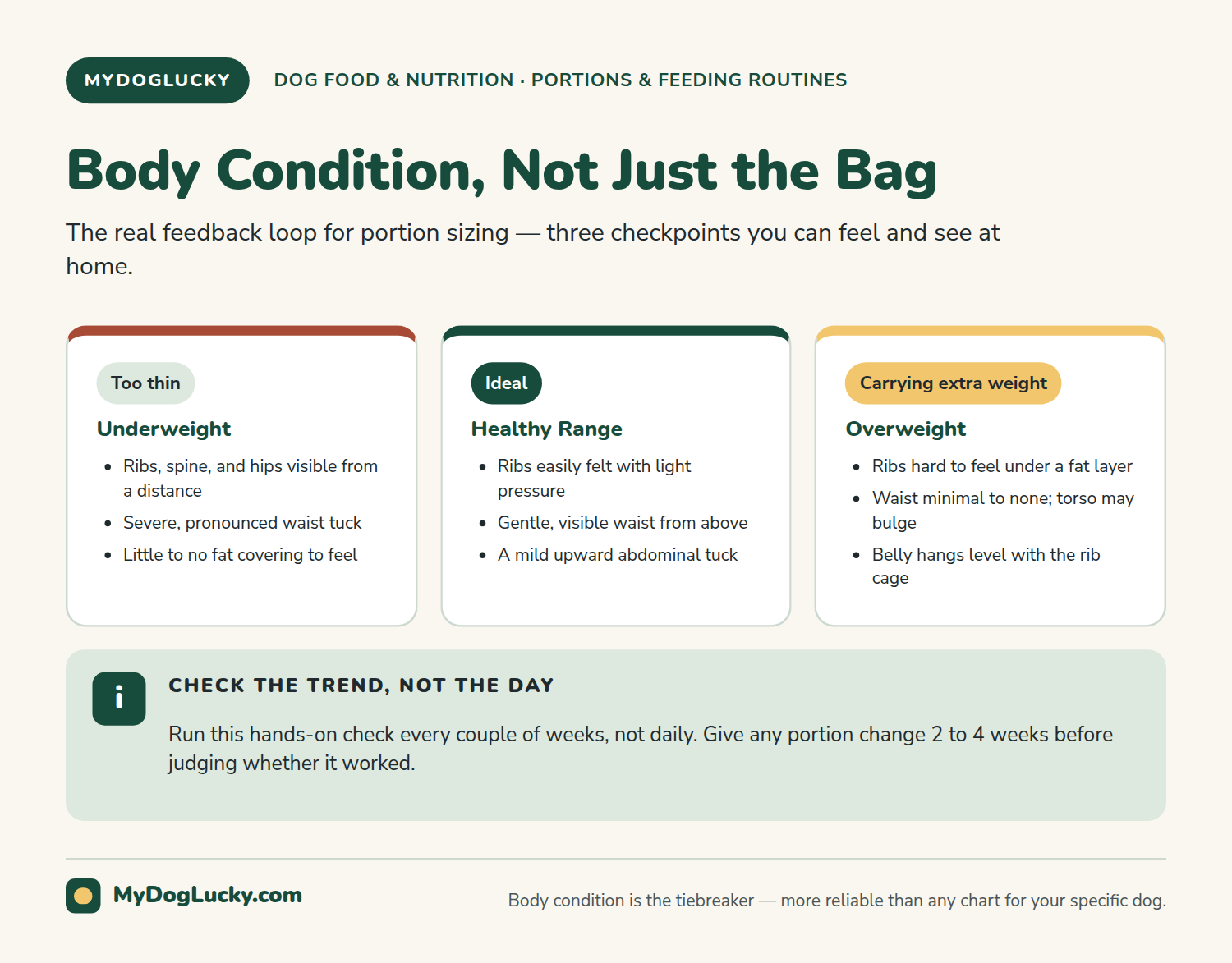
Most veterinary references use a 9-point body condition scale. A score of 1 means severely underweight, 9 means severely overweight, and 4 to 5 sits in the ideal range. Some clinics use a simplified 5-point version instead, where 3 out of 5 is ideal — same basic idea, fewer gradations.
Either version relies on the same three checkpoints. What you can feel over the ribs. What you can see as a waist from above. What you can see as a tuck from the side.
You don’t need a veterinary degree to run this check at home. You don’t need your dog to hold perfectly still for it, either. A couple of minutes, hands-on, gives you more useful information than a scale number ever will on its own.
What Ideal Feels Like Under Your Hands
Run your hands gently along your dog’s rib cage. Use about the same light pressure you’d use to feel the back of your own hand through a thin glove. At an ideal body condition, you should feel each rib without much searching. Expect a light, even layer of muscle and fat over bone. Not sharp ridges. Not a thick padded layer you have to press through to find anything.
Stand above your dog and look down. You should be able to see a waist: a visible narrowing behind the ribs, before the hips, creating a mild hourglass shape. From the side, look for an abdominal tuck. The belly line should slope gently upward from the bottom of the rib cage toward the back legs. It shouldn’t hang level or sag.
What Too Thin Looks Like
At the underweight end of the scale, ribs, spine, and hip bones become visible from a distance. Sometimes even through a longer coat. The waist tuck becomes severe and pronounced rather than gentle. There’s little to no fat covering to feel over the bones. Muscle mass may be reduced as well, which a vet checks separately by feeling along the spine and shoulder blades.
An underweight dog isn’t always a dog who’s being underfed. It can also point to a medical issue affecting appetite, digestion, or metabolism. That’s one of several reasons unexplained weight loss is worth a veterinary conversation. Adding more food and hoping for the best isn’t a plan.
What Carrying Extra Weight Looks Like
At the other end, ribs get progressively harder to feel under a layer of fat, sometimes requiring firm pressure to locate at all. The waist narrowing from above starts to disappear. In more advanced cases, the torso looks more like a straight line, or even bulges outward, instead of narrowing. The abdominal tuck flattens out. In more pronounced cases, the belly hangs level with, or below, the rib cage from the side.
None of this is about judgment. Worth saying clearly: a dog carrying extra weight isn’t a reflection of a bad owner. It’s usually the slow, easy-to-miss result of portions that crept upward, or treats that quietly added up. Months go by where nobody’s doing the math day to day. The next two sections cover exactly how to catch that trend and correct it.
A Quick Reference Table
| Checkpoint | Too thin | Ideal | Carrying extra weight |
|---|---|---|---|
| Ribs | Visible, easy to count from a distance | Easily felt with light pressure, not visibly prominent | Hard to feel through a fat layer |
| Waist (from above) | Severe, exaggerated hourglass | Gentle, visible narrowing | Minimal to none; torso may bulge |
| Abdominal profile (side view) | Sharp, pronounced tuck | Gentle upward slope | Flat, level, or sagging |
Reading the Trend, Not the Daily Number
Body condition doesn’t meaningfully change day to day. Checking it daily mostly just adds stress without adding information. Instead, do a hands-on check every couple of weeks. Pay attention to the trend over a month or two, rather than reacting to any single check.
A dog who’s solidly ideal at week one and still solidly ideal at week four needs no changes. A dog whose ribs are getting a little harder to find is telling you something. So is a dog whose waist looks a little less visible than it did a month ago. That’s worth acting on — gradually, which the next section covers.
How to Adjust Portions Without Guessing
Once you have a body condition trend to work with, adjusting portions is more straightforward than it sounds. Just resist the urge to overcorrect.
Make Small Changes, Not Overhauls
If your dog’s body condition is trending in the wrong direction, adjust the daily amount by roughly 5 to 10%. Don’t cut or add a large chunk all at once. For a dog eating 2 cups a day, that’s a change of a couple of tablespoons, not half a cup. Small, incremental moves are easier to sustain. They’re also less likely to cause digestive upset, and easier to fine-tune if you overshoot.
Large swings tend to overcorrect. Cut portions dramatically because your dog seems a little soft around the middle, and you risk a different problem. Suddenly you have a dog who’s begging constantly, scavenging harder, or losing weight faster than is healthy. Small changes, given time to show results, are the more reliable path.
Give Every Change 2 to 4 Weeks Before You Judge It
This is the part that trips up a lot of well-meaning owners. They react to daily fluctuations instead of waiting for a real trend. A dog’s weight and body condition naturally bounce around slightly day to day. Hydration, bowel movements, and how recently he ate all play a role. None of that noise tells you anything useful about whether a portion change is working.
Make one change, then hold steady for 2 to 4 weeks before reassessing body condition. That window gives you a real trend instead of daily noise. It also keeps you from stacking multiple changes on top of each other before you know whether the first one worked.
A simple four-step framework
- Start from the bag’s feeding guide. Use it to land on a reasonable opening portion for your dog’s weight.
- Adjust using body condition score. Check ribs, waist, and abdominal tuck every couple of weeks, not daily.
- Make small changes. Move the daily amount by roughly 5 to 10% at a time, not a dramatic overhaul.
- Reassess after 2 to 4 weeks — don’t react daily. Give each change real time to show a trend before judging it.
Made two or three rounds of small adjustments over a couple of months, and body condition still isn’t trending toward ideal? That’s a good signal to loop in your veterinarian rather than keep adjusting on your own — more on that later in this guide.
Why Treats and Other Extras Count Toward the Total
Every portion calculation in this guide so far assumes 100% of your dog’s calories come from his regular food. In most households, that’s not actually true. The gap between what you think you’re feeding, and what your dog is actually eating, is often hiding in the treat jar.
The 10% Guideline
VCA Animal Hospitals’ guidance on dog treats is direct. Treats should make up no more than about 10% of your dog’s total daily calorie intake. The remaining 90% should come from a complete and balanced main food. That’s a low bar to clear in a house with a training-heavy routine. Same goes for a soft spot for begging eyes, or a habit of sharing a bite of whatever’s on your plate.
Calories add up faster than most owners expect. A single medium dog biscuit can run 80 calories or more. That’s a meaningful chunk of a small dog’s entire daily budget, in one bite. Multiply that by a training session with a dozen treats. Add a few “just this once” shares from the dinner table. A dog who’s technically eating the “correct” measured portion of his main food can still be running a real calorie surplus.
Why “Light” or “Low-Calorie” Treats Aren’t Automatically the Fix
Treats marketed as light or lower-calorie sometimes help, but they’re not a guaranteed loophole. The calorie reduction on some products is modest, and it’s easy to compensate by simply handing out more of them. Checking the actual calorie count per treat matters more than trusting the front-of-bag marketing language.
Building Treats Into the Math, Not Around It
The practical fix is simple, even if it takes a bit of habit-building. Count treats and training rewards as part of the day’s total food budget, not as a separate category that doesn’t count. If your dog gets a lot of training treats on a given day, trim the regular meal portion slightly to compensate. Don’t just ignore the math.
A practical way to think about it
If your dog needs roughly 1,000 calories a day, aim to keep treats and extras at 100 calories or under. The remaining 900 or so should come from his regular meals. Breaking a few treats into smaller pieces stretches the treat budget further. So does using a portion of his actual kibble ration as training rewards — without adding to the total.
Why a Kitchen Scale Beats a Scoop or Cup
Even a perfectly calculated portion falls apart if the tool you’re using to measure it isn’t accurate. This is one of the most common gaps in dog feeding: the portion an owner thinks they’re giving, versus the portion their dog is actually getting. It’s also one of the most fixable.
What the Research Found
A study out of the University of Guelph’s Ontario Veterinary College put this to the test directly. Researchers watched 100 dog owners measure out food using three common tools. Those were a standard dry-measuring cup, a one-cup dry-food scoop, and a two-cup liquid measuring cup. The results were striking. Portions ranged from a 48% underestimation to a 152% overestimation of the intended amount. It depended on which device the owner used, and how much they were trying to measure.
The two-cup liquid measuring cup performed worst. Eyeballing a fill line in a larger container leaves a lot of room for error. Even the best-performing tool in the study, a properly sized dry-food measuring cup, still produced meaningful inconsistency between attempts. The researchers’ conclusion was straightforward. A kitchen scale, which measures by weight rather than volume, produced far more consistent and accurate portions across the board.
Why Volume Measurement Is Inherently Inconsistent
Kibble isn’t a liquid, and it doesn’t pack the same way twice. How firmly you scoop matters. So does whether you level it off or leave it heaping, and how much the kibble has settled in the bag. All of that changes how much food actually fills a “cup,” even using the exact same scoop every time. Different brands and formulas also vary in kibble size, shape, and density. A cup of one food and a cup of another can represent noticeably different calorie totals, even when the volume looks identical.
A gram scale sidesteps all of that. A gram is a gram, regardless of kibble shape, density, or how it happened to settle in the scoop. That makes day-to-day consistency dramatically easier to achieve.
Making the Switch
Most bags list a gram or ounce weight alongside the cup measurement. Your veterinary team can also convert your calculated calorie target into a gram amount. It’s based on the calorie content of your specific food. A basic digital kitchen scale, the kind sold for cooking, works fine for this. No specialty pet equipment required.
Once you’ve weighed a few meals and compared the result to your usual scoop, you may be surprised. A lot of variation can hide in a tool you’d been trusting for months or years.
Special Feeding Situations
The general framework above — bag chart, RER and MER, body condition, gradual adjustment — applies broadly. A few situations change the details enough to deserve their own explanation.
Puppies Need More Food, More Often
Puppies have dramatically higher energy needs relative to their size than adult dogs. Growth itself costs calories, on top of everything else a body needs to run. Veterinary nutrition references put puppies under 4 months old at roughly 3 times RER. Puppies 4 months and older land around 2 times RER. Both figures run noticeably higher than the 1.6 to 1.8 multiplier range used for adult dogs.
Meal frequency shifts accordingly. Guidance from the American Kennel Club generally points to about four meals a day for puppies between 6 and 12 weeks old. That tapers to three meals a day between 3 and 6 months. It drops to twice a day sometime between 6 months and a year, depending on breed size and growth rate. Puppy-formula foods are typically more calorie- and nutrient-dense than adult food, for exactly this reason. A small stomach can get enough nutrition without needing an unrealistic volume of food at each sitting.
Growth rates and needs vary a lot by breed size. A toy breed puppy and a giant breed puppy are on very different growth curves. That’s why puppy feeding amounts benefit from closer, more frequent veterinary check-ins than adult feeding typically needs.
Large and giant breed puppies in particular benefit from controlled, steady growth rather than rapid weight gain. Growing too fast can add unnecessary stress on developing joints. That’s a conversation worth having with your veterinarian at each puppy visit, rather than something to manage from a general chart alone. “How Often Should You Feed a Dog” covers meal-timing questions like this one in more depth, across life stages.
Multi-Dog Households and the Food-Motivated Dog
Feeding two or more dogs from a shared space creates its own portion-control challenge, separate from the calorie math itself. A confident, food-motivated dog can finish his own bowl fast. Then he moves on to a slower or less assertive housemate’s food before that dog’s done. That quietly undoes careful portion planning for both dogs, in opposite directions.
Feeding dogs in separate spaces solves most of this. So does supervising mealtime closely enough to intervene. Some households use separated feeding stations or crates during mealtime. Others simply stagger timing, so one dog isn’t finished and roaming while the other still has food down. Whatever the setup, the goal stays the same. Each dog actually eats the portion measured for him, not whatever’s left after a faster housemate finishes first.
Working and Highly Active Dogs
Dogs doing serious physical work on a regular basis can need substantially more calories. The standard adult multipliers in this guide don’t account for that much output. Think search-and-rescue training, extended field work, sled-pulling, or high-level agility and dock-diving competition. How much more depends heavily on the intensity, duration, and frequency of the work. It also varies enough between individual dogs that a general table isn’t a reliable guide here.
If your dog falls into this category, work directly with a veterinarian, or a veterinary nutritionist familiar with canine sports nutrition. That gets you a far more accurate number than extrapolating from multipliers meant for an average companion dog’s daily walk-and-couch routine.
Spayed and Neutered Dogs Typically Need Less
Covered in more detail earlier in this guide, but worth restating here. Spaying or neutering measurably lowers a dog’s baseline calorie needs. That shift is a common, quiet cause of gradual weight gain in the months after surgery. If your dog was recently spayed or neutered, treat that as a cue. Watch body condition a bit more closely over the following months, rather than assuming the pre-surgery portion still applies unchanged.
Common Feeding Mistakes That Add Up
Eyeballing Portions Instead of Measuring
“About a scoop” feels close enough in the moment. But small daily overages compound over weeks and months. A portion that’s 10 or 15% too generous every single day adds up over time. By the time it’s noticeable just by looking, it’s a real, visible difference in body condition.
Free-Feeding and the Weight Gain Nobody Notices Day to Day
Leaving a full bowl out around the clock removes the portion control this entire guide is built around. Some dogs self-regulate reasonably well with free access to food; plenty of others don’t. Gradual weight gain from free-feeding is a genuinely hard trend to catch. Nobody’s measuring anything, and the change happens slowly enough that it doesn’t register day to day. Scheduled, measured meals make portion problems visible early, instead of invisible until they’re significant.
Not Counting Table Scraps and Training Treats
Covered in more detail earlier, but it bears repeating as a mistake in its own right. A measured, correct-looking portion of regular food can still add up to a calorie surplus. Training treats, a bite of dinner, and the occasional “just this once” share all factor in. If it goes in your dog’s mouth, it counts toward the daily total.
Switching Foods Abruptly While Also Changing Portions
Changing how much you’re feeding is a different question from changing what you’re feeding. It’s easy to accidentally do both at once. Say, switching to a new formula and a new portion size in the same week. That makes it hard to tell which change caused which result. Abrupt food switches on their own can also cause digestive upset. “How to Switch Dog Food” walks through a slower, staged transition that keeps the two variables separate.
Ignoring the Bag’s Actual Calorie Information
Bags list a calorie count per cup or per kilogram, usually in smaller print than the feeding chart itself. That number is what makes the RER/MER math in this guide actually usable for your specific food. Two foods with very different calorie densities can have wildly different “correct” cup measurements for the exact same calorie target. “How to Read Dog Food Labels” breaks down where to find that information, and what else on the label is worth understanding.
Reacting to a Single Day Instead of a Multi-Week Trend
Skipping a meal. An unusually hungry evening. A slightly rounder-looking belly after a big walk. None of it means much in isolation. Treating every single day as a data point to react to leads to constant, unnecessary portion changes. That makes it harder, not easier, to figure out what’s actually working.
Not Adjusting After a Change in Activity or Health
A portion built around an active summer of daily hikes doesn’t automatically make sense during a slower winter. The same goes for a recovery period after surgery, or a stretch where an old injury is limiting movement. Activity changes, sometimes gradually and sometimes overnight, and feeding amounts often need to follow. Building a body condition check into these transitions catches the mismatch early, instead of assuming the old portion still fits.
When to Loop In Your Veterinarian
Most feeding questions resolve with the framework in this guide. A reasonable starting portion, a body condition check every couple of weeks, and small adjustments given time to show a trend. A few situations call for a veterinary conversation instead of, or alongside, more DIY adjustment. And if you’re still asking how much should I feed my dog after several weeks of honest effort, that’s worth noting. The lingering uncertainty is itself a reason to bring in your vet. Don’t keep guessing alone.
Unexplained Weight Loss or Gain
Weight change that doesn’t track with an obvious cause deserves a veterinary visit rather than a portion tweak. No portion increase, no reduced activity, no new treats in the routine — and the number is still moving. Unexplained weight shifts can reflect a medical issue affecting appetite, digestion, or metabolism. Figuring out whether that’s the case is squarely a job for bloodwork and a physical exam. More careful measuring at home won’t answer it.
A Medical Condition That Affects Metabolism
Certain health conditions change how a dog’s body uses calories. That means the standard RER/MER math in this guide may not apply the way it would for an otherwise healthy dog. If your dog has a diagnosed condition affecting metabolism, appetite, or weight, talk with your veterinarian. That’s the right person to translate general guidance like this into a number that actually fits his situation.
Before Starting Any Weight-Loss Plan
Are body condition checks clearly trending toward overweight, and is it time to actively reduce portions? Do that with veterinary involvement, rather than as a solo project.
AAHA’s guidance on canine weight loss recommends a veterinary visit first. That visit rules out underlying medical conditions that can contribute to weight gain. It also helps set an individualized target weight and plan, rather than guessing at one. Weight-loss feeding amounts are typically based on a dog’s target weight, not his current weight. That’s a distinction that’s easy to get backwards without guidance.
Worth a call, not just a portion adjustment
- Weight loss or gain with no clear cause in your dog’s routine.
- A diagnosed medical condition that could affect appetite or metabolism.
- Starting a structured weight-loss plan for an overweight dog.
- A puppy whose growth or weight gain seems unusually fast or slow for his breed and age.
- Persistent hunger or food-seeking behavior despite portions that match calculated needs.
Frequently Asked Questions About Feeding Your Dog
How much should I feed my dog if my dog’s weight falls between two lines on the bag chart?
Use the higher line as your starting point if your dog is more active. Use the lower line if he’s on the calmer end. Then adjust from there using body condition over the following weeks. The chart’s weight bands are approximations to begin with. Landing precisely between two lines isn’t a problem to solve exactly. It’s a cue to lean on body condition sooner, rather than agonizing over which line is technically correct.
Prefer an actual calculation to splitting the difference by eye? The RER and MER formulas covered earlier in this guide let you plug in your dog’s exact weight. No need to round to the nearest chart line.
Is it normal for feeding amounts to change over my dog’s life?
Yes, and expecting that change ahead of time makes it easier to catch. Puppies need considerably more relative to their size than adults. Spay or neuter surgery typically lowers needs. Activity level shifts with age, season, and health. Senior dogs often need somewhat less, as muscle mass and activity gradually decline. A portion that was right two years ago isn’t guaranteed to still be right today.
Should I feed based on my dog’s weight or his body condition?
Both, but body condition should have the final word. Weight-based charts and RER/MER math get you a reasonable starting estimate. Body condition — what you can actually feel and see — tells you whether that estimate is working for your specific dog. That’s ultimately the more reliable signal.
How many times a day should I feed my adult dog?
Most healthy adult dogs do well on two meals a day, spaced roughly 8 to 12 hours apart. Some do fine on one well-timed meal. Others benefit from smaller, more frequent meals for medical or behavioral reasons. “How Often Should You Feed a Dog” covers meal timing and frequency in more detail. It also covers how puppies and senior dogs differ from the standard adult pattern.
My dog seems hungry all the time even though I’m feeding the calculated amount. What’s going on?
A few possibilities are worth considering, and none of them are solved by simply feeding more without a plan. Some dogs are naturally food-motivated, regardless of how much they’re actually eating. Some eat too quickly and don’t register fullness well. Persistent, unusual hunger can occasionally point to a medical issue, especially if it’s a new change rather than a lifelong trait. That’s worth mentioning to your veterinarian.
A slow feeder or puzzle bowl can help with the eating-too-fast piece. Genuinely persistent, out-of-character hunger deserves a veterinary conversation, rather than just a bigger bowl. It’s also worth double-checking your measuring method before assuming the amount itself is wrong. A scoop that’s running short can look exactly like a hungrier dog, when the real issue is a less generous cup.
Do senior dogs need less food?
Often, yes, though it varies by individual. Many senior dogs move less than they used to and lose some muscle mass. Both of those can lower calorie needs somewhat. Others maintain a similar activity level well into their senior years and need less dramatic adjustment. Body condition checks matter just as much at this life stage — arguably more. Senior dogs are also more likely to have a medical condition that affects weight in either direction.
Can I trust the calorie count printed on the bag?
The calorie information on a bag comes from the manufacturer’s own testing or calculation methods. Reputable brands generally provide reasonably reliable figures. It’s still worth treating it as one input among several, rather than the single source of truth. “How to Read Dog Food Labels” goes into more detail on what that number does and doesn’t tell you.
Is free-feeding — leaving food out all day — ever okay?
It can work for some dogs who naturally self-regulate and maintain a stable, healthy body condition without portion control. It’s genuinely risky for others. Free-feeding removes the ability to track exactly how much your dog is eating. It makes gradual weight gain much easier to miss, until it’s already significant. If you free-feed, periodic body condition checks matter even more than they would with scheduled, measured meals.
How do I know if my dog is at a healthy weight without a vet visit?
A hands-on body condition check gives you a genuinely useful at-home read. Feel for ribs, look for a waist from above, and check for an abdominal tuck from the side. It’s the method covered in detail earlier in this guide.
It’s a helpful ongoing tool between veterinary visits. It doesn’t replace a professional weigh-in and exam, though, especially if you’re ever unsure how to interpret what you’re feeling. Consistently unsure whether what you’re feeling counts as “ideal” or “a little soft”? Bring the question to your next veterinary visit. Ask your vet to walk through the check on your specific dog. It’s a quick thing to learn hands-on, and it makes every future check more reliable.
If I switch my dog to a new food, does his calorie target change?
His actual calorie need — the RER/MER number — stays roughly the same, since that’s based on his body, not his food. What changes is how much of the new food delivers that many calories, since different foods vary in calorie density. That’s exactly why a food switch and a portion-size guess shouldn’t happen in the same week. “How to Switch Dog Food” walks through transitioning gradually, while keeping portions measured accurately along the way.
How Much Should I Feed My Dog? The Bottom Line
If you remember one thing from this guide, make it this. How much should I feed my dog starts with the bag’s chart — but it doesn’t end there. That number gets you in the right range. Body condition is what actually gets you to the right portion for your dog. Check it every couple of weeks, adjust in small steps, and give each change real time before you judge the results.
Treats and table scraps count toward the total, even when it doesn’t feel like they should. A kitchen scale beats a scoop for consistency, especially if you’ve ever switched between brands with noticeably different kibble sizes. And puppies, working dogs, multi-dog households, and recently spayed or neutered dogs all bend the general rules. Each deserves its own closer look.
None of this replaces an actual conversation with your veterinarian. They can examine your dog, factor in his health history, and turn general guidance like this into a number specific to him. Think of this guide as the homework that makes that conversation more productive, not a replacement for having it.
Sources
- WSAVA (World Small Animal Veterinary Association). Global Nutrition Guidelines
- WSAVA Global Nutrition Committee. Global Nutrition Toolkit
- Tufts University Cummings School of Veterinary Medicine. Nutrition & Obesity Service, Clinical Nutrition Service
- Merck Veterinary Manual. Nutritional Requirements of Small Animals
- Merck Veterinary Manual. Daily Maintenance Energy Requirements for Dogs and Cats (reference table)
- American Animal Hospital Association. 2021 AAHA Nutrition and Weight Management Guidelines: Prevention of Obesity
- American Animal Hospital Association. Canine Body Condition Score Chart
- American Animal Hospital Association. Slim Down With Your Hound: How to Help Your Dog Lose Weight
- VCA Animal Hospitals. Body Condition Scores
- VCA Animal Hospitals. Dog Treats
- American Kennel Club. How to Check Your Dog’s Body Condition Score
- American Kennel Club. Puppy Feeding Fundamentals
- University of Guelph, Ontario Veterinary College (reported via ScienceDaily). Dog Owners Often Inaccurately Measure Out Kibble
This article is general nutrition education for U.S. dog owners. It is not an individualized feeding plan, diagnosis, or veterinary recommendation for your dog. Calorie needs vary significantly between individual dogs, even at the same weight and life stage. Talk with your veterinarian before starting a weight-loss plan or changing your dog’s diet because of a medical condition. The same goes if you notice unexplained weight loss or gain.



Trackbacks/Pingbacks