

If Your Dog Ate Something Toxic to Dogs: What to Do Right Now
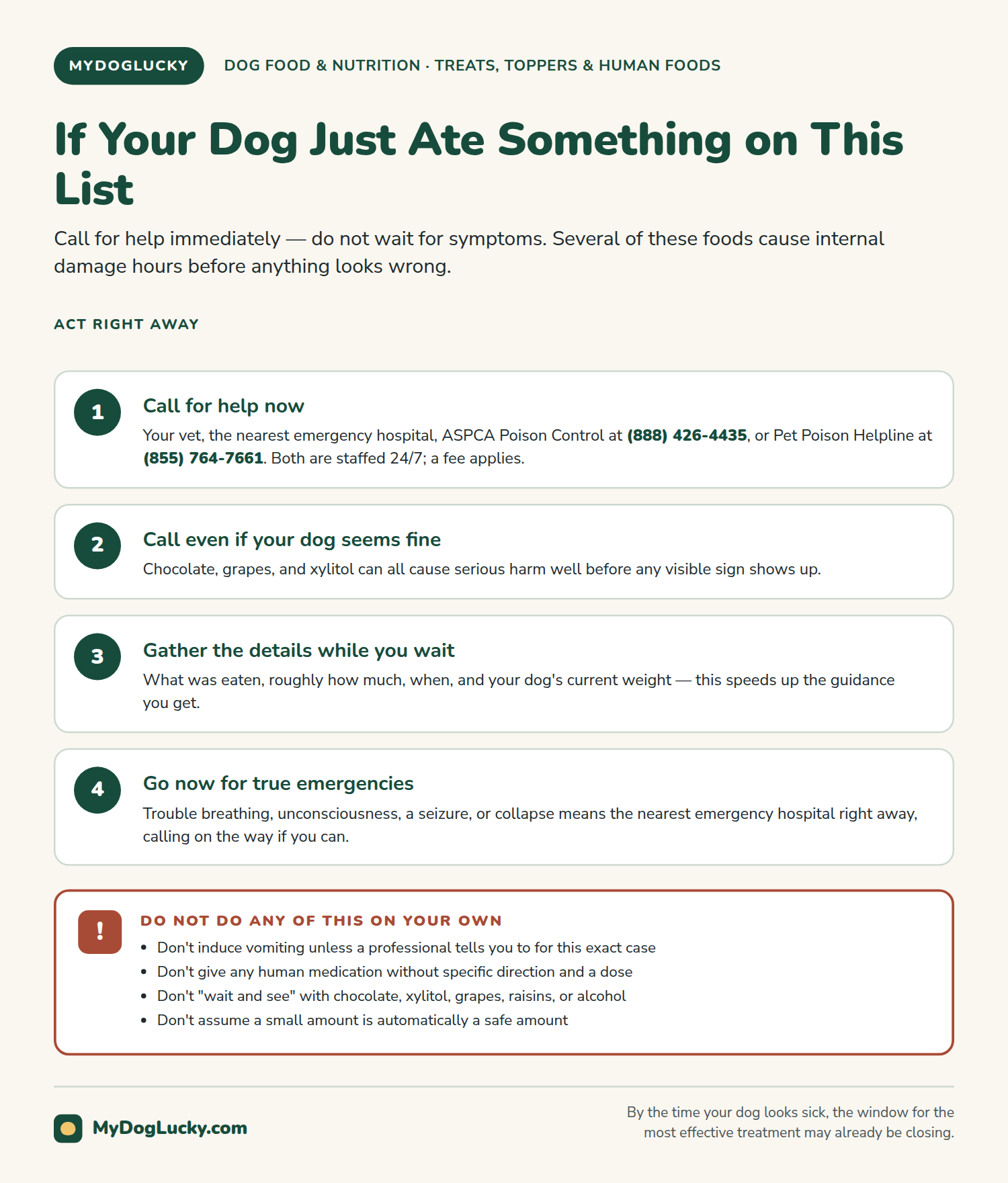
Call for help immediately. Do not wait for symptoms.
If your dog just ate chocolate, grapes, raisins, onions, garlic, xylitol, alcohol, macadamia nuts, raw yeast dough, or any other item on this list, contact one of these right now:
- Your regular veterinarian if they’re open, or the nearest emergency veterinary hospital if it’s after hours.
- ASPCA Animal Poison Control Center: (888) 426-4435. Staffed 24 hours a day, 7 days a week, 365 days a year. A consultation fee applies.
- Pet Poison Helpline: (855) 764-7661. Also available 24/7. A fee applies per incident, and it covers follow-up calls on the same case.
Call even if your dog seems completely fine right now. Several of these substances cause serious internal damage hours before any visible sign shows up. By the time your dog looks sick, the window for the most effective treatment may already be closing.
Foods toxic to dogs cover a wide range, from a food that causes a rough 24 hours to one that can be fatal within hours if nothing is done. There’s no way to sort which situation you’re in just by looking at your dog or guessing at the amount. That uncertainty is exactly why the phone call comes first, before anything else in this guide, and before you spend time reading about symptoms, causes, or prevention.
If your dog is having trouble breathing, is unconscious, is having a seizure, or collapses, treat this as a true emergency: go to the nearest emergency veterinary hospital now, and call on the way if you can.
What Not to Do While You Wait for Guidance
While you’re on the phone with your vet or poison control, or driving to an emergency clinic, a few common instincts can make the situation worse instead of better. Skip all of these unless a professional specifically tells you otherwise for your dog’s exact situation.
Do not do any of the following on your own
- Do not induce vomiting unless a veterinarian or poison control specialist directs you to do it for that specific case and tells you how.
- Do not give your dog any human medication — including over-the-counter anti-nausea, antihistamine, or pain medication — unless a veterinarian specifically tells you to and gives you an exact product and dose.
- Do not “wait and see” with high-risk items like chocolate, xylitol, grapes, raisins, or alcohol. Symptoms often show up long after the internal damage has already started.
- Do not assume a small amount is automatically a safe amount. Several items on this list can cause real harm at doses far smaller than most owners expect.
Why You Shouldn’t Induce Vomiting on Your Own
Making a dog vomit sounds like an obvious first move, but it isn’t always the right one, and it isn’t always safe. Some substances cause more damage coming back up than staying down. Timing matters too: vomiting is only useful within a limited window after ingestion, and outside that window it does little except distress your dog. There’s also a real risk of aspiration — vomit entering the airway — especially if it’s done incorrectly or with the wrong technique. This is exactly the kind of call that needs a professional who knows the specific substance, the amount, and your dog’s health history before recommending it.
Why Human Medication Is Off the Table
It’s tempting to reach for something from your own medicine cabinet while you wait for a callback. Don’t. Several common over-the-counter medications are themselves toxic to dogs, and others can mask symptoms a vet needs to see clearly, or interact badly with whatever your dog just ate. If a veterinarian tells you over the phone to give a specific over-the-counter product, follow that instruction exactly — but never substitute your own judgment for theirs on dosing or product choice.
Why “Wait and See” Backfires With High-Risk Foods
Several of the most dangerous foods on this list have a delayed onset that catches owners off guard. Grape and raisin ingestion, for instance, can cause acute kidney injury, and more severe signs often aren’t visible until 24 to 48 hours after ingestion — well after the kidney damage has already begun, according to VCA Animal Hospitals. Xylitol works on two separate timelines: dangerously low blood sugar can hit within 30 minutes to two hours, while liver damage can develop 12 to 48 hours later. Waiting for your dog to “look sick” means waiting past the point where treatment does the most good.
Why “It Was Only a Little” Isn’t a Safe Assumption
Amount matters, but it isn’t the whole story. Some toxic compounds are far more concentrated than the fresh food you’re picturing — one teaspoon of garlic powder carries roughly the same punch as eight fresh cloves, according to VCA’s veterinary guidance, because drying removes the water that diluted it. Grapes and raisins are even less predictable: there’s no well-established toxic dose, and some dogs develop kidney injury after eating what looks like a trivial amount, while others tolerate more without incident, and there’s currently no way to predict in advance which dog is which. “It was only a little” is a starting point for the phone call, not a reason to skip it.
Information to Have Ready When You Call
Whoever answers the phone — your vet’s staff, an emergency clinic, or a poison control specialist — will move faster with a clear picture of what happened. Gathering this while you dial, rather than after, saves time that actually matters.
What Your Dog Ate
Name the specific food, and grab the packaging if you have it. An ingredient label can confirm whether a product contains xylitol or another sweetener, and it can tell a specialist which type of chocolate you’re dealing with — baker’s, dark, milk, or white all carry very different risk levels. If there’s no packaging, describe it as specifically as you can: “dark chocolate baking bar,” not just “chocolate.”
How Much Was Eaten
Estimate the amount as concretely as possible — a whole bar, half a cup of raisins, roughly a dozen grapes. If you can compare what’s left to what was originally there (an empty bag, a mostly-full bag), do that math before you call. This single detail often shapes the entire treatment plan.
When It Happened
Give your best estimate of the time of ingestion, even if it’s a range. Onset timing varies a lot by substance — some symptoms start within 30 minutes, others take a day or more — so knowing how much time has already passed helps a professional gauge where your dog is in that timeline.
Your Dog’s Weight
Toxic effects are almost always assessed relative to body weight, so an accurate, current weight — from a recent vet visit if you have one — is one of the most useful numbers you can provide. A guess is better than nothing, but an actual number is far better than a guess.
Symptoms Already Present
Note anything you’ve already observed: vomiting, drooling, diarrhea, tremors, wobbliness, unusual restlessness, or lethargy. Include the timing of each if you can. Even “nothing yet” is useful information — it tells the specialist your dog may still be early in the exposure window.
Your Dog’s Breed, Age, and Health History
Mention your dog’s breed, approximate age, and any known health conditions or current medications. Smaller dogs, very young or very old dogs, and dogs with existing kidney, liver, or heart conditions are often more vulnerable to the same exposure that a larger, healthier adult dog might tolerate better.
Quick checklist to have ready before you dial
- What was eaten, plus the packaging or label if you have it
- How much was eaten, as specifically as you can estimate
- When it happened, even as a rough time range
- Your dog’s current weight
- Any symptoms already showing, with rough timing
- Your dog’s breed, age, and any known health conditions or medications
Keep the packaging on hand after the call, too. If symptoms change or a follow-up is needed, having the exact product and its label saves time you won’t want to spend hunting for it later.
What’s in this guide
- If your dog ate something toxic: what to do right now
- What not to do while you wait for guidance
- Information to have ready when you call
- Foods toxic to dogs: an ingredient-by-ingredient guide
- Symptoms to watch for after your dog eats something risky
- Preventing food-related poisoning at home
- Frequently asked questions
- Sources
Foods Toxic to Dogs: An Ingredient-by-Ingredient Guide
Once you’ve made the call and you’re waiting for guidance, or you’re reading ahead of any emergency so you know what to watch for, this section covers the specific foods behind most calls to poison control. It’s not the same list as “foods dogs shouldn’t eat for weight or digestion reasons” — a related, gentler question some owners ask is can dogs eat fruits and vegetables, and the honest answer there is mostly yes, with exceptions. This list is narrower and higher-stakes: these are foods where ingestion is a genuine toxicity risk, not just a nutrition or portion-size issue.
Surprising everyday sources worth double-checking
These toxins don’t only show up where you’d expect. A few places they commonly hide:
- Sugar-free gum, mints, and some “natural” or reduced-sugar peanut butters (xylitol)
- Onion or garlic powder in gravy, stuffing, seasoned rice, and soup mixes (allium toxicity)
- Trail mix, granola bars, and fruit cake containing raisins or currants
- Chocolate-covered espresso beans, raisins, or macadamia nuts — a double dose in one bite
- Rising bread or pizza dough left on a counter or in a proofing bowl (raw yeast dough)
- Mouthwash and hand sanitizer, in addition to obvious alcoholic drinks
- Bacon grease, turkey skin, and gravy poured over holiday leftovers (fatty-food risk)
- Homemade salt-dough ornaments or holiday crafts
None of these require an ingredient list that reads like a chemistry class — a quick label check before your dog gets near a new product is usually enough.
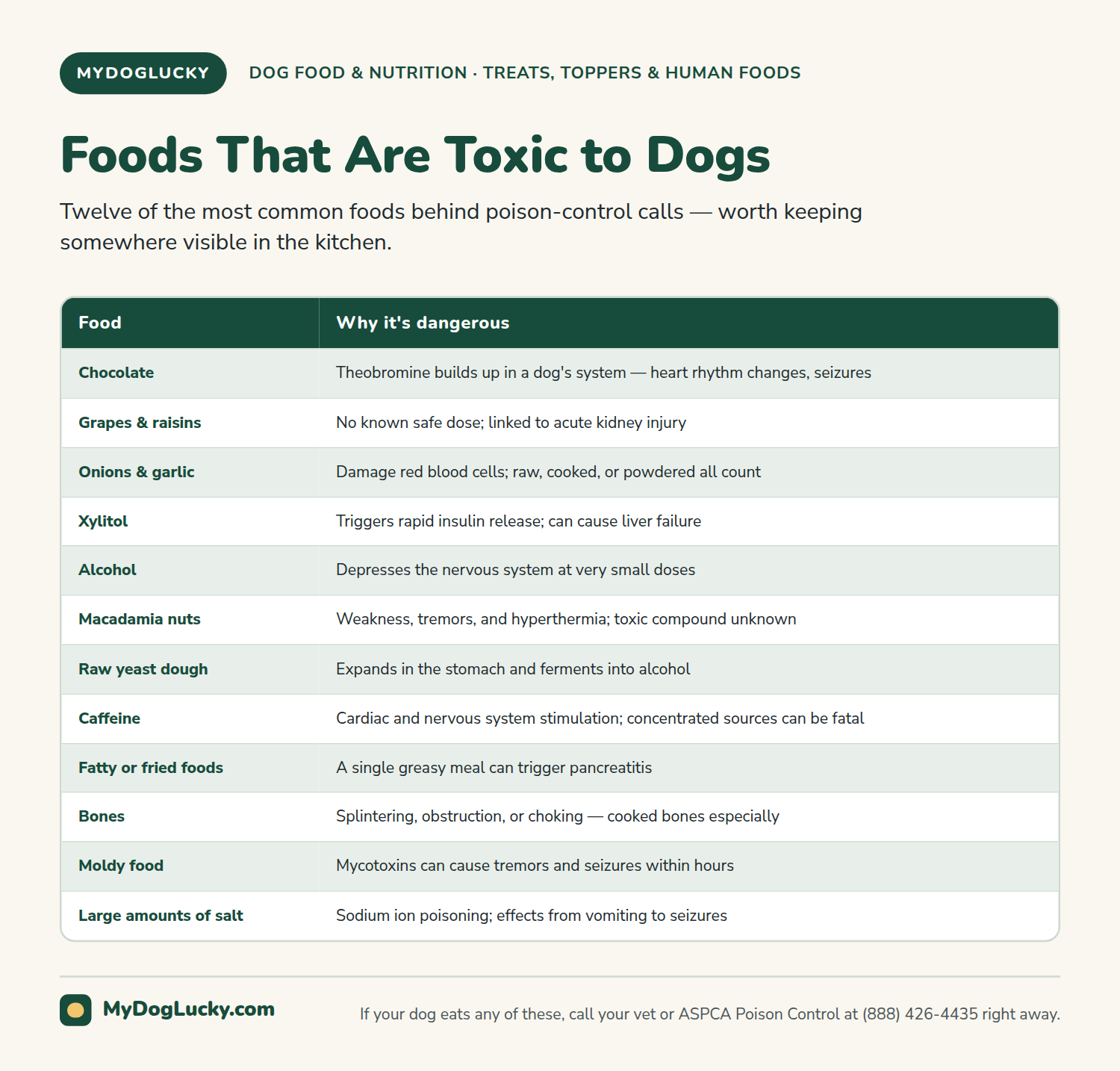
| Food | Primary risk | Typical onset |
|---|---|---|
| Chocolate | Theobromine toxicity — heart rhythm changes, seizures | 6–12 hours |
| Grapes & raisins | Acute kidney injury | Early signs 12–24 hrs; severe signs 24–48 hrs |
| Onions, garlic, chives, leeks | Red blood cell damage (hemolytic anemia) | Hours to several days |
| Xylitol | Hypoglycemia, then possible liver failure | 30 min–2 hrs (sugar); 12–48 hrs (liver) |
| Alcohol | Central nervous system depression | Within about 1 hour |
| Macadamia nuts | Weakness, tremors, hyperthermia | Within about 12 hours |
| Raw yeast dough | Bloat/GDV risk plus alcohol toxicity | Within 1–2 hours |
| Caffeine | Cardiac and nervous system stimulation | A few hours; can last days |
| Fatty or fried foods | Pancreatitis | Hours to a day or two |
| Bones (cooked, raw, or treats) | Splintering, obstruction, choking | Immediate to several days |
| Moldy food | Tremorgenic mycotoxin poisoning | 1–2 hours or more |
| Large amounts of salt | Sodium ion poisoning | Hours |
Chocolate
Chocolate contains theobromine, a compound dogs metabolize much more slowly than people do, which allows it to build up to toxic levels. The Merck Veterinary Manual outlines a rough severity scale by dose: mild digestive signs can start around 20 mg of methylxanthines per kilogram of body weight, cardiac effects around 40–50 mg/kg, and seizures at roughly 60 mg/kg or higher. Signs typically appear 6 to 12 hours after ingestion and, in severe cases, can persist for up to 72 hours.
What makes this genuinely confusing for owners is that not all chocolate is equal. The darker and more concentrated the chocolate, the more dangerous it is ounce for ounce.
| Chocolate type | Methylxanthine content | Relative danger |
|---|---|---|
| Baker’s / unsweetened | About 440 mg per ounce | Highest — even a small piece is a serious concern |
| Dark / semisweet | About 150–160 mg per ounce | High |
| Milk chocolate | About 64 mg per ounce | Moderate — still needs a call for a small dog |
| White chocolate | About 1 mg per ounce | Lowest, but not zero — and rarely eaten alone |
These figures are general veterinary toxicology reference points, not a way to decide on your own whether your dog’s specific ingestion is “under the limit.” A poison control specialist or your veterinarian can weigh the exact chocolate type, the amount, and your dog’s exact weight far more precisely than a table like this ever can. If your dog ate chocolate of any kind, that’s still a reason to call — use the information above to describe what happened clearly, not to self-clear the situation.
Grapes and Raisins
Grapes, raisins, and currants are linked to acute kidney injury in dogs, and this is one of the few items on this list where “how much is too much” genuinely can’t be predicted in advance. According to VCA Animal Hospitals, there is no well-established toxic dose for any of these fruits, some dogs have individual sensitivities that cause poisoning after eating a small amount, and there’s currently no reliable way to know which dogs are more vulnerable before it happens.
Research referenced by ASPCA’s professional resources has pointed to tartaric acid as the likely toxic component, though the concentration of tartaric acid in grapes varies widely from fruit to fruit, which helps explain why the same amount can affect two dogs so differently.
The practical consequence: treat any amount of grape, raisin, or currant ingestion as a reason to call, not as something to judge case by case. Early signs like vomiting or diarrhea can show up 12 to 24 hours after ingestion, but the more serious markers of kidney injury — lethargy, excessive thirst and urination, abdominal pain, and breath with an ammonia-like odor — often don’t appear until 24 to 48 hours in, by which point kidney damage may already be underway. Once urine output stops entirely, the prognosis becomes poor. This is a case where early intervention makes a real difference in outcome.
Onions, Garlic, Chives, and Leeks (Allium Toxicity)
Onions, garlic, chives, and leeks belong to the Allium plant family, and all of them can damage a dog’s red blood cells. Those cells carry oxygen throughout the body, so when enough of them are destroyed, organs don’t get the oxygen supply they need. VCA’s veterinary guidance describes two overlapping symptom sets: gastrointestinal irritation (drooling, nausea, vomiting, abdominal pain, diarrhea) that can appear from any exposure, and more systemic signs — weakness, elevated heart rate, increased breathing effort, pale gums, and red-tinged urine — that reflect the red blood cell damage itself.
A detail that surprises a lot of owners: every form counts. Raw, cooked, dried, and powdered onion or garlic are all toxic, and dried or powdered forms are actually more concentrated, since removing the water leaves the active compounds behind in a smaller volume. One teaspoon of garlic powder carries roughly the same load as eight fresh cloves. That means a dog who licks up spilled onion soup mix, gravy made with onion powder, or a seasoned dish isn’t automatically in the clear just because it “wasn’t a real onion.”
Xylitol
Xylitol is a sugar substitute used in a wide range of products, and it’s one of the fastest-acting toxins on this list. In dogs, xylitol triggers a rapid release of insulin, which can cause dangerously low blood sugar in as little as 30 minutes to two hours after ingestion, according to VCA Animal Hospitals. A second, separate risk follows on a slower timeline: elevated liver enzymes can appear within 12 to 48 hours, and liver failure can develop in that same 24- to 48-hour window. Lower doses tend to cause the hypoglycemia; higher doses raise the risk of liver damage.
The products that most often catch owners off guard aren’t candy. Sugar-free gum is the single most frequent source of xylitol poisoning cases, but xylitol also turns up in sugar-free candies and breath mints, some baked goods, certain brands of peanut butter, pudding and snack cups, some toothpaste, and various over-the-counter medications and supplements. Reading the ingredient label — not just assuming a product is “natural” or “sugar-free and therefore fine” — is the only reliable way to know before you offer something as a treat.
Alcohol
Dogs are far more sensitive to alcohol than people are, and it takes very little relative to body size to cause a problem. Sources go beyond an obvious spilled drink: unbaked yeast dough produces alcohol as it ferments, some desserts and sauces are made with liquor or extracts, and even certain hand sanitizers and mouthwashes contain enough ethanol to matter if a dog gets into them.
According to ASPCA poison control resources, effects can include vomiting, diarrhea, lack of coordination, depression, difficulty breathing, and tremors, generally starting within about an hour of exposure. Because alcohol depresses the central nervous system, more significant exposures can affect breathing and heart function, which is why any known or suspected alcohol ingestion warrants a call rather than a wait-and-see approach.
Macadamia Nuts
Macadamia nuts are toxic to dogs even though the exact compound responsible hasn’t been identified — ASPCA poison control lists the toxic principle as unknown, which is a reminder that “we don’t know why” and “it isn’t dangerous” are two very different things. Reported symptoms include depression, weakness (especially noticeable in the back legs), vomiting, and tremors, typically appearing within about 12 hours of ingestion.
Most dogs recover within 24 to 72 hours with supportive veterinary care, but that recovery window assumes the exposure was caught and managed — it isn’t a reason to skip the call. Watch especially for macadamia nuts combined with chocolate, as in some baked goods, since that combination stacks two separate toxicity risks on top of each other.
Raw Yeast Dough
Raw bread or pizza dough made with live yeast is dangerous in two distinct ways, and both stem from the same cause: a warm, moist stomach is an excellent environment for yeast to keep working exactly the way it would on a counter. First, the dough can continue expanding after it’s swallowed, stretching the stomach and, in some cases, contributing to bloat or a life-threatening twisting of the stomach known as gastric dilatation-volvulus.
Second, the fermentation process produces alcohol as a byproduct, which is absorbed and can cause the same alcohol toxicity described above. Both risks can develop within roughly one to two hours of ingestion. If your dog gets into rising dough — on the counter, in a proofing bowl, or via an accessible bread machine — this is not a “let’s see how it goes” situation, even if the amount looks small.
Caffeine
Caffeine shows up in more places than most owners expect: coffee and coffee grounds, tea and tea bags, soda, energy drinks, some diet pills, and certain herbal supplements, according to VCA’s veterinary guidance. Dogs and cats are more sensitive to caffeine than people are, and concentrated sources are the real danger — VCA notes that ingesting just one or two caffeine pills can be fatal for a small dog.
Symptoms include increased heart rate, hyperactivity, restlessness, pacing, vocalizing, stomach upset, and increased urination, and severe cases can involve dangerous cardiac and nervous system stimulation. Signs can start within a few hours and, in some cases, persist for several days, which makes early reporting to a vet or poison control especially useful for guiding treatment.
Very Fatty or Fried Foods (Pancreatitis Risk)
Unlike most of the items above, fatty and fried foods aren’t a single-compound toxin — the danger here is pancreatitis, an inflammation of the pancreas that a single greasy meal can trigger. The American Animal Hospital Association identifies ingesting a high-fat meal, such as greasy table scraps or fatty cuts of meat, as a primary trigger, and notes that even one exposure can set it off, particularly in dogs who’ve had a prior episode. Symptoms include vomiting that’s often severe and frequent, diarrhea, loss of appetite, abdominal pain, lethargy, fever, a distended abdomen, and difficulty breathing in more severe cases.
This is exactly the risk that spikes around holiday meals: turkey skin, ham fat, bacon grease, gravy, and fried appetizers are all common culprits. AAHA also flags certain dogs as higher-risk, including miniature schnauzers, Yorkshire terriers, and dachshunds, along with overweight dogs, whose fat metabolism is already altered. If your dog gets into a genuinely fatty meal, watch closely over the following day or two, and call your vet promptly if vomiting, lethargy, or abdominal pain shows up rather than assuming it will pass on its own.
Bones — Raw, Cooked, and Commercial Bone Treats
Bones deserve their own entry because the risk isn’t a toxin — it’s physical injury, and it’s more common than many owners assume. The FDA’s Center for Veterinary Medicine has specifically warned against cooked bones from the table (chicken, turkey, pork, beef) and against many commercial packaged “bone treats,” after receiving reports connecting them to gastrointestinal obstruction, choking, cuts and wounds in the mouth and tonsils, vomiting, diarrhea, rectal bleeding, and death. In the reports reviewed for that warning, roughly 90 dogs were affected and 15 reportedly died, with several additional reports describing bones that were moldy or that splintered when chewed.
Raw bones are a more debated topic, and it’s worth being straightforward about that rather than picking a side: raw bones are generally considered less likely to splinter into sharp shards than cooked bones, but they still carry real risks, including choking, tooth fractures, and gastrointestinal obstruction or perforation if a fragment is swallowed whole. Veterinary professionals don’t universally agree on raw bone feeding, and the right answer can depend on your individual dog’s chewing style, size, and health history.
The cautious, factual takeaway either way: any bone — raw, cooked, or a packaged treat — should only be offered under supervision, matched appropriately to your dog’s size, and discussed with your veterinarian first if you’re unsure. If your dog swallowed bone fragments, is gagging, drooling excessively, or straining without producing stool, treat that as an urgent call, not a wait-and-see situation.
Moldy Food
Moldy food is an easy risk to overlook because it often comes from the trash or compost rather than the kitchen counter. Certain molds — particularly some Penicillium species — produce tremorgenic mycotoxins, compounds that disrupt normal nervous system function. The Merck Veterinary Manual lists common sources as moldy walnuts, peanuts, and dairy products, along with compost, garbage, and old bread or pasta that a dog has managed to dig into.
Onset can be fast: clinical signs can appear within one to two hours, sometimes sooner, and include vomiting, tremors, muscle twitching, wobbliness, and in more severe cases, seizures. Lower-dose exposures can cause tremors lasting hours to days, while recovery from more severe cases can take days to weeks. Keeping trash cans and compost bins genuinely inaccessible — not just covered, but latched or out of reach — closes off one of the more preventable sources of this exposure.
Large Amounts of Salt
Excess salt intake, sometimes called sodium ion poisoning, can happen from more sources than the average owner expects: table salt, salty snack foods like chips or pretzels, cured or heavily brined meats, homemade salt-dough crafts (a seasonal risk around the holidays), and even ingesting seawater or rock salt or ice-melt products tracked in on paws. According to ASPCA poison control resources, effects can include vomiting, diarrhea, depression, tremors, seizures, and in severe cases, death.
Dogs with limited access to fresh water after a high-salt exposure are at particular risk, since adequate water access is part of how the body manages excess sodium. If you suspect your dog ate a meaningfully salty item — especially a batch of homemade salt dough or a large amount of a salty snack — that’s worth a call rather than just offering extra water and hoping it resolves.
What Happens When You Call: What to Expect
Knowing roughly what a poison control call or an emergency vet visit involves can make the process feel less overwhelming when you’re in the middle of it. A poison control specialist will typically ask for the exact details covered earlier in this article — the substance, the amount, the timing, your dog’s weight and health history — and use that information, often cross-referenced against your dog’s specific situation, to give you a recommendation: monitor at home with specific instructions, or head to a vet now. If they recommend a vet visit, they can often provide your veterinarian with a case number and treatment guidance directly, which speeds things up once you arrive.
At an emergency clinic or your regular vet’s office, next steps depend heavily on what was eaten and how much time has passed. Some cases call for inducing vomiting under professional supervision, ideally within a couple of hours of ingestion, when it’s still likely to remove a meaningful amount of the substance. Others call for activated charcoal, which can bind certain toxins in the digestive tract and reduce how much gets absorbed.
Bloodwork is common for many exposures — checking kidney values after grape or raisin ingestion, liver values and blood sugar after xylitol, or heart rhythm after chocolate or caffeine — since it gives the veterinary team an objective picture rather than relying on visible symptoms alone. IV fluids are frequently part of treatment too, both to support the kidneys and liver and to help flush certain toxins out of the system faster.
None of this is meant to replace a professional’s actual explanation of your dog’s specific plan — it’s here so the process feels a little less like a black box when you’re standing in a waiting room, worried, at 11 p.m. Ask questions. A good veterinary team expects them, especially from an owner who’s already done the work of gathering the right information before arriving.
Symptoms to Watch For After Your Dog Eats Something Risky
Not every situation is as clear-cut as “my dog definitely ate a whole bar of dark chocolate.” Sometimes you catch your dog mid-bite, find an empty wrapper with no idea how much was actually there, or just have a nagging feeling something’s off. In those borderline cases, watching for these signs — organized loosely by body system — can help you decide how urgently to act. This isn’t a full symptom checklist for every condition a dog can have; it’s specifically about what tends to show up after a toxic or risky food exposure.
Digestive Signs
Vomiting, diarrhea, drooling more than usual, and a sudden loss of appetite are often the earliest signs across nearly every item on this list. On their own, a single vomiting episode isn’t automatically an emergency — but paired with a known or suspected ingestion of something on this list, it’s a reason to call rather than wait for a second episode to confirm your suspicion.
Neurological Signs
Tremors, muscle twitching, wobbliness or difficulty walking normally (ataxia), disorientation, and seizures point toward toxins that affect the nervous system directly — xylitol, moldy food, and in more severe cases, chocolate or caffeine. Any of these signs, even mild ones, is a reason to seek care now rather than monitor further.
Heart and Breathing Changes
A noticeably fast heart rate, heavy panting unrelated to heat or exercise, or genuine difficulty breathing can show up with chocolate, caffeine, and alcohol exposure, and can also signal a developing emergency with pancreatitis in more severe cases. Breathing changes specifically should never be treated as something to watch overnight.
Energy and Behavior Changes
Lethargy, unusual restlessness or agitation, weakness (especially in the back legs), and collapse are broad signs, but they’re consistent enough across multiple toxins on this list — macadamia nuts, grapes and raisins, xylitol — that any of them following a known ingestion deserves prompt attention rather than a “let’s see how tomorrow goes” approach.
Thirst and Urination Changes
Excessive thirst and urination, or conversely, reduced or absent urination, both matter, particularly after a possible grape, raisin, or salt exposure, since both point toward the kidneys. A dog who stops producing urine after one of these exposures needs emergency evaluation, not a wait-and-see period.
Mouth, Throat, and Airway Signs
Pawing at the mouth, excessive drooling, gagging, difficulty swallowing, or visible distress around the throat can point to a physical injury — a bone fragment or splinter caught in the mouth or throat — rather than a chemical toxin. These signs call for the same urgency as any other item on this list, since an airway obstruction can escalate quickly.
The theme across every one of these categories is the same: these are reasons not to wait, not a checklist for deciding whether your dog is “sick enough” to bother a vet. Trust the pattern over your own uncertainty. A dog showing two or three signs from different categories at once — say, vomiting plus tremors, or lethargy plus reduced urination — is a stronger signal than any single sign in isolation, and warrants moving quickly rather than continuing to monitor. If you’re unsure whether what you’re seeing counts, that uncertainty is itself a reason to call and describe it rather than wait for something more obvious.
Preventing Food-Related Poisoning at Home
Most food-related poisoning cases trace back to a handful of predictable situations — an unattended counter, a distracted guest, a trash can a determined dog has already figured out. None of these require an unrealistic level of vigilance to prevent. They mostly require a few specific habits.
Kitchen, Counter, and Trash Management
Keep counters clear of anything genuinely dangerous when you leave the room, even briefly — dogs are opportunists, and “he’s never counter-surfed before” isn’t a guarantee for today. Use a trash can with a secure, ideally latching lid, and treat compost bins the same way, since both are common sources of moldy food and food scraps that shouldn’t be eaten. Store xylitol-containing gum, candy, and baked goods somewhere your dog genuinely can’t reach, not just somewhere he usually doesn’t bother with.
A step-stool or drawer-based storage habit for anything on this list beats hoping your dog never gets curious. If you bake, keep raw yeast dough covered and out of reach while it rises, and clear crumbs and drips right away rather than at the end of the session — a dog underfoot in the kitchen has more opportunities than most owners realize. Pantry doors and lower cabinets are also worth a look; a determined dog who’s found one unsecured cabinet will usually try the others.
Guests and Holiday-Season Risks
Visitors and holidays are a well-documented spike period for food-related poisoning calls, for a simple reason: more rich food is out, more people are distracted, and guests often don’t know — or forget — what’s dangerous for your dog. A quick heads-up before people arrive (“please don’t feed him anything from your plate, even a little”) prevents a lot of this. During holidays specifically, keep chocolate desserts, grapes and raisins in fruit trays or baked goods, onion- and garlic-seasoned dishes, alcohol, and any bone-in meat scraps well away from where a dog can reach unattended, including trash from meal prep.
Certain calendar dates deserve extra attention. Halloween brings concentrated chocolate into the house in bowls left at dog height. Thanksgiving and winter holidays combine fatty table scraps, onion-heavy stuffing and gravy, bones from the roast, and alcohol in one meal. Easter and other spring holidays often bring chocolate again, sometimes alongside foil or plastic wrapping that adds its own choking risk. Planning ahead for these specific windows — a closed door to the dining room, a designated “no feeding the dog” reminder to guests — does more than trying to supervise everything in the moment.
Training a Reliable “Leave It”
A solid “leave it” cue is one of the most practical safety tools you can build, and it’s worth treating as a safety behavior, not just a party trick. Practice it in low-distraction settings first, rewarding your dog generously for disengaging from a tempting item, then gradually raise the difficulty as the behavior gets more reliable — a treat on the floor at a distance, then closer, then in a busier room, then outdoors.
A dog with a genuinely trained “leave it” is far more likely to respond in the actual moment — a dropped grape, an unattended plate, a dropped pill — than one who’s only heard the phrase shouted after the fact. Practicing it as part of a normal routine, a few short sessions a week, keeps it sharp enough to actually work under real pressure.
Houseplants and Other Non-Food Hazards
This guide focuses specifically on food, but it’s worth a brief mention that plenty of household poisoning risks aren’t food at all. Certain houseplants, some human medications, cleaning products, and lawn and garden chemicals can all be dangerous if a dog gets into them, and the same core rules from this article still apply: call promptly, don’t guess at treatment on your own, and have the product or plant identified before you call if you can.
If you’re plant-proofing or hazard-proofing your home, checking ASPCA’s separate toxic and non-toxic plant lists is a reasonable next step — that’s genuinely outside the scope of a food-focused article like this one, but it’s the same category of risk and deserves the same level of attention.
Frequently Asked Questions
How much chocolate is dangerous for a dog?
It depends on both the type of chocolate and your dog’s weight. Darker, more concentrated chocolate — baker’s chocolate especially — is dangerous in much smaller amounts than milk chocolate. General veterinary toxicology references put mild signs starting around 20 mg of methylxanthines per kilogram of body weight, with cardiac effects and seizures at higher doses. Rather than trying to calculate this yourself, call your vet or poison control with the chocolate type, the estimated amount, and your dog’s weight — they can assess the actual risk far more precisely than a general threshold can.
Is peanut butter safe if it doesn’t have xylitol?
Plain peanut butter without xylitol or other sweeteners is generally fine for most dogs in small amounts, but always check the label first — xylitol has shown up in a growing number of “natural” and reduced-sugar peanut butter brands specifically because it’s marketed as a healthier sugar substitute for people. Read the ingredient list every time you buy a new jar or brand, not just the first time.
What if my dog only licked something toxic?
Call anyway. The dose from a lick is almost always smaller than from eating a piece or a portion, which does lower the risk in many cases — but “lower risk” isn’t the same as “no risk,” especially with items like xylitol or grapes and raisins, where even small or unpredictable amounts have caused real problems. Describe exactly what happened, including that it was a lick rather than a bite, and let the professional on the phone factor that into their assessment.
What if I don’t know exactly how much my dog ate?
Give your best estimate and say plainly that it’s an estimate. A range (“somewhere between a handful and half the bag”) is still useful information. Don’t delay the call trying to pin down an exact number — the professional you’re speaking with is used to working with imperfect information and can still guide you based on a reasonable range.
Are grapes ever safe for dogs in small amounts?
There’s no reliable “safe amount” established for grapes, raisins, or currants. Because there’s no known safe dose and no way to predict which dogs are more sensitive, the safest approach is to treat grapes and raisins as off-limits entirely, rather than trying to judge a “small enough” portion.
Should I give my dog hydrogen peroxide to make him vomit?
Not without a veterinarian or poison control specialist telling you to, and telling you exactly how. Inducing vomiting isn’t appropriate for every substance or every situation, timing matters, and doing it incorrectly carries its own risks, including aspiration. This is a case where a quick phone call replaces a guess with an actual answer.
Is a little bit of onion or garlic in gravy or broth a real risk?
Yes, potentially. Onion and garlic powder are more concentrated than the fresh vegetable, and they’re common, easy-to-miss ingredients in gravies, broths, seasoned rice, and many prepared dishes. If your dog ate a meaningful portion of a dish that likely contained onion or garlic in any form, treat it the same way you would a direct exposure and call for guidance.
How long after eating something toxic do symptoms usually show up?
It varies widely by substance, from as little as 30 minutes (xylitol’s effect on blood sugar) to 24–48 hours (grape and raisin kidney injury, xylitol’s effect on the liver). That range is exactly why waiting for symptoms before calling is risky — by the time some symptoms appear, the most effective treatment window may have already passed.
My dog seems totally fine after eating chocolate, grapes, or xylitol. Do I still need to call?
Yes. Several of these toxins cause damage internally before any outward sign appears, sometimes by a full day or more. “Seems fine right now” doesn’t rule out a problem that’s already developing — it’s simply too early to see it yet.
Are cooked bones ever safe to give a dog?
Cooked bones are specifically flagged as a risk by the FDA’s Center for Veterinary Medicine because cooking makes bones more likely to splinter into sharp fragments, which can cause mouth injuries, choking, or gastrointestinal obstruction or perforation. This applies to bones from the table as well as many commercial packaged bone treats. If you’re considering giving your dog any bone, cooked or raw, talk with your veterinarian first about what’s appropriate for your dog’s size and chewing habits.
Is a small piece of xylitol gum really dangerous, or only a full pack?
Xylitol content varies a lot by brand and product, and small dogs need very little of it to be affected. Because there’s no reliably “safe” small amount you can assume, treat any sugar-free gum, mint, or candy ingestion of unknown xylitol content as a reason to call — regardless of how small the piece looked.
What if my dog ate a chocolate-covered item, like chocolate-covered raisins or espresso beans?
Combination products stack two risks into one bite rather than diluting either one — chocolate-covered raisins carry both the theobromine risk from the chocolate and the unpredictable kidney-injury risk from the raisins. Treat a combination product as seriously as the most dangerous ingredient in it, and tell whoever you call about every component, not just the most obvious one.
Do I need to worry about dog food and treats made specifically for dogs?
Products made and labeled specifically for dogs are formulated to exclude the toxins covered in this article, so day-to-day feeding isn’t where most poisoning cases come from. The exposures that matter most are usually accidental: a dog getting into human food, a spilled container, or something left within reach. If you’re ever unsure whether a specific packaged item is safe, a quick check of the ingredient label for xylitol, onion or garlic powder, or other flagged ingredients takes less time than guessing.
Can my dog build up a tolerance if he eats small amounts of something like onion regularly?
No. Allium toxicity works by damaging red blood cells over time, so repeated small exposures — a little gravy here, some seasoned scraps there — can add up cumulatively rather than being harmless because “he’s always fine after.” If your dog regularly gets table scraps, it’s worth being just as careful about onion and garlic content as you would be with a single larger exposure, not less.
Is it worth researching symptoms online before deciding whether to call?
A quick check to confirm a food is genuinely on the toxic list, like this article, is reasonable. Spending significant time researching symptoms instead of calling is not — the professionals on the other end of the ASPCA Animal Poison Control Center and Pet Poison Helpline lines are trained specifically for this, and they can act on partial information faster than a search engine can give you a confident answer. If you’re debating whether something is “serious enough” to call about, that debate is itself the signal to make the call.
Sources
- ASPCA. ASPCA Animal Poison Control Center
- ASPCA. People Foods to Avoid Feeding Your Pets
- ASPCA. Toxic and Non-Toxic Plants: Macadamia Nut
- ASPCApro. Toxic Component in Grapes and Raisins Identified
- Merck Veterinary Manual. Chocolate Toxicosis in Animals
- Merck Veterinary Manual. Tremorgenic Neuromycotoxicosis in Dogs
- VCA Animal Hospitals. Xylitol Toxicity in Dogs
- VCA Animal Hospitals. Onion, Garlic, Chive, and Leek Toxicity in Dogs
- VCA Animal Hospitals. Caffeine Toxicity in Pets
- VCA Animal Hospitals. Grape, Raisin, and Currant Poisoning in Dogs
- Pet Poison Helpline. Pet Poison Helpline: 24/7 Animal Poison Control Center
- American Animal Hospital Association. Understanding Pancreatitis in Pets
- U.S. Food and Drug Administration, Center for Veterinary Medicine. No Bones (or Bone Treats) About It: Reasons Not to Give Your Dog Bones
This article is general education for U.S. dog owners. It is not a substitute for an emergency evaluation, individualized veterinary advice, or a poison control consultation for your specific dog. Toxic doses, onset timing, and risk vary by individual dog, and only a veterinarian or animal poison control specialist can assess your dog’s actual situation. If your dog has eaten something on this list, or you suspect they have, contact your veterinarian, an emergency veterinary hospital, ASPCA Animal Poison Control Center at (888) 426-4435, or Pet Poison Helpline at (855) 764-7661 right away. This article covers common food-related toxins; it is not a complete list of every substance that can harm a dog.
⚠️ Needs review before publishing
- Veterinary/toxicology reviewer sign-off needed on every specific toxicity claim in this article, including: chocolate methylxanthine dose thresholds and chocolate-type concentrations; grape/raisin no-established-safe-dose guidance and tartaric acid causation; allium toxicity mechanism and concentration comparison (garlic powder vs. fresh cloves); xylitol hypoglycemia and liver-failure timelines and common product sources; alcohol/ethanol toxicity onset and effects; macadamia nut symptom timeline; raw yeast dough bloat/GDV and alcohol-fermentation risk; caffeine toxicity thresholds and sources; pancreatitis-fatty food link and at-risk breed list; bones section (FDA case/fatality figures, raw-vs-cooked framing); moldy food/tremorgenic mycotoxin onset and sources; salt toxicosis sources and effects.
- Verify current ASPCA Animal Poison Control Center phone number ((888) 426-4435), consultation fee language, and 24/7 availability before publishing.
- Verify current Pet Poison Helpline phone number ((855) 764-7661), per-incident fee amount, and 24/7 availability before publishing.
- Confirm the FDA bone treat report figures (approximately 90 dogs affected, 15 deaths) are still the most current publicly cited data at time of publication, and update if the FDA has issued a newer advisory.
- Confirm no additional foods have been added to, or removed from, current ASPCA/Pet Poison Helpline toxic food guidance since this article’s research date.



Trackbacks/Pingbacks