

Why is my dog throwing up? Most of the time, a single episode traces back to something fairly ordinary — a meal eaten too fast, a mouthful of grass, a stomach reacting to something he shouldn’t have gotten into. But vomiting is a symptom, not a diagnosis. The same behavior that shows up after an ordinary stomach upset can also be the first visible sign of a genuine emergency.
That range is exactly why this guide leads with urgency instead of causes. Before you read any further, check your dog against the red flags below. If he’s showing any of them, stop reading and call your veterinarian or head to the nearest emergency clinic. If he isn’t, keep going — most vomiting turns out to be manageable, and the rest of this guide walks through what it can mean, what’s worth watching, and when a wait-and-see approach is genuinely reasonable.
If you’re standing in the kitchen at 11 p.m. watching your dog hunch over a puddle on the floor, you want two things, fast: to know whether this is an emergency, and to understand what’s actually going on. This guide gives you both, in that order. We’ll walk through the signs that mean go now, the broad categories of what vomiting can mean without trying to diagnose your specific dog from a screen, what’s useful to observe and record before you call your vet, what a typical exam involves, and prevention that’s grounded in veterinary sources instead of guesswork.
One note on scope before we get into it: this article focuses on vomiting specifically, not chronic dog diarrhea, which runs on its own timeline and deserves its own deep dive. We’ll mention a handful of specific dangers — including a few foods dogs should never eat — because they come up constantly in real cases, but this isn’t a complete poison-proofing guide either. And nothing here replaces an actual exam. A guide like this can help you describe what you’re seeing more clearly and decide how quickly to act. It can’t feel your dog’s abdomen, run bloodwork, or take an X-ray.
What’s in this guide
- The short answer: why is my dog throwing up?
- Emergency red flags: signs that mean go now
- What vomiting can mean: common categories of causes
- What to observe and record before you call the vet
- What a vet may evaluate
- Preventing vomiting episodes
- What not to do when your dog is throwing up
- Monitor, call today, or go now: a clear decision guide
- Puppies, seniors, and medically vulnerable dogs
- Vomiting vs. regurgitation: why the difference matters
- Common mistakes and misunderstandings
- Frequently asked questions about dog vomiting
- Sources
The Short Answer: Why Is My Dog Throwing Up?
There’s no single answer, and that’s the honest starting point. Vomiting is one of the most common reasons dogs see a veterinarian, and according to VCA Animal Hospitals, it can stem from something as minor as dietary indiscretion or as serious as an intestinal obstruction, pancreatitis, or organ disease. The same forceful heave can mean a dozen different things, which is exactly why this article walks through categories instead of handing you one tidy explanation.
Vomiting Is a Symptom, Not a Diagnosis
Vomiting itself isn’t a disease. It’s a physical response — the stomach and upper small intestine actively contracting to expel their contents, according to the Merck Veterinary Manual. Something triggered that response, and the trigger is what actually matters. Two dogs vomiting the exact same way, at the exact same time of day, can have completely different things going on underneath. That’s why an online article, including this one, can describe patterns and possibilities. It can’t tell you what’s happening inside your specific dog.
How Common Is Occasional Vomiting in Dogs?
A single vomiting episode, especially one that happens once and doesn’t repeat, is common enough that most dogs experience it at some point without it signaling anything serious. What changes the picture is frequency, what else is going on, and how your dog looks and acts afterward. A dog who vomits once, then acts completely normal — eating, drinking, playing — is in a very different situation than a dog who vomits repeatedly, seems withdrawn, or won’t settle. The rest of this guide helps you tell those two situations apart.
Emergency Red Flags: Signs That Mean Go Now
Read this section first if you haven’t already. Some signs alongside vomiting mean the situation needs emergency veterinary attention right now, not a wait-and-see evening and not a next-available appointment. This is the one place in this article where directness matters more than nuance.
Seek emergency veterinary care now if you see:
- Blood in the vomit — bright red streaks, or a darker, coffee-ground appearance, which can indicate bleeding higher in the digestive tract.
- Repeated or projectile vomiting — multiple episodes in a short window, or vomiting that comes out with unusual force.
- A distended, bloated, or painful abdomen — a belly that looks swollen, feels tight, or that your dog reacts to when you touch it.
- Retching without producing anything — repeated attempts to vomit with little or nothing coming up. This is a possible sign of bloat (gastric dilatation-volvulus, or GDV), a life-threatening emergency.
- Lethargy or collapse — a dog who’s unusually flat, hard to rouse, wobbly, or unable to stand.
- Known or suspected toxin ingestion — you saw him get into something, or you found chewed packaging, an empty container, or a missing amount of something that shouldn’t be missing.
- A puppy, senior, or medically vulnerable dog — young, old, pregnant, or dogs with an existing health condition can decline faster than a healthy adult dog, so the threshold for calling is lower.
- Vomiting alongside diarrhea and signs of dehydration — sunken-looking eyes, dry or tacky gums, or skin that’s slow to spring back when gently lifted.
Any one of these, on its own, is reason enough to call your veterinarian immediately or head to the nearest emergency clinic. Don’t wait for a second sign to confirm it.
Why These Signs Can’t Wait
Each of these red flags points toward something that tends to worsen quickly without treatment. Blood in vomit can signal ulceration, a clotting problem, or significant irritation somewhere in the digestive tract. A distended or painful abdomen, especially paired with unproductive retching, is one of the hallmark presentations of bloat — a condition where minutes matter. Lethargy and collapse suggest your dog’s body is already struggling to compensate for whatever’s wrong. None of these are signs to observe overnight and reassess in the morning.
Retching Without Producing Anything: A Possible Sign of Bloat
Gastric dilatation-volvulus, commonly called bloat, happens when the stomach fills with gas and, in its more dangerous form, twists on itself. The American College of Veterinary Surgeons describes it as a “rapidly progressive life-threatening condition of dogs that requires immediate medical attention.” Early signs include restlessness, abdominal pain, stretching, drooling, and retching without producing anything. As it progresses, dogs can develop visible abdominal swelling, weakness, and collapse.
Deep-chested, large and giant breeds — Great Danes, Weimaraners, St. Bernards, Irish Setters, and Gordon Setters among them, per the ACVS — carry a higher risk, though bloat isn’t exclusive to those breeds. Risk factors also include eating one large meal a day, older age, a family history of bloat, and elevated feeding. If your dog is trying repeatedly to vomit and nothing is coming up, especially alongside a visibly swollen belly or obvious distress, treat it as an emergency and get him to a vet immediately. Survival odds are meaningfully better with fast treatment.
If You Know or Suspect a Toxin Was Involved
If your dog got into something that might be toxic — a food, a plant, a medication, a household chemical — call for help immediately rather than waiting to see if symptoms develop. The ASPCA Animal Poison Control Center is staffed 24/7 by veterinary toxicology experts at (888) 426-4435; a consultation fee applies. The AVMA’s first-aid guidance for pet owners also lists the Pet Poison Helpline at (855) 764-7661 as another option. Have the product name, packaging, and an estimate of how much and when your dog was exposed ready when you call — it genuinely speeds things up.
Don’t try to make your dog vomit on your own without professional direction first. Some substances cause more damage coming back up than staying down, and a vet or poison-control specialist needs to know what was ingested before recommending that step. More on this in the “what not to do” section below.
What Vomiting Can Mean: Common Categories of Causes
If your dog isn’t showing any of the red flags above, it’s worth understanding the broad categories vomiting tends to fall into. This isn’t a checklist for diagnosing your own dog — that’s exactly what a veterinary exam is for. Think of it instead as a map of the territory, so you have context for the conversation you’ll have with your vet if the vomiting continues or doesn’t fit a mild, self-resolving pattern.
Dietary Indiscretion
Dietary indiscretion is the technical, slightly dry term for a dog eating something he shouldn’t have — garbage, roadkill, a dropped chicken bone, something dug up in the yard. VCA Animal Hospitals lists it among the most common, minor causes of vomiting. A dog’s stomach reacts to the unfamiliar or spoiled material by expelling it, sometimes within hours of the incident. A single episode tied to an obvious event, like raiding the trash, followed by a return to normal behavior, tends to fall on the milder end of the spectrum — though it’s still worth watching, since some scavenged items can cause obstruction or more serious irritation.
A Sudden Food Change
Switching foods abruptly — a new brand, a new protein, even a new bag of the same food with a slightly different formulation — can upset a dog’s digestive system enough to trigger vomiting or diarrhea. This is one of the more preventable causes on this list, and it’s why most feeding guidance recommends transitioning gradually over a week or more rather than swapping bowls overnight. If vomiting started right around a diet change, that timing is a genuinely useful detail to mention to your vet.
Motion Sickness
Some dogs, especially puppies whose inner-ear balance system is still developing, get carsick the same way some people do. Motion sickness typically shows up during or shortly after car rides, sometimes preceded by drooling, restlessness, or whining. It tends to improve as puppies mature and can often be managed with shorter trips, better ventilation, facing forward, and building up tolerance gradually — though a vet can also discuss anti-nausea options for dogs who don’t outgrow it.
Mild, Self-Limiting GI Upset
Sometimes a dog’s stomach is simply off for a day, without an obvious trigger and without an identifiable cause even after testing. This category covers the vomiting episodes that happen once, maybe twice, and then resolve on their own with no other symptoms. It’s a real category, not a dismissal — but it’s a conclusion a vet reaches after ruling other things out, not an assumption to start with, especially if vomiting repeats or is joined by any other symptom.
Intestinal Parasites
Intestinal parasites, including roundworms, hookworms, and others, are a recognized cause of vomiting, particularly in puppies and dogs with an incomplete parasite-prevention history, per VCA. Parasites can also cause diarrhea, a dull coat, a pot-bellied appearance, and weight loss despite a normal appetite. Routine fecal testing and parasite prevention, discussed more in the prevention section below, are how most cases get caught and managed before they cause a dramatic symptom.
Infections (Viral and Bacterial)
Bacterial and viral infections of the digestive tract can cause vomiting, sometimes alongside diarrhea, fever, and lethargy. Some, like parvovirus, are serious and disproportionately dangerous in puppies and unvaccinated dogs; others are milder and self-limiting. The vomiting itself often can’t tell you which one you’re dealing with — the accompanying symptoms, your dog’s vaccination history, and a veterinary exam are what actually differentiate a mild bug from something that needs more aggressive treatment.
Foreign Body or Obstruction
Dogs swallow things they shouldn’t — socks, toy parts, bones, corn cobs, string, rocks. When an object gets lodged somewhere in the digestive tract, it can cause repeated vomiting, decreased appetite, straining to defecate, abdominal tenderness, and a dog who reacts when picked up or handled around the belly, according to VCA’s guidance on foreign bodies in dogs. “Time is critical,” the source notes, “since an intestinal or stomach obstruction often compromises the blood supply to these vital tissues.” Diagnosis typically involves X-rays, sometimes with contrast material, and treatment is often exploratory surgery once an obstruction is confirmed or strongly suspected.
Pancreatitis
The pancreas produces digestive enzymes and hormones like insulin. When it becomes inflamed — a condition called pancreatitis — vomiting is one of the hallmark symptoms, often alongside abdominal pain, lethargy, and reduced appetite. Certain triggers come up often in clinical guidance, including a sudden high-fat meal (table scraps and fatty treats included) and, per the ASPCA, ingestion of foods like nuts that carry a specific pancreatitis risk. It ranges from mild cases managed with supportive care to severe cases that need hospitalization, which is part of why it’s a category a vet needs to evaluate rather than something to guess at home.
Systemic Disease
Vomiting isn’t always about the digestive tract itself. Kidney disease, liver disease, and certain metabolic or hormonal conditions can all cause vomiting as one symptom among several, according to the Merck Veterinary Manual. These tend to come with other signs too — changes in thirst or urination, appetite changes, weight loss, or lethargy that doesn’t match a simple stomach bug. This category is exactly why a vet’s exam and bloodwork matter for vomiting that’s persistent, recurring, or unexplained: some of the more serious underlying causes don’t show themselves through vomiting alone.
Toxin Ingestion
A wide range of common items are toxic to dogs and can cause vomiting, sometimes alongside other symptoms, sometimes as the first visible sign. The ASPCA’s list of foods dogs should never eat includes chocolate and caffeine, grapes and raisins (linked to kidney damage), onions, garlic, and chives (which can damage red blood cells), macadamia nuts, xylitol (an artificial sweetener that can also cause liver damage), alcohol and raw bread dough, and salty foods. Household items — certain plants, human medications, cleaning products, and more — round out a much longer list. If toxin ingestion is a possibility, treat it as described in the red-flags section above: call for help immediately rather than waiting to see what develops.
| Category | Often Comes With | General Urgency |
|---|---|---|
| Dietary indiscretion | One-off event, normal behavior after | Usually monitor; watch for obstruction signs |
| Sudden food change | Timing tied to a new food or bag | Usually monitor |
| Motion sickness | Car rides, drooling, restlessness | Usually monitor |
| Mild GI upset | One or two episodes, otherwise normal | Usually monitor |
| Intestinal parasites | Diarrhea, dull coat, weight changes | Call your vet |
| Infection (viral/bacterial) | Fever, diarrhea, lethargy | Call your vet; go now if severe |
| Foreign body/obstruction | Repeated vomiting, straining, belly pain | Go now |
| Pancreatitis | Abdominal pain, lethargy, low appetite | Call your vet; go now if severe |
| Systemic disease | Thirst/urination changes, weight loss | Call your vet |
| Toxin ingestion | Known or suspected exposure | Go now / call poison control |
This table is a general guide, not a diagnosis. Plenty of overlap exists between categories, and the same symptom can point in more than one direction. When in doubt, a phone call to your vet’s office costs you a few minutes; guessing wrong can cost a lot more.
What to Observe and Record Before You Call the Vet
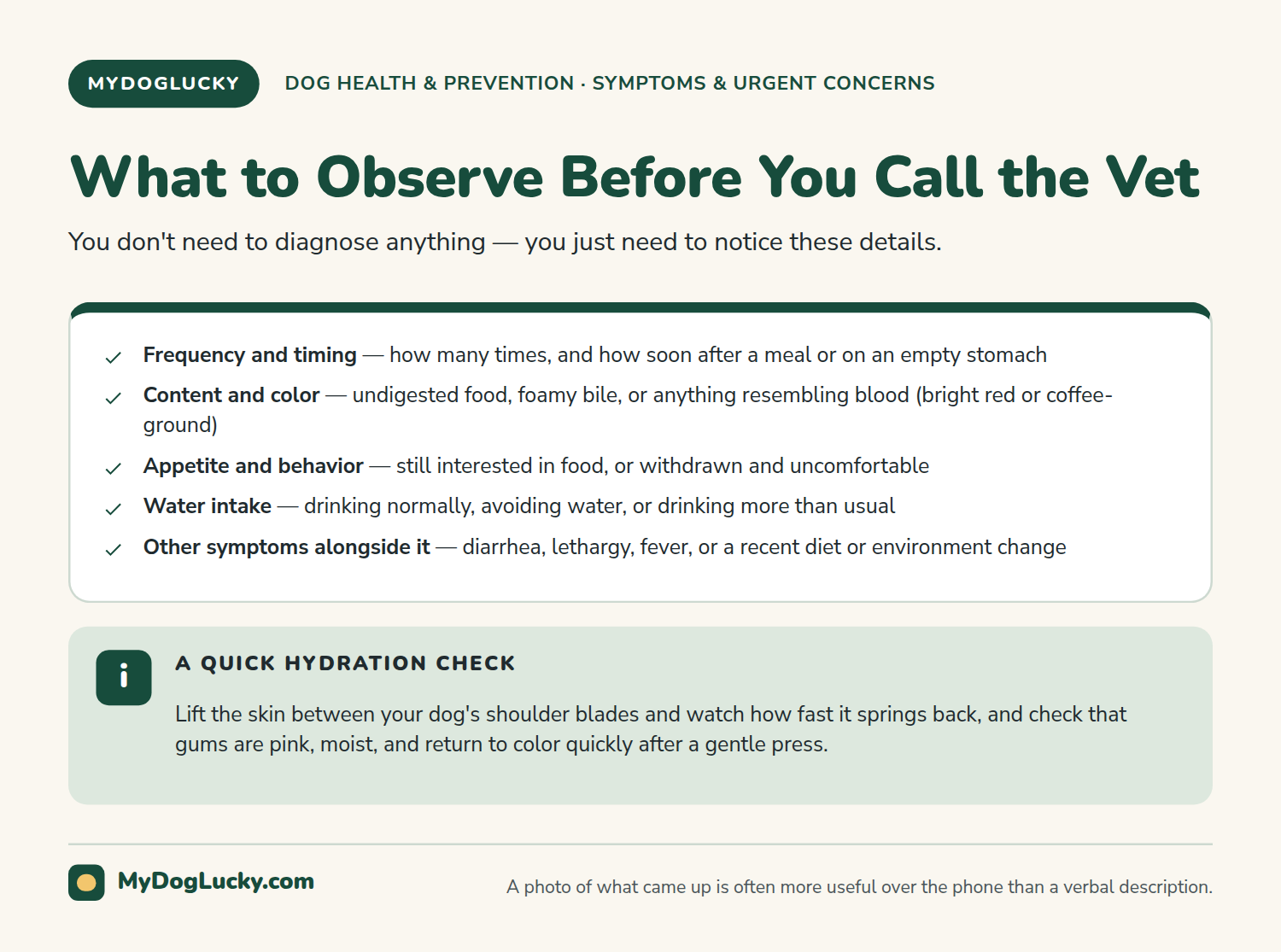
You don’t need to diagnose anything. You just need to notice, because the details you can describe accurately are exactly what helps your vet triage the call and decide how quickly your dog needs to be seen.
Frequency and Timing
How many times has your dog vomited, and over what span of time? Once in an evening is a very different report than five times since breakfast. Note roughly when each episode happened, and whether it’s tied to meals — right after eating, hours later, or on an empty stomach in the morning, which can sometimes point toward different things.
Content, Color, and Texture
What came up matters. Undigested food, foamy yellow bile, a foreign object, or anything resembling blood — bright red or a darker, coffee-ground color — are all details worth noting precisely rather than generally. If it’s safe and reasonable to do so, a photo on your phone can be more useful than a verbal description when you’re describing it to a vet over the phone.
Appetite and Behavior
Is your dog still interested in food and water, or refusing both? Is he acting like himself — greeting you, moving normally, engaging — or withdrawn, restless, and clearly uncomfortable? A dog who vomits once and then begs for dinner is telling you something different than a dog who vomits and then hides under the bed.
Water Intake and Hydration Signs
Note whether your dog is drinking normally, drinking excessively, or avoiding water altogether. You can also do a quick, gentle hydration check: lift the skin between your dog’s shoulder blades and watch how fast it springs back — a slow return can suggest dehydration. Check his gums, too; they should be pink and moist, and should return to pink quickly after you press gently with a finger.
Other Symptoms Happening Alongside It
Diarrhea, coughing, lethargy, a fever you can feel as unusual warmth, weight loss, or changes in urination all matter. Vomiting rarely happens in a vacuum, and the symptoms riding alongside it are often what actually points a vet toward the right category of cause. Even something that seems unrelated — a new toy that’s gone missing, a walk somewhere unusual, a recent food change — is worth mentioning.
What to have ready when you call
- How many times, and over what timeframe
- What the vomit looked like (and a photo, if you have one)
- Whether it’s tied to meals or happening on an empty stomach
- Appetite, water intake, and energy level since it started
- Any other symptoms — diarrhea, coughing, fever, behavior changes
- Anything unusual your dog may have eaten or gotten into recently
- Any medications, supplements, or recent diet changes
Keeping a Simple Log for Recurring Episodes
If vomiting has happened more than once over the past few weeks, a short written log is more useful than trying to reconstruct dates from memory during an appointment. A few lines per entry is plenty: the date, roughly what time relative to meals, what came up, and anything else going on that day. Patterns that are invisible in the moment — always after a specific treat, always on a particular day of the week, always a few hours after a walk somewhere new — often become obvious once they’re written down side by side. Bring that log to the appointment, or read it off during a phone call, rather than trying to summarize weeks of episodes from memory under time pressure.
What a Vet May Evaluate
Once you’re in the exam room, your vet works through a process designed to narrow down the broad categories above into an actual answer for your dog. Here’s the general shape of that process, drawn from veterinary sources — not a script every visit follows exactly, since your vet adjusts based on what they find as they go.
History and Physical Exam
Expect a detailed set of questions covering everything in the “what to observe” section above, plus your dog’s full diet, medication and supplement list, recent activities, and vaccination history. The physical exam typically includes checking your dog’s temperature, listening to the heart and lungs, examining the mouth, and gently palpating the abdomen to feel for pain, gas, or anything abnormal, per the Merck Veterinary Manual’s diagnostic approach to acute vomiting.
Bloodwork and Urinalysis
Blood and urine tests help your vet check organ function, hydration and electrolyte status, and signs of infection or inflammation. This is often where systemic causes — kidney disease, liver disease, certain metabolic conditions — first show up, sometimes before they’d be obvious from symptoms alone.
Imaging: X-Rays and Ultrasound
X-rays can reveal a foreign object, gas patterns consistent with bloat, or other structural abnormalities. Ultrasound offers a more detailed look at organs and soft tissue and can sometimes catch things X-rays miss. VCA’s guidance on foreign body obstruction notes that several X-ray views, or a specialized series using contrast material, are sometimes needed to confirm a diagnosis that a single image doesn’t make clear.
Fecal Testing and Other Targeted Tests
A fecal test checks for intestinal parasites. Depending on what your vet suspects, additional targeted tests — a pancreatic-specific blood panel, an infectious disease test, or an endoscopic exam with biopsy for chronic or unexplained cases — may come next. The Merck Veterinary Manual notes that chronic vomiting cases sometimes call for endoscopy, advanced imaging like CT or MRI, or exploratory surgery when other tests don’t provide a clear answer.
What These Tests Are Ruling Out, Not What They’re Assuming
It’s worth understanding the logic here: your vet isn’t running every test because they expect the worst. They’re systematically ruling categories out, starting with the most likely and most urgent, until what’s left points toward an actual answer. A clean set of bloodwork and X-rays is genuinely useful information, even when it doesn’t hand you an immediate diagnosis — it narrows the field and often shifts the plan toward monitoring or a more targeted next step.
Preventing Vomiting Episodes
Not every cause of vomiting is preventable — infections, obstructions, and disease can happen despite your best efforts. But several of the most common triggers genuinely are, and reducing their odds is worth the small effort involved.
Slow Feeders for Dogs Who Eat Fast
A dog who inhales his food in under a minute is more likely to vomit shortly after eating, sometimes bringing up barely digested food. A slow feeder bowl, a puzzle feeder, or simply spreading kibble across a flat surface or mat can stretch a meal out and ease the strain on his stomach. This is also one of several feeding practices sometimes discussed alongside bloat-prevention conversations, since eating very fast and gulping air has been raised as a contributing factor in some research, though it’s one piece of a larger risk picture rather than a guarantee against it.
Preventing Dietary Indiscretion
Secure the trash can, keep counters clear of anything tempting, supervise yard time if your dog scavenges, and be mindful on walks in areas where discarded food or trash is common. This won’t eliminate every opportunity — dogs are motivated and resourceful — but reducing access meaningfully cuts down on the single most common cause of an ordinary vomiting episode.
Gradual Food Transitions
When you do need to change your dog’s food, mix the new food in gradually over seven to ten days, increasing the new portion and decreasing the old one a little each day. This gives his digestive system time to adjust rather than reacting to an abrupt switch, and it’s one of the simplest, most preventable changes an owner can make.
Parasite Prevention
Routine parasite prevention — heartworm, flea, and tick preventives, along with regular fecal testing and deworming as recommended by your vet — reduces the odds of intestinal parasites contributing to vomiting, especially in puppies and dogs with outdoor access. Ask your vet what schedule makes sense for your dog’s age, location, and lifestyle, since recommendations vary by region and individual risk.
Reducing Motion Sickness
For dogs prone to car sickness, shorter practice trips, good ventilation, a forward-facing view, and withholding a large meal right before a drive can all help. Some dogs improve with repeated, low-stress exposure over time. If motion sickness is frequent or severe enough to make travel genuinely difficult, your vet can discuss whether an anti-nausea medication designed for dogs makes sense for your specific situation.
Routine Veterinary Checkups
Several of the more serious causes on the list above — pancreatitis, systemic disease, chronic parasite burdens — are often caught earlier through routine wellness visits and bloodwork than they are through a single vomiting episode alone. A dog who’s due for an annual or senior wellness exam isn’t just checking a box; that visit is part of how gradual, easy-to-miss changes get flagged before they show up as a dramatic symptom. Staying current on those routine visits is, in its own quiet way, a form of prevention too.
What Not to Do When Your Dog Is Throwing Up
A few instincts, however well-meaning, can make things worse or delay the care your dog actually needs. Here’s what veterinary sources caution against.
Avoid these common mistakes
- Don’t withhold water for an extended period without guidance. A brief pause is sometimes reasonable, but ongoing water restriction should only happen under veterinary direction — the Merck Veterinary Manual specifically notes that water should only be limited if supplemental fluids are being provided, which is a call for your vet to make, not something to manage alone at home.
- Don’t give human anti-nausea or GI medication without your vet’s direction. Some medications used for vomiting in dogs, including certain acid reducers, are only appropriate at specific doses your vet determines — and some common human medications are outright dangerous for dogs. Never give any medication, including something you already have in your cabinet, unless a vet has told you to.
- Don’t induce vomiting without professional guidance first. If you suspect your dog ingested something toxic, call your vet, the ASPCA Animal Poison Control Center, or the Pet Poison Helpline before trying to make him vomit. Some substances cause additional damage coming back up, and a professional needs to know what was ingested before recommending that step, per the AVMA’s first-aid guidance.
- Don’t assume it will pass on its own if a red flag is present. A wait-and-see approach is reasonable for mild, isolated vomiting with no other symptoms. It stops being reasonable the moment any sign from the emergency red-flags list above shows up.
- Don’t skip the call because your dog “seems fine otherwise.” Some serious conditions, including early bloat and certain toxins, can look deceptively mild in their first hour. If something about the situation is nagging at you, that’s worth a phone call, even if you can’t fully articulate why yet.
Monitor, Call Today, or Go Now: A Clear Decision Guide
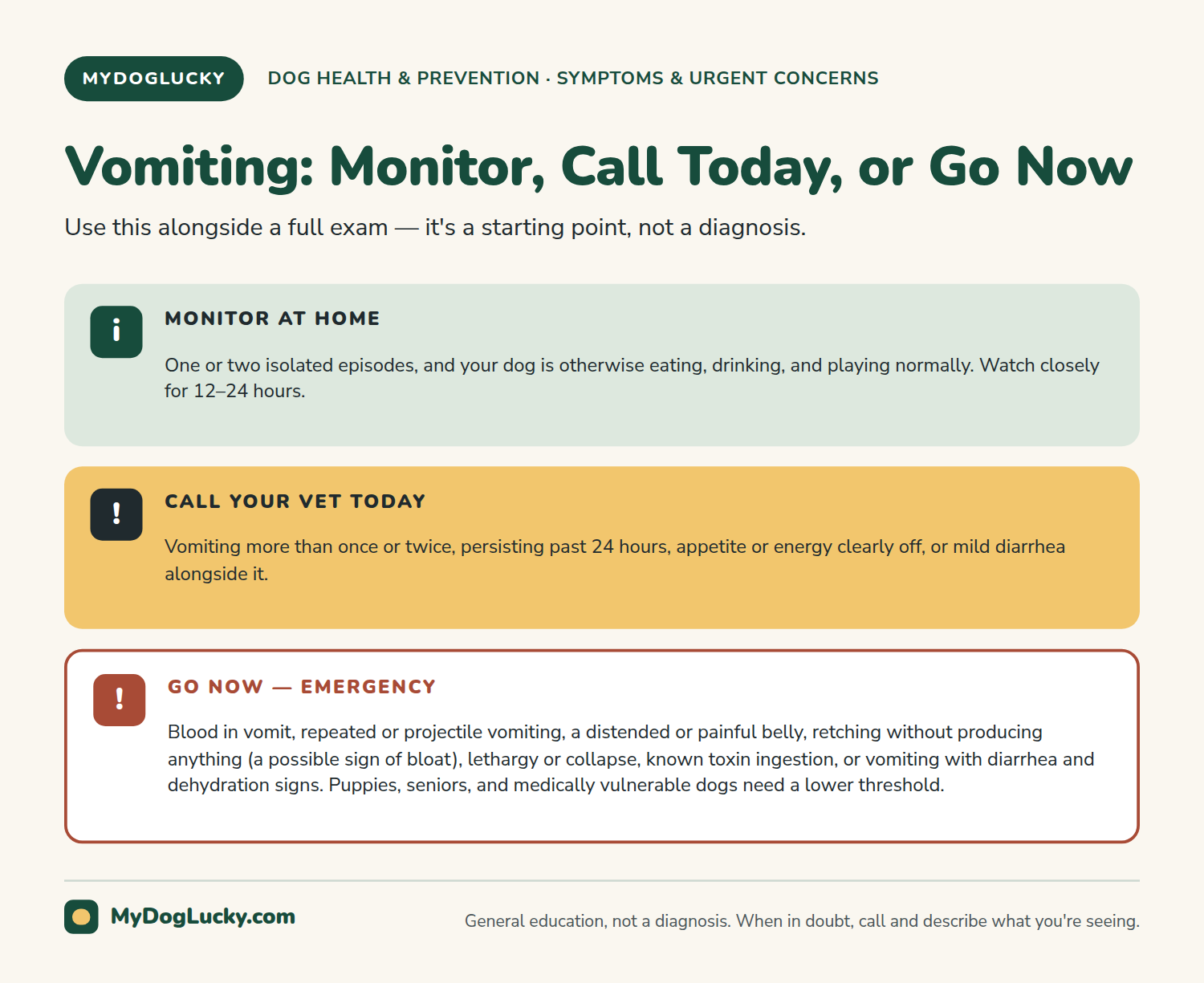
Here’s the whole decision, distilled into three tiers. Use it alongside the detailed red-flags section above, not as a replacement for it.
| Tier | What You’re Seeing | What to Do |
|---|---|---|
| Monitor at home | One or two isolated episodes, dog otherwise acting normal, eating, drinking, and playful | Watch closely for 12–24 hours; call if it repeats, worsens, or a red flag appears |
| Call your vet today | Vomiting more than once or twice, persists past 24 hours, appetite or energy clearly off, mild diarrhea alongside it | Call your vet’s office same-day and describe exactly what you’re seeing |
| Go now (emergency) | Any red flag from the list above — blood, repeated/projectile vomiting, distended or painful belly, unproductive retching, lethargy/collapse, known toxin, high-risk dog, vomiting with diarrhea and dehydration | Go to your vet or the nearest emergency clinic immediately |
When “Monitor” Genuinely Applies
Monitoring at home is a reasonable choice for a dog who vomits once, shows no red flags, and otherwise seems like himself. Offer a small amount of water after an hour or so if he seems interested, and let him rest. If he holds that down and seems fine, a small, bland meal a few hours later is often appropriate — though this is general guidance, not a substitute for your vet’s specific instructions if you’re unsure.
When “Call Today” Genuinely Applies
This tier covers the middle ground: not an emergency, but not something to quietly wait out either. Repeated vomiting without the more severe red flags, vomiting that persists past a day, or a dog who’s clearly not himself all belong here. Your vet’s office can often help you decide over the phone whether same-day evaluation makes sense based on what you describe.
When “Go Now” Genuinely Applies
This is every sign covered in the red-flags section above. If you’re unsure whether something counts, call and describe it rather than deciding on your own that it’s probably fine. Veterinary staff triage these calls regularly, and it’s genuinely their job to help you figure out how urgent something is.
Puppies, Seniors, and Medically Vulnerable Dogs
The same vomiting episode carries different risk depending on who’s experiencing it. A healthy three-year-old Labrador and a ten-week-old puppy don’t have the same margin for error.
Puppies
Puppies dehydrate faster than adult dogs because of their smaller size, and they’re more vulnerable to certain infections — parvovirus chief among them — that cause vomiting as a primary symptom. A puppy who’s vomiting, especially alongside diarrhea, lethargy, or a skipped meal, warrants a same-day call at minimum, and immediate care if any red flag is present. Don’t assume “puppies are resilient” buys you extra waiting time; if anything, it’s the opposite.
Senior Dogs
Older dogs are more likely to have an underlying condition — kidney disease, liver disease, a mass, or a chronic illness — that vomiting could be connected to, and they often have less physical reserve to compensate for dehydration or prolonged illness. The American Animal Hospital Association’s life-stage guidance notes that dogs are naturally good at hiding pain, discomfort, and illness, which means a senior dog who’s vomiting may already be more affected than he’s visibly showing. A lower threshold for calling the vet is a reasonable, sensible response, not an overreaction.
Pregnant Dogs and Dogs with Chronic Conditions
A pregnant dog, a dog with diabetes, kidney disease, a heart condition, or any ongoing medical issue has less room for a “let’s wait and see” approach. Vomiting can complicate an existing condition faster than it would in an otherwise healthy dog, and some medications used to manage chronic conditions interact with dehydration or reduced appetite in ways that need a vet’s input sooner rather than later. If your dog falls into this group, treat vomiting as a call-your-vet situation by default, even if it looks mild at first.
Vomiting vs. Regurgitation: Why the Difference Matters
Owners often use “vomiting” and “regurgitation” interchangeably, but vets draw a real distinction between them, and it changes what they look for.
What Separates the Two
Vomiting is active: the stomach and upper small intestine physically contract to force contents up, often preceded by drooling, retching, or visible abdominal heaving. Regurgitation is passive — food or liquid comes back up with little to no effort, sometimes seconds or minutes after eating, without the heaving or retching that comes with true vomiting, according to the Merck Veterinary Manual’s description of the two processes.
Why It Changes the Conversation With Your Vet
The two point toward different possible causes. Vomiting more often relates to the stomach, intestines, or a systemic issue elsewhere in the body. Regurgitation more often points toward something happening in the esophagus, the tube connecting the mouth to the stomach. Being able to describe which one you actually witnessed — did your dog heave and strain, or did it just come back up with no apparent effort? — gives your vet a meaningfully more useful starting point than “he threw up” alone.
If You’re Not Sure Which One You Saw
That’s genuinely common, and it’s fine to say so. Describing exactly what you observed — timing relative to the last meal, whether there was any straining or abdominal movement, what the material looked like — lets your vet work out which process was more likely, even without a textbook-perfect description from you.
Common Mistakes and Misunderstandings
Assuming One Episode Always Means Something Serious
Occasional, isolated vomiting with no other symptoms is common and often resolves without treatment. Panicking over a single episode, in a dog who’s otherwise acting completely normal, usually isn’t necessary — though it’s still worth watching for 12 to 24 hours rather than dismissing entirely.
Assuming Repeated Vomiting Will “Work Itself Out”
The opposite mistake is just as common: waiting several days through repeated vomiting, hoping it resolves, while a dog quietly becomes more dehydrated and unwell. Repeated vomiting, or vomiting that continues past a day, needs a same-day call regardless of how your dog otherwise seems.
Treating a Bland Diet as a Universal Fix
A short-term bland diet is something vets commonly recommend after an isolated episode, but it’s a step your vet directs based on your dog’s specific situation, not a blanket solution to try before calling for advice on anything more than mild, isolated vomiting.
Giving Over-the-Counter Medication Without Guidance
Reaching for something already in the medicine cabinet feels proactive, but several human medications are unsafe for dogs, and even the ones sometimes used in veterinary medicine require a dose and context your vet determines — not a guess based on your dog’s size.
Confusing “Not Eating” With “Fine, Just Picky”
A dog who skips one meal because he’s not feeling well is easy to mistake for a dog who’s simply being choosy about his food. If reduced appetite is paired with vomiting, treat it as a real symptom worth mentioning, not a personality quirk.
Ignoring a Pattern Because Each Episode Alone Seems Minor
A dog who vomits once every few weeks, always brushed off as “he just does that sometimes,” may actually have a chronic issue worth investigating. Recurring vomiting, even when each individual episode looks mild, is a pattern worth bringing up at your dog’s next vet visit rather than writing off as quirky.
Waiting for “Worse” Before Calling With a Vulnerable Dog
Owners of puppies, seniors, and dogs with chronic conditions sometimes wait for a more dramatic symptom before calling, assuming a milder sign doesn’t yet justify it. As covered above, these dogs warrant a lower threshold, not a higher one.
Frequently Asked Questions About Dog Vomiting
Should I be worried if my dog throws up once?
Not necessarily. A single episode, with no red flags and a dog who’s otherwise acting normal, is common and often resolves on its own. Watch him for the next 12 to 24 hours — normal appetite, energy, and no repeat episodes are reassuring signs. If it happens again, or any red flag from above shows up, call your vet.
What color of vomit is concerning?
Bright red streaks or a darker, coffee-ground appearance can indicate bleeding somewhere in the digestive tract and should prompt an immediate call to your vet. Yellow, foamy vomit is usually bile and, on its own, is less urgent, though frequent bile vomiting is still worth mentioning at your next visit.
Is yellow vomit (bile) something to worry about?
Occasional yellow, foamy vomit — often from an empty stomach — is common and usually not an emergency on its own. If it happens repeatedly, especially first thing in the morning, mention the pattern to your vet. It can sometimes be managed with adjusted feeding timing, but that’s a conversation for your vet, not a self-diagnosis.
Should I withhold food after my dog vomits?
A brief pause, often a few hours, is commonly recommended after an isolated episode, followed by a small, bland meal if your dog seems interested and hasn’t vomited again. Extended food or water withholding should happen only under your vet’s direction, especially for puppies, seniors, or small dogs who can’t go long without eating.
Can stress or anxiety cause a dog to vomit?
Yes, stress and anxiety can trigger vomiting in some dogs, similar to how motion sickness works. A stressful event — travel, boarding, a vet visit, a loud thunderstorm — can be followed by an isolated vomiting episode. If it happens consistently around specific triggers, that pattern is worth discussing with your vet or a veterinary behaviorist.
Why does my dog vomit yellow bile in the morning on an empty stomach?
This pattern, sometimes called bilious vomiting syndrome, tends to happen when a dog’s stomach sits empty for too long overnight. Some owners find that a small bedtime snack or an earlier breakfast reduces it, but persistent morning vomiting is still worth mentioning to your vet rather than managing entirely on your own.
Can I give my dog Pepcid, Pepto-Bismol, or another over-the-counter medication?
Don’t give any medication, including over-the-counter options, without your vet’s direction first. Some human medications are unsafe for dogs, and even ones vets sometimes use require a specific product, dose, and context based on your individual dog — not a guess based on his size.
How long can vomiting go on before it becomes an emergency?
Vomiting that continues past 24 hours, or that happens more than once or twice in that window, warrants a same-day call to your vet even without other red flags. Any red flag from the emergency list above means immediate care, regardless of how long it’s been going on.
Why is my dog vomiting but acting completely normal otherwise?
This can happen with mild causes like dietary indiscretion or a minor stomach upset, and it’s a genuinely reassuring sign. It doesn’t rule out anything more serious on its own, though — keep watching for the next 24 hours, and call your vet if it repeats or his behavior changes.
Can food allergies or intolerances cause vomiting?
Yes. VCA lists food intolerance and allergies among the recognized causes of vomiting in dogs. This is typically identified through a structured elimination diet supervised by your vet, not through guesswork or switching foods repeatedly on your own.
My dog vomited after eating grass. Is that a problem?
Occasional grass-eating followed by vomiting is common and usually not concerning on its own. Frequent or compulsive grass-eating, especially paired with other symptoms, is worth mentioning to your vet, since it can sometimes reflect an underlying digestive issue rather than simple preference.
Is it normal for puppies to vomit more than adult dogs?
Puppies explore the world with their mouths and are more prone to dietary indiscretion, sudden food changes, and parasites, so occasional vomiting isn’t unusual. That said, puppies also dehydrate faster and are more vulnerable to serious infections, so the threshold for calling your vet should be lower than it would be for a healthy adult dog.
What should I do if my dog is vomiting and has diarrhea?
Vomiting combined with diarrhea raises the risk of dehydration faster than either symptom alone, and it’s specifically listed as an emergency red flag when dehydration signs are also present. Call your vet the same day at minimum, and seek emergency care if you notice lethargy, blood, or other red flags alongside it.
Can intestinal worms cause a dog to throw up?
Yes. Intestinal parasites are a recognized cause of vomiting, particularly in puppies, according to VCA. Routine fecal testing, deworming, and parasite prevention are how most cases are caught and managed.
What does it mean if my dog vomits white foam?
White, foamy vomit is often just saliva and gastric fluid, similar in significance to yellow bile vomiting. An isolated episode usually isn’t an emergency, but repeated foamy vomiting, especially with other symptoms, should be evaluated by your vet.
Should I bring a sample of the vomit to the vet?
A photo on your phone is often just as useful and much easier to manage. If your vet specifically asks you to bring a sample — for instance, if a foreign object or toxin is suspected — a small amount in a sealed container or bag is fine to bring along.
How much does an emergency vet visit for vomiting typically cost?
Costs vary widely by region, clinic, and what your dog needs that day — from an exam and supportive care to imaging, bloodwork, or surgery for something like an obstruction. Calling ahead or asking for a written estimate when you arrive gives you the most accurate number for your specific situation.
Should I call my regular vet first, or go straight to the emergency clinic?
If your dog is showing any red flag from the emergency list above, go straight to the nearest emergency clinic rather than waiting for a callback. For anything less urgent, your regular vet’s office is usually the right first call — they know your dog’s history and can help you decide how quickly he needs to be seen.
Can a change in drinking water or treats cause vomiting?
It’s possible, though it’s a less common trigger than a full diet change. A new treat, a new flavored chew, or even a change in tap versus filtered water has been reported by some owners as coinciding with an isolated episode. If you’ve recently introduced something new, mention it to your vet as one possible factor rather than assuming it’s automatically the cause.
My senior dog vomited once and otherwise seems fine. Do I still need to call?
A single, isolated episode in an otherwise normal senior dog can often be monitored for 12 to 24 hours the same way it would be in a younger dog. Because senior dogs are more likely to have an underlying condition and can hide discomfort well, though, it’s reasonable to call your vet’s office and describe what happened, even if you end up simply watching him at home per their guidance.
Where This Leaves You
Vomiting is common enough that almost every dog experiences it at some point, and most of the time, it resolves without drama. But because the same symptom can mean something trivial or something urgent, the safest approach is the one this guide leads with: check for red flags first, then work through the rest with a clear head instead of a search engine full of worst-case scenarios.
Keep the emergency signs — blood, repeated or projectile vomiting, a distended or painful belly, unproductive retching, lethargy or collapse, a known toxin, or vomiting with diarrhea and dehydration — somewhere you’ll actually remember them. Save your vet’s number and the nearest emergency clinic’s number in your phone this week, before you need them at 11 p.m. And when something feels off but doesn’t neatly match a red flag, call and describe it anyway. That’s what your vet’s office is there for, and it’s a far better use of five minutes than guessing.
⚠️ Needs review before publishing:
– Full triage framework (monitor / call today / go now) — needs named veterinary reviewer sign-off before this goes live
– Every red-flag and emergency claim, including the bloat/GDV description — needs veterinary reviewer confirmation
– Confirm the ASPCA Animal Poison Control Center and Pet Poison Helpline phone numbers are current at time of publishing
Sources
- VCA Animal Hospitals. Vomiting in Dogs
- VCA Animal Hospitals. Foreign Bodies in Dogs
- Merck Veterinary Manual. Vomiting in Dogs
- American College of Veterinary Surgeons. Gastric Dilatation-Volvulus (Bloat)
- ASPCA. Animal Poison Control Center
- ASPCA. People Foods to Avoid Feeding Your Pets
- American Veterinary Medical Association. First Aid Tips for Pet Owners
- American Veterinary Medical Association. Household Hazards
- American Animal Hospital Association. How Often Should My Dog Go to the Vet? A Dog Life Stage Guide
This article is general education for U.S. dog owners. It is not individualized veterinary advice, a diagnosis, or a substitute for an in-person veterinary exam. If your dog shows any of the emergency red flags described above — including blood in vomit, repeated or projectile vomiting, a distended or painful abdomen, retching without producing anything, lethargy or collapse, known toxin ingestion, or vomiting alongside diarrhea and dehydration signs — seek veterinary care immediately.




Trackbacks/Pingbacks