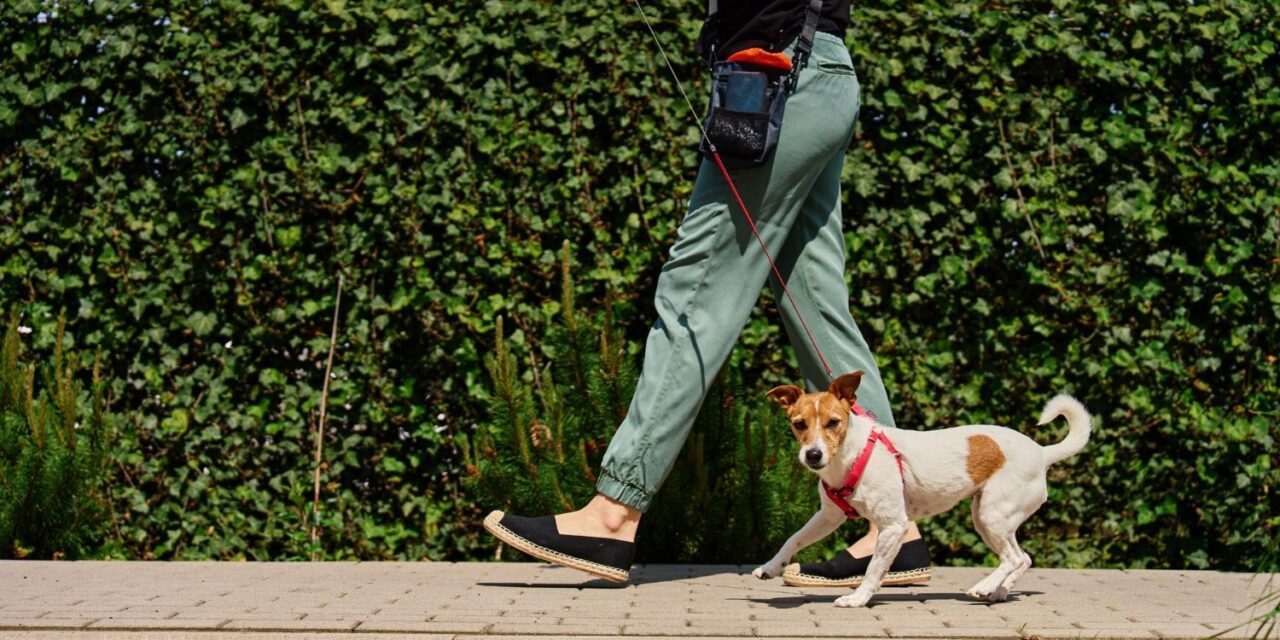
If you’re searching for how to stop leash pulling, you probably have a sore shoulder and a dog who treats every walk like the start of a race. Here’s the honest version of the answer. Dogs pull because pulling works: the leash goes tight, and the dog still gets to the tree, the fire hydrant, the other dog. You stop it by making sure pulling never works again, by paying your dog generously for walking on a loose leash, and by teaching that skill in easy places before you ask for it on a busy sidewalk.
That’s the whole method in three sentences. The rest of this guide is the part that makes it stick: why your dog pulls in the first place, which equipment helps and which quietly makes things worse, four reward-based techniques that actually build the skill, a stage-by-stage progression with clear success criteria, and the troubleshooting for the days when your dog forgets everything at the corner.
One scope note before we start. This article is about ordinary pulling, the kind driven by excitement, speed, and a strong opinion about which way the walk should go. If your dog lunges, barks, or growls at other dogs or people on leash, that’s reactivity, and it needs a different plan. We’ll point you toward that help where it comes up, but the techniques here are not a reactivity protocol.
What’s in this guide
- How to stop leash pulling: the short answer
- Why dogs pull on the leash in the first place
- Equipment that helps vs. equipment that hurts
- The two-walks idea: management walks and training walks
- Technique 1: pay for position
- Technique 2: stop-and-wait, done correctly
- Technique 3: change of direction and penalty yards
- Technique 4: the “let’s go” cue and pattern games
- Sniff breaks as a reward: teaching “go sniff”
- The loose-leash progression, stage by stage
- Pulling toward dogs and people
- Big dogs, small handlers, kids, and retractable leashes
- Adolescent regression and senior dogs
- Realistic timelines
- Troubleshooting: five problems you’ll probably hit
- The smallest useful practice plan
- Common mistakes that slow progress
- Frequently asked questions about leash pulling
- Sources
How to Stop Leash Pulling: The Short Answer
Loose-leash walking is a trained skill, not a personality trait. Some dogs pick it up faster than others, but no dog arrives knowing that a slack leash is the goal. From your dog’s point of view, the leash is a strange rope that occasionally goes tight, and going tight has never once stopped him from getting somewhere good.
So the plan has three parts, and they work together. Skip one and the other two get much slower.
- Pulling stops working. A tight leash no longer moves your dog forward. Not sometimes. Not “except when we’re late.” The moment tension appears, forward progress pauses.
- A loose leash pays, and pays well. You reward your dog for walking near you with slack in the line, often at first, then less often as the habit builds. Food, praise, and permission to go sniff all count as payment.
- You build the skill where it’s easy first. Hallway before yard, yard before quiet street, quiet street before the block with the squirrel condo. You raise difficulty one notch at a time, only after your dog passes a clear test at the current level.
The first part is management. The second is training. The third is the progression that keeps both from falling apart. Most advice on how to stop leash pulling covers one of the three and treats the other two as optional. They aren’t, which is why so many owners try “just stop when he pulls” for a week, see no change, and conclude their dog is a lost cause. He isn’t. The plan was incomplete.
What this looks like on a real Tuesday
A five-minute practice session in the hallway before work, with a pocket of small treats. A morning walk on a front-clip harness where you don’t fight about anything and your dog gets a long sniff at every third tree. A short training loop on the quiet side street in the evening, where you pay for every few steps of slack. That’s it. No hour-long boot camp, no special pass, no equipment that hurts.
Why Dogs Pull on the Leash in the First Place
Any honest answer to how to stop leash pulling starts with why it happens, because each cause points to a slightly different fix. Describe the behavior first, then look for the reason. “He drags me toward every dog we see” and “he pulls steadily the whole way out and walks nicely coming home” are both pulling, but they’re not the same problem.
Pulling Has a Reinforcement History
This is the big one. Every time your dog has leaned into the leash and reached the mailbox, the fire hydrant, or the neighbor’s cat, pulling paid off. Dogs repeat what works. That’s not a character flaw; it’s how learning works for every animal, including us. VCA Animal Hospitals’ behavior guidance on pulling makes the same point: dogs pull because the behavior is rewarded by forward movement, and it continues as long as it keeps working.
A dog with three years of successful pulling behind him has a strong habit. Not a hopeless one, but a strong one, and that history is the honest reason why some dogs take longer than others.
The “Opposition Reflex”
Trainers use the phrase “opposition reflex” for a dog’s tendency to lean into steady pressure rather than yield to it. It’s a description of what most dogs do, not a formal term from physiology, so treat it as shorthand. Push against a dog’s chest and he pushes back. Pull steadily on a collar and he leans forward. That means a handler who keeps constant tension on the leash is, without meaning to, cueing the dog to pull harder. Slack in the leash isn’t just the goal. It’s also part of the method.
The World Is Faster Than You
A comfortable trot for a medium-sized dog is faster than a comfortable walk for a human. Your dog isn’t racing; he’s moving at his own natural pace and you’re the one who’s slow. Add the fact that interesting things are ahead and boring things (you, your phone) are behind, and forward pressure is the default. Part of loose-leash training is teaching your dog that your pace can be worth matching, which only happens if matching it pays.
Arousal and the “Everything Is Breaking News” Dog
Some dogs leave the house at a low simmer and boil over by the end of the driveway. For this dog, every lamppost is breaking news and every squirrel is a developing story. Arousal makes learning harder. A dog who’s over threshold can’t attend to you, can’t take treats, and can’t notice that the leash went tight. If your dog is in this state for most of the walk, the training has to start somewhere calmer, and the walk itself may need a warm-up before you ask for anything.
Not Enough Sniffing
Sniffing is a dog’s main way of gathering information and, for many dogs, one of the most satisfying parts of being outside. A walk that never allows it builds pressure. Dogs who get regular chances to sniff often pull less between those chances, because the walk stops feeling like a sprint between forbidden smells. This is why the “go sniff” cue later in this guide matters so much. It turns sniffing from a thing your dog steals into a thing you pay with.
Nobody Taught the Alternative
Most dogs who pull were never taught what to do instead. They were told “no,” or the leash was tightened, or the walk got shorter. None of that explains what a loose leash is or why it’s worth offering. Reward-based training fills that gap by making the wanted behavior clear and valuable, which is the whole reason it works.
Breed and Individual Tendencies, Hedged
Some dogs come from lines bred to pull, track, or move fast and far: sled-type dogs, many scent hounds, some herding and sporting breeds. Those tendencies can make loose-leash walking a bigger project. They don’t make it impossible, and they don’t predict any individual dog. Lines vary, individuals vary, and a mixed-breed dog with a mystery family tree may surprise you in either direction. Use breed as context, not as a diagnosis or an excuse.
Equipment That Helps vs. Equipment That Hurts
No piece of equipment answers how to stop leash pulling on its own. Gear can make the training safer and easier, or it can add pain and pressure that create new problems. Here’s the honest rundown by category, with no brand names, because the category matters far more than the label on the box. For a specific product recommendation, ask a certified trainer who can see your dog and check the fit.
Why We Don’t Recommend Prong, Choke, or Shock Collars, or Leash Pops
This is the part of the article where we’re going to be direct, because you’ll find plenty of advice elsewhere that says otherwise.
The American Veterinary Society of Animal Behavior’s 2021 humane training position statement is unambiguous. It advises against training tools that work through pain, naming choke chains, prong collars, and electronic shock collars specifically, and against physical correction techniques including leash jerking. Its review of the research found no evidence that aversive methods are more effective than reward-based methods in any context, and it links aversive training to stress behaviors during sessions and to a higher likelihood of aggression and anxiety-related behavior afterward. The Certification Council for Professional Dog Trainers and the International Association of Animal Behavior Consultants both hold their certified members to a “least intrusive, minimally aversive” standard for the same reasons.
Then there’s the neck itself. A dog’s neck carries the trachea, the larynx, the thyroid gland, major blood vessels, and the nerves that run down to the front legs. Anything that concentrates force there is worth being careful with.
A 2020 study in Veterinary Record by Carter, McNally, and Roshier measured the pressure that different collar types applied to a simulated neck model under pulling forces. Every collar tested, including plain flat collars, produced pressures the authors considered capable of causing injury at the forces studied, with wider and padded collars spreading the load somewhat better. The authors suggested a harness for dogs that pull. Two caveats: it was a laboratory model, not live dogs, and it didn’t measure real injury rates. It still supports common sense. Pulling on a neck collar, or jerking one, loads structures you’d rather not load.
An older study in the Journal of the American Animal Hospital Association (Pauli and colleagues, 2006) found that pressure applied through a collar raised the pressure inside dogs’ eyes, while the same pressure through a harness did not. The authors recommended harnesses for dogs with eye conditions that make raised eye pressure risky. That’s a narrower finding than it sometimes gets stretched into, but it’s one more reason to move the load off the neck.
So: no prong, no choke, no shock, no leash pops. Not because we’re squeamish, but because the evidence says they carry real risks and don’t outperform the alternative.
Equipment by Category: What Each Does and Doesn’t Do
| Equipment category | Helps with | Watch out for |
|---|---|---|
| Flat collar (buckle or snap) | Holding ID tags; fine for a dog who already walks on a loose leash | Concentrates force on the neck when a dog pulls; not a good training attachment point for a puller |
| Martingale (limited-slip) collar | Preventing a narrow-headed dog from backing out of a collar | Still loads the neck when pulled; it’s an escape-prevention tool, not a training tool |
| Back-clip harness | Keeping pressure off the neck; comfortable for most dogs; good for sniff walks and long lines | Gives a strong dog excellent leverage; can make pulling easier, not harder, until training catches up |
| Front-clip harness | Reducing the payoff of pulling by turning the dog’s chest toward you when the leash goes tight; keeps pressure off the neck | Fit matters: a poorly fitted one can rub the armpits or restrict the shoulders; it manages pulling but doesn’t teach the loose leash on its own |
| Two-point (front and back clip) harness with a double-ended leash | Steering a big or strong dog with two contact points; extra safety for a small handler | More to manage in your hands; takes a few sessions to feel natural |
| Head halter | Giving a small handler steering control over a large dog’s head; useful for some strong pullers under a trainer’s guidance | Needs careful, gradual acclimation with food; many dogs dislike it at first; never jerk it (it can twist the neck); attach a backup leash to a collar or harness |
| Fixed-length leash, about 6 feet (1.8 m) | Clear, consistent feedback; enough room for a natural sniff without constant tension; the standard training leash | Length is only useful if you let there be slack; a leash held short and tight teaches nothing |
| Long line (15 to 30 feet / 4.5 to 9 m) | Decompression walks in open, safe areas; lets a dog sniff and move freely without practicing pulling on a short leash | Only where it’s safe and allowed; wear gloves; use with a harness, never a collar or head halter |
| Retractable leash | Very little for a dog who pulls | Constant light tension teaches pulling; no clear feedback; cord injuries to hands and legs; brakes can fail; not for training |
| Prong, choke, or shock collar | Nothing that a harness and training don’t do better, per AVSAB’s 2021 review | Pain-based; risk of neck injury; linked to stress, anxiety, and aggression; can teach the dog that other dogs or people predict pain |
A Few Notes on Fit and Acclimation
A front-clip harness should let your dog’s shoulders move freely, sit well behind the armpits, and stay snug enough that two fingers fit under the straps without the whole thing rotating. If your dog’s gait changes when it goes on, refit it or try a different style.
A head halter deserves its own paragraph, because it’s the piece of equipment most often put on wrong. It sits over the muzzle and behind the ears, and steers the head the way a halter steers a horse. It can give a small person real control over a big dog. It is also a strange sensation, and most dogs paw at it at first.
Introduce it over several days with food: show it, treat; nose through the loop, treat; fasten for two seconds, treat; and so on. Never use it for corrections, never let a dog hit the end of the leash at speed on it, and clip a second leash to a harness or flat collar as a backup.
If your dog still hates it after a patient introduction, a front-clip harness is a fine alternative. Ask a certified trainer to show you the acclimation steps in person if you’re unsure.
The Two-Walks Idea: Management Walks and Training Walks
Here’s a shift that makes everything else about how to stop leash pulling easier: stop expecting one walk to do two jobs.
Your dog needs exercise, bathroom breaks, and sniffing, ideally today, regardless of where his leash skills are. You also need short, focused sessions to teach the loose leash. Trying to do both at once means your dog practices pulling for 40 minutes and gets trained for 3, and the 40 wins. So split them.
The Management Walk
This is the walk that gets everyone’s needs met without arguing. Use equipment that reduces the payoff of pulling (a front-clip harness for most dogs) and give your dog room to be a dog. Let him sniff. Take a long line to a field if you have one nearby. Don’t run drills, don’t fight for position, and don’t worry if the leash is tight for stretches. The goal is a tired, satisfied dog who isn’t rehearsing an all-out sled-dog pull on a flat collar.
Some trainers suggest a visual cue for this walk so the dog knows the rules are different: a specific harness, a different leash, or a bandana. Dogs are good at noticing “this is the sniff harness” versus “this is the training leash.” Use whatever’s practical.
The Training Walk
Short. Five to ten minutes. High rate of reinforcement. Easy environment first. This is where you build the skill with the techniques below. It might be a loop of the hallway, a few laps of the yard, or one block of a quiet street. Timing matters here: a training walk after exercise, when your dog has burned off the first burst of energy and had a chance to relieve himself, usually goes far better than one straight out the door.
You don’t need two separate outings every day. Many owners do the management walk in the morning and a five-minute training session in the evening, or tack a short training loop onto the end of a longer sniff walk when their dog is calmer. The point is that the two jobs stay clearly separate in your head and in your dog’s.

Technique 1: Pay for Position
If you take only one technique from this article on how to stop leash pulling, take this one. Everything else supports it. The idea is simple: you decide where you want your dog to walk, and you pay him for being there so often that the position becomes his default.
Pick a Position and a Marker
Choose a spot: usually your dog’s shoulder somewhere around your leg, on whichever side you prefer. It doesn’t have to be a formal heel. “Near my left leg with the leash slack” is plenty. Then pick a marker: a clicker, or a short word like “yes,” said the same way every time. The marker tells your dog the exact moment he did the right thing, and it buys you a second or two to get the treat to him.
Practice the marker indoors first. Say “yes,” give a treat. Repeat ten times. Now the word means something.
Rate of Reinforcement: Pay Often, Then Less Often
Early on, pay a lot. In the hallway, that might mean a treat every one or two steps that your dog is in position with slack in the leash. That sounds like a lot of treats, and it is, which is why you use tiny ones (pea-sized, soft, and easy to swallow while moving) and count them toward your dog’s daily food. A high rate of reinforcement at the start is what makes the position “stick.” Skimping here is the most common reason this technique seems not to work.
As your dog starts offering the position on his own, stretch it out. Two steps, then four, then a random mix of three, seven, two, ten. This is a variable schedule: the dog can’t predict which step pays, so he keeps offering the behavior. Slot machines run on the same principle. The ASPCA’s guidance on reward-based training describes the same progression, from rewarding every correct response while a behavior is new toward rewarding it intermittently once it’s reliable.
Treat Placement: The Seam of Your Leg
Where you deliver the treat teaches the dog where to be. Deliver it right at the seam of your pants, at your dog’s nose height, on the side you’ve chosen. If you hand treats out in front of you, your dog learns to walk in front of you. If you deliver them at your leg, he learns that the good stuff shows up there. This one detail fixes a surprising amount of drifting and crossing in front.
A practical tip: keep treats in the pocket on the same side as the dog, or in a pouch on that hip, so your hand travels straight down instead of across your body.
Fading the Food
Food doesn’t have to be forever, but it also doesn’t have to disappear. As the position becomes reliable in a given environment, you thin the schedule and mix in other payments: cheerful praise, a chance to sniff, a few steps of faster pace, a game. Keep occasional food in the mix for a long time, especially in harder environments. Most owners find their dog needs almost no food on the familiar route within a couple of months, and still benefits from a few treats in a new place. That’s normal. New place, new difficulty, new pay rate.
A first indoor session, step by step
- Clip the leash on. Stand still with slack in the line. Mark and treat at your leg the moment your dog looks at you or steps near you.
- Take one step. If your dog moves with you and the leash stays loose, mark and treat at the seam of your leg.
- Repeat for two or three minutes. Aim for a treat every step or two.
- End with something your dog likes: a toy, a scatter of treats on the floor, or a release word like “all done.”

Technique 2: Stop-and-Wait, Done Correctly
“Be a tree” is the first advice most people get on how to stop leash pulling. The moment the leash goes tight, stop. Don’t move until it’s loose again. It’s sound as far as it goes, and it comes straight from the principle in the short answer: pulling must stop working. Here’s how to do it well, and why it disappoints people when it’s the only thing they do.
The Right Way to Stop
When the leash tightens, stop walking. Plant your feet. Don’t pull back, don’t say anything, and don’t reel the dog in. Just stop. Then wait for slack. Slack usually happens because the dog turns to see why the world stopped, or takes half a step back. The second the leash loosens, mark (“yes”), and walk on. If your dog turns and comes all the way back to your leg, that’s a jackpot moment: treat at the seam, then walk on.
The walking on is the reward. That’s the trick. You’re using forward movement, the thing the dog wants, as payment for slack. Trainers call this the Premack principle, or “Grandma’s rule”: do the less-fun thing (loosen the leash) and you get the fun thing (progress).
Why It Fails on Its Own
Stop-and-wait removes the payoff for pulling. It does not teach the dog where to walk or why. A dog who only ever experiences “tight leash means we stop” learns to loosen the leash just enough to get moving, then pulls again three steps later. You end up stopping every four feet, the walk takes an hour, the dog is frustrated, you’re frustrated, and no one has learned much.
It also fails when the environment is too hard. A dog who’s over threshold at the sight of a squirrel doesn’t notice that you stopped. He just strains harder. Stopping works when the dog is calm enough to notice the consequence, which means using it in the easier stages of the progression, not as your first move on the busiest street in town.
The fix is to pair it with Technique 1. Stop when the leash tightens, yes. But pay heavily for the loose leash in between stops, so the dog has something better to do than test the tension again. Stop-and-wait is the brakes. Paying for position is the steering.
Two Details That Make It Work Better
First, react to the leash, not the dog. Stop when it goes tight, even if the dog is only a few inches ahead. If you sometimes let a slightly tight leash slide because you’re in a hurry, you’ve just put pulling on a variable schedule, and variable schedules build strong habits. That’s fine for the behavior you want. It’s a problem for the one you don’t.
Second, avoid the “stop, then reel in, then treat” pattern. If you pull the dog back to you and then feed him, you’ve taught him that a tight leash is the start of a sequence that ends in a treat. Let the dog create the slack.
Technique 3: Change of Direction and Penalty Yards
Direction changes keep your dog paying attention to where you’re going instead of assuming the walk is a straight line to the good stuff. Done kindly, they’re one of the most useful tools for a dog who forges ahead. Done as a surprise yank, they’re just a leash correction with extra steps, and we’ve covered why those are out.
The Humane Turn
When your dog starts to move ahead of you and the leash is about to tighten, say a cheerful cue (“this way!”), then turn and walk in the other direction. Say the cue before you turn, not after. Give the dog a second to respond. When he catches up to your leg, mark and treat at the seam, and keep going. You’re not jerking him around; you’re changing the plan and inviting him to come along. The leash may go briefly taut if he doesn’t respond right away, but you’re not adding force to it, and you slow down so the tension is minimal.
In the yard or on a quiet street, you can practice this as a game: walk five steps, turn, walk five steps, turn, mark and treat every time the dog is at your side after the turn. Dogs learn quickly that you’re unpredictable and worth watching.
Penalty Yards
Penalty yards is the version to use when your dog pulls toward something specific: a tree, a smell, a friendly person who’s agreed to help. The moment the leash tightens, calmly back up a few steps, taking the dog with you. Then, when the leash is loose, walk toward the thing again. If it tightens, back up again. Each pull costs distance; each loose leash earns it. Most dogs figure out the math within a handful of repetitions, and reaching the tree on a loose leash is a far bigger reward than any treat you have in your pocket.
Keep the backing-up slow and gentle. This is not a leash pop in reverse. It’s a quiet, boring loss of ground.
Where This Fits
Direction changes and penalty yards are for the middle stages of the progression, once your dog understands the marker and the paid position. They’re also great for the corner problem, which we’ll get to in troubleshooting. They are not appropriate for a dog who’s pulling because he’s afraid of something behind him, or who’s lunging at another dog. That’s a reactivity conversation, not a leash-skills one.
Technique 4: The “Let’s Go” Cue and Pattern Games
A “let’s go” cue is a signal that means “we’re moving now, and moving with me pays.” It’s useful at every stage, and it gives you a polite way to end a sniff, leave a distraction, or restart after a stop without hauling on the leash.
Teaching “Let’s Go”
Indoors, with your dog at your side, say “let’s go” in a bright voice, take two steps, and mark and treat at your leg. Repeat until the words get your dog’s attention and a step forward. Then use it exactly when you need it outside: when your dog finishes a sniff, when you turn a corner, when you want to move past something. Follow it with reinforcement the first many times. Later, the walk itself is the reward and the treats become occasional.
A cue that always predicts something good is one your dog will respond to. A cue that always predicts being dragged away from the best smell on the block is one he’ll learn to ignore. Pair “let’s go” with a treat or a “go sniff” at the next tree, and it stays valuable.
Pattern Games: 1-2-3 Walking
Pattern games are simple, predictable routines that give a dog a rhythm to lock into. They’re popular among reward-based trainers because they work for both distracted and slightly nervous dogs, and because they’re nearly impossible to do wrong.
The 1-2-3 walk goes like this. Walk with your dog and count out loud in a steady rhythm: “one, two, three.” On “three,” deliver a treat at the seam of your leg. Keep walking. “One, two, three,” treat. The count becomes a predictable pattern, and your dog starts to anticipate the treat on “three,” which pulls his attention back to you every few steps. It’s a rate of reinforcement you can carry through a distracting stretch of sidewalk without thinking about it. As the skill improves, you stretch the counts or count silently, or only pay on some “threes.”
“Find It” Scatters
“Find it” is a quick game where you say the words and toss a few small treats on the ground for the dog to sniff out. It’s a reset button. Use it when your dog is starting to get excited and you want to lower his arousal, when you need him to pause while a distraction passes, or as a reward for a nice stretch of loose leash. Sniffing for food is calming for most dogs, and it pairs nicely with the sniff cue coming up next. Scatter on grass or clean pavement rather than the parking lot.

Sniff Breaks as a Reward: Teaching “Go Sniff”
If the leash is the thing your dog fights, sniffing is often the thing he’s fighting for. So use it. A “go sniff” cue turns the walk’s biggest reward into something you control and can hand out, instead of something your dog has to take.
How to Teach It
When your dog is walking nicely and you’re approaching a spot he’d obviously like to investigate, say “go sniff” and loosen the leash fully, moving with him to the spot. Let him sniff for as long as is practical. Then say “let’s go,” and reward the first few steps back into position. Repeat every walk. Within a week or two, “go sniff” means “you’re released to investigate,” and “let’s go” means “we’re walking again, and that pays.”
You can then start using “go sniff” as a payment for loose-leash walking. Ten good steps? “Go sniff.” Passed the interesting bush without pulling? “Go sniff” at the next one. Over time, the dog learns that walking nicely gets him more sniffing, not less, which is exactly the opposite of what pulling taught him.
Why Sniff Time Lowers Pulling
It sounds backwards that part of how to stop leash pulling is letting your dog sniff more. But a walk with regular, generous sniff breaks is a more satisfying walk, and a satisfied dog has less pent-up drive to drag you to the next scent. Many owners notice that shortening the distance and adding sniffing gives their dog a better outing than a long, fast march ever did. Some trainers describe a slow, sniff-heavy walk as a “decompression walk,” and it’s worth building at least one into most weeks, ideally on a long line in a safe open area.
There’s a fairness angle too. You’re asking your dog to give up his natural pace and his favorite activity for stretches of the walk. Paying him back with what he actually wants is what keeps the deal feeling fair from his side of the leash.
The Loose-Leash Progression, Stage by Stage
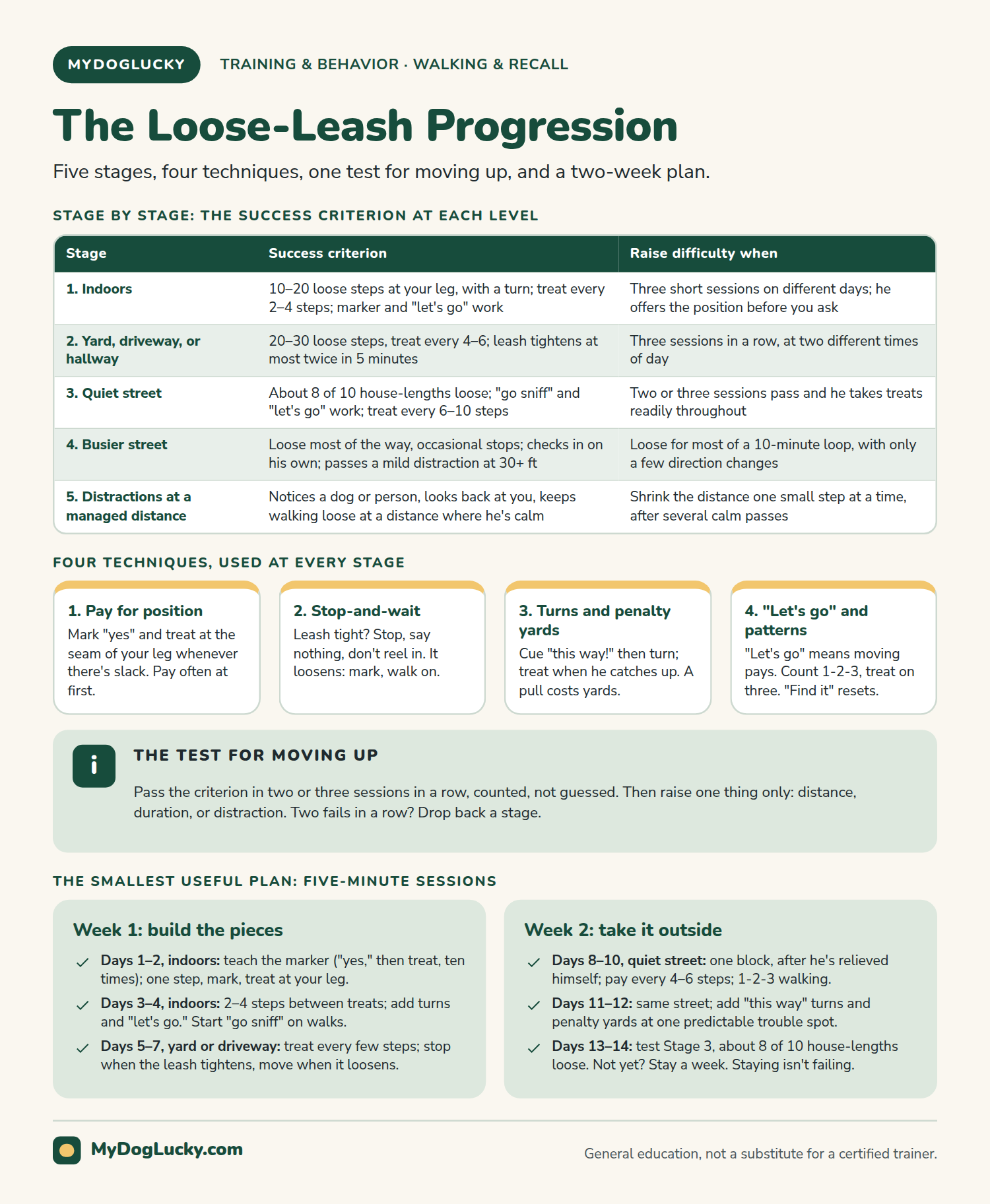
This is where most attempts at how to stop leash pulling fall apart: people start on the busy street, where the dog can’t succeed, and conclude the method doesn’t work. The method works fine. The starting point was wrong. Here’s the progression, with a success criterion at each stage. Don’t move up until your dog meets it in at least two or three sessions in a row.
| Stage | Success criterion | Raise difficulty when |
|---|---|---|
| 1. Indoors (hallway, living room) | Dog stays at your leg with a loose leash for 10 to 20 steps, including a turn, with a treat every 2 to 4 steps; responds to marker and “let’s go” | You get this in three short sessions on different days, and your dog starts offering the position before you ask |
| 2. Yard, driveway, or building hallway | Loose leash for 20 to 30 steps with treats every 4 to 6 steps; leash tightens no more than twice in a 5-minute session; recovers from a stop within a few seconds | Three sessions in a row meet the criterion, at two different times of day |
| 3. Quiet street, no dogs or people close by | Roughly 8 out of 10 short stretches (say, one house length each) are loose-leash; “go sniff” and “let’s go” work; a treat every 6 to 10 steps | Two or three sessions meet the criterion and your dog takes treats readily the whole time |
| 4. Busier street (traffic, people at a distance) | Loose leash most of the way with occasional stops; dog checks in on his own; can walk past a mild distraction at 30-plus feet without tightening | The dog is loose-leash for most of a 10-minute loop, and you’ve used direction changes or penalty yards no more than a few times |
| 5. Distractions (other dogs, people, wildlife, at a managed distance) | Dog can notice a distraction, look back at you, and keep walking loose at a distance where he’s calm; pattern games hold his attention past it | Shrink the distance gradually, one small step at a time, only after several calm passes at the current distance |
Raise One Variable at a Time
Trainers talk about “the three Ds”: distance, duration, and distraction. Distance is how far you are from the interesting thing. Duration is how many steps of loose leash you ask for between payments. Distraction is how exciting the environment is. When you make the walk harder, change one of these, not all three. Going from the yard to a quiet street? Shorten the duration between treats back to every couple of steps for the first session, because you’ve just raised distraction. Adding a friend with a calm dog at the end of the block? Keep the distance large and the pay rate high.
If your dog fails twice in a row at a new level, that’s information, not defiance. Drop back to the last stage he passed, get two or three good sessions, and try again with a smaller step up. This is normal, and it’s how the skill gets solid instead of brittle.
Make the Criterion Observable
“Walking better” isn’t a criterion. “Eight of ten house-lengths with slack in the leash” is. Count, roughly. Some owners keep a note on their phone; others just pay attention to how many times they had to stop. The point is that you know, without guessing, whether your dog is ready for the next step. Guessing usually means moving up too fast.
Pulling Toward Dogs and People
Plenty of dogs walk nicely until another dog or a friendly stranger appears, and then the leash goes tight and the training seems to evaporate. Before you decide what to do about it, watch what your dog’s body does. That tells you which problem you have.
The Frustrated Greeter
A frustrated greeter wants to get to the other dog or person, and the leash is in the way. Body language is loose and wiggly: tail wagging, mouth open, maybe a whine, bouncing on the front feet. He pulls because saying hello is the best thing in the world and the leash is stopping him.
This is a leash-skills and impulse-control problem, and the techniques in this article apply. Penalty yards work well here: pulling toward the person moves him away, a loose leash moves him closer, and a calm approach earns a greeting (if the person and their dog are willing). Pattern games and “find it” help lower the excitement enough for him to think.
Two useful rules. First, don’t let every dog on the street be a greeting. If your dog learns that most dogs are walked past, and some are greeted after a loose approach, greetings become something he earns rather than something he expects. Second, make the greeting itself short and end it before it gets rowdy, with a “let’s go” and a treat.
The Fearful or Reactive Dog
A fearful or reactive dog looks different, and the difference matters. Body stiff, weight forward or backed away, hard stare, closed mouth, hackles up, barking, growling, or lunging. Some dogs pull toward the other dog in this state; some pull away. Either way, this is not a loose-leash problem. It’s a dog who’s over threshold, and the leash techniques here won’t fix it and could make it worse if they involve any pressure or if you keep walking him into situations he can’t handle.
When it’s reactivity, not pulling
If your dog lunges, barks, growls, or snaps at dogs or people on leash, or if he freezes and refuses to move forward, put the loose-leash plan on hold for those moments and get help from a certified trainer who works with reactivity, or from a veterinary behaviorist.
Cornell’s Riney Canine Health Center describes reactive behavior as an over-the-top response to a trigger, often rooted in fear or frustration, and recommends managing distance and working with a qualified professional. In the meantime: increase distance, avoid head-on approaches, use the “find it” scatter to help your dog disengage, and don’t punish the barking. It’s information about how your dog feels, and it’s telling you the distance is too short.
Big Dogs, Small Handlers, Kids, and Retractable Leashes
The techniques don’t change for a big dog. The safety margin does.
Big, Strong Dogs and Smaller Handlers
A large dog who lunges can pull an adult off their feet. Until the training has caught up, management has to carry more of the load. A two-point harness setup, meaning a harness with both a front and a back attachment point and a leash with a clip at each end, gives you two contact points and lets you steer the front of the dog while keeping a secure hold on the back. Used calmly, it’s a steering aid, not a correction device. Some handlers of very strong dogs add a head halter under a trainer’s guidance, with the acclimation described earlier and a backup leash.
Leash handling matters more than most people realize. Hold the leash in the hand on the opposite side from the dog, with the slack looped across your body and your dog-side hand free to deliver treats or grab the leash near the harness if you need to. Don’t wrap the leash around your wrist or fingers; a sudden lunge can break bones. Keep your feet apart and your knees soft when you know a distraction is coming. Walk in the direction that keeps parked cars, hedges, or a fence between your dog and the thing he’d pull toward.
And be honest about the walks you skip. If certain routes or times of day reliably overwhelm both of you, change them for now. Quiet routes, off-peak hours, and a long-line session in a fenced field are all better than a walk that ends with someone hurt.
Kids Walking the Dog
A child should not be the primary handler of a dog who pulls, no matter how much the child wants the job. The risk isn’t only to the child; a dog who gets loose because a kid let go can be hit by a car.
A reasonable middle ground is the “two leashes” setup: the child holds one leash attached to the harness, and an adult holds a second leash to the same harness or to a collar, keeping real control while the child gets to participate. Once the dog is loose-leash reliable in easy environments, a child can hold the leash on their own for short stretches in those same easy environments, with the adult close by.
Kids can also be excellent at the fun parts: the 1-2-3 count, the “find it” scatter, and delivering treats at the seam of the leg when the dog is in position. Give them those jobs.
Why Retractable Leashes Don’t Work for Training
A retractable leash keeps light, constant tension on the line so it will rewind. That’s the opposite of what you’re teaching. Your dog learns that a slightly tight leash is normal, and that pulling harder makes more leash come out, which is pulling being rewarded by the equipment itself. There’s also no clear “loose leash” for you to mark, because the leash is never truly loose.
The safety issues are separate but real. The thin cord can cause deep cuts and burns on hands and legs when it wraps or snaps taut, the locking mechanism can fail under a hard lunge, and a dog 20 feet ahead of you is 20 feet closer to traffic than you can do anything about. If you like giving your dog more room to roam, a long line on a harness in a safe area does the same job with a clear on-off signal and no spring-loaded surprises.
Adolescent Regression and Senior Dogs
The Adolescent Slide
Somewhere between about six months and eighteen months, many dogs who were walking beautifully start pulling again, seemingly out of nowhere. This is normal adolescence. The dog is bigger, more confident, more interested in the world, and less interested in you, in roughly that order. It isn’t defiance, and it doesn’t mean the earlier training failed.
The fix is to go back down the progression. Not all the way to the hallway, necessarily, but to the last stage where your dog can succeed, and to bump the rate of reinforcement back up. Adolescents often need more sniff time and more physical exercise than they did as puppies, too. Expect a few months of two steps forward, one step back. The skills come back, and they usually come back stronger, because you’re now building them on a dog with a more mature attention span.
Senior Dogs and Sudden Changes on Leash
An older dog whose leash behavior changes deserves a vet visit before a training plan. New pulling, lagging behind, stopping and refusing to walk, sudden reluctance on stairs or curbs, or an odd, crab-like gait can all be signs of pain, most often from arthritis or other joint problems. Merck’s veterinary behavior chapter notes that medical problems can contribute to behavior changes and that ruling them out is part of any behavioral workup. Hearing or vision loss can change how a senior reacts to things approaching on a walk, too.
If your veterinarian finds a problem and treats it, you may find the “leash problem” resolves on its own. If your senior is sound, the techniques here work at any age. Just use a harness, keep sessions short, and let the sniffing be a bigger share of the walk. Older dogs have earned that.
Realistic Timelines
Nobody can promise you a number of days for how to stop leash pulling, and anyone who does is guessing or selling something. Here’s what tends to be true.
A puppy who starts loose-leash work early, with no history of pulling, often walks nicely in easy environments within a few weeks and generalizes to busier ones over a few months. An adult dog with years of successful pulling behind him usually shows a clear change in the easy stages within two or three weeks of daily short sessions, and then needs a few months of steady work to hold it on real walks with real distractions. Big, strong, high-drive dogs, and dogs who also have reactivity to sort out, take longer.
The variable you control most is repetition. Five minutes a day, six days a week, beats a 45-minute session on Sunday. Progress also isn’t a straight line. There will be a week where nothing improves and then a week where it clicks. Judge over a month, not a walk.
A useful way to think about it: you’re not “fixing pulling.” You’re teaching a new default behavior, and then making that default hold up in harder and harder places. That’s a longer project than fixing one bad walk, and it’s also a much more durable result.
Troubleshooting: Five Problems You’ll Probably Hit
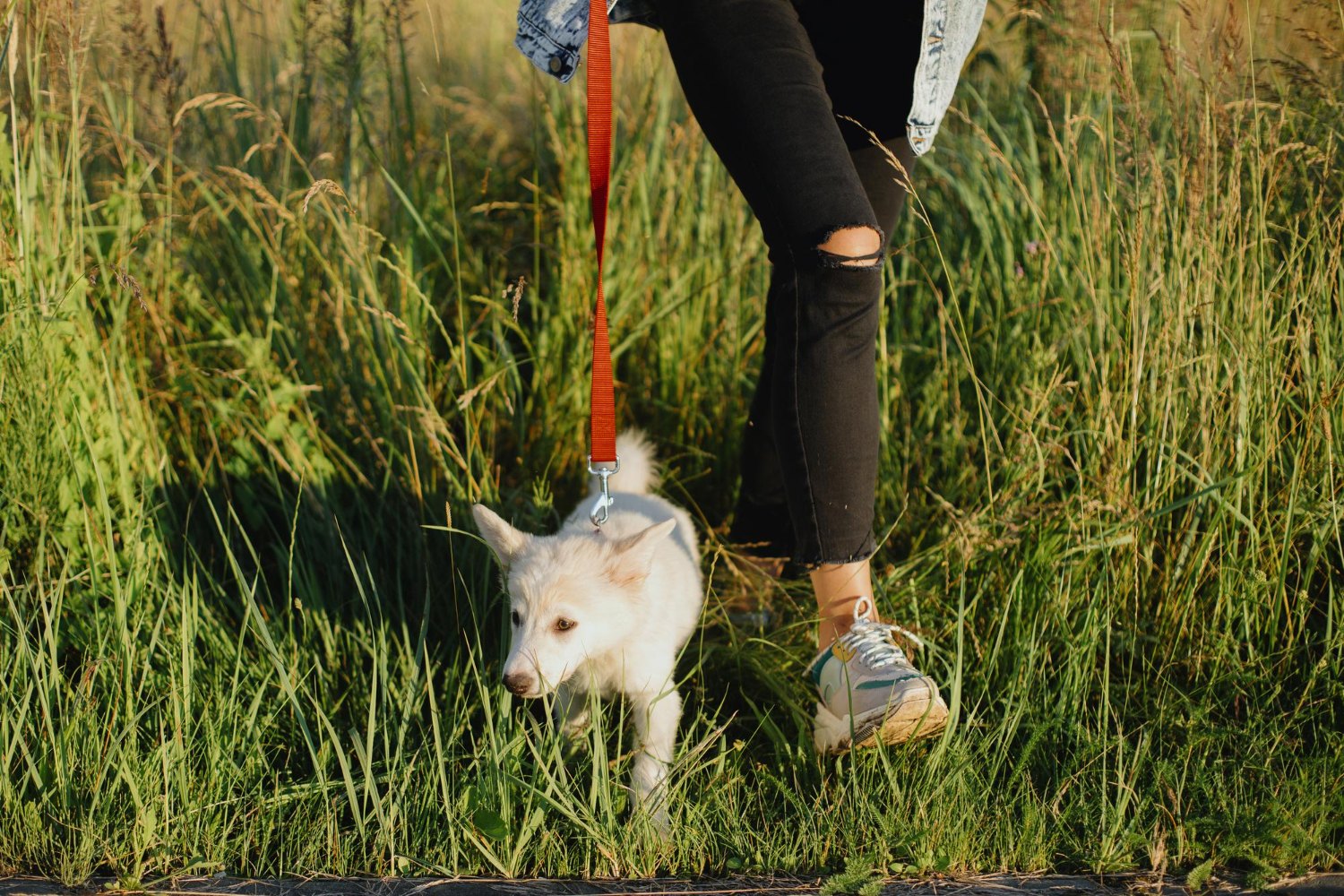
1. He Walks Nicely, Then Explodes at the Corner
Corners are where the world changes. New sights, new smells, a sudden view of the park. If your dog is fine for the first block and loses his mind at the turn, treat the corner as its own training exercise. Slow down ten feet before it. Run a 1-2-3 pattern through the turn. Stop on the corner and do a “find it” scatter before you go around. Use penalty yards: if he surges around the corner, calmly back up and try again. And ask what’s on the other side. If the answer is “the route to the dog park,” consider a different route for now, so the corner stops predicting the best thing on earth.
2. He Only Pulls on the Way Out
This is extremely common and tells you something useful: the pulling is about anticipation, not about the leash. The way out predicts the good stuff; the way home doesn’t. You have a few options. Start the training loop where the good stuff already happened, so the dog is on the “calm” side of his excitement. Put the exercise or sniff walk first and the training walk after. Or use the destination as the reward: loose leash gets you closer to the park, tight leash means penalty yards. A dog who’s learned that the fastest route to the park is a loose leash tends to be a very motivated student.
3. He Ignores Treats Outside
A dog who won’t take food outside is telling you one of three things. The environment is too hard (drop back a stage), the treats aren’t good enough for the environment (use something soft and smelly instead of dry biscuits), or he’s too full or too aroused to care. Try the session before a meal rather than after. Use “find it” scatters, which many dogs will do even when they won’t take a treat from your hand. Try a toy or a chance to sniff as the reward instead. And check the obvious: if he’s been walked past the same overwhelming spot every day, he may need a calmer starting location, not a better cookie.
If a dog who normally loves food refuses it everywhere, including at home, that’s a reason to call your veterinarian, not a training problem.
4. He Pulls the Moment the Harness Goes On
The harness has become a cue for “the exciting part starts now.” Uncouple it. Put the harness on and then sit down for five minutes. Put it on before a meal. Put it on and do a short indoor training session, then take it off with no walk. Once the harness stops reliably predicting an immediate departure, the frantic burst at the door tends to fade. Meanwhile, wait for four feet on the floor and a moment of stillness before the door opens, and pay for that. Doorway calmness is a skill of its own, and it makes the first 30 seconds of every walk easier.
5. You Don’t Have Time
This is the most honest problem on the list, and the one people feel guilty about. The question of how to stop leash pulling when you have no time has a smaller answer than you’d expect: you don’t need more time, you need a smaller plan. Five minutes in the hallway while the coffee brews. A 1-2-3 pattern for the first block of the walk you’re already taking. Penalty yards at the one tree that always causes trouble. “Go sniff” as a reward instead of a treat, so you don’t need to carry anything.
If even that’s too much this month, then this month is for management: a front-clip harness, routes that keep everyone safe, and sniff walks. The training can start when life allows. Your dog will still be able to learn then.
The Smallest Useful Practice Plan
If this whole guide to how to stop leash pulling feels like a lot, here’s a two-week starting point that fits around a normal week. Sessions are five minutes unless noted. Skip a day if you have to; just don’t skip a week.
Week 1: build the pieces
- Days 1–2: Indoors. Teach the marker (“yes” then treat, ten times). Then one-step, mark, treat at the seam of your leg, for a few minutes. Switch the regular walk to a front-clip harness if you haven’t already, and give it a “go sniff” at every second or third tree.
- Days 3–4: Indoors. Two to four steps between treats, add turns and a “let’s go” cue. On the regular walk, start saying “go sniff” and “let’s go” so the words get meaning.
- Days 5–7: Yard, driveway, or building hallway. Treat every few steps. Stop-and-wait when the leash tightens; mark and move the moment it loosens. Aim for the Stage 2 criterion.
Week 2: take it outside
- Days 8–10: Quiet street, one block, right after the dog has relieved himself. Pay every 4 to 6 steps. Use 1-2-3 walking for the stretches that feel wobbly. “Go sniff” as a reward for a good stretch.
- Days 11–12: Same street, add direction changes with the “this way” cue. Try penalty yards at one predictable trouble spot.
- Days 13–14: Test the Stage 3 criterion: about 8 of 10 house-lengths on a loose leash. If you’re there, plan the next step up. If not, stay here another week. Staying is not failing.
After two weeks, most dogs show a visible difference in the easy places. That’s the foundation. The following months are about carrying it into harder places one variable at a time, keeping the sniff walks going, and paying enough that the loose leash stays worth it.
Common Mistakes That Slow Progress
Starting Where the Dog Can’t Succeed
The busy street is the final exam. Nobody passes the final exam on the first day of class. Start in the hallway, even if it feels silly.
Paying Too Little, Too Late
A treat every 30 steps in week one isn’t a rate of reinforcement; it’s a rumor. Pay often early, then fade.
Letting Pulling Work “Just This Once”
Every time a tight leash gets your dog somewhere, you’ve paid for pulling. Intermittent payoff is exactly what makes habits stick. If you’re in too much of a hurry to hold the line today, use the management walk and don’t count it as training.
Keeping the Leash Short and Tight
A leash held with constant tension cues the dog to lean into it, and gives you nothing to mark. Let there be slack. That’s the whole point.
Reeling the Dog In and Then Treating
This teaches “tight leash, get pulled back, get a cookie.” Let the dog create the slack, then pay.
Using Corrections Because It Feels Faster
A leash pop might interrupt a pull in the moment. It doesn’t teach the loose leash, it loads the neck, and AVSAB’s review links it to fallout you’ll be dealing with for far longer than the pulling. It also risks teaching your dog that the thing he was looking at when the pop happened, often another dog, predicts pain.
Never Letting the Dog Sniff
A walk with no sniffing is a walk with no built-in reward. Use it.
Changing Everything at Once
New street, new distractions, longer duration between treats, all in one session, and then the conclusion that “he can’t do it outside.” He can. Change one thing.
Mistaking a Bad Walk for a Bad Dog
Yesterday’s great walk and today’s disaster are both data points. Look at the trend over weeks. And keep the moral labels off him. He’s a dog who’s learning something new and had a hard day, nothing more.
Frequently Asked Questions About Leash Pulling
What is the fastest way to stop a dog from pulling on the leash?
There isn’t a fast answer to how to stop leash pulling that also lasts. The fastest reliable route is to combine management (a front-clip harness so pulling pays less right now) with short daily training sessions that pay heavily for a loose leash in easy places. Most owners see a change in the easy stages within two to three weeks. Anything promising to stop pulling in a day is either a management tool being described as training or an aversive tool with risks we’ve covered above.
Is a harness or a collar better for a dog that pulls?
A harness, and for most pullers a front-clip harness. A collar concentrates force on the neck, where the trachea, thyroid, and major blood vessels live, and lab-model research suggests that even flat collars can reach injurious pressures when a dog pulls hard. A harness spreads the load. It’s not a training method, but it keeps the dog safe while you train.
Do front-clip harnesses hurt dogs or affect their gait?
A well-fitted one shouldn’t hurt. Some styles that cross the chest can restrict shoulder movement in some dogs, which is why fit matters and why it’s worth watching your dog trot in it. If his stride shortens or he seems reluctant to move, adjust or try a different style. Ask a certified trainer or your veterinarian to check the fit if you’re unsure.
Should I use a head halter?
It depends on the dog and the handler. A head halter can give a smaller person real steering control over a big, strong dog, and some dogs accept it well after a gradual, food-based introduction. Many dogs dislike it at first, it must never be jerked, and it should always be used with a backup leash on a collar or harness. If your dog fights it after a patient acclimation, a front-clip harness is a reasonable alternative. A certified trainer can show you the introduction in person.
Why does “be a tree” not work for my dog?
Usually one of three reasons: it’s the only thing you’re doing (it removes the payoff for pulling but doesn’t teach what to do instead), the environment is too exciting for the dog to notice you stopped, or the leash sometimes gets to work anyway when you’re in a hurry. Pair it with paying for position, use it in easier places first, and stop every single time the leash tightens, not just when it’s convenient.
How many treats is too many?
Early on, a lot is correct. Use pea-sized soft treats and count them toward the day’s food, or use part of your dog’s regular meal if he’ll work for it. As the behavior becomes reliable, thin the schedule and swap in sniff breaks and praise. If your dog is gaining weight, reduce meal size on training days rather than cutting the training.
My dog walks fine for the trainer or my partner but pulls with me. Why?
Dogs learn each person’s rules separately. If pulling has sometimes worked with you and never with someone else, your dog knows the difference. It’s not personal, and it’s fixable. Go back to the easy stages with you holding the leash, pay well, and stop pulling from working on your walks specifically. It usually comes together faster the second time.
Can I fix leash pulling in an older dog?
Yes. Older dogs learn fine; they just have a longer habit to replace. Get a veterinary check first if the pulling is new or the dog’s gait or willingness to walk has changed, since pain can show up as odd leash behavior. Then use the same progression, on a harness, with shorter sessions and generous sniffing.
What about a dog who lunges and barks at other dogs on leash?
That’s reactivity, not pulling, and the loose-leash techniques here aren’t the right tool for it. Increase distance from other dogs, use “find it” scatters to help your dog disengage, don’t punish the barking, and work with a certified trainer who handles reactivity or a veterinary behaviorist. Loose-leash training can continue in places where your dog is calm.
Does my dog need to walk in a formal heel?
No. A formal heel (dog’s shoulder at your knee, eyes on you) is a competition skill and a lot of work for both of you. For everyday walks, “the leash is loose and you’re roughly beside me” is plenty. Pick the standard you’ll actually maintain and pay for that.
Where to Start This Week
Pick the position you want, teach the marker in the hallway tonight, and pay your dog for standing there. Tomorrow, add a step. Switch the regular walk to a front-clip harness and start saying “go sniff” at the trees. That’s the first three days, and it’s enough.
Then hold the line on the one rule that every answer to how to stop leash pulling depends on: pulling stops working. Not as a punishment, just as a fact of physics on your walks. Pay for the loose leash often, fade the food slowly, and raise the difficulty one notch at a time when your dog passes the test at the current level.
If what you’re seeing is lunging, barking, or fear rather than plain excitement, that’s not a leash-skills problem, and a certified trainer or veterinary behaviorist can help you build the right plan. And if your dog’s walking changes suddenly, especially as he gets older, let your veterinarian look before you look for a training answer. Most leash pulling, though, is exactly what it looks like: a dog who learned that pulling works, and who’s ready to learn something better the moment you start paying for it.
Sources
- American Veterinary Society of Animal Behavior. Position Statement on Humane Dog Training (2021)
- VCA Animal Hospitals. Controlling Pulling on Walks (accessed September 2026)
- American Kennel Club. How to Stop Your Dog From Pulling on the Leash (accessed September 2026)
- American Kennel Club. Leash Training: How to Train a Dog or Puppy to Walk on a Leash (accessed September 2026)
- ASPCA. Positive Reinforcement Training (accessed September 2026)
- Cornell University College of Veterinary Medicine, Riney Canine Health Center. Managing Reactive Behavior (accessed September 2026)
- Merck Veterinary Manual. Behavior Problems of Dogs (accessed September 2026)
- University of California, Davis, School of Veterinary Medicine. Loose Leash Walking (accessed September 2026)
- Carter, A., McNally, D., Roshier, A. Canine collars: an investigation of collar type and the forces applied to a simulated neck model. Veterinary Record (2020)
- Pauli, A. M., Bentley, E., Diehl, K. A., Miller, P. E. Effects of the application of neck pressure by a collar or harness on intraocular pressure in dogs. Journal of the American Animal Hospital Association 42(3):207–211 (2006)
- Certification Council for Professional Dog Trainers. Position Statements (Humane Hierarchy and LIMA) (accessed September 2026)
- International Association of Animal Behavior Consultants. Position Statements (LIMA) (accessed September 2026)
- Best Friends Animal Society. How to Stop a Dog From Pulling on Leash (accessed September 2026)
This article is general education for U.S. dog owners. It is not individualized training or veterinary advice for your dog. Lunging, barking, growling, or fearful behavior on leash should be evaluated by a certified trainer experienced with reactivity or by a veterinary behaviorist. Any sudden change in how a dog walks, especially in an older dog, is a reason to talk with your veterinarian before starting a training plan.