
Clicker training is a way of telling your dog, at the exact moment it happens, “yes, that one earns a reward.” A short, consistent signal marks the behavior. A treat follows. The signal can be a click, a tongue click, or a quick word like “yes,” and the skill hiding inside the whole system is timing.
The clicker itself is optional. The little plastic box is just a very consistent noise. What matters is that your dog learns the signal always predicts something good, that you deliver it at the right moment, and that you pay often enough for your dog to stay curious instead of confused.
This guide covers how a marker works, how to charge one, and timing drills you can run without a dog. It compares luring, capturing, and shaping with small worked examples, then moves through rate of reinforcement, cues, fading, and troubleshooting. You’ll also see how the same mechanics apply to everyday tasks. Full plans for how to stop leash pulling, dog recall training, and puppy biting each deserve their own articles. Here, they show up as practice targets.
What’s in this guide
- Clicker training in plain English: the short answer
- Choosing your marker: click, tongue click, or a word
- Why a marker works: bridging the gap and adding precision
- Charging the marker: your first five minutes
- Timing drills you can do without a dog
- Treats and handling: what to reward with and where it goes
- Luring, capturing, and shaping: three ways to get something to click
- Rate of reinforcement and raising the bar
- Adding the cue: behavior first, word second
- What to click, what not to click, and ending the behavior
- Noise-sensitive dogs: softer markers and safer setups
- Multi-dog homes and helpful humans
- Clicker training in everyday life: five practical applications
- Fading the clicker without losing the behavior
- Troubleshooting: when clicker sessions go sideways
- Common clicker training mistakes
- Realistic timelines without promises
- When to get professional help
- A 10-minute practice plan to start today
- Frequently asked questions about clicker training
- Sources
Clicker Training in Plain English: The Short Answer
Here’s the working definition. You choose a marker signal, teach your dog that it predicts a reward, and then use it to pinpoint the exact behavior you want more of. Click, then treat. The click says, “That’s it, right there.” The treat pays for it.
Most owners are surprised by how little equipment this takes. You need a marker, a handful of small treats, and a few quiet minutes. You also need to watch your dog closely, because this method rewards the person who notices small things.
A Marker Gives Information, Not Orders
The most common mix-up is treating the click like a command, something like “come here” or “look at me.” It isn’t one. A click is closer to a camera flash. It captures a moment and says, “That moment was worth something.”
Your dog has already done the behavior by the time the click sounds. The click doesn’t ask for anything new. It confirms, and then the treat pays.
That distinction shapes everything else in this article. Because a click is information, it can be very precise, and it can build behaviors your dog has never been asked to do. Because it isn’t a command, it shouldn’t be used to summon, interrupt, or redirect. That rule gets its own section later.
The Click-Then-Treat Sequence
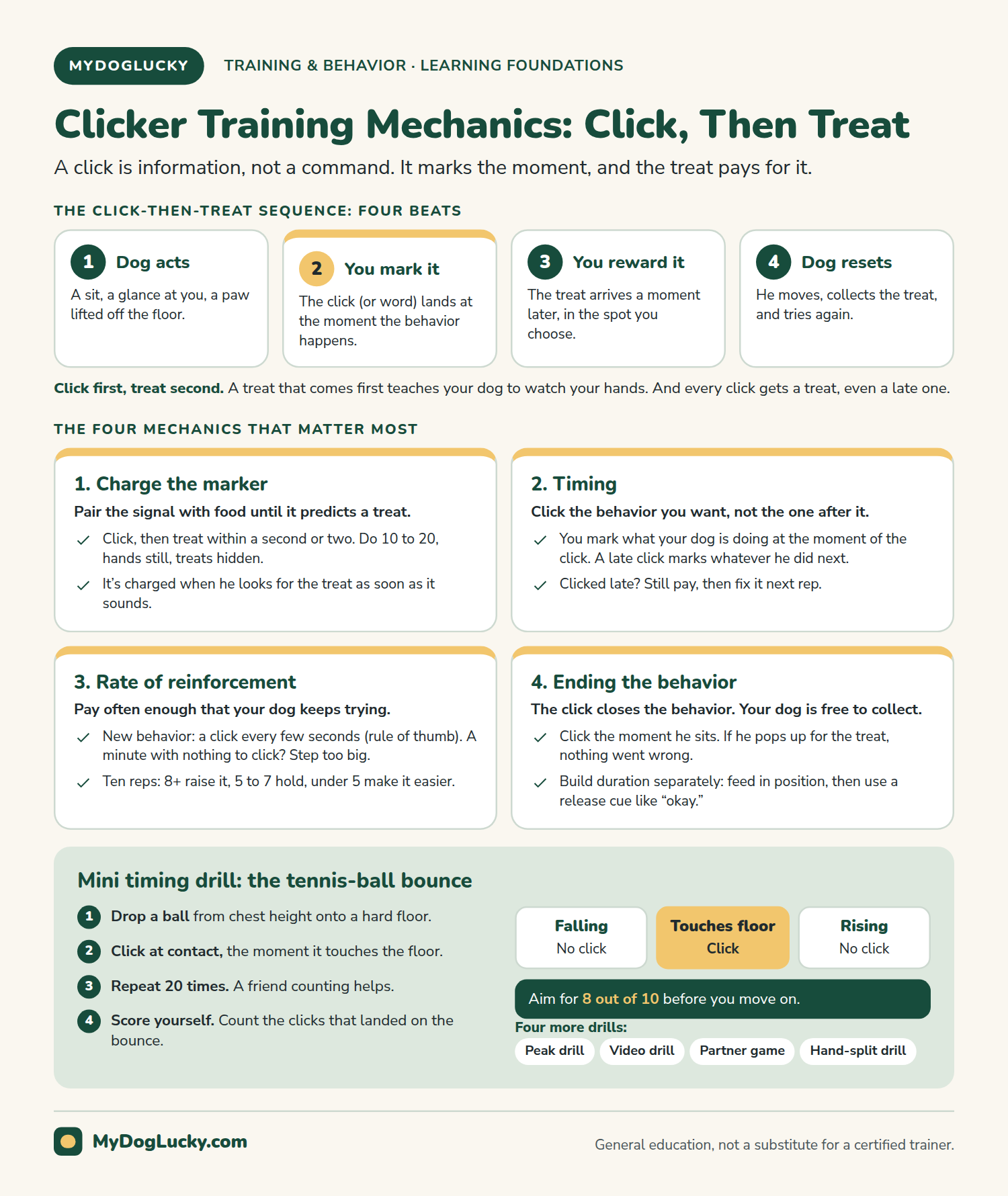
Every clicker exchange follows the same four beats:
- Your dog does something. A sit, a glance at you, a paw lifted off the floor.
- You mark it. The click (or word) lands at the moment the behavior happens.
- You deliver the reward. The treat arrives a moment later, in the spot you choose.
- Your dog resets. He moves, collects, and tries again.
Notice that the click ends the behavior. Your dog is free to move the second he hears it. That surprises many new clicker trainers, and we’ll come back to it.
The Four Mechanics That Matter Most
Nearly every problem with marker training traces back to one of four mechanics:
- Charging the marker. Your dog learns that the signal predicts a treat.
- Timing. The click lands on the behavior you want, not the one after it.
- Rate of reinforcement. You pay often enough that your dog keeps trying.
- Ending the behavior. The click closes the behavior, so your dog is free to collect.
Each one gets its own section below. The infographic gives you the one-page version, including a mini timing drill you can try tonight.
What the Research Says, and What It Doesn’t
Clicker training is popular with trainers, so it’s fair to ask whether it beats simply handing out treats. The research is more mixed than the enthusiasm suggests.
In a 2016 experiment, Chiandetti and colleagues taught 51 dogs a new task under three conditions: a clicker plus food, a spoken “Bravo” plus food, and food alone. All three groups learned at about the same pace. The authors noted limits, including testing in familiar home settings and only one novel task.
A 2016 review by Feng, Howell, and Bennett looked at the wider animal-learning literature. They concluded that clickers likely work as conditioned reinforcers, meaning signals that have come to predict something good. Clicks may also have “marking” and “bridging” effects, but the evidence for those is thinner.
A 2017 follow-up compared trainers’ descriptions of clicker use with the methods used in studies. Trainers stressed thoroughly conditioning the signal first, and they typically stopped using the click once a behavior was learned. The authors suggested that inadequate conditioning in some experiments could partly explain why those studies found no learning benefit.
What It Means at Home
A reasonable reading (ours, not a research finding) is that a marker isn’t magic, and a well-timed “yes” can do the same job as a click. The real payoff is precision and a habit of noticing. The AVSAB’s humane training position statement lists a clicker or verbal marker as an acceptable way to mark behavior, alongside toys, treats, and other rewards.
What you need to start
- A marker: a clicker, a tongue click, or a short word.
- About 30 tiny, soft treats, roughly pea-sized (smaller for small dogs).
- A treat pouch or pocket, so treats stay out of sight until after the mark.
- A quiet room, five minutes, and a dog who isn’t stuffed from a big meal.
One safety note before you begin
If your dog startles, flinches, or moves away when he hears a click, jump to the section on softer markers first. If he stiffens, growls, or snaps around treats or handling, pause and talk with your veterinarian and a qualified professional. This is a teaching tool. It isn’t a fix for fear or aggression.
Choosing Your Marker: Click, Tongue Click, or a Word
You have several practical options. All of them work if they’re brief, distinct, and used the same way every time. Choose based on your hands, your dog’s ears, and your household.
| Marker | Strengths | Watch-outs | Often a good fit for |
|---|---|---|---|
| Box or button clicker | Sounds identical every time, whatever your mood. | Needs a free hand. The sound can startle some dogs. | Learning timing, new skills, dogs comfortable with the sound |
| Tongue click | Always with you. Leaves both hands free. Volume is adjustable. | Varies with your mouth and mood. | Walks, hands-full moments, dogs sensitive to a sharp click |
| Short word (“yes,” “yep,” or a made-up word) | Free and quiet. Works anywhere you can speak. | Tone drifts. Everyday conversation waters it down. | Sound-sensitive dogs, outings, people who like talking to their dog |
| Visual or touch marker (thumbs-up, small light flash, gentle touch) | Works for dogs who can’t hear the other options. | Needs line of sight or contact. Must be just as consistent. | Deaf or hard-of-hearing dogs, loud environments |
The AKC’s clicker training article makes the same point: there’s nothing magical about the sound. Alternatives include finger snaps, tongue clucks, a word like “yes,” and physical signals for dogs who can’t hear.
Rules for Any Marker
Whatever you pick, hold it to these standards:
- Short. One quick sound or syllable. “Yes” works. “Goooood job!” doesn’t.
- Distinct. It should stand out from ordinary conversation. If you say “yes” forty times on a phone call, your marker just lost value.
- Single. One marker per household, or per dog. A pile of similar signals blurs the message.
- Reliable. A click always gets a treat. Always. We’ll come back to that rule.
A Word About the Box Itself
If you choose a clicker, test the volume before you use it near your dog. Press it once in another room, then in your pocket, then in your closed hand. Some dogs shrug off a loud click. Others flinch at a quiet one. Learn which kind you have before session one.
Why a Marker Works: Bridging the Gap and Adding Precision
Three practical problems explain why clicker training leans on a marker.
The Gap Between Behavior and Treat
Dogs live in the moment. If your dog sits, you reach into a pouch, and the treat arrives two seconds later, your dog may already be standing. From his side of the leash, the treat paid for standing up.
A marker bridges that gap. The click lands as his rear touches the floor. The treat can arrive a moment later, and your dog still knows which moment earned it. Trainers often describe this as a “bridge,” though the research on bridging specifically is still thin, as noted above.
Precision You Can’t Get With Your Hands
Some behaviors last a fraction of a second: a head turn, a glance away from a squirrel, a paw lifting. You can’t hand over food fast enough to catch those. A click can.
Marking tiny pieces is what makes shaping possible. It’s how a dog learns to touch a lid with a paw without anyone touching his paw.
Consistency That Praise Can’t Match
Your voice changes with your mood. A cheerful “good boy!” on a sunny Saturday and a distracted one on a rushed Monday aren’t the same signal. Your voice is a paragraph. A click is a period. Praise still has a place, but for marking exact moments, a short, identical signal is easier to decode.
Charging the Marker: Your First Five Minutes
Charging (some trainers say “loading”) means pairing the marker with food until the signal alone predicts a treat. The AKC’s clicker article puts it simply: click, then treat right away, and after about 10 to 20 repetitions your dog will understand that the marker predicts a reward. Some dogs need more, and that’s fine.
Step by Step
- Pick a quiet spot. A kitchen or hallway with no other pets works well. Turn off the TV.
- Hide the treats. Keep them in a pouch or pocket. Your hands should be still and empty when you click.
- Click, then treat. The treat arrives within a second or two. Your dog doesn’t need to do anything.
- Pause, then repeat. Let your dog finish eating and look around again. Vary the pauses a little so you’re not a metronome.
- Stop after 10 to 20 clicks. That’s usually a minute or two. Take a break, then do another short round later in the day.
One timing detail matters here. Click when your dog is doing something ordinary, like sniffing the carpet or glancing around. Don’t click while he’s staring at your treat hand. Otherwise he may decide the hand movement is the signal.
How to Tell the Marker Is Charged
Watch for the response. When the click sounds, your dog’s head turns toward you or your hand, his ears flick, and he looks for the treat before you’ve moved. That look-for-the-treat reaction is the sign the sound now means something.
Quick test: wait until your dog looks away, keep your hands still, and click once. If he swings back toward you, you’re ready. If not, do another short round.
Charging in New Places
A marker charged in the kitchen doesn’t automatically carry over to the yard. Do a few refresher clicks in each new spot first. If your dog startles or moves away from the sound at any point, stop. The softer-marker section below is your next step, not another click.
Timing Drills You Can Do Without a Dog
Your dog isn’t the best place to practice your timing. He’s busy, he’s small, and he moves. A bouncing ball, on the other hand, is patient and consistent. Practice the mechanics on things that won’t get confused by your mistakes.
The Tennis-Ball Bounce Drill
- Drop a ball. Hold a tennis ball at chest height over a hard floor and let it fall.
- Click at contact. Not on the way down. Not on the way back up. At the moment it touches the floor.
- Repeat 20 times. A friend counting or a phone recording helps.
- Score yourself. Count the clicks that landed on the bounce. Aim for eight out of ten before you move on.
Four More Drills
- The peak drill. Click at the top of the bounce instead. This trains you to mark a chosen moment, not just the most obvious one.
- The video drill. Play a training video on mute. Click at the moment a dog’s rear touches the floor in a sit, before he rises. Aim for eight out of ten.
- The partner game. One person leaves the room. The other picks a simple target, like touching a book. When the first person returns, they wander freely while you click steps toward the target. No talking. You’ll learn quickly how a late click sends a learner sideways.
- The hand-split drill. Click with one hand while the other reaches into the pouch and delivers a treat to a plate. Do ten in a row. Patting your head while rubbing your stomach is the warm-up.
How Close Is Close Enough?
Closer is better, but you don’t need to be flawless. A click that lands while the behavior is happening, or just as it finishes, works fine. A click that lands after your dog has moved on marks whatever he did next.
That’s the rule to memorize: you mark what your dog is doing at the moment of the click, not what you meant to mark. When you do click late, still pay, then fix the timing on the next repetition.
Treats and Handling: What to Reward With and Where It Goes
Rewards do the paying. Choosing them well, and delivering them in the right spot, keeps clicker training sessions smooth.
Treat Choice by Category
You don’t need a particular product. You need a reward your dog actually wants, cut small enough that eating it doesn’t slow the game down.
- Everyday soft treats, pea-sized or smaller, for quiet practice at home.
- Higher-value extras, such as tiny bits of cooked meat or cheese, if your dog tolerates them and your veterinarian is comfortable with them. Good for distractions.
- Part of the regular meal. Kibble suits low-distraction sessions, and it counts toward the day’s food.
- Lickable spreads from a spoon or tube, handy for hold-still moments like grooming. Check labels with your veterinarian’s guidance, since some spreads contain ingredients that aren’t safe for dogs.
- Play and real-life rewards. Tug, a sniff break, or a thrown toy suit dogs who are less food motivated.
Treats carry calories. Keep them a small part of the day, and ask your veterinarian how many extra calories fit your dog, especially if he has food allergies, weight concerns, or a prescribed diet.
Where the Treat Goes Teaches Position
Treat delivery is quiet teaching. Wherever the treat lands, that’s where your dog learns to be.
- For a sit, deliver the treat at nose height, directly in front.
- For a down or settle, deliver low, between the front paws.
- For loose leash, deliver at your hip or leg, so your dog learns that’s the good spot.
- For a mat, toss or place the treat on the mat itself.
- For resets, toss the treat a few feet away so your dog has to come back and try again.
A common real-life version of this mistake: an owner delivers loose-leash treats out in front of the body. The dog learns that forward is where the food lives, and he surges ahead to get there.
Hands, Leashes, and the Left-Handed Problem
Clicker in one hand, treats in the other, leash somewhere, and phone in a pocket. It’s easy to run out of hands.
Many instructions assume you’re right-handed, with the clicker in the right and treats in the left. If you’re left-handed, flip that. A practical suggestion: give the click to your quicker, more reliable hand, since timing matters most there. Let the other hand handle treats, and practice with the hand-split drill until it feels natural.
A few other workarounds help:
- Use a tongue click or verbal marker on walks to free both hands.
- Clip the leash to a belt loop for indoor practice, so your hands stay free.
- If gripping a small clicker is hard, choose a larger button style or skip the device.
Luring, Capturing, and Shaping: Three Ways to Get Something to Click
You can’t click a behavior that hasn’t happened yet. Trainers use three main methods to get the behavior to appear. The AKC’s clicker article names all three.
| Method | How it works | Best for | Watch-outs |
|---|---|---|---|
| Luring | A treat or hand guides your dog’s nose into position. You click when he gets there. | Simple body positions like sit, down, and spin | Your dog may follow the food and ignore everything else. Fade the lure early. |
| Capturing | You wait for your dog to do the behavior on his own, then click it. | Calm behaviors he already offers, like lying down or looking away from a distraction | Slow if the behavior rarely happens. It only works for what actually occurs. |
| Shaping | You click tiny steps toward a final behavior and raise the bar gradually. | New or multi-step behaviors like a paw touch or going to a mat | Needs a good rate of reinforcement and a plan for each step. |
Three small worked examples show how each method looks in practice. Each assumes your marker is already charged.
Example 1: A Nose Target (Light Luring)
A nose target means your dog touches his nose to your open palm. It’s one of the most useful beginner skills, and it doubles as a way to move your dog around without pushing or pulling.
- Present the hand. Hold a flat palm about four to six inches from your dog’s nose, at his nose height. Keep the treat in your other hand, out of sight.
- Click the touch. Most dogs sniff a new hand out of curiosity. The moment his nose contacts your palm, click.
- Treat from the other hand, delivered near where you want his head.
- Repeat five or six times, then move your hand a few inches to the side, lower, or higher.
- Add the cue later. Say “touch” only once he’s reliably moving toward your hand.
Success check: your dog touches the palm within a couple of seconds, at least eight tries out of ten, in three different spots.
Example 2: Settling on a Mat (Capturing Plus Shaping)
A mat settle is a foundation for calm behavior at home, at the vet, and at a friend’s house. It’s also a fine test of your patience, since you click things that barely look like anything.
- Set the stage. Put a small mat or folded towel on the floor in a quiet room. Stand near it with treats.
- Click any glance at the mat. Then toss a treat onto it. Landing on the mat gives your dog a reason to step there.
- Click steps onto it. One paw, then two, then all four. Keep delivering treats on the mat.
- Capture the sit or down. Say nothing. Click when your dog folds himself down, and deliver the treat low, between his paws.
- Stretch the time slowly. Click after one second, then two, then a little longer. Click softer signs, like a hip rolling to one side, a long exhale, or a resting chin.
Success check: he steps on the mat by himself and lies down on it, in at least three rooms, with a few seconds of calm before the click.
The mat slowly becomes a very small, very rewarding stage. Some dogs discover it’s also an excellent napping spot, which, to be fair, is the point.
Example 3: A Paw Touch (Shaping)
Here, your dog learns to touch a small flat object, like a plastic lid or sticky note, with a paw. It builds foot awareness, which becomes a stepping stone for cooperative care later.
- Put the lid on the floor. Keep your hands out of the way.
- Click any look at the lid. Deliver the treat a few feet away, so your dog resets and comes back to look again.
- Click a sniff, then a nose touch, then any paw movement toward it, such as a shift or a lift.
- Raise the bar in tiny steps. Paw lifted, paw near the lid, paw touching the lid.
- Keep the pace brisk. Early on, clicks may come every few seconds. Never grab the paw to help.
Success check: he lifts a paw and touches the lid within a few seconds, at least eight out of ten tries.
Blending the Methods
You’ll rarely use one method alone. Many trainers lure simple body positions, capture relaxed ones, and shape anything with more than a couple of steps.
If you use a lure, fade it quickly. After three to five repetitions, do the same hand motion with no food in it, and reward from the other hand. Otherwise your dog learns to follow snacks instead of learning the behavior.
Rate of Reinforcement and Raising the Bar
“Rate of reinforcement” is just how often your dog earns a click and a treat. A high rate early in learning keeps your dog engaged and makes the game obvious. A low rate makes the game feel like guessing.
A common trainer rule of thumb (not a researched number) is a click every few seconds when a behavior is brand new. If a minute passes with nothing to click, the step is too big.
What “Criteria” Means
Criteria are your current requirements for a click. For a mat settle, the first criterion might be “any glance at the mat.” Later it becomes “all four paws on the mat,” then “lying down,” then “lying down for five seconds.”
Raising the bar means changing those criteria on purpose. Doing it well is most of the craft.
Six Rules for Raising the Bar
- Change one thing at a time. Ask for a little more time, or a little more distance, or a little more distraction. Never all at once.
- Succeed first. Raise the bar only after your dog succeeds several times in a row at the current level.
- Use a simple scoreboard. Try ten repetitions. Eight or more successes means raise it slightly. Five to seven means hold steady. Fewer than five means make it easier. (Again, a working rule of thumb.)
- Treat two or three misses in a row as a signal. The step is too big. Drop back and rebuild.
- Keep sessions short. Two to five minutes is plenty. End on a success.
- Expect dips in new places. A new room or a busy sidewalk means restarting at an easier level. That’s normal, not backsliding.
Think of raising difficulty like adding hot sauce. A drop at a time, taste, then decide. A whole spoonful and nobody’s happy.
| What you can raise | Example (mat settle) | If your dog struggles |
|---|---|---|
| Duration | Lying on the mat for 2 seconds, then 5 | Go back to a shorter time and click sooner |
| Distance | You take one step away, then two | Stay close and return to feed in position |
| Distraction | A dropped spoon, then a family member walking by | Lower the distraction or move farther from it |
| Precision | All four paws on the mat, not just two | Click closer approximations for a few reps |
Adding the Cue: Behavior First, Word Second
A cue is a signal that means “do this behavior now, and a reward is available.” It can be a word, a hand signal, or both. Many dogs read hand signals more easily than words, and there’s nothing wrong with using them.
The order matters. Teach the behavior first, then name it.
How to Add a Cue
- Wait for reliability. Your dog offers the behavior easily, at least eight out of ten times, without a lure.
- Say the cue once, just before your dog starts the behavior. Keep your voice neutral.
- Click and treat when he does it.
- Test. After several repetitions, say the cue when he’s looking at you. If he does the behavior, click. If not, wait quietly, then reset and try again.
- Stop clicking un-cued versions. Once he knows the cue, click only the behavior that follows it.
Cue Rules Worth Following
- Say it once. A cue repeated five times teaches your dog to wait for the fifth one.
- One word per behavior. “Down” can’t mean lie down, get off the couch, and stop jumping.
- Practice in more than one room. The cue has to work outside the kitchen before it counts.
What to Click, What Not to Click, and Ending the Behavior
Most new-trainer trouble lives in this section. The rules are short, but they’re worth reading twice.
The Clicker Is Not a Remote Control
A click means “treat coming.” It doesn’t mean “look at me,” “come here,” or “stop that.” Using it as a remote control teaches your dog something you didn’t plan.
- Don’t click to get attention. If your dog is sniffing the grass and you click to make him look, you paid for sniffing. He learns to ignore you until the click arrives.
- Don’t click to call your dog. Use a separate recall cue, and click for the response. The click is not a leash.
- Don’t click to interrupt. Barking, jumping, and counter surfing need management and a different plan, not a click.
- Don’t click for everything. Constant clicking dilutes the signal. Save it for the criteria you set.
Always Pay After a Click, and Never Before
Every click gets a treat, even a late click and even a click you pressed by accident. The AKC’s article says the same: every click must be followed by a reward. A click without a treat weakens the signal.
The order matters too. The click marks the moment, then the treat pays. If the treat comes first, your dog learns to watch your hands, not his own behavior. That’s a bribe, not a mark.
The Click Ends the Behavior
When your dog hears the click, the behavior is over, and he’s free to move and collect. If you click a sit and he pops up to take the treat, nothing has gone wrong. That is exactly what the click means.
Some new trainers respond by delaying the click until he’s sat for a while. That just makes the click late. Click at the moment he sits, then let him come for the treat, and build duration separately.
For behaviors that need duration, like a settle or a stay, deliver the treat while your dog is still in position. Then use a separate release cue such as “okay” to say he can move. A click can’t say “keep going.” Feeding in position and a calm voice can.
| Situation | Click? | Why |
|---|---|---|
| Rear touches the floor in a sit | Yes, right then | You mark the behavior, not the pop-up that follows |
| Your dog is across the yard and you want him back | No | Use the recall cue, then click on arrival |
| Your dog is barking at the window | No | A click isn’t an interrupter, and you’d risk paying for the barking |
Noise-Sensitive Dogs: Softer Markers and Safer Setups
Clicker training only works if the signal feels good to your dog, and some dogs find a click unpleasant. Signs can include startling, flinching, ducking, pinned ears, moving away when you pick up the clicker, or refusing a treat that follows the sound. A marker is supposed to predict good things. If it feels like a small alarm, it isn’t doing its job.
What to Do
- Stop using the sound. Don’t try to click “through” the reaction, and don’t make it louder to compensate.
- Switch to a verbal marker. A soft, short “yes” in a calm voice works for many dogs. Charge it the same way you’d charge a click.
- Try a tongue click. It’s quieter and adjustable, though it varies with your mouth.
- Muffle the clicker. Some trainers press it inside a pocket, or through a layer of fabric, or hold it away from the dog’s head. Watch how your dog reacts. If he still flinches, choose a different marker.
- Consider a visual or touch marker. It suits deaf or hard-of-hearing dogs, and some sound-sensitive ones.
Re-charge slowly with the new signal. Start at a low volume, keep sessions very short, and watch your dog’s body more than the treat. A relaxed, loose dog who looks for the treat is a good sign. A dog who freezes, turns away, or won’t eat is telling you to pause.
A dog who once responded to the click and suddenly doesn’t may have a change in hearing, or something else entirely. Mention it to your veterinarian.
Stop and get help if you see any of these
- Your dog cowers, trembles, hides, or panics at the click or other household sounds.
- He refuses food he’d normally take, or can’t settle after a session.
- He stiffens, growls, snaps, or bites when you handle him or reach near food or toys.
- He is reactive on walks, meaning he lunges, barks, or growls at people, dogs, or other triggers.
Start with your veterinarian to rule out pain or other medical causes. Then look for a veterinary behaviorist or a certified trainer who uses reward-based methods. Please don’t try to solve reactivity or fear alone with a clicker in a stressful setting.
Multi-Dog Homes and Helpful Humans
Clicker training gets trickier when more than one dog can hear the sound. A click meant for one may send another sprinting across the room to collect a treat he didn’t earn.
Separate First, Then Combine
The simplest fix is to practice one dog at a time. Use a closed door or a baby gate while the other dog rests with a chew. Some households give each dog a different verbal marker. That can work, but separation is easier to run. Later, you can add a second dog on a mat across the room, with generous distance.
Watch for Treat Tension
Treats can turn ordinary housemates into rivals. If either dog stiffens, freezes, stares at the other, or growls when treats appear, stop and separate them. Don’t train through it. Talk to a qualified professional before you try again.
Kids and Other Helpers
Older children are often good at the timing drills, and the ball-bounce game is a hit. Agree on one marker and one cue per behavior, so your dog isn’t decoding five versions of “sit.” Keep treat delivery with an adult, and supervise all dog and child interactions, especially around food.
Clicker Training in Everyday Life: Five Practical Applications
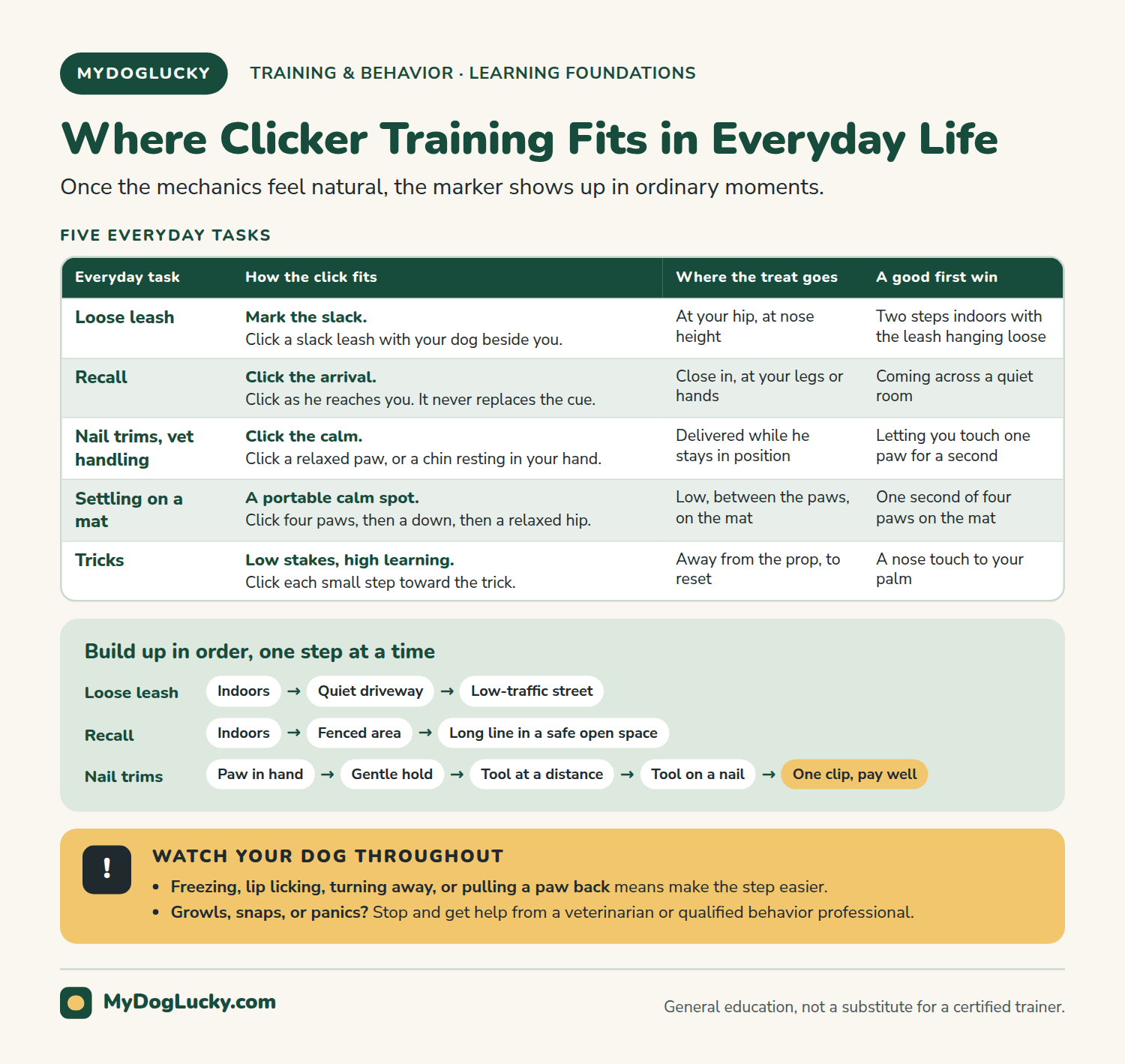
Once the mechanics feel natural, the marker shows up in ordinary moments. Here’s where it’s most often used, and where the click fits.
| Everyday task | What you click | Where the treat goes | A good first win |
|---|---|---|---|
| Loose leash | A slack leash with your dog beside you | At your hip, at nose height | Two steps indoors with the leash hanging loose |
| Recall | Arrival, after the recall cue | Close in, at your legs or hands | Coming across a quiet room |
| Nail trims and vet handling | A relaxed paw, or a chin resting in your hand | Delivered while he stays in position | Letting you touch one paw for a second |
| Settling on a mat | Four paws on the mat, then a down, then a relaxed hip | Low, between the paws, on the mat | One second of four paws on the mat |
| Tricks | Each small step toward the trick | Away from the prop, to reset | A nose touch to your palm |
Loose Leash: Mark the Slack
Loose leash walking is the everyday task most owners ask about first. The marker’s job is to tell your dog when the leash was slack and he was near you. Click that moment, and deliver the treat at your leg so he learns the good spot is beside you.
Start indoors, then move to a quiet driveway, then a low-traffic street. Skip leash pops and other corrections. The full plan for how to stop leash pulling covers gear, routes, and stop-and-go strategies.
Recall: Click the Arrival
Dog recall training deserves its own guide, but the marker’s role is simple. When your dog turns and comes on your cue, click as he reaches you, and pay well at your legs. Keep the recall cue separate from the click. The click never replaces it.
Practice indoors, then in a fenced area, then on a long line in a safe open space. Don’t test a new recall off leash in an unfenced area. Never punish a slow response, since that teaches your dog that coming to you has a cost.
Nail Trims and Vet Handling: Click the Calm
Cooperative care means teaching your dog to take part in handling. The idea is that your dog can say “I need a break” by moving away, and you respect it. The click marks each tiny step toward being comfortable.
A common progression for nails looks like this:
- Click and treat for a paw simply resting in your hand.
- Add a gentle hold, for one second, then two.
- Show the clippers or grinder from a distance, click, and treat.
- Touch a nail with the tool, without clipping. Click and treat.
- Work toward a single clip, then stop and pay well.
A chin rest is another handy foundation. Teach your dog to rest his chin in your palm or on a folded towel, click that stillness, and feed in position. It becomes a friendly starting pose for ear checks, eye checks, or exams.
Watch your dog throughout. Freezing, lip licking, turning away, or pulling a paw back means he needs you to make the step easier. If he growls, snaps, or panics, stop and get help from a veterinarian or qualified behavior professional. Ask your clinic whether short, no-pressure practice visits are possible. Our separate guide on how to trim dog nails covers technique.
Settling on a Mat: A Portable Calm Spot
Once your dog settles on the mat at home, bring it along. A rug or folded blanket can become his spot at a friend’s house, on a cafe patio, or in a waiting room. Move to a slightly busier place one step at a time, and follow the criteria rules above.
Tricks: Low Stakes, High Learning
Tricks look like party entertainment, but they’re excellent practice for your timing and for your dog’s learning. Spin, touch, bow, shake, and “go get your toy” all use the same shaping steps.
Choose tricks that suit your dog’s body. If he has stiff joints or mobility limits, skip repeated jumping or standing on his hind legs, and ask your veterinarian what’s comfortable. Low-impact tricks like nose touches and chin rests work at any age.
A Quick Note on Canine Sports
Agility, rally, obedience, nose work, and trick-dog programs often use marker signals, and many reward-based classes teach the mechanics covered here. You don’t need any of them for a happy life together. If you’re curious, watch a class first, ask which methods they use, and check with your veterinarian before high-impact activities like jumping.
Fading the Clicker Without Losing the Behavior
In clicker training, most trainers use the click while a behavior is being taught, then use it less as the behavior gets reliable. The 2017 Feng and colleagues paper reports that trainers typically stop using the click once behaviors are learned. That doesn’t mean rewards disappear. It means the marker’s teaching job is done.
A Gradual Fade
- Make sure it’s solid. The behavior happens on cue, in several places, at your set criteria.
- Click only the best ones. Keep paying for every repetition, but mark only the strongest few.
- Move to intermittent payment. Sometimes a treat, sometimes praise or a game, so your dog keeps trying without expecting a treat every time.
- Shift to real-life rewards. The door opens, the leash comes on, or a sniff break follows a good response.
- Keep the marker for new skills. It comes back out any time you teach something fresh or a behavior gets sloppy.
Don’t fade too quickly. If the behavior weakens, go back a step. Some households keep a marker for good, especially for precise tasks like nail-trim cooperation, and that’s fine.
Troubleshooting: When Clicker Sessions Go Sideways
Every clicker trainer runs into these.
Your Dog Stops Offering Anything
What you see: He stands still, wanders off, or stares at you.
Likely causes: The step is too hard, clicks are too far apart, the session ran too long, or the treats aren’t interesting enough. Sometimes he’s tired or uncomfortable.
Try this: Go back to an easier step, click more often, shorten the session, or upgrade the treat. If a normally willing dog suddenly refuses to sit or lie down, mention it to your veterinarian, since pain can hide in behavior.
Your Dog Gets Frantic
What you see: Jumping, barking, spinning, grabbing at the treat hand.
Likely causes: High excitement, very rich treats, fast-paced delivery, or long sessions.
Try this: Slow the pace. Deliver treats low and calmly, or scatter a treat on the floor for a sniff reset. Pick calmer behaviors like a mat settle. If the frantic energy comes with teeth, especially in a young dog, a plan for puppy biting is a better starting point than more clicking. If it escalates, stop and call a trainer.
Your Dog Mouths or Grabs at the Hand
What you see: Snatching, nipping fingers, mouthing the pouch.
Try this: Offer treats on a flat palm, or drop them on the floor or a plate. Hold still and pause until his mouth is soft before opening your hand. Don’t yank back, which can trigger more grabbing. If he stiffens or growls when you reach with a treat, stop and talk with a qualified professional.
You Clicked Late
What you see: Your dog repeats the wrong thing, like standing up right after a sit.
Try this: Film a session and watch it back, ideally in slow motion. Return to the timing drills. Click slightly earlier, and if you still land late, click while he’s in position and treat right away. The dog wasn’t wrong. The click was.
Common Clicker Training Mistakes
Some of these appear above. Here they are in one place, with what your dog may actually learn from each.
| Mistake | What your dog may learn | Fix |
|---|---|---|
| Clicking to get attention | Ignore you until the click comes | Click a moment he offers, like a natural glance |
| Treat before the click | Watch your hands | Click first, hand moves second |
| Skipping the charging | The click means nothing | A few short charge sessions, then test |
| Clicking without paying | The signal is unreliable | Every click gets a treat |
| Raising the bar too fast | This game is confusing | Change one thing at a time, and follow the scoreboard |
| Waiting to click “until it’s over” | Popping up is part of the behavior | Click during the behavior, then release |
Realistic Timelines Without Promises
The honest answer to “how long will clicker training take?” is that it varies. The AKC describes roughly 10 to 20 repetitions for a dog to grasp the link between marker and treat. Others need more, especially in busy places.
What speeds or slows progress: your dog’s earlier training, his interest in food or play, the quality of your timing and delivery, the environment, and his age, health, and comfort.
Measure in counts, not calendar days. “In the kitchen, eight of ten nose touches within two seconds” tells you far more than “week two.” A few numbers in a notebook show progress even when it feels flat.
Progress is uneven. A new location resets performance, and plateaus are common. Several short sessions a day usually beat one long one. If nothing improves after several weeks of consistent, well-timed practice, change the plan or ask a trainer to watch a session.
When to Get Professional Help
Clicker training is a friendly, low-risk skill for most dogs. It isn’t the right tool for everything. Bring in help if:
- Your dog is afraid of the marker, of handling, or of household sounds.
- He growls, snaps, or bites, guards treats or toys, or lunges at people or dogs on walks.
- He gets frantic and can’t settle even when you slow things down.
- He suddenly stops responding to things he knew, especially sits and downs.
- You’ve practiced consistently for several weeks and feel stuck.
Start With Your Veterinarian
Sudden behavior changes can reflect pain, hearing loss, vision changes, or illness. Your veterinarian can rule those out first. For some fear or anxiety problems, a veterinarian may also discuss behavior medication as one part of a broader plan. That’s a decision for you and your veterinary team, not something to try on your own.
Who Else Can Help
- Certified trainers: CPDT-KA (through CCPDT), or Karen Pryor Academy Certified Training Partners (KPA-CTP), for skills and everyday problems.
- Behavior consultants: IAABC-certified consultants, or CBCC-KA credentialed consultants, for behavior problems like fear and reactivity.
- Veterinary behaviorists (DACVB) and Certified Applied Animal Behaviorists (CAAB) for serious or complicated cases.
How to vet a trainer
Ask what methods and equipment they use, and what happens when a dog makes a mistake. Look for reward-based answers. Avoid anyone who relies on shock, prong, or choke collars, leash pops, intimidation, or “dominance” talk. The AVSAB’s humane training position statement recommends reward-based methods and says aversive methods are associated with aggression and anxiety-related behaviors.
A 10-Minute Practice Plan to Start Today
This is the smallest useful version. Use a portion of your dog’s regular meal as treats if you like, and stop early if he loses interest.
| Minutes | What to do | Success check |
|---|---|---|
| 0 to 2 | No dog yet. Run 20 reps of the ball-bounce drill. Cut the treats and set up your pouch. | 8 of 10 clicks land on the bounce |
| 2 to 4 | Charge the marker. Click, then treat, 10 to 20 times, in a quiet room. | Your dog looks for the treat when he hears the marker |
| 4 to 6 | Nose target. Present your palm, click the touch, and treat from the other hand. | Three touches in a row without a lure |
| 6 to 8 | Mat capture. Click any glance at the mat, then any step onto it. Treat on the mat. | All four paws on the mat once |
| 8 to 10 | Easy wins and wrap-up. Ask for two or three nose touches, pay generously, and end. | He leaves the session still interested |
After the session, write down one line: what he did, where, and how many tries. That’s your baseline.
The Next Few Days
- Day 2: A two-minute recharge in a different room, then more nose touches.
- Day 3: Mat settle, with a click for four paws on the mat.
- Day 4: Paw touch to a lid, in tiny steps.
- Day 5 to 7: Add the “touch” cue once he reliably goes to your hand, and practice in a second room.
Keep it flexible. Skip a day if life happens, and repeat a step that needs more time.
Frequently Asked Questions About Clicker Training
Do I need to buy a clicker?
No. A tongue click or a short word works as a marker. A clicker’s main advantage is a consistent sound. Choose whichever fits your hands and your dog’s ears.
Is clicker training better than just giving treats?
Research is mixed. In one 2016 study of 51 dogs, dogs learned a new task at a similar pace with a clicker, a spoken word, or food alone. Many trainers still value markers for precision and for marking behavior at a distance. Either way, reward-based methods are the standard the AVSAB recommends.
Can I clicker train an older dog?
Yes. Keep sessions short, choose low-impact behaviors, and ask your veterinarian about any stiffness, pain, or hearing changes.
Won’t all these treats make my dog gain weight?
They can if you don’t count them. Use tiny pieces, use part of the regular meal, and ask your veterinarian how many extra calories fit your dog’s day.
Will my dog only work if I have a clicker or treats?
Not if you fade the marker gradually and shift to varied rewards, praise, and real-life rewards. See the fading section above.
My dog isn’t food motivated. Can we still do this?
Yes. Try play, tug, a thrown toy, or a chance to sniff as the reward. If a normally food-loving dog suddenly turns down treats, mention it to your veterinarian.
Can I use a clicker to stop barking or jumping?
Not directly. A click marks a behavior you want, so you’d click quiet moments or four paws on the floor while managing the situation. Aggression, fear, or panic needs professional help, not a clicker.
Is a tongue click as good as a clicker?
It can be, if you make it the same every time. The Chiandetti study found dogs learned equally well whether the signal was a click or a word, in that one task.
Where to Start This Week
The easiest way into clicker training is one skill in one place. The nose touch in the kitchen is a fine choice. Run the ball-bounce drill first, then charge your marker, then collect your first ten clicks. Write down what happened.
The rest, from luring to cues to fading, builds from that small start. Your timing will improve, your dog will figure out the game, and at some point you’ll click a tiny moment nobody else in the room noticed. That’s the fun part. Enjoy it, and keep the treats small.
Sources
- American Veterinary Society of Animal Behavior. Position Statement on Humane Dog Training. 2021.
- Gibeault S. Clicker Training: Mark & Reward Dog Training Using Clickers. American Kennel Club. Updated July 19, 2023.
- Feng LC, Howell TJ, Bennett PC. How clicker training works: Comparing Reinforcing, Marking, and Bridging Hypotheses. Applied Animal Behaviour Science 2016;181:34–40.
- Chiandetti C, Avella S, Fongaro E, Cerri F. Can clicker training facilitate conditioning in dogs? Applied Animal Behaviour Science 2016;184:109–116.
- Feng LC, Howell TJ, Bennett PC. Comparing trainers’ reports of clicker use to the use of clickers in applied research studies: methodological differences may explain conflicting results. Pet Behaviour Science 2017.
- Certification Council for Professional Dog Trainers. Find a certified trainer.
- International Association of Animal Behavior Consultants. Find a behavior consultant.
- American College of Veterinary Behaviorists. Find a veterinary behaviorist.
- Karen Pryor Academy. Certified training partner program.
This article is general education for U.S. dog owners. It is not individualized training, behavior, or veterinary advice for your dog. Fear, growling, snapping, guarding, reactivity, or any bite should be evaluated by a certified trainer, Certified Applied Animal Behaviorist, or veterinary behaviorist, and sudden changes in behavior or in how your dog responds to sound are a reason to talk with your veterinarian first, because pain, illness, and hearing changes can alter how a dog learns and reacts.