

Somewhere around your dog’s seventh or eighth birthday, a bag of dog food starts showing up with the word “senior” printed across the front in a calmer, more reassuring font than the puppy bag ever used. It feels like a signal. Time to switch, right? Here’s the part that surprises a lot of owners searching for the best senior dog food: there’s no official senior life stage in pet food regulation at all. The word on the bag is marketing, not a nutrient standard, and that single fact changes how you should be reading the label.
This isn’t a takedown of senior formulas — plenty of them are reasonable, well-made foods. It’s a guide to what actually tends to change as a dog ages, which of those changes deserve a diet response and which don’t, and how to evaluate a “senior” bag on its actual nutrient content instead of its packaging. We’ll also walk through the protein question specifically, because the old advice to cut protein for older dogs has been largely overturned by more recent research, and that reversal hasn’t fully reached the pet food aisle yet.
One thing this article won’t do: hand you a fixed age or a single “best” bag and call it done. Your dog’s actual needs come from an exam and bloodwork, not a birthday. We’ll end with a framework for that vet conversation, because that’s where a real diet decision for an aging dog actually gets made.
What’s in this guide
- Why “senior” isn’t an official AAFCO life stage
- What actually changes as your dog ages
- The “seniors need less protein” myth, corrected
- How to evaluate a senior formula critically
- Body-condition monitoring: why weight loss can be the more urgent sign
- Joint-support ingredients: what the evidence actually shows
- Dental changes and feeding adjustments
- Why a wellness exam should drive the diet conversation
- A bloodwork-based framework for talking to your vet
- Common mistakes when choosing or switching senior food
- A realistic next step
- Frequently asked questions about senior dog food
- Sources
Why “Senior” Isn’t an Official AAFCO Life Stage
Most dog owners assume “senior dog food” is a regulated category, the same way “puppy food” seems to be. It isn’t, and knowing that changes how much weight you should put on the word itself.
The Life Stages AAFCO Actually Recognizes
The Association of American Feed Control Officials, the body whose nutrient profiles underpin nearly every “complete and balanced” claim on a U.S. dog food bag, recognizes exactly four life stages: gestation/lactation, growth, maintenance, and all life stages. That’s it. There’s no fifth category for senior, mature, or geriatric dogs, and the FDA’s Center for Veterinary Medicine confirms the same two working profiles on its own consumer guidance — growth and reproduction, and adult maintenance. A ten-year-old Labrador and a two-year-old Labrador, nutritionally speaking under AAFCO’s framework, are both just “adult.”
What “Senior” on the Bag Really Means
So what is a manufacturer doing when they print “senior” on a bag? Formulating it however they choose, within the adult maintenance nutrient minimums, and marketing it toward an age group. Some senior formulas run lower in calories. Some run higher in protein. Some add joint-support ingredients; others don’t. Because there’s no regulated senior profile to meet, two bags can both say “senior” and differ meaningfully in fat content, calorie density, and protein level. A 2011 nutrient-composition review from Tufts’ Cummings School Clinical Nutrition Service found exactly this kind of wide variation across commercial senior diets — which is a long-standing finding, not a new one, and it’s still true of the category today.
Why This Surprises So Many Owners
It’s a reasonable assumption to make. Puppy food genuinely is formulated differently, built around AAFCO’s growth profile with defined minimums for calcium, phosphorus, and calories that matter enormously for a developing skeleton. Senior food doesn’t have an equivalent regulatory backbone. That gap matters practically: it means the word “senior” tells you almost nothing on its own about whether a particular bag fits your particular dog. You have to look past the label to the nutrient panel and ingredient list, which is exactly what the rest of this guide walks through.
What Actually Changes As Your Dog Ages
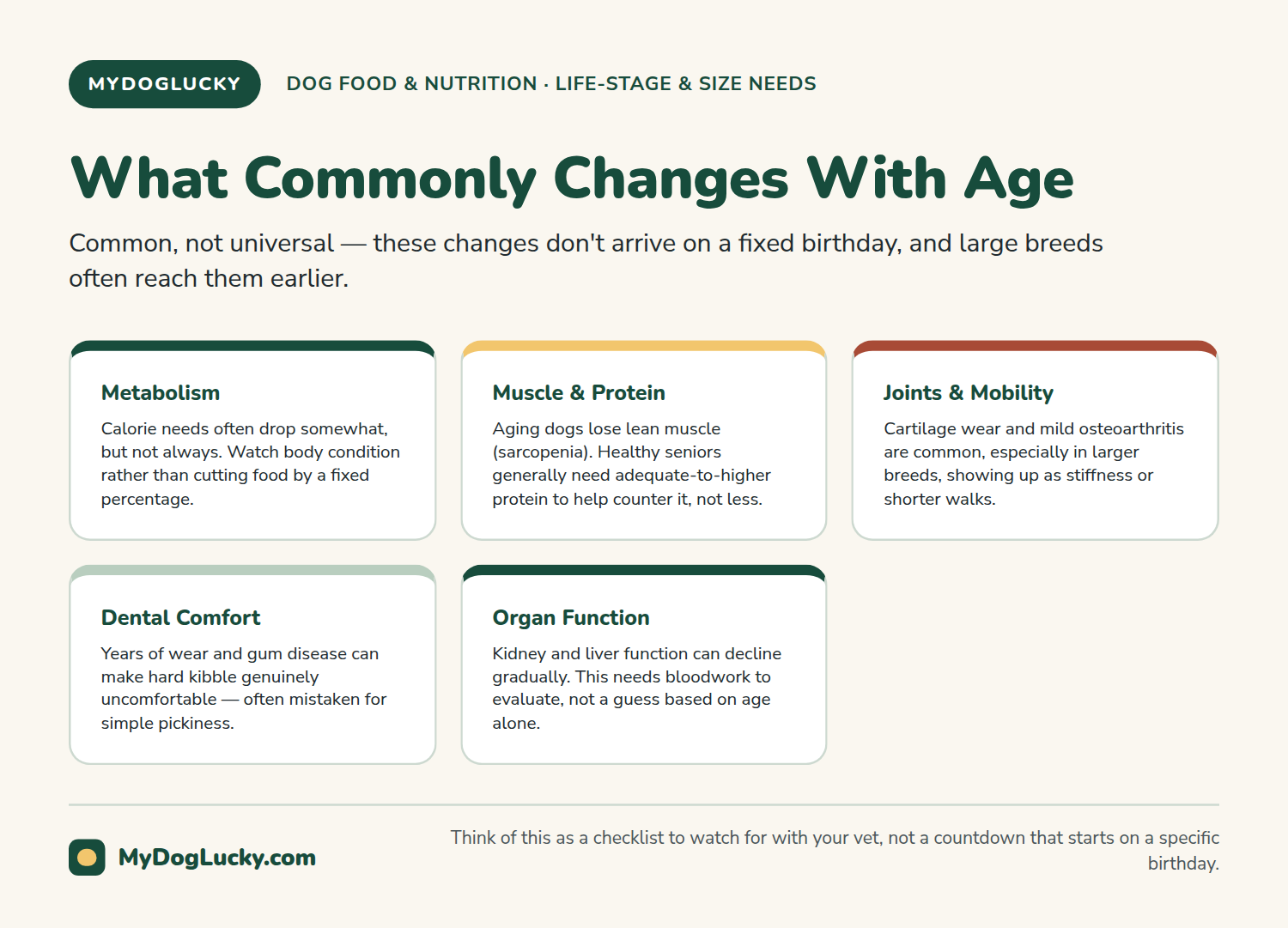
Even without a regulated senior category, real physiological changes do tend to show up as dogs get older. The word “tend” is doing real work in that sentence — these changes are common, not universal, and they don’t arrive on a fixed schedule. Large and giant breeds often reach these changes earlier, sometimes by five or six years old, while small breeds may not show them until ten or eleven.
Metabolism and Calorie Needs: Often Lower, Not Always
Many senior dogs burn somewhat fewer calories at rest than they did as younger adults, and daily energy requirements can decrease by roughly a tenth or more in some aging dogs, according to VCA Animal Hospitals’ nutrition guidance. Less activity, some loss of lean muscle, and slower metabolic rate all contribute. But “many” isn’t “all.” Some senior dogs maintain their activity level and appetite well into their older years and need essentially the same calorie intake they always did.
A few, especially very old dogs, actually need more calories because they’re losing weight they shouldn’t be losing. This is why a flat rule like “cut back 20% once your dog turns seven” doesn’t hold up as a universal instruction — it’s a starting hypothesis to test against your own dog’s body condition, not a fact to apply blindly.
Muscle Mass: The Real Reason Protein Matters More, Not Less
This is the section that contradicts what a lot of owners have heard for years, so we’ll flag it here and go deeper in the next major section. Aging dogs are prone to losing lean muscle mass, a process researchers call sarcopenia, and adequate — often higher — protein intake is one of the tools that helps counter it, not something to restrict. We’ll walk through the evidence and the important exception (kidney disease) in detail below.
Joints and Mobility
Cartilage wear, mild osteoarthritis, and general stiffness are common as dogs age, particularly in larger breeds and dogs with a history of joint injury. This shows up as slower rising from rest, reluctance on stairs, or a shorter comfortable walk distance before your dog wants to head home. It’s a mobility and orthopedic issue as much as a nutrition one, and we’ll cover what the evidence actually says about joint-support ingredients in food later in this guide, because the claims on some bags run ahead of the science.
Dental Changes
Years of chewing, plus a cumulative buildup of tartar and periodontal disease if dental care has been inconsistent, can leave an older dog with fewer comfortable teeth, more sensitive gums, or outright pain when biting down on hard kibble. This is one of the more overlooked reasons a senior dog “goes off” dry food — not a change in taste preference, but genuine discomfort chewing it. We’ll cover practical texture adjustments in a dedicated section below.
Organ Function: Why This Needs a Vet, Not a Guess
Kidney and liver function can decline gradually with age in some dogs, and this is the single area in this whole guide where we want to be most careful about scope. Conversations about protein and phosphorus levels relative to kidney health are legitimate and important — but they’re only meaningful in the context of actual bloodwork showing how a specific dog’s kidneys are functioning. Adjusting protein or phosphorus on your own, based on age alone and without lab values, isn’t a safe substitute for that conversation. We’ll return to this distinction with more detail in the protein-myth section, because it’s the part most likely to get oversimplified in casual advice.
The “Seniors Need Less Protein” Myth, Corrected
If you take away one thing from this article, make it this one, because it’s the piece of outdated advice still circulating the most confidently. Healthy senior dogs generally do not need less protein than younger adults. In many cases, the more useful conversation is about making sure they’re getting enough.
Where the Myth Came From
The idea that older dogs should eat less protein traces back to concern about kidney health — the reasoning being that if protein metabolism puts some load on the kidneys, reducing protein preemptively might protect aging kidneys before any problem showed up. It was a plausible-sounding hypothesis decades ago, and it filtered into a lot of consumer-facing pet food guidance and casual advice that’s still repeated today. The trouble is that later research didn’t bear it out for healthy dogs.
What Current Research Actually Shows
A peer-reviewed 2026 review in the journal Animals, examining protein requirements across canine life stages, states it plainly: protein restriction is not necessary for healthy elderly dogs, and the older rationale for restricting it to protect kidney function doesn’t hold up under closer study.
The same review cites research suggesting older dogs may need meaningfully more protein — in one commonly cited estimate, up to roughly 50% more than a younger adult dog — specifically to help maintain lean muscle mass as sarcopenia sets in. The American Kennel Club’s nutrition guidance echoes the same shift, describing the “less protein for seniors” idea as an outdated belief and pointing to muscle-mass preservation as the reason adequate-to-higher protein tends to matter more, not less, in a dog’s later years.
There’s a practical reason behind the number, too. Many senior dogs eat somewhat less overall as their calorie needs drop or their appetite softens. When total food intake goes down, the proportion of protein relative to total calories needs to go up just to deliver the same absolute amount of protein — otherwise a smaller portion of an unchanged-protein food quietly under-delivers the amino acids an aging body needs to hold onto muscle.
The Healthy-Senior vs. Kidney-Disease Distinction (Read This Part Carefully)
Here’s where nuance matters and where this article draws a firm line. Everything above applies to healthy senior dogs with normally functioning kidneys. Dogs diagnosed with chronic kidney disease are a genuinely different situation, and in that specific context, a veterinarian may recommend a therapeutic diet with adjusted protein and phosphorus levels as part of managing the disease. That’s an individualized medical decision made from bloodwork and a diagnosis, not a general rule to apply preemptively to every aging dog “just in case.”
This is precisely the kind of decision this article can’t make for you, and shouldn’t try to. If your dog has diagnosed kidney disease, or if bloodwork shows early kidney changes, that conversation belongs with your veterinarian, working from your dog’s actual lab values — not from a general internet rule about protein and age. Restricting protein in a healthy senior dog based on age alone, without a kidney diagnosis, risks working against muscle maintenance for no real benefit.
What “Enough Protein” Looks Like in Practice
For a healthy adult or senior dog, AAFCO’s adult maintenance minimum sits at 18% protein on a dry-matter basis, and multiple veterinary sources note that healthy senior dogs often do well with protein levels above that minimum — commonly cited ranges run from the high-20s to low-30s percent dry matter, though the right number for your dog depends on body condition, kidney function, and activity level, which is exactly the kind of thing worth reviewing with your vet rather than targeting a number in isolation. What matters more than hitting an exact percentage is two things: protein quality (how digestible and complete the amino acid profile is) and making sure total protein intake doesn’t quietly drop just because portion sizes shrink.
How to Evaluate a Senior Formula Critically
Once you understand that “senior” is a marketing category, not a regulated one, the practical question becomes: what should you actually look at on the bag? Here’s where the evaluation moves from the front label to the nutrition panel.
Why There’s No Single “Best Senior Dog Food”
Owners searching for the best senior dog food are often looking for one bag that fits every older dog. It doesn’t exist, and that’s not a dodge — it’s a direct consequence of everything covered above. A lean, active ten-year-old terrier with healthy kidneys and no joint pain has different needs than a heavier, more sedentary twelve-year-old retriever with early osteoarthritis. “Best” depends on your specific dog’s body condition, activity level, dental comfort, and any diagnosed health conditions, which is exactly why this guide leans on evaluation criteria instead of a single recommendation.
Read Past the Word “Senior” — What to Check Instead
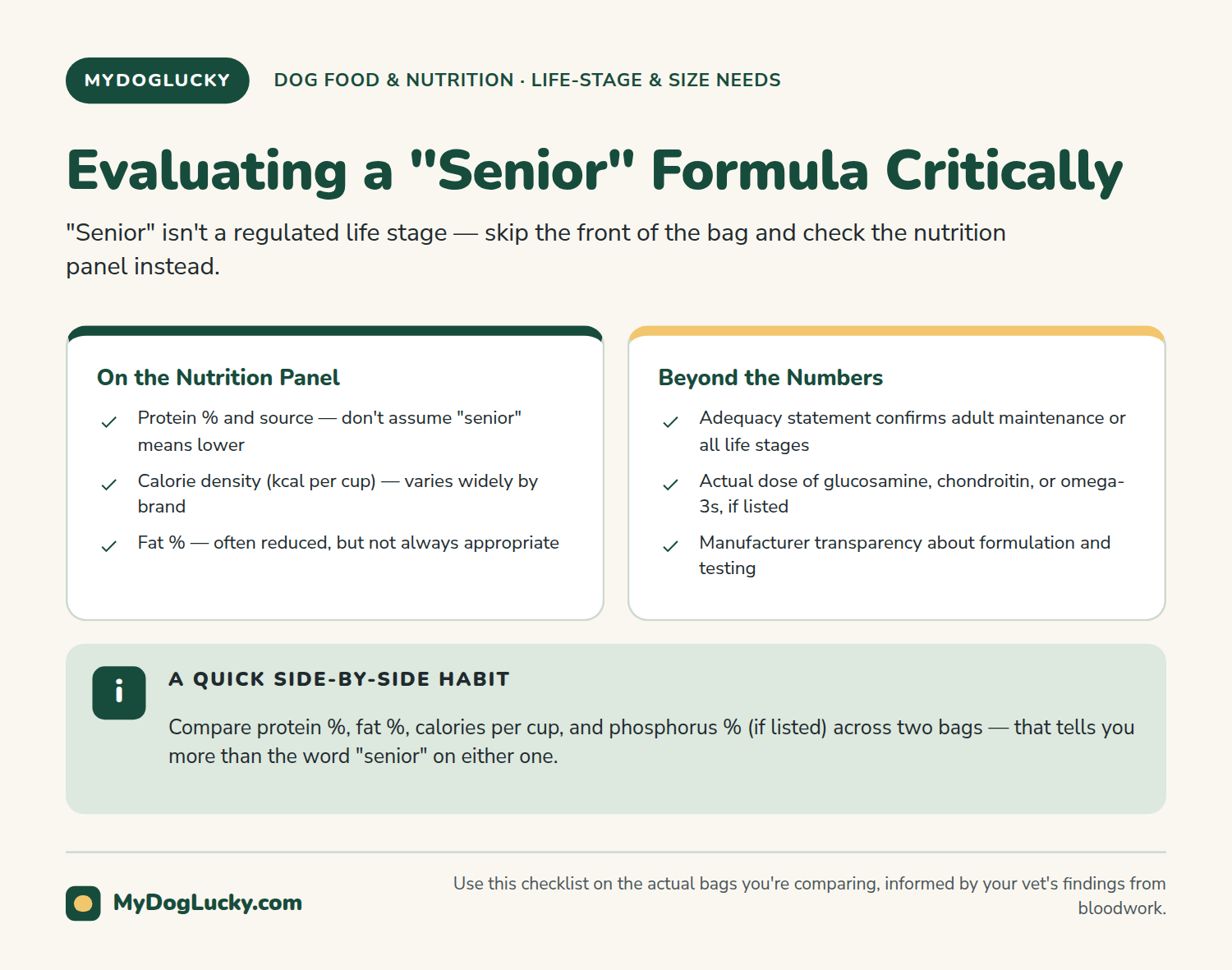
Skip the front of the bag and go straight to the guaranteed analysis panel and the ingredient list. A few things are worth checking every time:
- Protein percentage and source. Given the myth correction above, don’t assume “senior” means lower protein — check the actual number, and favor named animal protein sources near the top of the ingredient list.
- Calorie density (kcal per cup or per can). This varies more between senior formulas than most owners expect, and it matters more than the word “senior” for a dog who needs to lose or maintain weight.
- Fat percentage. Often reduced in senior formulas to help manage calorie intake for less active dogs, but not universally, and not always appropriately for a lean, active senior.
- The nutritional adequacy statement. Confirm it’s formulated for “adult maintenance” or “all life stages” and passed either AAFCO’s nutrient profile method or an actual feeding trial — this tells you more about baseline quality control than the word “senior” ever will.
- Added joint-support ingredients, if present. Note the actual dose of glucosamine, chondroitin, or omega-3s if listed, since amounts vary widely and some are present at levels too low to matter. More on this below.
- Manufacturer transparency. Does the company publish contact information for a nutritionist, list a manufacturing location, or answer specific nutrient questions? That’s a reasonable proxy for quality control, per guidance many veterinary nutritionists point owners toward.
A quick side-by-side habit worth building
Next time you’re comparing two senior bags, put them side by side and check just four numbers: protein %, fat %, calories per cup, and phosphorus % (if listed). That alone tells you more about fit for your dog than the word “senior” on either bag, and it takes about two minutes once you know where to look.
How Senior Formulas Typically Differ From Standard Adult Maintenance
| What to check | Common approach in “senior” formulas | Why it varies so much |
|---|---|---|
| Calories per cup | Often somewhat lower, to suit reduced activity | No regulated target; some senior dogs need standard or higher calories |
| Protein % | Ranges widely — some lower, many at or above adult maintenance | Reflects the still-shifting understanding of senior protein needs |
| Fat % | Frequently reduced to manage weight | Not appropriate for every senior, especially lean or underweight dogs |
| Fiber | Sometimes increased for digestive regularity and satiety | Helpful for some dogs, unnecessary for others |
| Joint-support additions | Glucosamine, chondroitin, or omega-3s at varying doses | No standard minimum dose required to use the claim |
A Note on Sensitive Stomachs and Other Layered Needs
Some senior dogs are also managing a sensitive stomach, a food allergy, or another condition entirely separate from age. If your dog needs dog food for sensitive stomachs on top of these senior-specific considerations, that’s a real layering of criteria worth bringing to your vet together, rather than solving each piece separately with a different bag every few months.
Body-Condition Monitoring: Why Weight Loss Can Be the More Urgent Sign
Most nutrition advice for dogs, at any age, focuses on preventing weight gain. In senior dogs specifically, unexplained weight loss deserves at least as much attention, and often more urgency, than weight gain does.
Body Condition Score vs. the Bathroom Scale
A number on a scale tells you less than it seems to. Body condition scoring — a hands-on, visual assessment of fat cover over the ribs, waist, and abdomen, typically scored on a 9-point scale — is the tool veterinary nutrition organizations including WSAVA’s Global Nutrition Committee recommend using at every visit, precisely because it accounts for a dog’s frame and muscling in a way a single weight number can’t.
You can do a rough version of this at home between vet visits: can you feel ribs easily under a thin layer of fat, is there a visible waist from above, and does the abdomen tuck up behind the ribs when viewed from the side? Those three checks, done consistently, catch gradual change faster than most owners expect.
Muscle Condition Score: A Separate, Often-Missed Measurement
Here’s a distinction that surprises a lot of owners: a dog can maintain a “normal” body weight while quietly losing muscle mass, especially over months rather than weeks. WSAVA’s toolkit includes a separate muscle condition score for exactly this reason, evaluating the muscle over the skull, spine, and hips independently of fat cover. A senior dog who feels bonier along the spine or more prominent at the hip bones than a year ago, even at a stable weight, may be losing lean mass — the same sarcopenia process covered in the protein section above — and that’s worth flagging to your vet as its own data point, separate from the number on the scale.
When a Thin Senior Dog Needs a Workup, Not Just More Food
It’s tempting to respond to a thinning senior dog by simply offering more food, a richer topper, or a higher-calorie bag. Sometimes that’s genuinely the right move. But unexplained or progressive weight loss in an older dog can also signal dental pain making eating uncomfortable, an underlying illness affecting appetite or absorption, or a metabolic change that needs diagnosis before it needs more calories. Adding food without understanding why the weight is dropping can mask a problem instead of solving it, and it can delay the point at which a treatable condition gets caught early. This is one of the clearer “talk to your vet before you improvise” situations in senior dog care.
Worth a call to your vet, not just more food at home
- Noticeable weight loss over a few weeks to a couple of months, especially without a diet change.
- Ribs, spine, or hip bones becoming easier to feel or see than they were.
- Weight loss paired with reduced appetite, increased thirst, vomiting, or lethargy.
- A senior dog who’s always eaten well suddenly eating less or more slowly.
None of these automatically mean something serious. They mean the change is worth describing to your veterinarian, with specifics and, if possible, a rough timeline, rather than waiting to see if it resolves on its own.
When a Heavier Senior Dog Needs a Plan, Not Shame
The flip side matters too. Extra weight puts additional load on aging joints and is linked with a range of other health risks, and it’s worth addressing — calmly, without moral judgment attached to how the weight got there. A gradual, vet-guided calorie adjustment, paired with joint-friendly activity, tends to work better and hold longer than a sudden diet overhaul. Weight management in an older dog is also a good moment to double-check that any reduction in calories isn’t accidentally cutting protein intake along with it — the two don’t have to move together, and a higher-protein, moderate-calorie food is often a better fit than simply feeding less of the same food.
How Often to Reassess Body and Muscle Condition
A quick hands-on check every month or two is enough to catch gradual change in most senior dogs, and it takes less time than it sounds like. Run your hands along the ribs, feel for the waist from above, and note whether the spine or hip bones feel more prominent than last time. Write it down somewhere, even a note on your phone with the date, because month-to-month memory is unreliable and a slow drift is exactly the kind of change that’s easy to miss in person but obvious in hindsight. Bring anything you notice to your dog’s next wellness visit rather than waiting for the annual exam if the change seems to be moving quickly.
Joint-Support Ingredients: What the Evidence Actually Shows
Glucosamine, chondroitin, and omega-3 fatty acids show up on a lot of senior dog food bags, usually next to a picture of a dog bounding happily across a lawn. The evidence behind these ingredients is real but genuinely mixed, and it’s worth understanding honestly rather than either dismissing them entirely or expecting more than they can deliver.
Omega-3 Fatty Acids: The More Consistent Evidence
Of the common joint-support ingredients, omega-3 fatty acids (specifically EPA and DHA, most often from fish oil) have the more consistent research support for dogs with osteoarthritis. A multicenter veterinary practice study published in the Journal of the American Veterinary Medical Association found measurable improvement in weight-bearing and mobility in osteoarthritic dogs fed a diet supplemented with omega-3 fatty acids. More recent clinical trials looking at marine-derived fatty acid compounds specifically have found comparable pain-relief benefits to standard anti-inflammatory medication in some dogs with hip osteoarthritis over several weeks. That’s a meaningful result, though it comes with the usual caveats of veterinary research — sample sizes tend to be modest, and individual response varies.
Glucosamine and Chondroitin: Mixed and Limited Evidence
Glucosamine and chondroitin are the most commonly added joint-support ingredients in commercial dog food, and the evidence for them is considerably less settled than the marketing suggests. A published review of glucosamine and chondroitin use in canine osteoarthritis describes the overall evidence as mixed, with some trials showing modest benefit and others showing no meaningful difference from placebo.
One randomized, placebo-controlled trial comparing glucosamine/chondroitin, marine-based fatty acid compounds, and a standard anti-inflammatory medication for dogs with hip osteoarthritis found that the marine fatty acid compounds produced significant improvement, while the glucosamine/chondroitin group did not separate meaningfully from placebo over the six-week study period. That doesn’t mean glucosamine and chondroitin never help any dog — individual response varies, and some owners and vets do report a difference — but it does mean the evidence doesn’t support calling them a reliable fix.
What This Means for Choosing a Food or Supplement
Given this evidence picture, a few practical conclusions follow. First, don’t treat “contains glucosamine and chondroitin” on a bag as a guarantee of joint benefit — and be skeptical of doses baked into kibble, which are often too low to match the amounts used in the clinical trials showing any benefit at all. Second, omega-3s have somewhat firmer support, but food-level doses may still fall short of what’s used in research; if joint support is a genuine goal, that’s worth discussing with your vet as a dosed supplement decision rather than assuming the food alone covers it.
Third, and most importantly, joint-support ingredients are a complement to appropriate veterinary management of osteoarthritis — not a substitute for pain control, weight management, and mobility support your vet can prescribe or recommend. A dog who’s visibly stiff or slow needs a veterinary evaluation of pain and joint health, not just a bag with the right ingredient list.
Other Ingredients You’ll See Marketed for Aging Dogs
Senior bags sometimes add antioxidants (vitamin E, vitamin C), medium-chain triglycerides, or other ingredients marketed toward cognitive support or general “healthy aging.” The honest summary is that the research behind most of these, in commercial food-level amounts, is thinner than the research on omega-3s for joints — promising in some smaller studies, not settled enough to call any of it a proven benefit at the doses typically found in a bag of kibble.
That doesn’t make them harmful additions, and a reasonably formulated senior food with a few of these extras isn’t a bad choice. It just means none of them should be the deciding factor in choosing a food, ahead of the more basic checks — protein, calories, fat, and a valid nutritional adequacy statement — covered earlier in this guide.
Dental Changes and Feeding Adjustments
Dental comfort is one of the most under-discussed reasons a senior dog’s eating habits change, and it’s often mistaken for pickiness or a change in taste preference.
Common Dental Changes in Older Dogs
Years of chewing wear down enamel, and periodontal disease — inflammation and infection around the teeth and gums — becomes more common with age, especially without consistent dental care throughout a dog’s life. Some senior dogs lose teeth to disease or extraction. Others develop sensitive, receding gums that make hard kibble genuinely uncomfortable to bite down on, even with a full set of teeth still in place. A dog who suddenly eats more slowly, drops kibble from his mouth, chews on one side, or turns away from a previously loved dry food is often telling you something about his mouth, not his palate.
Softening Kibble, Wet Food, and Texture Options
A few practical adjustments help most dogs with dental discomfort continue eating comfortably:
- Adding warm water to kibble and letting it sit for several minutes softens the texture significantly, at no cost and with no food switch required.
- Transitioning some or all meals to wet food, which is naturally soft and often more aromatic — useful both for dental comfort and for a senior dog whose appetite or sense of smell has declined.
- Smaller, more frequent meals can be easier to manage than one or two large meals for a dog with limited chewing comfort.
- Blending kibble with water into a slurry works for dogs with more significant dental limitations, though it’s worth checking with your vet that the resulting consistency still delivers adequate calories per meal.
Signs a Dental Problem Needs a Vet Visit, Not a Food Swap
Softening food is a reasonable comfort measure, but it’s not a substitute for treating the underlying dental disease if that’s what’s driving the discomfort. Bad breath, visible tartar, red or bleeding gums, pawing at the mouth, or a clear preference for one side of the mouth when chewing are reasons to schedule a dental evaluation rather than simply adjusting texture indefinitely. Untreated dental disease is painful and has been linked to broader health effects beyond the mouth, so treating it as a food-texture problem alone tends to under-address what’s actually going on.
Why a Wellness Exam Should Drive the Diet Conversation, Not a Birthday
Everything covered so far points toward the same conclusion: the right time to reassess your dog’s diet isn’t a specific age. It’s when an exam and bloodwork tell you something concrete about what’s actually changing in your dog’s body.
The Mid-Life Check-In
Many veterinarians recommend a more thorough wellness conversation starting somewhere in a dog’s middle years — often earlier for large and giant breeds — well before “senior” feels like the obvious label. This isn’t about switching foods preemptively. It’s about establishing a baseline: what does your dog’s bloodwork look like now, while healthy, so that any future change has something concrete to compare against? A baseline taken at six or seven years old is far more useful for catching a subtle shift at ten than trying to interpret a single set of senior-years labs with nothing to compare them to.
What a Senior Wellness Exam Typically Includes
According to VCA Animal Hospitals’ guidance on senior wellness testing, a thorough senior workup typically includes a complete blood count, a biochemistry profile (which screens for kidney and liver function, blood sugar, and other markers), a urinalysis (which adds further insight into kidney function and can catch early urinary issues), and often a thyroid panel, particularly if weight or energy changes have shown up. Many practices recommend this kind of testing annually for senior dogs, sometimes more often if a previous result flagged something to monitor.
Turning Bloodwork Into a Feeding Conversation, Not a Guess
This is where the diet conversation should actually start. Normal kidney values on a senior dog’s bloodwork are a good reason to continue supporting adequate protein for muscle maintenance, not a reason to restrict it “just in case.” Early kidney changes are a reason to talk with your vet about what adjustment, if any, makes sense for your specific dog’s specific numbers — a conversation that has almost nothing to do with age alone and everything to do with what the labs actually show. Unexplained weight change, a new thyroid finding, or a change in blood sugar markers should each drive their own specific dietary conversation, grounded in that result, rather than a generic switch to “the senior bag.”
A Bloodwork-Based Framework for Talking to Your Vet About Senior Food
It helps to walk into that conversation with a few concrete questions rather than a vague sense that “it’s probably time for senior food.” Here’s a starting framework built around what your vet’s findings actually mean for feeding.
| What your vet’s exam shows | A useful question to bring to that conversation |
|---|---|
| Normal kidney values, healthy body and muscle condition | Is my current food’s protein level still appropriate, and should I watch anything specific as my dog ages further? |
| Early kidney changes on bloodwork | Based on these specific numbers, do you recommend any dietary adjustment now, or just closer monitoring? |
| Gradual weight loss or declining muscle condition score | Should we investigate an underlying cause before increasing calories, or is a diet adjustment the right first step? |
| Weight gain, reduced activity | What’s a realistic calorie target, and how do we protect protein intake while reducing total calories? |
| New stiffness or reduced mobility | Would a dosed omega-3 supplement or pain-management plan make more sense than switching to a joint-support food? |
| Dental disease found on exam | Once this is treated, what texture or feeding adjustment makes sense during recovery? |
A rough rule of thumb for timing this conversation
Bring up diet specifically at your dog’s next wellness visit once he’s in his mid-to-later years, rather than waiting for a birthday or a bag to run out. If your vet already runs annual bloodwork, that visit is the natural moment — you’ll have real numbers to work from instead of guessing.
Common Mistakes When Choosing or Switching Senior Food
Switching Foods Based on Age Alone
A birthday isn’t a diagnosis. Switching to a senior formula the week your dog turns seven, without any change in body condition, energy, or bloodwork, treats a marketing category as if it were a medical milestone. It’s not wrong to make the switch eventually — it’s the timing and the reasoning worth reconsidering.
Cutting Protein Preemptively “to Protect the Kidneys”
Covered at length above, and worth repeating here because it’s still common advice: restricting protein in a healthy senior dog with normal kidney values isn’t supported by current research, and it can work against muscle maintenance. Save protein restriction for an actual kidney diagnosis, guided by your vet.
Adding Food to a Thinning Dog Without Asking Why
More calories can mask, rather than solve, a weight-loss problem that has a specific underlying cause. Investigate before you increase portions in a senior dog who’s losing weight unexpectedly.
Assuming Glucosamine on the Bag Means Meaningful Joint Support
Doses baked into kibble are often lower than what clinical trials use, and the evidence for glucosamine and chondroitin specifically is mixed even at adequate doses. Treat it as a possible complement, not a proven fix, and loop in your vet if joint pain is a real concern.
Ignoring Dental Discomfort as “Just Getting Old”
A senior dog eating less or more slowly is often in dental discomfort, not simply losing interest in food. That’s a reason for a dental exam, not just a softer kibble and a shrug.
Chasing a “Best Senior Dog Food” List Instead of Your Dog’s Actual Numbers
Generic rankings can’t account for your specific dog’s body condition, kidney function, dental comfort, or activity level. Use this guide’s evaluation criteria on the actual bags you’re considering, informed by your vet’s findings, rather than outsourcing the decision to a list built for no dog in particular.
Making a Switch and Never Checking Back In
Switching foods is often treated as a one-time decision — pick a bag, move on. For a senior dog, it’s worth treating more like the start of a small experiment. Note the date you switched, watch body condition and stool quality over the following few weeks, and mention the change at the next wellness visit so it shows up in the bigger picture alongside bloodwork, rather than getting lost as a detail nobody thought to bring up.
A Realistic Next Step
If you came here looking for one bag to buy, here’s the more useful takeaway: there isn’t a single best senior dog food, but there is a reliable process for finding the right one for your specific dog. Start with your vet, not the pet store aisle. Bring up diet at your dog’s next wellness visit, especially if it’s been a while since bloodwork. Ask what your dog’s kidney values, body condition, and muscle condition actually show, and let those numbers — not the word “senior” on a bag — guide whether protein, calories, or texture need to change.
From there, use the evaluation checklist above on whatever foods you’re actually comparing: protein percentage and source, calorie density, fat level, and any joint-support additions, checked against your dog’s real needs rather than the marketing on the front of the bag. If joint pain, dental disease, or unexplained weight change show up along the way, treat those as their own conversations with your vet, not problems a food switch alone will solve. That’s a slower process than grabbing whatever bag says “senior” in reassuring script. It’s also the one that actually fits the dog you have.
None of this needs to happen all at once. Pick the next wellness visit on your calendar, jot down two or three questions from the framework above, and bring the actual bag you’re feeding so your vet can look at real numbers instead of a description from memory. Most of this guide is really one idea repeated from a few different angles: let your specific dog’s body, bloodwork, and mouth drive the decision, and treat the word “senior” on a bag as a starting point for questions, not an answer in itself.
Frequently Asked Questions About Senior Dog Food
What age is a dog considered a “senior” for feeding purposes?
There’s no single official age, and no regulated definition ties feeding decisions to a birthday. Large and giant breeds are often considered senior starting around five to eight years old; small breeds often not until ten or eleven. Even then, the more useful marker is a wellness exam and bloodwork showing an actual change, not the age itself.
Do senior dogs really need less protein?
For healthy senior dogs, generally no — current research points the other way, toward adequate or higher protein to help maintain muscle mass as dogs age. The exception is a dog diagnosed with kidney disease, where a vet may recommend a specific, individualized protein adjustment based on bloodwork. That’s a different situation from healthy aging, and it shouldn’t be applied to every older dog by default.
Is “senior dog food” regulated by AAFCO the way puppy food is?
No. AAFCO recognizes four life stages — gestation/lactation, growth, maintenance, and all life stages — and “senior” isn’t one of them. A senior-labeled bag is formulated within the adult maintenance profile and marketed toward an age group, which means the actual nutrient content varies considerably between brands.
Should I switch my dog to senior food at a specific age?
Not automatically. A better approach is to bring diet up at your dog’s next wellness visit once he’s in his middle-to-later years, and let any actual findings — weight change, muscle condition, bloodwork, dental status — guide whether and how to adjust his food, rather than switching based on age alone.
My senior dog is losing weight. Should I just feed more?
Not without figuring out why first. Unexplained weight loss in a senior dog can reflect dental pain, an underlying illness, or a metabolic change that needs diagnosis before it needs more calories. Bring it up with your vet, ideally with a rough timeline of when you noticed the change.
Do glucosamine and chondroitin in dog food actually help with joint pain?
The evidence is mixed. Some studies show modest benefit; others show no meaningful difference from placebo, especially at the lower doses typically found in commercial kibble. Omega-3 fatty acids have somewhat more consistent research support for joint comfort in dogs with osteoarthritis. Neither should replace a veterinary evaluation if your dog is showing real signs of joint pain.
My older dog won’t eat dry kibble anymore. What’s going on?
Dental discomfort is a common and often overlooked cause. Years of wear, gum sensitivity, or periodontal disease can make hard kibble genuinely painful to chew, even with most teeth still present. Try softening kibble with warm water or transitioning to wet food, and schedule a dental exam if you notice bad breath, tartar, or reluctance to chew on one side.
How often should my senior dog have bloodwork done?
Many veterinary practices recommend annual bloodwork for senior dogs, sometimes more frequently if a previous result flagged something worth monitoring. That bloodwork is also the most useful input for deciding whether your dog’s diet needs any adjustment, which is why the two conversations tend to happen at the same visit.
Is it true that all “senior” dog foods have lower calories?
No. Many do run lower in calories to suit reduced activity, but it’s not universal, and calorie density varies significantly between brands. Check the calories-per-cup figure directly rather than assuming any senior-labeled bag automatically fits a lower-calorie need.
What’s the difference between body condition and muscle condition in an older dog?
Body condition reflects fat cover — whether your dog is underweight, ideal, or overweight. Muscle condition reflects lean muscle mass over the spine, skull, and hips, and it can decline even when body weight and fat cover look stable. Both are worth tracking separately in a senior dog, since muscle loss can happen quietly.
Can I just add a joint supplement instead of switching to a “joint support” senior food?
Often, yes, and it may give you more control over the actual dose than relying on whatever amount is baked into a bag of kibble. Talk with your vet about a specific, appropriately dosed supplement if joint support is the goal, rather than assuming a food with glucosamine listed in the ingredients delivers a meaningful amount.
My vet hasn’t mentioned changing my senior dog’s food. Should I bring it up myself?
Yes, especially if it’s been a while since your dog’s last full wellness exam and bloodwork, or if you’ve noticed any change in weight, energy, appetite, or mobility. Vets appreciate specific observations — when you noticed a change, how it’s progressed — more than a general “should I switch foods” question with no context behind it.
How much should I feed my senior dog once we’ve settled on a food?
Start with the feeding guide on the bag as a rough starting point, then adjust based on your dog’s actual body condition rather than following it exactly — those charts are averages, and your dog is an individual. The broader question of how much should I feed my dog, at any life stage, is really answered by watching body condition over time and adjusting portions accordingly, with your vet’s input if weight is trending the wrong direction.
Is wet food better than dry kibble for senior dogs?
Neither is universally better. Wet food tends to be easier on sensitive teeth and gums, often more palatable for a dog with a reduced appetite, and higher in moisture, which can help dogs who don’t drink much on their own. Dry kibble is typically more calorie-dense per volume and less expensive per calorie. The right choice depends on your dog’s dental comfort, weight goals, and budget rather than one format being categorically superior.
Can diet alone fix my senior dog’s joint pain?
Unlikely on its own. Diet and joint-support ingredients can be a helpful part of a broader plan, but visible joint pain in a dog usually calls for a full veterinary evaluation that may include pain management, weight optimization, physical therapy, or medication — not a food change as the sole intervention. Think of diet as one supporting piece, not the whole plan.
My dog is a healthy weight but seems to be losing muscle. Is that still worth mentioning to my vet?
Yes. A stable weight can hide gradual muscle loss, since fat and muscle don’t always change together. If your dog feels bonier along the spine or hips than before, even at an unchanged weight, that’s worth describing at the next visit as its own observation, separate from the number on the scale.
Sources
- Association of American Feed Control Officials (AAFCO). Reading Labels
- U.S. Food and Drug Administration, Center for Veterinary Medicine. “Complete and Balanced” Pet Food
- Merck Veterinary Manual. Nutritional Requirements of Small Animals
- World Small Animal Veterinary Association (WSAVA) Global Nutrition Committee. Global Nutrition Toolkit
- American Kennel Club. Best Dog Food for Senior Dogs: What to Know When Choosing a Food
- VCA Animal Hospitals. Feeding Mature and Senior Dogs
- VCA Animal Hospitals. Wellness Testing for Senior Dogs
- Tufts University, Cummings School of Veterinary Medicine, Clinical Nutrition Service. Nutrition Service
- Challenges and Methodologies to Assess Protein Requirement and Quality Across Different Life Stages in Dogs: A Review. Animals, 16(2):228 (2026). Full text
- Study of the effectiveness of glucosamine and chondroitin sulfate, marine-based fatty acid compounds, and carprofen for the treatment of dogs with hip osteoarthritis. Frontiers in Veterinary Science (2023). Full text
- Multicenter veterinary practice assessment of the effects of omega-3 fatty acids on osteoarthritis in dogs. Journal of the American Veterinary Medical Association, 236(1):59–66 (2010). Full text
This article is general education for U.S. dog owners. It is not individualized nutrition or veterinary advice for your dog. Protein, phosphorus, and calorie needs for an individual dog — especially one with diagnosed kidney disease, another chronic condition, or unexplained weight change — should be reviewed with your veterinarian using your dog’s actual bloodwork and exam findings, not a fixed age or a food label alone. Persistent joint pain, dental discomfort, or unexplained weight loss in a senior dog is a reason to schedule a veterinary evaluation.