
Are dog parks right for your dog? For some dogs, genuinely, joyfully yes. For others, a fenced field full of unfamiliar dogs is closer to a stressful obligation than a treat. Neither answer says anything bad about you as an owner. It just means your dog’s exercise and social life might be better spent somewhere else.
This guide walks through how to tell which category your dog falls into, the etiquette that keeps a dog park safe for everyone when it is a good fit, and a full menu of alternatives for the dogs who’d rather skip it entirely.
What’s in this guide
- Are dog parks right for your dog? The quick answer
- Is your dog actually a good fit?
- Health and vaccination prerequisites
- Reading the room: body language basics
- Warning signs it’s time to leave
- Dog park etiquette for owners
- Training skills worth having before your first visit
- Choosing a well-run dog park
- Cost, permits, and access
- Planning a first visit
- Puppies and dog parks
- Small dogs, large dogs, and mixed groups
- Breed-specific dog park considerations
- Bringing more than one dog from your household
- Seasonal dog park considerations
- If a fight breaks out
- Liability, injuries, and what happens if dogs don’t get along
- Alternatives to the dog park
- Dog park etiquette for kids and non-dog visitors
- How dog parks fit into a broader exercise plan
- Common dog park mistakes
- Common myths about dog parks
- Your dog park readiness checklist
- Common questions about dog parks
- Sources
Are dog parks right for your dog? The quick answer
A dog park is a good fit for a fully vaccinated adult dog who plays well with unfamiliar dogs, reads other dogs’ body language accurately, and comes back to you reliably when called. It’s not automatically a good fit just because your dog “likes other dogs” on leash walks or in your own backyard with familiar playmates. Off-leash group play with strangers is a different skill, and plenty of genuinely friendly dogs find it overwhelming.
If you’re not sure which category your dog falls into, the suitability checklist below, plus a short trial visit during a quiet time of day, will usually tell you within the first ten minutes.
Is your dog actually a good fit?
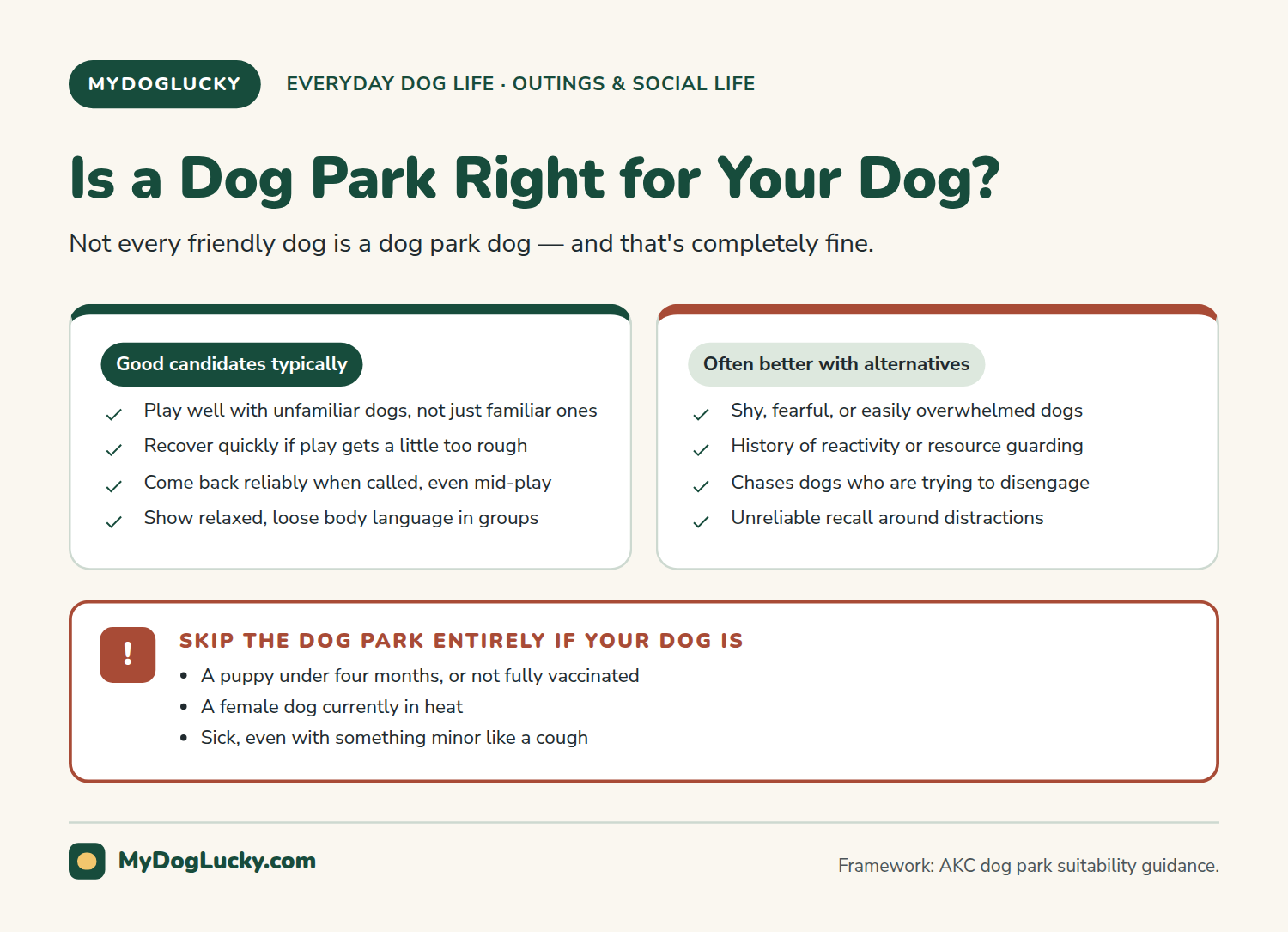
According to the AKC, dogs who should skip dog parks entirely include puppies under four months, unvaccinated dogs, females in heat, sick dogs, and dogs with existing behavioral concerns around other dogs. Beyond that hard list, a broader set of temperament traits predicts whether a given dog actually enjoys the environment.
Good candidates typically
- Play well with a range of unfamiliar dogs, not just familiar ones
- Recover quickly if a play session gets a little too rough
- Come back reliably when called, even mid-play
- Show relaxed, loose body language around groups of strange dogs
Dogs who often do better with alternatives
- Shy, fearful, or easily overwhelmed dogs
- Dogs with a history of reactivity, resource guarding, or fighting
- Dogs who chase others who are clearly trying to avoid them
- Dogs with an unreliable recall around high-arousal distractions
None of this is fixed forever. A dog who isn’t ready today may be ready after more training and controlled socialization later, and a dog who loved dog parks as a younger adult may prefer quieter options as a senior. Reassess periodically rather than treating one visit as the final verdict.
A useful way to think about it: temperament sets the ceiling, and training and experience determine how close a given dog gets to it. Two dogs with similar underlying temperaments can end up in very different places after a year of different experiences, one building confidence through calm, well-matched introductions, the other becoming more cautious after a handful of overwhelming ones. The environment you choose for those early experiences matters as much as the dog’s starting personality.
Health and vaccination prerequisites
Before any dog park visit, veterinary guidance from VCA Animal Hospitals recommends current vaccination against core diseases plus bordetella, leptospirosis, and canine influenza, along with flea, tick, and heartworm prevention. Puppies need their full vaccination series completed first, since off-leash group settings are exactly where a partially protected puppy is most exposed to contagious illness.
Skip the visit if your dog is showing any sign of illness, even something as minor as a cough or loose stool. A dog park concentrates a lot of dogs, and their shared sniffing and mouth contact, in a small space, which makes it an efficient way to spread something contagious to every dog there that day.
Keep a simple record of your dog’s vaccination dates and any parasite-prevention products he’s currently on, either in an app, a note on your phone, or a folder at home. Some parks and daycare facilities ask for proof at check-in, and having it ready saves a scramble, especially right after a move or a switch to a new veterinary clinic.
Reading the room: body language basics
Most dog park incidents have visible warning signs well before anything escalates. Learning to spot stress in your own dog, and in the dogs around him, is the single most useful skill for a safe visit.
- Shaking off when not wet, often after an intense interaction, is a common stress-release signal.
- Yawning when not tired frequently signals mild stress or discomfort, not sleepiness.
- Sniffing the ground or suddenly eating grass when another dog approaches can be a way of disengaging from an uncomfortable interaction.
- Avoiding eye contact or turning away from another dog or person is often a polite request for space.
- A loose, wiggly body with a relaxed, open mouth is the look of a genuinely comfortable, having-fun dog. Compare that to a stiff body and a closed, tense mouth.
Play bows and self-handicapping
A play bow, front legs stretched forward and chest low with the rear end up in the air, is one of the clearest “this is a game” signals in a dog’s body language. Watch for dogs using it to restart or de-escalate play after a rough moment, which is a good sign the interaction is still mutual and fun for both sides.
Self-handicapping, a bigger or stronger dog voluntarily playing gently, rolling onto his back, or slowing down for a smaller or younger playmate, is another good sign of a well-matched, considerate player. Its absence isn’t automatically a red flag, but its presence is a reliable, reassuring one.
Warning signs it’s time to leave
Step in or leave immediately if you see
- One dog repeatedly rolling another to the ground or relentlessly chasing a dog who’s trying to get away
- Your own dog standing at the gate, hiding behind you, or trying to leave
- Stiff, frozen body language followed by a hard stare between two dogs
- Genuine growling or snapping, rather than the normal noisy sounds of rough play
Trust the early signals over the hope that “they’ll work it out.” Most fights are preventable if an owner steps in during the tension-building phase rather than waiting for an actual scuffle.
Dog park etiquette for owners
- Watch your dog, not your phone. Active supervision is the single biggest thing that keeps a dog park safe.
- Know your dog’s play style and be ready to intervene if he’s overwhelming another dog, even if it looks like fun to him.
- Clean up immediately, every time, without exception.
- Leave toys and food at home unless the park explicitly allows them. Both are common triggers for resource guarding between unfamiliar dogs.
- Keep visits to around 30 minutes for most dogs. Arousal and fatigue both climb the longer a visit runs, which raises the odds of a mishap.
- Respect a “no” from another owner if they ask you to leash up or separate the dogs. They may be seeing something you’re not.
Training skills worth having before your first visit
A dog park rewards a handful of specific skills more than general obedience polish. None of these need to be perfect, but each one meaningfully lowers the odds of a bad first visit.
Reliable recall around distractions
Recall that only works in a quiet living room isn’t the same skill as recall that works with three dogs mid-chase twenty feet away. Practice calling your dog away from lower-stakes distractions first, like another dog on a walk or a squirrel across the yard, and reward generously every time he comes, even if it took him a moment to get there.
“Leave it” and “drop it”
Both matter more at a dog park than almost anywhere else. Another dog’s toy, a dropped treat, or something unpleasant in the grass all come up regularly, and a dog who reliably disengages on cue gives you a fast, low-drama way to defuse a brewing problem before it becomes one.
A calm greeting at the gate
Practice a brief settle-and-wait at the entrance before releasing him to play. A dog who bursts through the gate at a dead sprint toward a crowd of unfamiliar dogs starts the interaction at a much higher arousal level than one who walks in calmly and takes a moment to assess the group first.
Impulse control around gates and doors
A dog who can sit and wait while a gate opens, rather than shoving through the instant there’s a gap, is safer for everyone nearby, since a double-gated entry only works as a safety buffer if dogs aren’t crowding through both gates at once. Practicing a simple wait-at-doors habit at home carries over directly to this exact situation.
None of this has to be flawless
A dog with an 80% recall and a decent “leave it” is a reasonable dog park candidate. Waiting for perfect obedience before a first visit isn’t necessary, and honestly isn’t realistic for most dogs.
Choosing a well-run dog park
Not all dog parks are built or maintained equally, and the physical setup matters for safety.
- Secure fencing with a double-gated entry prevents dogs from bolting out while another dog is entering.
- Separate small-dog and large-dog areas reduce injury risk from size and play-style mismatches.
- Clean, hazard-free ground, free of standing water, sharp debris, or overflowing trash.
- Visibility across the whole space so owners can actually supervise, rather than blind corners where trouble can build unnoticed.
- An active, engaged crowd of regular owners is a good sign. A park where everyone’s on their phone is a red flag regardless of how nice the fencing is.
Cost, permits, and access
Most municipal dog parks are free and open to any vaccinated, leashed-to-the-gate dog, but not all of them work that way. Some cities require an annual dog license or a specific dog-park permit, sometimes with proof of current vaccination on file, before your dog is allowed to use certain fenced parks.
Private, membership-based dog parks and rental-yard services typically charge per visit or per membership period, in exchange for a smaller, often better-maintained or more controlled environment. Neither option is inherently better. A free municipal park with engaged, attentive regulars can be a great fit, and a paid option can be genuinely worth it for a dog who needs a calmer, smaller group than a busy public park usually offers.
Check before your first visit
A quick look at your city or county parks department’s website, or a call to a private facility, tells you what’s required, what it costs, and whether reservations are needed, before you show up and find out at the gate.
Planning a first visit
Visit during a quiet, low-traffic time for your dog’s very first trip, rather than a busy weekend afternoon. A smaller, calmer group gives you a much clearer read on how he actually handles the environment, without the noise of a crowded session masking real signals.
Keep the first visit short, ten to fifteen minutes, and leave on a good note rather than waiting until he’s overtired or overstimulated. A short, positive first experience sets up a better second one than a long, overwhelming one does.
Puppies and dog parks
Puppies under four months, or any puppy who hasn’t completed his full vaccination series, should stay out of off-leash dog parks entirely. The concentrated exposure to unfamiliar dogs, and whatever they might be carrying, is a real risk during the window before full immunity develops.
Once fully vaccinated, an adolescent or young adult dog’s first dog park visits still deserve extra supervision. Puppies figure out appropriate play pressure through experience, and an overly rough or overly timid start can shape how he approaches other dogs going forward.
Small dogs, large dogs, and mixed groups
Size mismatches are a common, preventable source of injury. A large dog’s normal play style, body-slamming, mouthing, chasing, can genuinely hurt a small dog even with no aggressive intent at all. Use a separate small-dog area when one’s available, and supervise extra closely in mixed-size parks without one.
A confident small dog and a gentle large dog can absolutely play safely together. The point isn’t a blanket rule against mixed play. It’s paying closer attention to size mismatches specifically, since the margin for a misjudged move is smaller.
Breed-specific dog park considerations
Breed tendencies aren’t a verdict on any individual dog, but they do shape what’s worth watching for and planning around at the park.
| Tendency | Example breeds | What to watch for |
|---|---|---|
| High prey drive | Sighthounds, terriers, some herding breeds | Chasing small dogs or fast-moving play that can shift from fun to predatory-looking behavior |
| Brachycephalic (short-nosed) | Bulldogs, Pugs, Boston Terriers | Overheating and breathing difficulty faster than other dogs during active play, especially in warm weather |
| Strong herding instinct | Border Collies, Australian Shepherds, Corgis | Nipping at heels or circling other dogs, which can read as pushy or annoying to some playmates |
| Guarding or protective lines | Some livestock guardian and protection breeds | Reduced tolerance for rough, unfamiliar play; may do better with select known dogs than an open group |
Individual variation within any breed is real, and often larger than the breed tendency itself. Use this table to set your expectations and supervision level going in, not to rule a dog in or out before you’ve actually watched him in the environment.
Bringing more than one dog from your household
Taking two or more of your own dogs to the park at once adds a layer most single-dog guidance skips over.
- Consider whether your dogs “pack up” together, since two dogs who reflexively back each other up can intimidate other dogs or escalate a minor disagreement faster than either would alone.
- Watch both dogs, not just the more excitable one. It’s easy to focus your attention on the bolder dog and miss early stress signs in a quieter one.
- Be ready to separate and leave with one dog first if the visit isn’t going well for him, even if the other is having a great time and you’d rather stay longer.
- Practice recall with both dogs together beforehand, not just individually, since calling two dogs away from an exciting group at once is a genuinely different skill than calling one.
Seasonal dog park considerations
The same park can be a completely different environment in July than it is in January, and each season brings its own set of things worth planning around.
Hot weather
Check the ground temperature before a summer visit. Hot asphalt, sand, or artificial turf can burn paw pads well before the air temperature itself feels dangerous. Shorten visits, bring water, and watch for excessive panting, drooling, or a dog who suddenly wants to stop playing, all early heat-stress signs worth taking seriously right away.
Cold, ice, and mud
Icy patches near gates and water bowls are a slip hazard for dogs at a full sprint, and de-icing salt on nearby sidewalks can irritate paw pads afterward. Muddy conditions after rain or snowmelt make for a messier visit but aren’t dangerous on their own, beyond a slipperier surface during fast play.
Peak-season crowding
Nice-weather weekends bring more dogs and more unfamiliar combinations into the same space at once, which raises the odds of a mismatch. If your dog does better in smaller groups, weekday mornings or early evenings are usually calmer than a sunny Saturday afternoon.
Match the season to your dog’s actual comfort
A dog who loves the park in spring might prefer a shorter visit, or a skip entirely, on a 95°F afternoon. Reading the specific day matters as much as reading the season in general.
If a fight breaks out
Stay calm, and don’t reach into the middle of it
- Make a loud noise, clap, shout, or use an air horn if you carry one, to startle and interrupt rather than reaching in.
- If two people are present, each grabs their own dog’s back legs and pulls straight back and away, rather than reaching toward the heads.
- Separate the dogs fully before checking for injuries.
- Exchange contact information with the other owner if there’s any visible injury, even a minor one.
- See a vet for any puncture wound, even a small one, since bite wounds often cause more damage under the skin than the surface shows.
Liability, injuries, and what happens if dogs don’t get along
Most dog park incidents are minor scuffles, not lawsuits, but it’s worth understanding the basics before something happens rather than scrambling to figure it out in the moment.
If your dog injures another dog
Exchange contact and, if you have it, veterinary or homeowner’s or renter’s insurance information with the other owner. Many homeowner’s and renter’s policies include liability coverage that can apply to dog-related incidents, though coverage varies significantly by policy and by state, so it’s worth an honest look at your own policy rather than assuming either way.
If your dog is injured
Get him seen by a vet promptly, even for what looks like a minor puncture, and keep any records or photos from the visit. Most public dog parks post rules stating that participation is at each owner’s own risk, which limits what recourse is available against the park itself, though the other owner may still bear responsibility depending on the circumstances and local law.
This isn’t legal advice
Laws and insurance coverage around dog-on-dog incidents vary by state and by policy. For anything beyond a minor scrape, a conversation with your insurance provider or, in a serious case, a local attorney is worth more than general guidance here.
Alternatives to the dog park
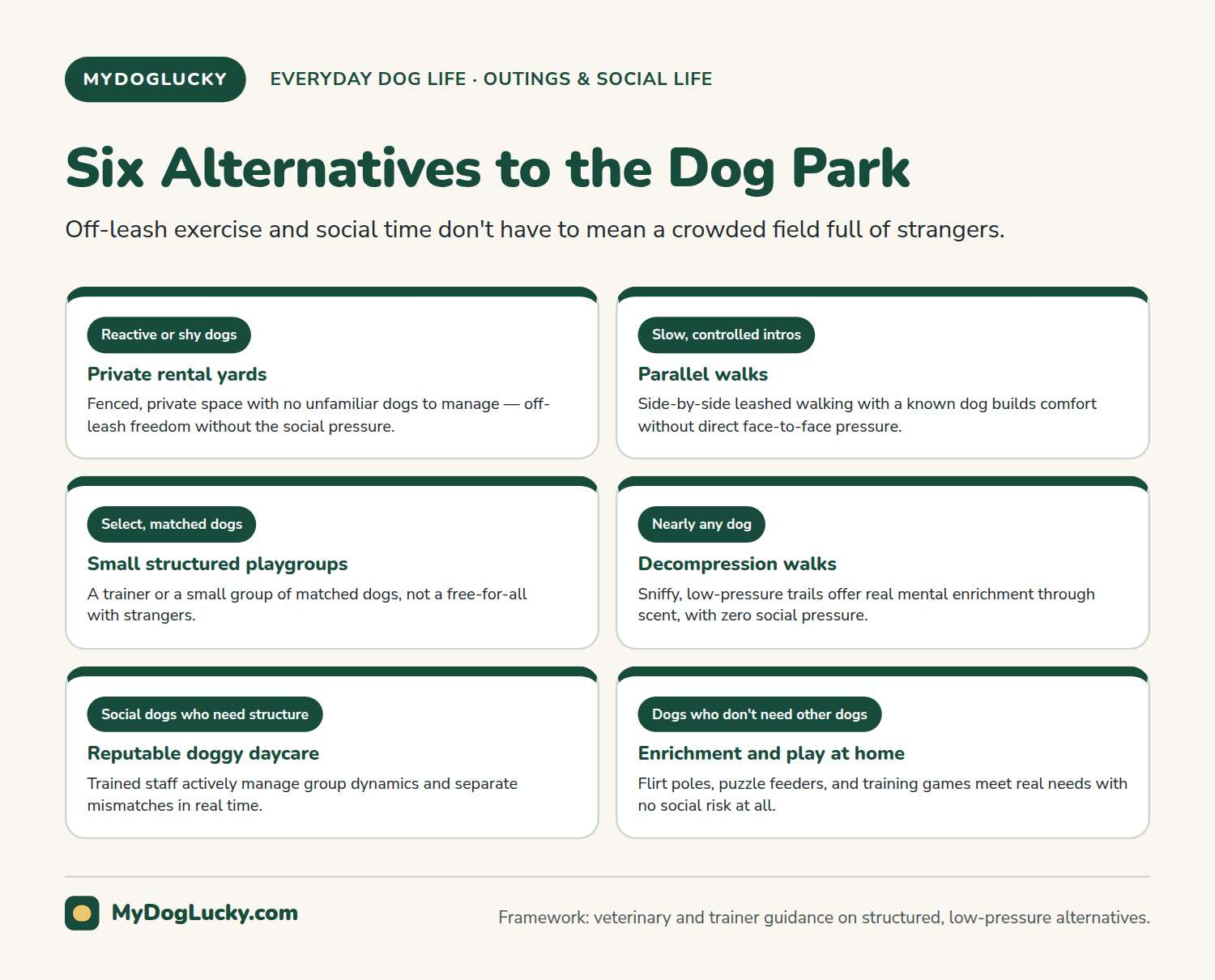
A dog who isn’t suited to open off-leash group play still has plenty of ways to get exercise and social time. These options generally offer more control over the environment, which is exactly what a shy, reactive, or easily overwhelmed dog benefits from.
| Alternative | Best for | Why it helps |
|---|---|---|
| Private rental yards (e.g., Sniffspot-style) | Reactive or shy dogs, off-leash exercise without strangers | Fenced, private space with no unfamiliar dogs to manage |
| Parallel walks with a known dog | Dogs who do better with slow, controlled introductions | Side-by-side leashed walking builds comfort without direct pressure |
| Small, structured playgroups | Dogs who play well with select, known dogs | A trainer or a small group of matched dogs, not a free-for-all |
| Decompression walks (sniffy, low-pressure trails) | Nearly any dog, especially anxious or reactive ones | Mental enrichment through scent, no social pressure at all |
| Reputable doggy daycare | Social dogs who need supervised structure | Trained staff actively manage group dynamics and separate mismatches |
| Enrichment and play at home | Dogs who don’t need other dogs to be fulfilled | Flirt poles, puzzle feeders, and training games meet real needs without social risk |
Mixing approaches works well
Plenty of owners use a dog park occasionally alongside these alternatives, rather than treating it as an all-or-nothing choice. A dog who does fine at the dog park twice a month might still benefit from decompression walks the rest of the week.
Dog park etiquette for kids and non-dog visitors
Dog parks aren’t designed with small children in mind, and most posted rules either discourage or outright prohibit young kids inside the fence, for good reason: a fast-moving group of excited, off-leash dogs and a small child at dog height is a real injury risk, even with friendly dogs and no aggressive intent involved anywhere in the group.
If you do bring an older child, keep them close, teach them not to run through groups of playing dogs, and have them ask an owner before approaching any unfamiliar dog. The same courtesy applies to any non-dog-owning visitor who wants to pet a dog they don’t know: always ask first, and respect a “no” from the owner without taking it personally.
How dog parks fit into a broader exercise and enrichment plan
A dog park visit is one tool among several, not the whole plan. Thinking of it that way takes some of the pressure off any single visit and makes it easier to skip a day without guilt.
Physical exercise versus mental engagement
Off-leash running and play burn energy fast, but they don’t replace the mental work of a sniffy walk, a training session, or a puzzle feeder. A dog who’s “hyper” despite frequent dog park visits often needs more of the latter, not more of the former.
Balancing high-arousal play with calmer activities
Some dogs get noticeably more reactive or wound-up in the hours after an intense group-play session, sometimes called an “arousal hangover.” If you notice that pattern, following a dog park visit with a calm, low-key rest of the day, rather than another high-energy activity, tends to help him settle back down faster.
There’s no single right amount
Some dogs thrive on frequent dog park visits as their primary exercise outlet. Others do best with it as an occasional treat alongside walks, training, and enrichment at home. Both are completely valid ways to meet a dog’s needs.
Common dog park mistakes
Assuming a leash-friendly dog will automatically do well off leash
Leash manners and off-leash group play are genuinely different skills. A dog who’s polite on walks can still struggle in an unstructured group.
Bringing food or high-value toys into a shared space
Both are common triggers for resource guarding between dogs who’ve never met, even normally easygoing ones.
Staying too long
Arousal and fatigue build over a visit. A dog who was playing beautifully at minute ten can become overstimulated and snappy by minute forty-five.
Ignoring your own dog’s early stress signals
Hoping a shy or overwhelmed dog will “warm up” by staying longer usually backfires. Leaving early and trying again another day works better.
Bringing a dog who’s clearly unwell “just this once”
Even mild symptoms can spread quickly through a park full of dogs sharing the same space, grass, and water bowls. Skip the visit and try again once he’s back to normal.
Assuming your dog will alert you before a problem happens
By the time a dog is growling or snapping, the stress usually built for several minutes beforehand. Watching proactively, rather than waiting for an obvious signal, catches most problems while they’re still easy to defuse.
Common myths about dog parks
“All dogs need dog parks to be properly socialized”
Socialization means comfortable, positive exposure to the world, not specifically off-leash group play with strangers. Plenty of well-socialized, happy dogs rarely or never visit a dog park.
“If my dog is friendly, he’ll be fine at any dog park”
Friendliness with familiar dogs doesn’t predict how a dog handles a crowded, unfamiliar group. Both traits are worth assessing separately.
“Growling always means a fight is about to happen”
Growling is communication, often a request for space rather than an imminent attack. It’s still worth taking seriously and separating the dogs, but it isn’t automatically the same as aggression.
“A bigger dog park with more dogs is always more fun”
For many dogs, a smaller, calmer group is a better, lower-stress experience than a crowded one, regardless of the park’s size.
“A tired dog is always a happy dog after the park”
Overstimulation and true tiredness can look similar from the outside. A dog who comes home wired, panting hard, or unusually clingy may have been overwhelmed rather than pleasantly worn out.
“Neutered or spayed dogs never cause problems at the park”
Spay or neuter status can affect some hormone-driven behaviors but doesn’t guarantee good manners or predict how any individual dog handles group play.
Your dog park readiness checklist
- Fully vaccinated, including bordetella and canine influenza if the park requires them.
- Reliable recall, even around distractions.
- No history of reactivity, resource guarding, or fights.
- Visiting during a quiet time for the first trip.
- No food or high-value toys brought in.
- A plan to leave within about 30 minutes.
Common questions about dog parks
At what age can puppies start visiting dog parks?
Only after completing the full puppy vaccination series, which your vet will confirm, and generally not before four months old at the earliest.
Is it normal for dogs to sound aggressive during normal play?
Yes, rough play often sounds louder and more intense than it looks up close. Watch the body language, loose and bouncy versus stiff and tense, rather than judging by sound alone.
My dog loves other dogs on walks but seems anxious at the dog park. Why?
On-leash greetings and open off-leash group play are very different experiences. Some dogs are genuinely more comfortable with the former and find the latter overstimulating.
Should I intervene if my dog is the one being too rough?
Yes. Call him away for a short break, even if the other dog seems okay with it. Giving both dogs a breather prevents a fun interaction from tipping into an unwanted one.
Are indoor dog parks or daycare facilities safer than outdoor ones?
They can be, largely because trained staff actively manage the group and separate mismatches, something an outdoor public park relies on individual owners to do themselves.
What should I do if another owner isn’t watching their dog?
Politely alert them if something concerning is happening, and don’t hesitate to leash up and leave if you’re not confident the situation is being managed.
Can senior dogs still enjoy dog parks?
Some do, especially in a calmer, smaller group. Others prefer to switch to lower-impact, lower-pressure alternatives as mobility or patience for rowdy play declines with age.
Do dog parks increase the risk of parasites or illness?
Yes, somewhat, simply from the concentration of dogs sharing a space. Current vaccination, parasite prevention, and skipping visits when your dog isn’t feeling well all reduce that risk significantly.
How do I know if a dog park is well-supervised before my first visit?
Watch from outside the fence for a few minutes first. Engaged owners who are actively watching, rather than clustered together chatting or on their phones, are a good sign.
Is it okay to skip dog parks entirely and never go?
Completely. There’s no requirement that a dog visit a dog park to live a full, well-exercised, well-socialized life. The alternatives above cover the same underlying needs.
Can I bring treats to reward my dog at the park?
Small, low-value treats used briefly for recall practice are usually fine, but leave anything high-value or a treat pouch full of food at home, since it’s a common trigger for resource guarding among unfamiliar dogs.
What if my dog just stands by the fence and doesn’t want to play?
That’s a completely normal response for a dog who isn’t comfortable in the environment yet. Let him observe at his own pace, don’t force interaction, and treat leaving early as a reasonable, low-drama outcome rather than a failure.
Are municipal dog parks required to have specific safety features?
Requirements vary widely by city and county. Some mandate double-gated entries and separate small-dog areas; others have minimal requirements. Check your local parks department’s website for what’s actually required in your area.
How often is it okay to visit a dog park?
There’s no fixed rule. Some dogs do well with several visits a week; others do better with occasional visits mixed with other types of exercise. Let your dog’s recovery and enthusiasm afterward guide the frequency more than a set schedule.
Should I introduce my dog to the dog park before or after basic training?
After at least some foundational recall and impulse-control work. A dog park is a high-distraction environment, which makes it a poor place to start training skills entirely from scratch.
Can a bad first dog park experience be undone?
Often, yes, with patience. A slower reintroduction, shorter visits, quieter times of day, and rebuilding confidence gradually can help many dogs recover from one rough experience, though a dog who remains fearful may simply do better with the alternatives instead.
Do dog parks work well for reactive dogs who are in active training?
Rarely as the training venue itself. Most trainers recommend working on reactivity in lower-stimulation settings first, like parallel walks or private rental yards, and treating a crowded public dog park as a later goal rather than a starting point.
What’s a reasonable distance to travel for a better-run dog park?
That’s a personal call based on your schedule and your dog’s needs, but plenty of owners find that a slightly longer drive to a calmer, well-maintained park is worth it compared to a chaotic one five minutes away.
Can weather alone be a reason to skip a planned visit?
Yes, and it’s a completely legitimate one. Extreme heat, ice, lightning, or a muddy mess after heavy rain are all reasonable grounds to swap a dog park visit for an alternative that day.
Is it normal for my dog to be more tired after a dog park visit than after a long walk?
Yes. The combination of physical exertion and mental stimulation from off-leash group play is often more tiring than steady-paced walking, even over a shorter total time.
Sources
- American Kennel Club. Should You Take Your Dog to a Dog Park?
- VCA Animal Hospitals. Proper Etiquette at the Dog Park
This article is general education for U.S. dog owners. It is not individualized veterinary or behavioral advice. Ask your veterinarian or a certified trainer about anything specific to your dog.




Trackbacks/Pingbacks