

Being a first time dog owner comes with a strange split. Everyone will tell you about the good part, the walks, the greetings at the door, the dog curled up next to you by the second week. Almost nobody sits you down beforehand and walks through the actual logistics: what it costs, what your home needs before day one, how your work schedule has to bend, and what the first few weeks genuinely feel like once the excitement wears off a little.
This guide is that conversation. It’s not about how to walk, feed, or train your dog day to day. That’s covered in MyDogLucky’s everyday dog care guide. This one is about everything that happens around the dog: the planning, the budget, the setup, and the support system that makes the rest of it sustainable.
Read it straight through before you bring a dog home, or use it as a reference once you already have. Either way, it’s built to answer the questions people usually only find out the hard way.
What’s in this guide
- Is now actually the right time?
- What it really costs: first year and ongoing
- How dog size changes the budget
- Where your dog comes from
- Evaluating a breeder, shelter, or rescue
- Home setup before day one
- Choosing a vet and setting up initial care
- A closer look at pet insurance
- Paperwork, ID, and the legal basics
- Fitting a dog into your work and schedule
- Building your support network
- Bringing a dog into a home with kids or other pets
- The emotional adjustment, honestly
- Your realistic first week
- Renting or living with roommates
- Moving, traveling, and life changes with a new dog
- Common first-time-owner mistakes
- Common myths about being a new dog owner
- Two tools: a budget worksheet and a first-week checklist
- Common questions from first-time dog owners
- Sources
Is now actually the right time?
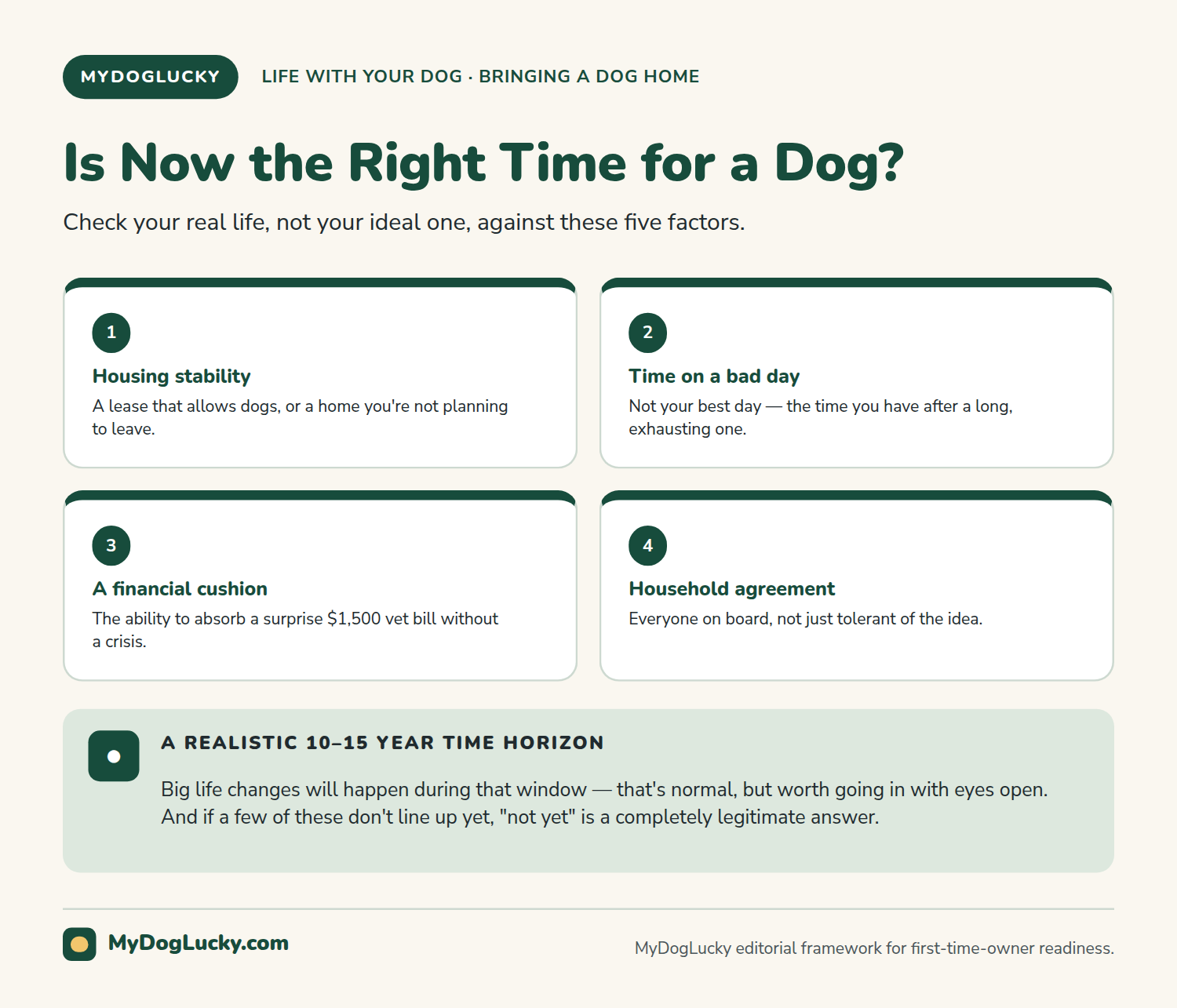
The honest version of this question isn’t “do I want a dog.” Almost everyone who’s shopping for a first-time dog owner guide already knows the answer to that one. The more useful question is whether your current life, not your ideal one, has room for a dog’s actual needs.
- Housing stability. A lease that allows dogs, or a home you’re not planning to leave, matters more than people expect. Rehoming a dog due to a housing change is one of the most common, and most avoidable, reasons dogs end up back in shelters.
- Time, realistically. Not the time you have on your best day. The time you have on a bad one, after a long shift, when you’re exhausted and the dog still needs a walk.
- Financial cushion. Not just the monthly budget for food, but the ability to absorb a surprise $1,500 vet bill without it being a crisis.
- Household agreement. Everyone who lives with you should be on board, not just tolerant. A dog who’s unwelcome to one household member is a much harder situation than one everyone actually wanted.
- Realistic time horizon. Many dogs live ten to fifteen years or more. Big life changes, moves, new jobs, new relationships, will happen during that window. That’s normal, but it’s worth going in with eyes open rather than assuming today’s routine holds forever.
“Not yet” is a legitimate answer
If a few of these don’t line up right now, that’s useful information, not a failure. A dog who arrives into a stable, prepared situation tends to have a much smoother transition than one who arrives into chaos everyone was hoping would sort itself out.
What it really costs: first year and ongoing
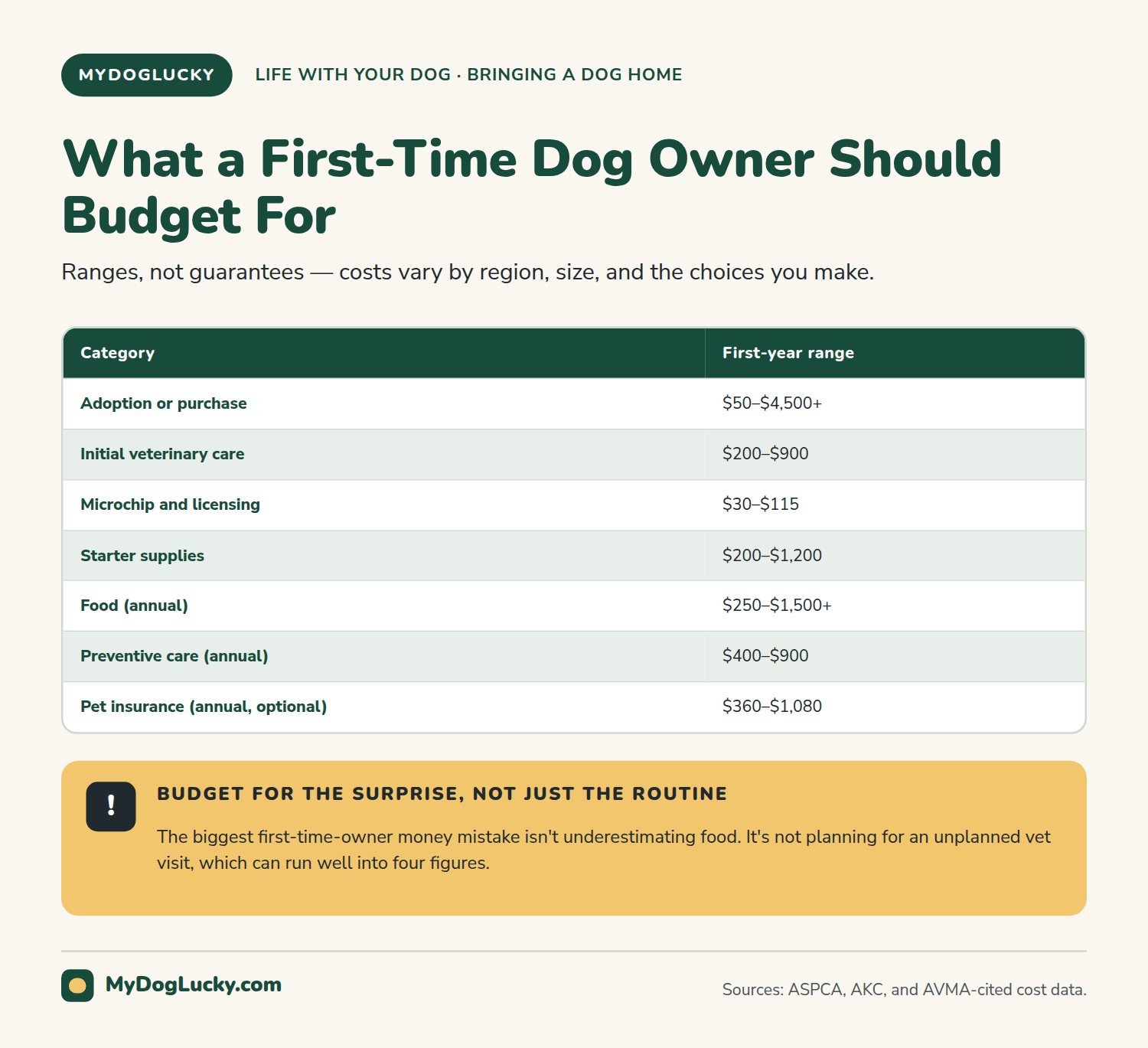
Cost estimates vary widely by region, dog size, and choices you make, so treat the numbers below as a planning range, not a guarantee. A useful synthesis of ASPCA, AKC, and AVMA-cited estimates puts first-year costs, including adoption or purchase, initial vet care, and starter supplies, somewhere between $1,500 and $4,500 or more. Ongoing annual costs for a healthy adult, mid-sized dog typically land between $1,200 and $3,500.
| Category | First-year range | Notes |
|---|---|---|
| Adoption or purchase | $50–$4,500+ | Shelter adoption fees often include spay/neuter, vaccines, and a microchip already |
| Initial veterinary care | $200–$900 | Wellness exam, core vaccine series, sometimes spay/neuter if not already done |
| Microchip and licensing | $30–$115 | Often a one-time cost plus an annual license renewal |
| Starter supplies | $200–$1,200 | Crate, bed, collar, leash, bowls, toys, basic cleaning supplies |
| Food (annual) | $250–$1,500+ | Varies significantly with dog size and food quality |
| Preventive care (annual) | $400–$900 | Wellness visits, heartworm and flea/tick prevention |
| Pet insurance (annual, optional) | $360–$1,080 | Premiums vary by breed, age, coverage level, and location |
Budget for the surprise, not just the routine
The single biggest first-time-owner financial mistake isn’t underestimating food or toys. It’s not planning for an unplanned vet visit. An emergency surgery or a sudden illness can run well into four figures. An emergency fund or pet insurance, set up before you need either, is worth treating as a real line item, not an afterthought.
How dog size changes the budget
The cost table above is a starting point, but dog size shifts nearly every line item, sometimes dramatically. A 12-pound terrier and a 90-pound mastiff cost different amounts to feed, medicate, board, and outfit, even when they’re the exact same age and health status.
| Size class | Typical annual food cost | What else runs higher |
|---|---|---|
| Small (under 25 lbs) | $250–$500 | Often lower medication doses; smaller gear is sometimes pricier per pound |
| Medium (25–60 lbs) | $450–$800 | The baseline most published estimates assume |
| Large (60–90 lbs) | $700–$1,200 | Larger-dose medications, bigger crate and bed, higher boarding rates |
| Giant (90 lbs+) | $1,000–$1,800+ | Highest food and medication costs; often shorter lifespans, which changes the lifetime total differently than the annual one |
Pet insurance premiums, boarding rates, and even some grooming services scale with weight too, so a giant-breed budget deserves a meaningful markup over the general ranges above, not just on food. If you’re choosing between breeds or sizes partly on cost, this is the table to run the math against before falling for a specific dog’s looks.
Where your dog comes from
Shelters, breed-specific rescues, and reputable breeders are the three main paths, and each comes with different tradeoffs in cost, predictability, and process.
- Shelters and rescues typically cost less upfront and often include spay/neuter, vaccines, and a microchip in the adoption fee. Behavioral and medical history may be limited, especially for a dog surrendered without much background.
- Breed-specific rescues tend to know their dogs well, since many use foster homes, and can often speak in detail to temperament and any known needs.
- Reputable breeders generally cost more but can offer health testing on the parents, an established socialization plan, and a much clearer sense of what to expect as the puppy grows.
Whichever path you choose, ask direct questions: known health or behavior history, what’s included in the fee, return or support policy if things don’t work out, and what happens if you need help down the line. A source that’s cagey about these questions is worth a second look.
| Source | Typical cost | Best for | Watch out for |
|---|---|---|---|
| Municipal shelter | $50–$300 | Lower cost, often includes medical basics already done | Limited history; behavior can shift once settled at home |
| Breed-specific rescue | $150–$600 | Wanting a known breed with foster-home behavioral insight | Waitlists for popular breeds; application and home-check process |
| Reputable breeder | $1,000–$4,500+ | Health-tested lineage and a known, structured socialization start | Price alone doesn’t guarantee reputability; screening matters more |
Evaluating a breeder, shelter, or rescue
Cost tells you very little about quality on its own. A high price doesn’t guarantee a responsible breeder, and a low adoption fee doesn’t mean a shelter or rescue is cutting corners. The actual signals are in how each source operates.
Signs of a reputable breeder
- Health testing results for the parent dogs, specific to conditions common in that breed, shown without you having to ask twice.
- Willingness to let you meet at least the mother, and ideally see where the puppies are raised.
- Questions for you, about your home, experience, and plans. A breeder who doesn’t screen buyers at all is a yellow flag.
- A written contract covering health guarantees and what happens if you can’t keep the dog later in life.
- No pressure to buy immediately, and no refusal to answer follow-up questions after the sale.
Red flags worth walking away from
Multiple litters or breeds available at once, no health testing documentation, refusal to let you see where puppies are raised, prices that seem too low for the claimed pedigree, or pressure to complete a purchase sight unseen. Any of these on their own is worth pausing on; more than one is worth walking away entirely.
What to ask a shelter or rescue
- What’s known about the dog’s history, even if it’s incomplete.
- How the dog has behaved in foster care or during a behavioral evaluation, if one was done.
- Whether the dog has been around kids, other dogs, or cats, and how that went.
- What post-adoption support the organization offers if you run into a training or behavior question.
- Return policy if the placement genuinely isn’t working, since a responsible rescue would rather take a dog back than see him bounce through multiple homes.
Home setup before day one
Most of the physical setup for a new dog is genuinely simple, but doing it before he arrives, rather than during his first chaotic hours home, makes a real difference.
- Essential supplies: food and water bowls, an appropriately sized crate or bed, a well-fitted collar or harness with ID tag, a leash, a few chew-safe toys, and basic grooming tools for his coat type.
- A designated rest space that’s calm and low-traffic, somewhere he can settle without being managed constantly during the first days.
- A basic dog-proofing pass: secured trash, medications and chemicals out of reach, cords managed, and toxic plants relocated or removed. A full room-by-room walk-through is worth doing specifically before arrival day, not after an incident.
- A plan for the first car ride home, whether that’s a secured crate, a harness attached to a seatbelt, or another safe restraint appropriate to his size.
Resist the urge to buy everything
It’s tempting to fill a cart with every product marketed at new owners. Start with the essentials above, see what your specific dog actually needs and likes, and add from there. Plenty of expensive gear ends up unused while a simple, well-chosen item gets used daily.
Choosing a vet and setting up initial care
Find a veterinarian before you need one in an emergency, not during one. Ask about their new-patient process, typical wait times for a routine appointment, after-hours or emergency protocols, and whether they’re accepting new patients at all, since some practices have long waitlists.
Schedule a first wellness visit within the first week or two of bringing your dog home, even if he seems perfectly healthy. This establishes a baseline, starts or continues his vaccine series, and gives you a chance to ask every question you’ve been saving up. Bring any records you were given by the shelter, rescue, or breeder.
What a first visit usually covers
- A full physical exam, weight, and body condition check
- Reviewing or starting the vaccine series appropriate to his age
- A parasite check and discussion of flea, tick, and heartworm prevention
- Spay or neuter timing, if not already done
- A chance to ask about food, training resources, and anything you’ve noticed since bringing him home
A closer look at pet insurance
Pet insurance comes up throughout this guide because timing genuinely matters, but the decision itself deserves more than a one-line mention. It’s not required, and it’s not right for every household, but understanding how it actually works helps you decide deliberately rather than by default.
How it typically works
Most U.S. pet insurance operates on a reimbursement model: you pay the vet bill upfront, submit a claim, and get a percentage reimbursed after your deductible is met, rather than the insurer paying the clinic directly. Plans vary in what they cover, accident-only, accident and illness, or accident, illness, and wellness, and in their annual payout caps, deductibles, and reimbursement percentages.
What’s usually excluded
- Pre-existing conditions, meaning anything diagnosed or showing symptoms before the policy started or during its waiting period. This is the single biggest reason earlier enrollment matters.
- Breed-specific conditions are sometimes excluded or capped differently, depending on the insurer and breed.
- Routine or wellness care is often a separate add-on rather than included in a base accident-and-illness plan.
Questions worth asking before you enroll
- What’s the waiting period before coverage actually starts for illness versus accidents?
- Are hereditary and breed-specific conditions covered, capped, or excluded?
- Does the reimbursement percentage drop as your dog ages, or stay fixed?
- Is there a per-condition, per-year, or lifetime payout cap?
Compare a few quotes rather than accepting the first one, since premiums and exclusions vary meaningfully between insurers for the same dog. If insurance doesn’t make sense for your situation, a dedicated savings account earmarked for vet costs accomplishes a similar goal without monthly premiums, though it lacks the protection against one very large, very early bill.
Paperwork, ID, and the legal basics
- Microchipping, if not already done, is a low-cost, one-time procedure that significantly improves the odds of a lost dog being reunited with you. Register the chip with your current contact information and keep it updated if you move.
- A visible ID tag on his collar is still worth having in addition to a microchip, since it’s the fastest way for someone who finds him to reach you directly.
- Local licensing is required in many U.S. cities and counties. Check your local government’s website, since requirements and fees vary by location.
- Pet insurance, if you’re considering it, is worth researching before you need it. Pre-existing conditions are typically excluded, so earlier enrollment usually means broader coverage.
- Emergency contact and care instructions written down somewhere accessible make it far easier for a sitter, neighbor, or family member to step in if you’re unexpectedly unavailable.
Fitting a dog into your work and schedule
A dog’s schedule needs to fit around your real work life, not an idealized version of it. Figure this out before he arrives, not after the first stressful week reveals the gap.
- Bathroom breaks. No healthy adult dog should regularly go more than about six hours without a bathroom break, and puppies need far more frequent access. If your workday is longer than that, arrange midday coverage: a dog walker, a neighbor, or daycare.
- The first weeks especially. If you can arrange time off, a flexible schedule, or work-from-home days for the first week or two, the settling-in period tends to go more smoothly.
- A realistic backup plan. Illness, travel, and long workdays all happen. Knowing who covers dog care before you’re in a bind beats scrambling to figure it out during one.
- Alone-time tolerance builds gradually. Especially for a puppy or a newly adopted dog, start with short absences and build up, rather than assuming a full workday alone will go fine from day one.
Building your support network
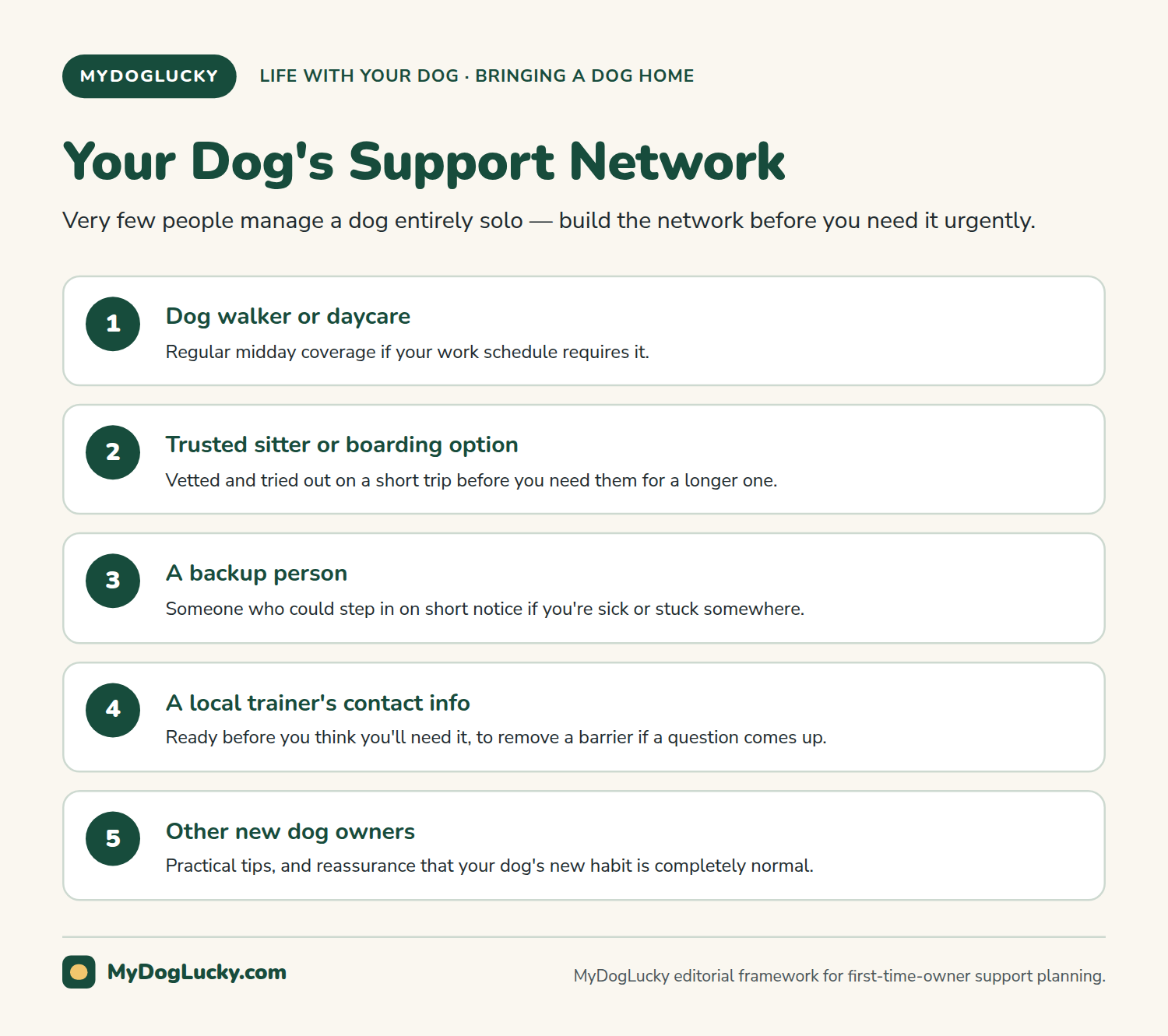
Very few people manage a dog entirely solo, and trying to is one of the more common paths to first-time-owner burnout. Build the network before you need it urgently.
- A dog walker or daycare for regular midday coverage if your schedule requires it.
- A trusted sitter or boarding option for travel, vetted and, ideally, tried out on a short trip before you need them for a longer one.
- A backup person, a neighbor, friend, or family member, who could step in on short notice if you’re sick or stuck somewhere unexpectedly.
- A local trainer’s contact information, even before you think you’ll need one. Having it ready removes a barrier if a behavior question comes up early.
- Other new dog owners, through a local training class or a puppy socialization group, are an underrated source of both practical tips and reassurance that your dog’s weird new habit is, in fact, extremely normal.
Bringing a dog into a home with kids or other pets
A new dog changes the whole household’s routine, not just yours, and a little planning around kids and existing pets prevents a lot of the friction people run into during the first weeks.
Households with children
- Set the ground rules before arrival day: no unsupervised interaction at first, no taking food or toys away from the dog, and how to approach him calmly rather than rushing in.
- Give the dog an escape route. A crate or gated space that’s entirely off-limits to kids gives him somewhere to decompress when the household gets loud or overwhelming.
- Supervise every interaction for at least the first several weeks, regardless of how gentle both the dog and the kids seem. Most bites involving children happen during unsupervised, seemingly benign moments.
- Teach kids to read basic stress signals, like a dog turning away, licking his lips, or going still, as a cue to back off rather than push further.
Households with existing pets
- Introduce dogs gradually and on neutral territory when possible, rather than immediately in the resident dog’s home space.
- Keep resources separate at first: individual food bowls, beds, and toys, since a new dog and a resident dog haven’t yet learned each other’s resource-guarding tendencies.
- Cat introductions go slower than most people expect. Scent swapping and visual introductions through a barrier, over days to weeks, work better than a same-day face-to-face meeting.
- Expect an adjustment period for the resident pet too. A settled dog or cat is having his routine disrupted just as much as you are, and some grumpiness during the transition is normal, not a sign the pairing won’t work.
Slower is genuinely faster here
Rushing introductions, of any kind, tends to create setbacks that take far longer to undo than the time saved by skipping the gradual approach. A few extra days of careful introductions is a small cost against months of repairing a bad first impression.
The emotional adjustment, honestly
Nobody warns first-time owners about this part enough: it’s completely normal to feel some combination of overwhelmed, exhausted, and occasionally regretful during the first weeks, even when you’re genuinely glad you got a dog. Some new owners describe something like “puppy blues,” a dip in mood tied to the sudden loss of sleep, freedom, and routine that a new dog brings, regardless of his age.
This feeling is common and it does pass
A rocky adjustment period doesn’t mean you made the wrong choice or that you’re bad at this. It usually means you’re in the hardest, least-settled part of a process that gets meaningfully easier within the first few weeks to a couple of months, as routines form and you both learn each other.
Give yourself the same grace you’d extend to any new, demanding routine. Ask for help when you need it, whether that’s a break from a family member, advice from your vet, or simply venting to another dog owner who’s been there. If the low feeling persists beyond the adjustment window, or feels like more than situational exhaustion, that’s worth talking through with your own doctor, separate from anything dog-related.
Your realistic first week
The first week is rarely the movie version. Expect a mix of genuinely sweet moments and a fair amount of logistics, minor accidents, and both of you figuring out each other’s signals.
- Keep the first few days low-key. Skip the big welcome party. A calm household lets your dog decompress and start reading you as a source of safety, not chaos.
- Expect some accidents, even from an adult dog in a brand-new environment. This is normal transition behavior, not necessarily a training failure.
- Start the first wellness vet visit within the first week or two, per the vet section above.
- Introduce household routines gradually rather than all at once: where he sleeps, when meals happen, what’s off-limits.
- Give him permission to decompress. Some dogs want to explore and greet everyone immediately. Others need a quiet few days to settle before showing their real personality. Both are normal.
Renting or living with roommates
If you rent, confirm your lease’s actual pet policy in writing before bringing a dog home, including any breed or size restrictions, pet deposits, and monthly pet rent. Verbal approval from a landlord isn’t the same as a documented lease addendum, and a mismatch here is one of the more preventable reasons dogs get rehomed.
If you live with roommates, have an explicit conversation about house rules, who’s responsible for what, and what happens if plans change, before the dog arrives rather than after a disagreement starts. A dog who’s a shared responsibility on paper but solely cared for by one person in practice is a setup that tends to strain both the household and the dog’s routine.
Moving, traveling, and life changes with a new dog
Life doesn’t pause once a dog joins the household, and a little forward planning keeps ordinary changes from turning into real disruptions for him.
Moving to a new home
- Keep as much of his routine intact as possible during the move itself: same feeding times, same walk schedule, familiar bedding in the new space.
- Set up a quiet, dog-proofed room in the new home first, so he has a calm landing spot rather than full access to an unfamiliar house on day one.
- Update his microchip registration and ID tag with the new address as soon as it’s official.
Traveling with or without your dog
- Research pet-friendly accommodations and any destination-specific requirements, including health certificates for air travel, well before your trip.
- If he’s staying behind, book boarding or a sitter early, especially around major holidays when good options fill up fast.
- Pack a familiar item, his own bed or a worn t-shirt of yours, for either scenario. Familiar scent reduces stress in an unfamiliar environment.
Other common life changes
New jobs, new relationships, a new baby, or a change in household composition all ripple into a dog’s routine. None of these require starting over from scratch, but each is worth a deliberate look at what’s changing in his day-to-day care, rather than assuming he’ll simply adapt unnoticed.
Common first-time-owner mistakes
Buying the dog before doing the planning
Supplies, a vet, a budget, and a schedule plan are all easier to sort out before a dog is already home and needing things immediately.
Underestimating the adjustment period
Expecting a smoothly settled dog and a smoothly settled you within the first few days sets up unnecessary disappointment. Weeks, not days, is the more realistic timeline.
Skipping pet insurance research because “he’s healthy right now”
Pre-existing condition exclusions mean earlier enrollment, while a dog is healthy, generally means broader future coverage. Waiting until after a diagnosis closes that option for that specific condition.
Not confirming the lease in writing
A landlord’s verbal “sure, that’s fine” isn’t the same protection as a documented pet addendum. Get it in writing before moving day.
Choosing a dog based on looks rather than lifestyle fit
A breed or individual dog’s appearance says very little about his energy level, grooming needs, or temperament. Matching those to your actual daily life matters far more for long-term happiness, on both ends of the leash, than matching your aesthetic preferences.
Trying to do it all without asking for help
First-time owners who skip building a support network tend to burn out faster, especially during the first few demanding weeks. Asking a neighbor, friend, or family member for an occasional hand isn’t a sign you’re failing at this.
Common myths about being a new dog owner
“A well-bred or well-socialized dog won’t need an adjustment period”
Even the most easygoing dog is adjusting to an entirely new home, routine, and set of people. Some adjustment period is normal regardless of background.
“If I have to think this hard about it, I’m not ready”
The opposite is usually true. Owners who plan ahead for cost, schedule, and setup tend to have a smoother transition than those who didn’t think it through beforehand.
“Pet insurance isn’t worth it if my dog is young and healthy”
Young and healthy is exactly when enrollment tends to be cheapest and coverage broadest, since it’s before any condition could be excluded as pre-existing.
“A single person or a busy household shouldn’t get a dog”
What matters more than household size is whether the actual logistics, time, backup care, and budget, are genuinely covered, not the number of people involved.
“The cheapest adoption option is always the best financial choice”
A low adoption fee can still lead to higher costs down the line if it means skipping health screening or landing a dog whose needs don’t match your setup. Weigh the full picture, not just the upfront number.
“Once the paperwork and supplies are sorted, the hard part is over”
Logistics are genuinely the easier half. The relationship-building, routine-forming, and mutual learning that follow take longer and matter more than any checklist item.
Two tools: a budget worksheet and a first-week checklist
First-year budget worksheet
Fill in your own estimates using the ranges from the cost table above, adjusted for your dog’s size and your region.
| Category | Your estimate |
|---|---|
| Adoption or purchase | $______ |
| Initial vet care | $______ |
| Microchip and licensing | $______ |
| Starter supplies | $______ |
| Food (annual) | $______ |
| Preventive care (annual) | $______ |
| Pet insurance (annual, optional) | $______ |
| Emergency fund contribution | $______ |
First-week checklist
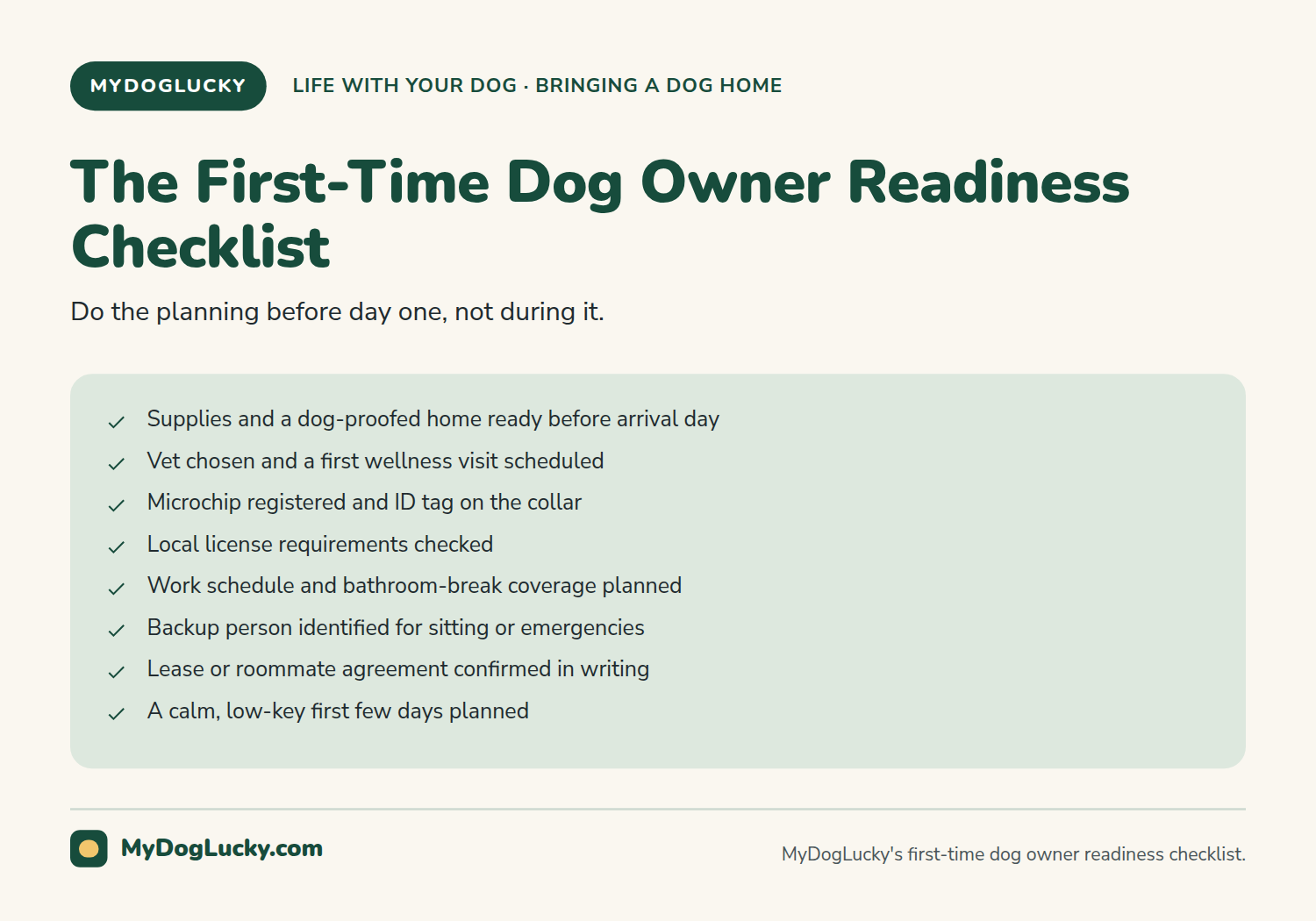
- Supplies and a dog-proofed home ready before arrival day
- Vet chosen and a first wellness visit scheduled
- Microchip registered (or being arranged) and ID tag on the collar
- Local license requirements checked
- Work schedule and bathroom-break coverage planned
- A backup person identified for sitting or emergencies
- Lease or roommate agreement confirmed in writing, if applicable
- A calm, low-key first few days planned, not a big welcome event
Common questions from first-time dog owners
How long does it typically take for a new dog to settle in?
Many owners notice a real shift within two to four weeks, with fuller settling over a couple of months. Individual dogs, and individual households, vary.
Should I get pet insurance right away?
If you’re considering it at all, enrolling while your dog is young and healthy generally gets you broader coverage, since pre-existing conditions are typically excluded from that point forward.
What if I can’t afford a big unexpected vet bill?
Pet insurance, a dedicated emergency fund, and knowing your vet’s payment plan options in advance are all worth setting up before you’re in a crisis, not during one.
Is it normal to feel regret in the first week?
It’s common enough to have a name, sometimes called puppy blues, and it usually reflects short-term exhaustion and disruption rather than a real long-term problem. Give it time before treating it as a verdict.
Do I really need a vet visit if my dog seems totally healthy?
Yes. A baseline exam catches issues that aren’t obvious from the outside and gets his preventive care and vaccine schedule properly established.
How much should I really expect to spend in the first month?
Often the highest-cost month of dog ownership, given supplies, adoption or purchase fees, and initial vet care all land close together. Budgeting toward the higher end of the first-year range for this specific month is reasonable.
What’s the biggest thing first-time owners underestimate?
Usually time, specifically the time needed in the first few weeks for settling in, training basics, and bathroom-break frequency, not the long-term daily routine once things stabilize.
Should I wait until I have a fenced yard to get a dog?
Not necessarily. Plenty of dogs live full, well-exercised lives with leash walks and no yard at all. A yard is a convenience, not a requirement.
How do I know if I’m ready even after reading all this?
If your housing, schedule, budget, and household are genuinely aligned, and you’ve done the planning in this guide rather than skipping it, you’re about as ready as anyone reasonably can be. Some adjustment is normal for everyone.
Is it better to adopt an adult dog or start with a puppy as a first-time owner?
Neither is universally better. An adult dog often comes with more known temperament information and skips the most intensive puppy stage, while a puppy lets you shape early experiences and training from the start. Match the choice to your actual time and experience level rather than a general preference.
Do I need a fenced yard, or is a house with a yard significantly easier?
It’s a convenience for off-leash time and potty breaks, not a requirement. Plenty of first-time owners in apartments manage very well with a consistent leash-walking routine.
What should I do if the dog isn’t a good fit after all?
Talk to the source you got him from first. Reputable breeders, shelters, and rescues generally have a return or support policy specifically for this situation, and using it is far better for the dog than a difficult, drawn-out placement.
How much should I budget specifically for training as a first-time owner?
Group classes often run $150 to $300 for a multi-week series, while private sessions cost more per hour but move at your dog’s specific pace. Either is a reasonable first-year investment, especially for a first-time owner still learning the basics alongside the dog.
Is it normal to research this much before getting a dog?
Yes, and it’s a genuinely good sign. Owners who do this kind of planning upfront tend to have fewer surprises and a smoother transition than those who make the decision impulsively.
What’s a reasonable amount of debt-free savings to have before getting a dog?
There’s no single universal number, but covering the higher end of the first-year cost range, plus a separate emergency-vet cushion of at least a few hundred dollars, is a reasonable starting bar for most households.
Can I be a good first-time owner if I work long hours?
Yes, with the right support system: reliable midday coverage, realistic alone-time expectations, and a dog whose energy level and needs actually match your schedule. The planning matters more than the hours themselves.
Sources
- ASPCA. Cutting Pet Care Costs
- Sniffspot. The Cost of Having a Dog: Complete 2026 Breakdown (citing AKC, ASPCA, and AVMA data)
This article is general education for U.S. dog owners. It is not individualized veterinary, financial, or legal advice. Ask your vet, your bank, or a local professional about anything specific to your situation.

