
Everyday dog care isn’t one big system. It’s six small ones, running at the same time. A routine your dog can predict. Enough movement. Enough mental work. A coat and nails that get looked after. A home that isn’t quietly full of hazards. A social life that fits the dog you actually have.
None of those six need to be perfect. They need to be reliable enough that your dog isn’t guessing. And realistic enough that you’ll still be doing them on a Tuesday in February, when nobody’s motivated. That’s the bar this guide is aiming for — not the Pinterest version of dog ownership, the sustainable one.
This is the entry point to everyday dog care on MyDogLucky. Read it straight through, or use it as a reference you come back to. It covers daily routines, exercise and walks, enrichment and play, grooming and hygiene, home and seasonal safety, and outings and social life. Two practical tools close it out.
What’s in this guide
- Daily routines: the base layer of everyday dog care
- Exercise and walks: how much movement your dog actually needs
- Enrichment and play: games that actually tire a dog out
- Grooming and hygiene: brushing, bathing, nails, and everyday cleanup
- Home and seasonal safety: dog-proofing and weather hazards
- Outings and social life: visitors, shared spaces, and public outings
- Two tools: a routine builder and a seasonal safety checklist
- Sources
Daily routines: the base layer of everyday dog care
Everyday dog care starts with routine. And routine is simpler than it sounds: the same few things, happening in the same order, most days. Not a schedule pinned to the minute — a shape your dog can count on. The AKC’s guidance is direct about the payoff. A well-structured routine helps with house training and grooming, prevents behavioral problems, and builds a dog’s confidence. A predictable day is a less stressful one.
That’s the real benefit. A dog who knows breakfast follows the first walk spends less of the day on alert. You get a calmer dog for the same effort you were already spending. You’re just spending it in a more predictable order.
What a routine actually needs to include
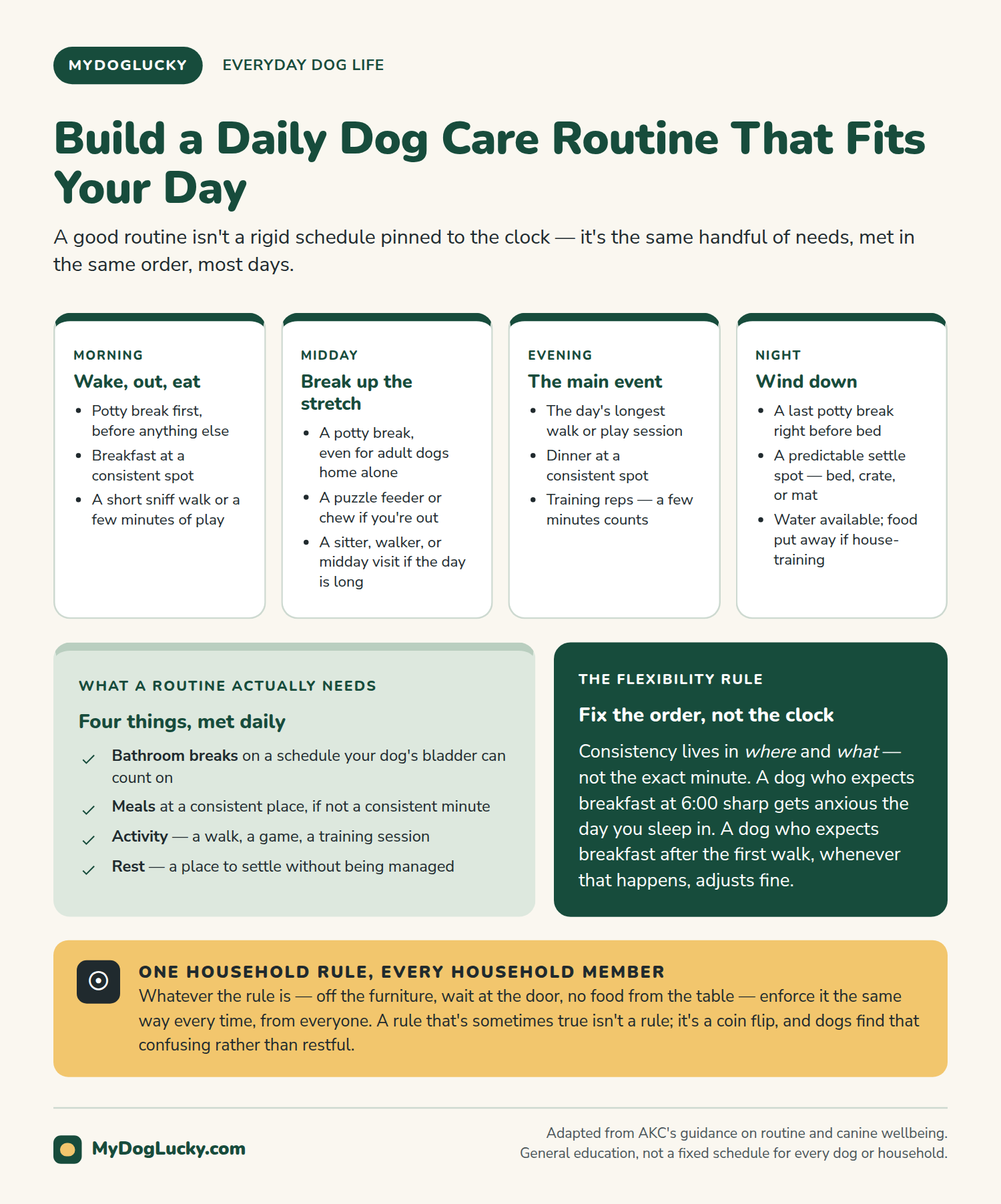
Strip it down, and every dog’s day needs four things: bathroom breaks, meals, activity, and rest. Everything else — the exact walk route, the toy rotation, whether dinner is at 5:30 or 6:15 — is detail you can adjust around your own life.
- Bathroom breaks on a schedule your dog’s bladder can actually count on. Morning, midday, evening, and last thing before bed is a reasonable floor for most adult dogs; puppies and seniors need more.
- Meals at a consistent place, even if the clock time drifts. Where and what matters more than precisely when.
- Activity — a walk, a training session, a game. It doesn’t need to be long every time. It needs to happen.
- Rest in a place your dog can settle without being managed. A bed, a mat, a crate with the door open. Somewhere that’s his.
Where rigid schedules backfire
Here’s the part that surprises people: an overly precise routine can create the exact anxiety it’s supposed to prevent. A dog who expects breakfast at 6:00 sharp doesn’t handle it well the one morning you sleep in. A dog whose routine is “breakfast happens after the first walk, whenever that is” adjusts fine to a late start. The sequence held, even when the clock didn’t.
So build consistency into the order of things, not the exact timing. That one shift takes the pressure off both of you. It’s the difference between a routine that helps and a routine that becomes one more thing you can fail at.
The one household rule that matters most
Whatever your house rules are — off the furniture, wait at the door before it opens, no begging at the table — enforce them the same way every time. Get everyone in the house doing the same. A rule that’s sometimes true isn’t a rule to a dog. It’s a coin flip. Inconsistent enforcement, not the rule itself, usually causes the confusion owners blame on “stubbornness.”
Building a routine around a real schedule
A daily routine isn’t the same for a retiree with a fenced yard and a shift worker in a studio apartment. It shouldn’t be. What changes is the shape, not the four ingredients.
| Your situation | What tends to work |
|---|---|
| Standard workday, home by evening | Morning walk before you leave. A midday break via sitter, walker, or neighbor if the day runs past 6–7 hours. A longer evening session. |
| Shift work or irregular hours | Anchor the routine to activities, not clock times — “walk after first coffee,” “dinner after the walk” — so it holds up across different start times. |
| Small space, no yard | More frequent, shorter outings rather than one long one. Indoor enrichment fills the gaps between them. |
| Multiple caregivers in the house | One shared, written routine, so a dog doesn’t get four different versions of “the rules” depending on who’s home. |
Senior dogs deserve a specific note here. Aging bladders often need more frequent breaks than they did at three years old. A housetrained senior who starts having accidents usually isn’t regressing out of nowhere. It’s most often a bladder-control change, or something else worth mentioning to your vet — not a training problem to correct.
Adjusting routines around travel, illness, or a disrupted week
Routines are meant to bend, not just hold. A trip, a houseguest, a bout of your own illness, or a sudden schedule change at work will all knock the usual order out of place sooner or later. The goal isn’t preventing that. It’s having a fallback version ready so “disrupted” doesn’t mean “abandoned.”
A minimum-viable version of the routine, the shortest walk that still counts, the fastest version of dinner, the smallest amount of one-on-one time, keeps the four core pieces intact even on the worst days. Write that bare-minimum version down somewhere, so a tired or distracted caregiver has an easy fallback instead of having to reinvent the day from scratch. Once life settles back down, easing back to the full routine over a few days, rather than snapping back overnight, tends to go more smoothly for a dog who’s had an unsettled stretch.
Exercise and walks: how much movement your dog actually needs
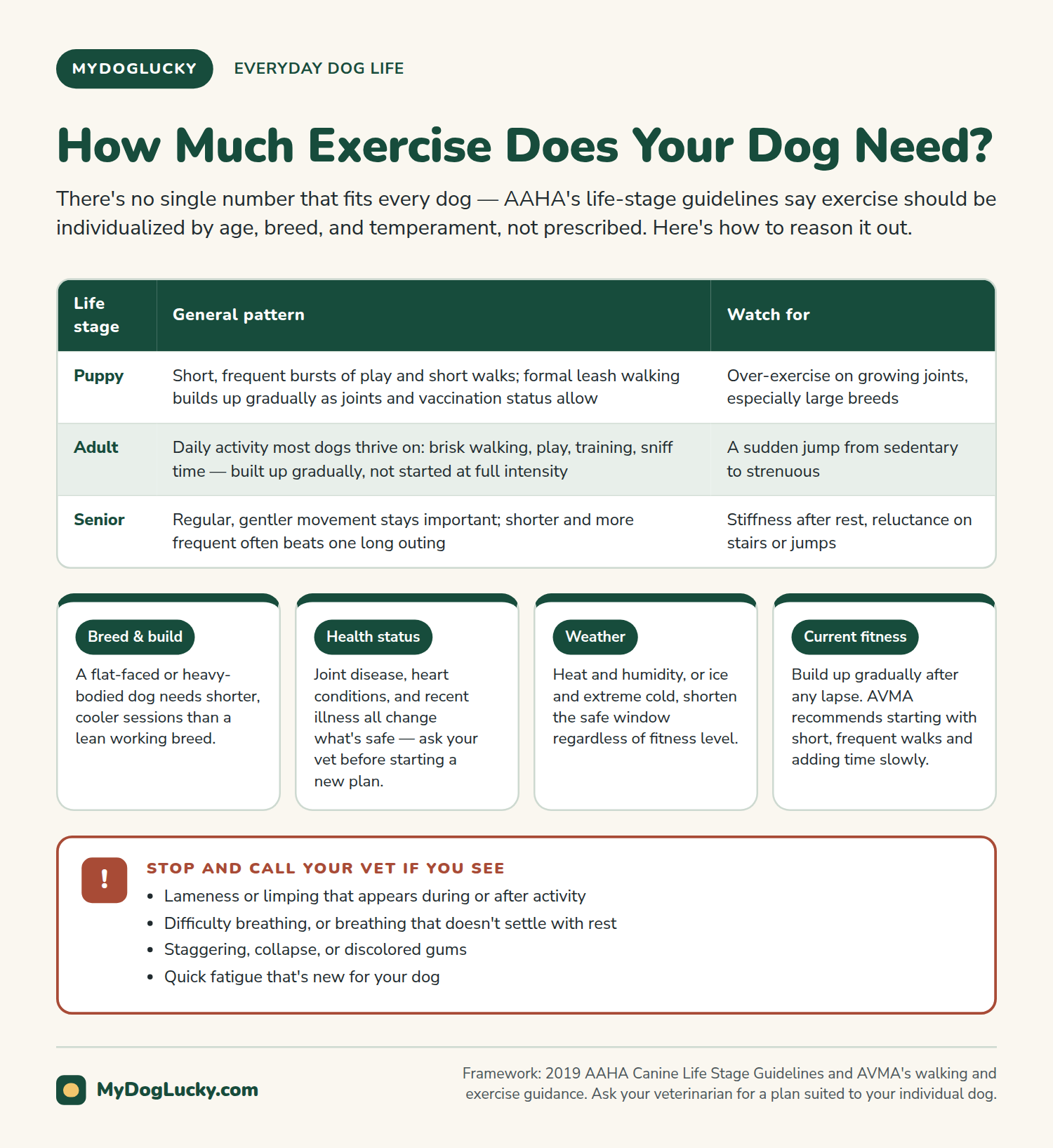
“How much exercise does my dog need” doesn’t have one right answer. Anyone giving you an exact number without knowing your dog’s age, breed, and health history is guessing. AAHA’s canine life-stage guidelines are explicit: exercise should be individualized by age, breed, and temperament, not handed out as a universal figure.
In practice, that means your job isn’t to hit a number. It’s to build a routine your specific dog can sustain and enjoy — then adjust it as he ages, gains or loses fitness, or develops a health condition.
A rough shape by life stage
| Life stage | General pattern | Watch for |
|---|---|---|
| Puppy | Short, frequent bursts of play and short walks. Formal leash walking builds up gradually as joints mature and vaccination status allows. | Over-exercising growing joints, especially in large and giant breeds. |
| Adult | Daily activity most dogs thrive on — brisk walking, play, training, sniffing time. Built up gradually, not started at full intensity. | Jumping straight from a sedentary stretch into something strenuous. |
| Senior | Regular, gentler movement stays important. Shorter, more frequent outings often beat one long one. | Stiffness after rest, new reluctance on stairs or jumping into the car. |
AVMA’s guidance on starting an exercise routine is a good default at any age. Begin with short, frequent walks. Take rests as needed. Build toward longer stretches of brisk walking gradually, not all at once. Adding running to the mix works the same way: start with shorter distances and build up slowly. Check with your veterinarian first if your dog has been mostly sedentary, is overweight, or has an existing health condition.
Four things that change the plan
Two dogs of the same breed and age can have very different exercise tolerances. What actually shifts the picture:
- Breed and build. A flat-faced (brachycephalic) or heavy-bodied dog needs shorter, cooler sessions than a lean working breed built for distance.
- Health status. Joint disease, heart conditions, and recent illness all change what’s safe. That’s a conversation for your veterinarian, not a guess.
- Weather. Heat and humidity, or ice and extreme cold, shrink the safe window no matter how fit your dog is (more in the safety section below).
- Current fitness. A dog coming back from injury, illness, or a sedentary winter needs to rebuild gradually — the same way a person would.
Stop and call your vet if you see
- Lameness or limping that shows up during or after activity
- Difficulty breathing, or breathing that doesn’t settle down with rest
- Staggering, collapse, or gums that look pale, blue, or brick red
- Fatigue that’s unusually quick for your dog, compared with his normal pattern
AVMA lists these as reasons to stop a walk or run and check in with a veterinarian — not to push through.
Equipment and walking basics
Train the walk before you need it to look good. A properly fitted collar or harness. Current ID tags. A leash your dog has actually practiced walking politely on. Some dogs do better in a harness than a collar for everyday walking — small breeds especially, or anything prone to airway or neck sensitivity — since it spreads pressure across the chest rather than the throat.
A walk doesn’t have to be brisk to count. A slower walk that lets your dog sniff is still exercise. Often it’s the more satisfying kind — more on that next.
Signs you’re over- or under-exercising your dog
Both ends of the spectrum show up in behavior more clearly than in a step count. A consistently under-exercised dog tends toward restlessness, destructive chewing, excessive barking, or a wired energy that doesn’t settle even at the end of the day. An over-exercised dog, on the other hand, can show reluctance to get up and go the next day, stiffness after rest, or a change in gait that wasn’t there before, particularly in a young, still-growing dog or an older one with early joint changes.
The most reliable check is your own dog’s pattern over a week or two, not a single day. A dog who’s consistently eager for activity and settles well afterward is probably in a reasonable range. A dog who either can’t wind down or seems to be dreading the next walk is telling you something worth adjusting.
Enrichment and play: games that actually tire a dog out
A tired dog isn’t always an exercised dog. Plenty of dogs get a daily walk and are still bored. That boredom shows up as barking, chewing, digging, or a restlessness more walking doesn’t fix. The missing piece is usually mental work, not more miles.
Why sniffing does more than you’d think
Letting your dog sniff isn’t a delay on the way to real exercise. It may be the more valuable part of the walk. A 2024 scoping review in Applied Animal Behaviour Science looked at 27 studies and 772 dogs, across working, shelter, and companion populations. Scent activities were linked to more resting and sitting, and less pacing and vocalizing, than in dogs who didn’t get them. Barking dropped across several of the conditions tested, too. One study found that dogs who’d just finished nose work approached an ambiguous, possibly-good situation faster afterward — a pattern researchers use as a marker of a more optimistic mood.
The review is honest about its limits. Physiological measures like cortisol were mixed. Body temperature can rise during active searching, worth keeping in mind on hot days. But the behavioral pattern holds up well enough to take seriously. A dog who gets real sniff time is, by observable behavior, often a calmer dog.
An everyday enrichment menu
Most of this needs no special equipment and no training background. A rotation through a few categories covers most dogs’ needs:
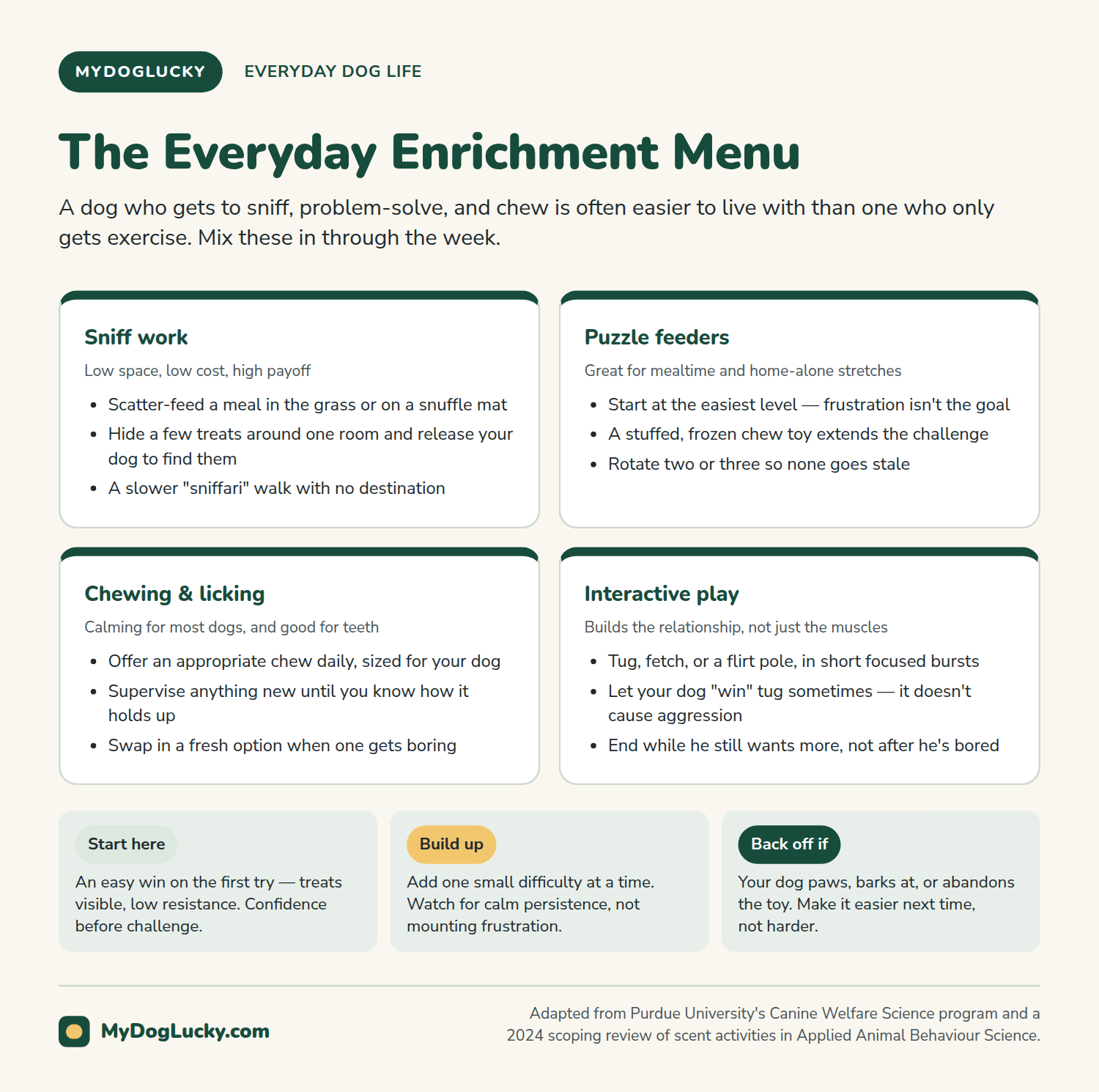
- Sniff work. Scatter a meal in the grass instead of a bowl. Hide a handful of treats around one room and let your dog find them. Or take a slower walk with no destination, and let him lead the pace.
- Puzzle feeders. Purdue’s Canine Welfare Science program frames food puzzle toys as a simple way to build problem-solving into an ordinary meal. Start at the easiest setting. The goal is a dog who succeeds and stays interested, not one who gets frustrated and walks away.
- Chewing and licking. A stuffed, frozen chew toy or an appropriate daily chew is genuinely calming for most dogs, and it does double duty for dental health.
- Interactive play. Tug, fetch, or a flirt pole, in short focused bursts, builds the relationship as much as the body. Letting your dog “win” a round of tug now and then is fine — current trainer guidance doesn’t back the old idea that it causes aggression.
Picking the right difficulty
Start easy enough that your dog wins on the first try — treats visible, low resistance. Add one small difficulty at a time from there. Watch for calm, persistent effort, not mounting frustration. If your dog paws at, barks at, or walks away from a puzzle, that’s feedback, not a smarter dog needing a harder toy. This one’s too hard right now. Make it easier and rebuild.
Enrichment on a bad day or a tiny budget
Some days the walk doesn’t happen. Enrichment is the good backup plan, and most of it costs nothing. An old towel, rolled up with kibble tucked into the folds. A cardboard box with treats hidden under crumpled paper, supervised so it doesn’t become a snack. Five minutes of training a trick you already know — mental work, no new equipment required. None of it replaces real exercise over time. But on the day you can’t manage a walk, it’s a legitimate stand-in, not nothing.
Rotating enrichment so it doesn’t get stale
Novelty matters almost as much as the activity itself. A puzzle feeder your dog has solved fifty times stops being much of a puzzle. Keeping three or four options in rotation, rather than leaving the same one out every day, keeps each one feeling fresh when it reappears. You don’t need a large collection: swapping between just a handful of options, and occasionally putting one away for a few weeks before bringing it back, does most of the work.
It also helps to match the activity to your dog’s actual mood that day. A dog who’s had a quiet, low-stimulation day might appreciate an easy win, while a dog who’s clearly got extra energy to burn can handle more of a challenge. Reading the dog in front of you beats following a fixed schedule of “puzzle Mondays.”
Grooming and hygiene: brushing, bathing, nails, and everyday cleanup
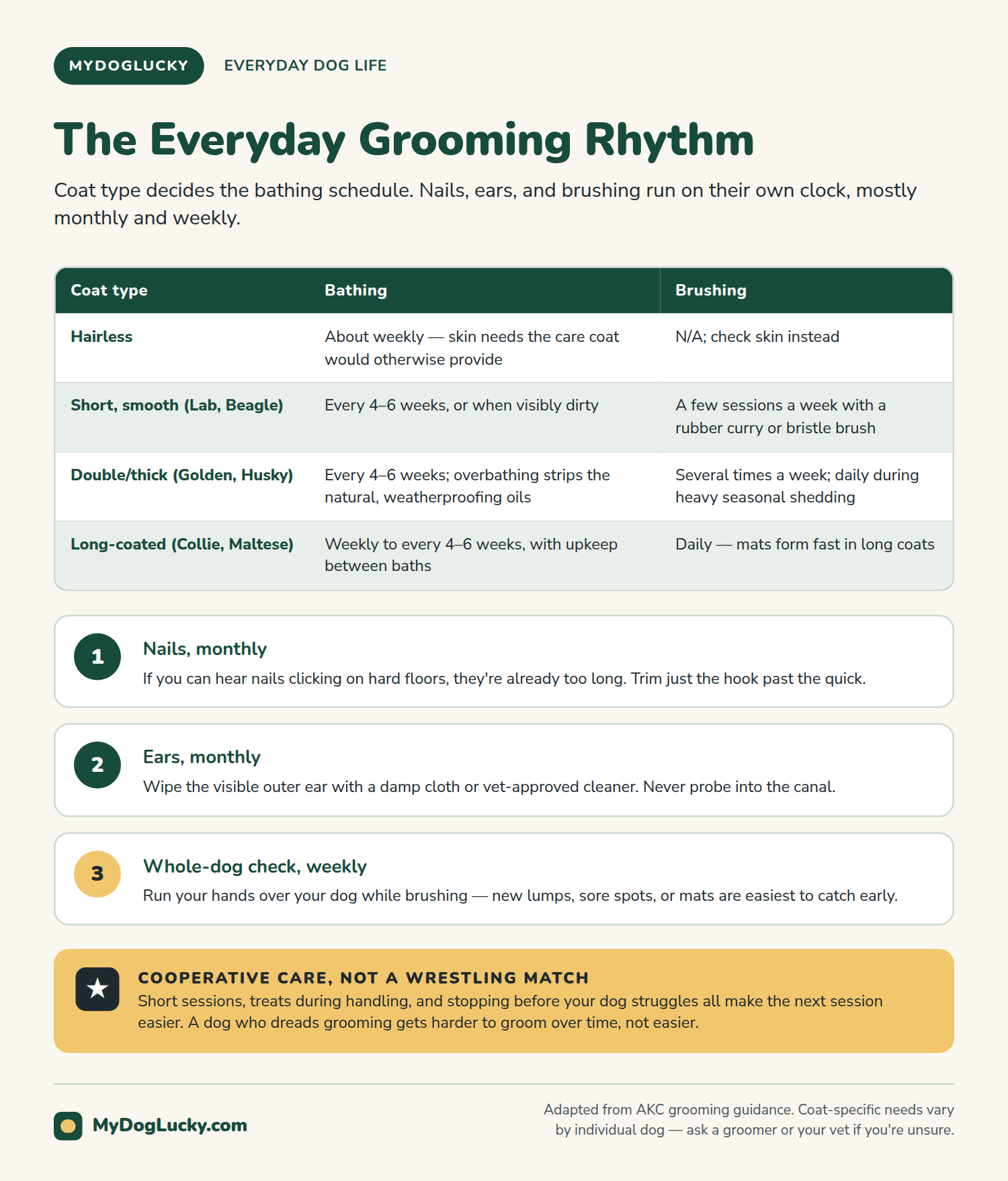
Bathing frequency comes down mostly to coat type. Nails and ears run on a fixed monthly rhythm, pretty much regardless of coat.
Bathing, by coat type
There’s no single “right” bathing frequency. It depends heavily on coat type, and overdoing it can cause its own problems. The AKC’s grooming guidance breaks it down roughly like this:
| Coat type | General bathing frequency | Why |
|---|---|---|
| Hairless breeds | About weekly | Skin needs the care a coat would otherwise provide |
| Long-coated (Collie, Maltese) | Weekly to every 4–6 weeks | With regular brushing and upkeep between baths |
| Corded long coats (Puli) | Less frequent than most coats | These coats don’t tend to develop the typical “dog smell” |
| Double/thick coats (Golden, Husky) | Roughly every 4–6 weeks | Overbathing strips natural oils and disrupts seasonal insulation |
Between baths, the AKC’s guidance is blunt about priorities. Thorough brushing and combing does more for your dog’s skin and coat health than the bath itself. A bath on a matted, neglected coat mostly just gets a matted, neglected coat wet.
Brushing, nails, and ears
These three run on their own schedule, independent of bath day:
- Brushing. Most dogs need a few sessions a week. Long-coated breeds often do best with daily brushing, since mats form fast once hair starts tangling.
- Nail trims. If you can hear your dog’s nails clicking on a hard floor, they’re already past due. Monthly is a reasonable default for most dogs — more often for ones who don’t wear them down naturally on pavement.
- Ear cleaning. Most dogs benefit from cleaning the visible outer ear about once a month. Use a damp cloth or a vet-approved cleaner — never anything inserted into the canal.
Make it cooperative, not a wrestling match
Short sessions, treats during handling, and stopping before your dog struggles all make the next session easier than the last one. A dog who’s had a bad experience with nail trims doesn’t forget it. The fix isn’t holding him tighter next time. It’s rebuilding trust in smaller steps, sometimes with your veterinarian or a groomer’s help for the first few sessions.
The weekly hands-on check
Brushing is also your best regular chance to notice something before it becomes a bigger problem. A new lump. A sore spot. A patch of hair loss, ear discharge, or a mat you didn’t know was forming. None of it requires a special routine. It just means paying attention while your hands are already on your dog.
Seasonal coat changes and shedding
Many breeds, especially double-coated ones, shed their undercoat heavily once or twice a year as the season changes, a process sometimes called “blowing coat.” This is a different event from ordinary year-round shedding, and it usually calls for a temporary step-up in brushing frequency, sometimes daily for a few weeks, to keep loose undercoat from matting against the skin.
Resist the urge to shave a double coat down for summer as a shortcut through this. The undercoat plays a real role in insulating against both heat and cold, and a proper brushing routine through the shedding season generally serves a dog better than removing the coat altogether.
Home and seasonal safety: dog-proofing and weather hazards
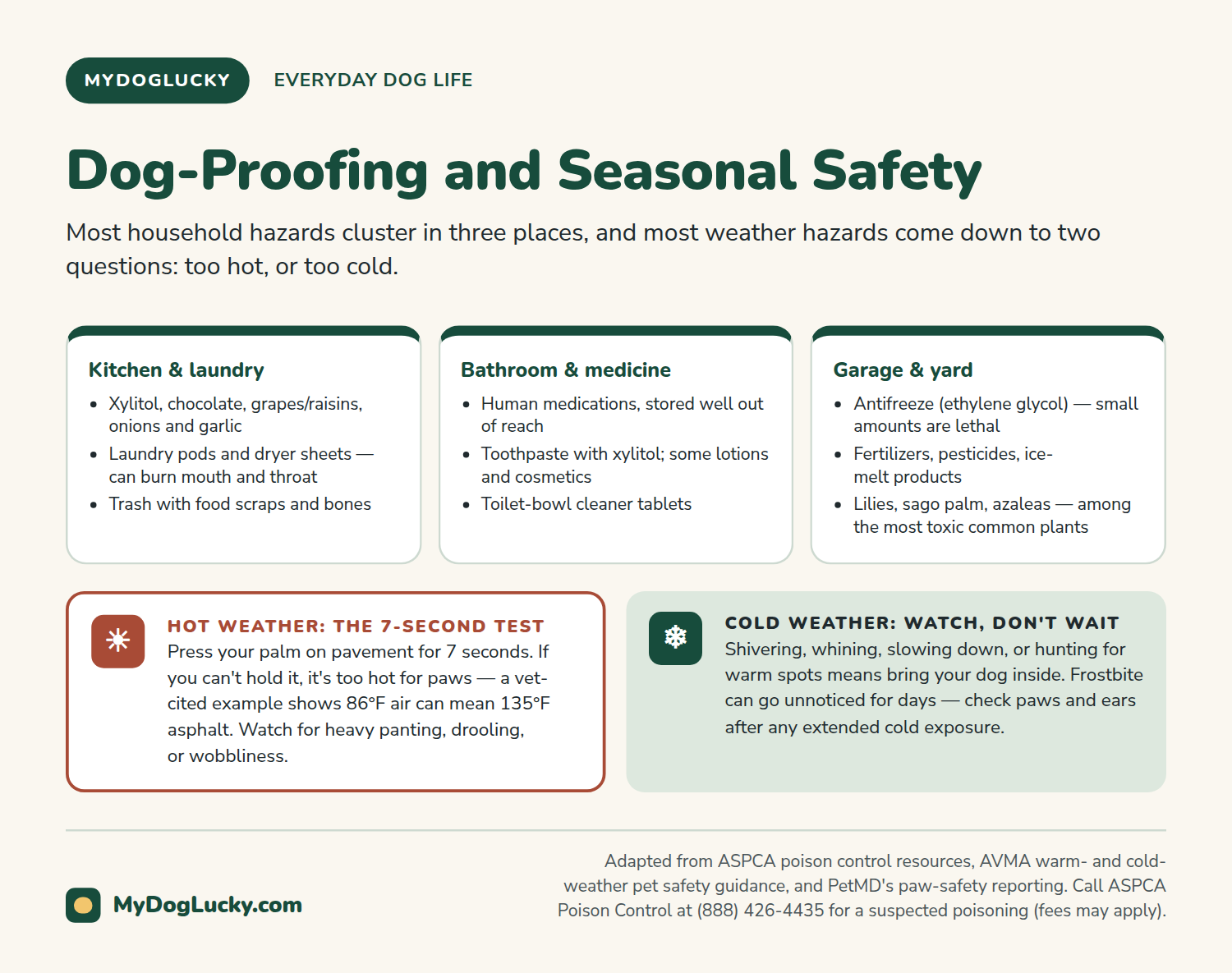
Most household hazards for dogs cluster in a few predictable places. Most weather hazards come down to two questions: too hot, or too cold. Neither takes an elaborate system — just knowing what to look for.
Room-by-room hazards worth checking for
The ASPCA’s poison control resources point to a few recurring hot spots in an ordinary home:
- Kitchen and laundry. Xylitol (in sugar-free gum and some peanut butters), chocolate, grapes and raisins, onions and garlic, and trash containing food scraps or bones. Laundry pods and dryer sheets can cause real chemical burns to the mouth and throat, not just stomach upset.
- Bathroom and medicine storage. Human medications are one of the most common calls to poison control. Store them somewhere your dog genuinely cannot reach — a counter isn’t high enough for every dog. Toothpaste with xylitol and some lotions or cosmetics are lower-severity, but still worth keeping put away.
- Garage and yard. Antifreeze (ethylene glycol) is lethal in small amounts and tastes sweet enough that dogs will drink it. Store it sealed and clean up drips right away. Fertilizers, pesticides, and ice-melt products belong on the same “keep it shut” list.
Plants deserve their own mention. The ASPCA’s list of the most toxic common plants includes lilies (mainly dangerous to cats, but still a cause of stomach upset in dogs), azaleas and rhododendrons (irregular heartbeats and seizures in larger ingestions), and sago palms (severe vomiting, diarrhea, clotting problems, and liver failure). Tulip and daffodil bulbs, hydrangeas, peace lilies, pothos, lantana, and hostas sit lower on the severity scale. Still worth knowing about before you plant them somewhere a dog can reach.
If you suspect poisoning
Call the ASPCA Animal Poison Control Center at (888) 426-4435 (a consultation fee may apply) or your veterinarian right away. Don’t wait to see if symptoms appear. And don’t induce vomiting unless a professional specifically tells you to for that situation — some substances do more damage coming back up than staying down.
Hot weather: paws, panting, and the pavement test
Dogs cool themselves mostly through panting, which makes them far more heat-sensitive than most owners expect. Flat-faced breeds, overweight dogs, seniors, and very young puppies are at the highest risk. AVMA lists anxiousness, excessive panting, restlessness, excessive drooling, unsteadiness, and abnormal gum color as heat-stress signs that call for immediate veterinary attention.
Pavement is its own hazard, separate from air temperature. Veterinarian Primrose Moss, quoted by PetMD, recommends a simple test: press your palm or the sole of your foot on a surface for seven seconds. If you can’t hold it there comfortably, it’s too hot for your dog’s paws. She notes that at just 86°F air temperature, road surfaces can reach 135°F — hot enough to burn. Walk on grass, stick to early morning or evening, or move activity indoors on the worst days. And never leave a dog in a parked car, even briefly, even with the windows cracked. Interior temperatures climb fast, on days that don’t even feel especially hot.
Cold weather: watch behavior, not just the thermometer
Cold tolerance varies enormously by coat, body fat, and health. So AVMA points owners toward watching behavior rather than relying on one temperature cutoff. Whining, shivering, seeming anxious, slowing down or stopping, appearing weak, or hunting for somewhere to burrow all mean it’s time to bring your dog inside. Frostbite is trickier — it may not be obvious until a few days after the damage happened. Any suspected cold injury is worth a same-week vet check, not a wait-and-see approach.
Short-haired and short-legged dogs are especially vulnerable in snow and ice, simply because more of their body touches the cold ground. Trimming the hair between paw pads reduces painful ice buildup. Rinsing paws after a walk on treated sidewalks removes ice-melt chemicals before your dog licks them off.
Building a basic pet first-aid kit
A small, dedicated kit saves precious minutes in an actual emergency, when hunting through drawers is the last thing you want to be doing. A reasonable starting kit includes gauze and self-adhesive bandage wrap, a digital thermometer, blunt-tipped scissors, tweezers for splinters or ticks, a muzzle your dog is comfortable wearing if he’s ever painful or frightened enough to bite defensively, and a written card with your vet’s number, the nearest emergency clinic’s number, and the ASPCA Animal Poison Control number.
Keep the kit somewhere every household member knows, not tucked away in a spot only one person remembers, and check it every few months for anything expired or used up. A first-aid kit doesn’t replace a vet visit for anything serious, but it does buy time and reduce panic in the minutes before you can get there.
Outings and social life: visitors, shared spaces, and public outings
Not every dog wants every outing, and that’s a perfectly fine place to land. The goal isn’t maximum socializing. It’s outings that actually suit the dog you have.
Dog parks: worth it for some dogs, not for others
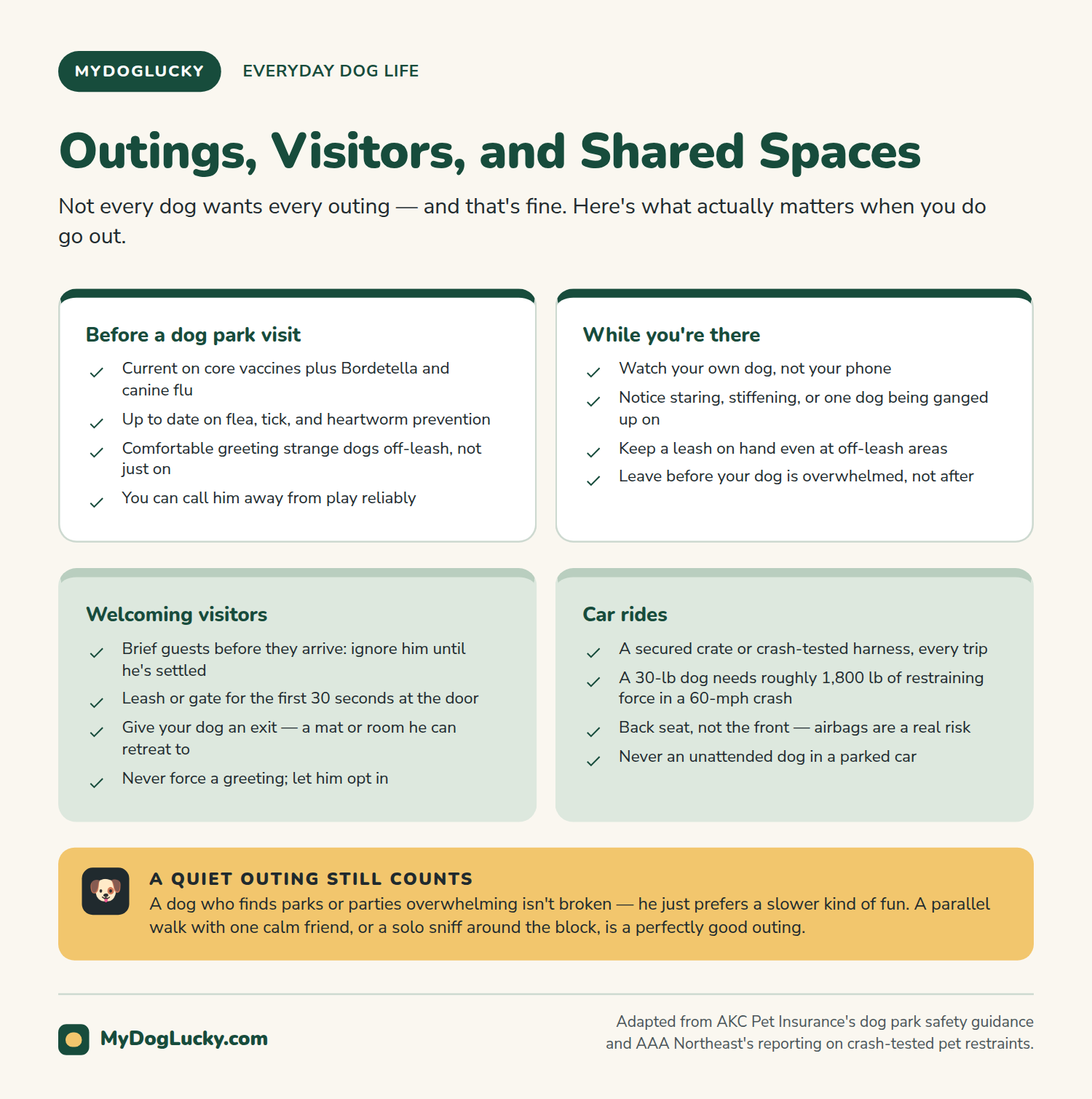
A dog park can be a great outlet for a dog who reads other dogs well and enjoys rough-and-tumble play. It can also be genuinely stressful for a dog who doesn’t — no shame in skipping it. Before a visit, AKC Pet Insurance’s safety guidance recommends confirming your dog is current on core vaccines plus Bordetella and canine flu, and current on flea, tick, and heartworm prevention. A shared off-leash space is a shared exposure risk.
Once you’re there, supervision is the job, not a spectator sport. Watch your own dog, not your phone. Notice staring, stiffening, or one dog being ganged up on, before it escalates. Keep a leash within reach even in an off-leash area. Leaving before your dog is overwhelmed beats leaving after.
Welcoming visitors without chaos
Arrivals are a predictable flashpoint, and a little preparation goes a long way. Brief guests before they arrive: ask them to ignore your dog until he’s settled, rather than the instinctive “oh, I don’t mind” that rewards jumping. A leash or a gate for the first thirty seconds at the door manages the moment while the habit is still developing. And give your dog somewhere to retreat to — a mat, a crate, another room — so a greeting is something he opts into, not something that happens to him.
Car rides: restraint isn’t optional
An unrestrained dog in a moving car is a safety risk to everyone in it, not just the dog. AAA Northeast puts the physics plainly: at 60 mph, everyone and everything in the vehicle is moving at 60 mph. A 30-pound dog in a crash at that speed exerts roughly 1,800 pounds of force — far more than anyone could hold back by hand. A secured crate or a crash-tested harness, used every trip, solves that. The back seat is safer than the front, because of airbag risk. A parked car is never a safe place to leave a dog alone, for the same heat reasons covered above.
A quiet outing still counts
A dog who finds parks, parties, or crowds overwhelming isn’t a harder dog. He just prefers a slower kind of fun. A parallel walk with one calm dog friend. A solo sniff around the block. A quiet drive with the windows down. All legitimate outings. Matching the outing to the dog beats forcing the dog to match the outing.
Reading your dog’s comfort level at a glance
A quick body-language check, before and during any outing, tells you more than trying to predict in advance how your dog will handle it. A loose, wiggly body, soft eyes, and a relaxed, open mouth generally mean he’s comfortable. A stiff posture, a tucked tail, lip-licking or yawning outside of mealtime or bedtime, and pulling toward an exit are all early signs that he’s had enough, well before anything more obvious shows up.
None of these signals mean something went wrong. They’re just information. Ending an outing a few minutes early because your dog is showing early stress signs, rather than pushing through to “get the full experience,” tends to make the next outing easier, not harder.
Two tools: a routine builder and a seasonal safety checklist
Everyday dog care gets easier once it’s written down somewhere other than your head. Both of these take a few minutes to fill in, and pay for themselves the first time life gets busy.
The routine builder
List what actually happens on a normal day, in order — not what you think should happen. This surfaces the gaps. Usually the midday stretch, or the evening activity that keeps sliding to “tomorrow.”
| Time window | Bathroom | Food | Activity | Who’s covering it |
|---|---|---|---|---|
| Morning | □ | □ | □ | |
| Midday | □ | □ | □ | |
| Evening | □ | □ | □ | |
| Night | □ | □ | □ |
Fill it in for a real week, not an ideal one. Any blank box in the “who’s covering it” column is a gap worth solving — before it turns into a missed walk, or a rushed one.
The seasonal safety checklist
- Test pavement with the seven-second palm rule before hot-weather walks
- Confirm shaded, ventilated rest spots are available outdoors in summer
- Check paws for ice buildup and cracked pads after winter walks
- Store antifreeze, ice melt, and fertilizer sealed and out of reach
- Walk the yard each spring for new plantings that made the toxic-plant list
- Restock a basic pet first-aid kit and save the poison control number in your phone
Run through it at the start of each season. It takes less time than one vet visit for something it would have prevented.
Where to start this week
If you only do one thing from this guide, make it the routine builder above. Everyday dog care mostly falls apart at the gaps — the midday break nobody claimed, the evening walk that “usually” happens. Naming the gap is most of the fix.
From there, add one section at a time, rather than overhauling everything on the same Saturday. Add real sniff time to one walk this week. Put nail trims on a monthly reminder. Do one pass of the room-by-room safety list. Everyday care is called “everyday” because it’s supposed to be sustainable — not because it’s supposed to be finished by Sunday night.
Sources
- American Kennel Club. Why Your Dog Needs a Routine at Every Stage of Life.
- American Animal Hospital Association. 2019 AAHA Canine Life Stage Guidelines.
- American Veterinary Medical Association. Walking or Running With Your Dog.
- American Veterinary Medical Association. Warm Weather Pet Safety.
- American Veterinary Medical Association. Cold Weather Animal Safety.
- American Animal Hospital Association. Too Hot to Handle: A Guide to Heatstroke in Pets.
- American Kennel Club. How Often Should You Bathe Your Dog?
- American Kennel Club. Dog Grooming at Home: Brushing, Bathing, and Nail Care.
- Purdue University College of Veterinary Medicine, Canine Welfare Science. A Guide to Using Food Puzzle Toys With Your Dog.
- Scoping review. The Value of Sniffing: A Scoping Review of Scent Activities for Canines. Applied Animal Behaviour Science (2024).
- ASPCA. Poisonous Household Products.
- ASPCA. Top 10 Toxic Plants for Pets: What to Look Out For.
- ASPCApro. Room-by-Room Household Pet Poison Checklist.
- PetMD. How to Protect Dog Paws in Summer.
- AAA Northeast. What You Need to Know About Dog Car Restraints.
- AKC Pet Insurance. Dog Park Rules & Safety Tips.
This article is general education for U.S. dog owners. It is not veterinary, behavior, or safety advice for an individual dog. If you suspect poisoning, heatstroke, or another emergency, contact your veterinarian or an emergency animal hospital immediately. Any sudden change in a dog’s health, mobility, or behavior is a reason to speak with your veterinarian.


Trackbacks/Pingbacks