Separation anxiety in dogs is a genuine distress response. It isn’t spite, and it isn’t a training failure. A dog with separation anxiety isn’t getting even with you for leaving. He’s frightened, and the fear often begins within minutes of the door closing. If you’re reading this after a rough morning, a note from a neighbor, or a video that was hard to watch, you’re in good company. Many owners arrive here feeling guilty and worn out. Help exists, and it’s humane.
This guide covers what the condition looks like, how it differs from boredom and other causes, and why home video matters so much. It explains what a proper assessment involves, how graduated absences work, and how to arrange coverage while your dog learns. You’ll also find plain talk about what doesn’t help, when a veterinarian may discuss medication, and how to find a qualified professional.
One note on scope. This article is about clinical distress and getting professional help. It isn’t the general schedule question of how long a healthy dog can stay home alone. That’s a separate MyDogLucky topic, and its answers differ for a dog who is in distress.
Stop and call a professional if you see any of this
- Panic. Frantic pacing, nonstop vocalizing, heavy drooling, or trembling that doesn’t settle.
- Self-injury. Bleeding paws, broken teeth, torn nails, or wounds from clawing at a door, window, or crate.
- Destruction that harms your dog, including swallowing pieces of what he tears up.
- A dog who can’t settle when alone for long stretches, or who is left in a space that could overheat.
- Any bite or snap when you try to interrupt a panic episode or block an exit.
Call your veterinarian first. Pain and medical problems can look like separation distress, and they need to be ruled out. If your dog is injured, struggling to breathe, or overheated right now, go to an emergency clinic. Then ask about a referral to a veterinary behaviorist or another qualified behavior professional.
What’s in this guide
- Separation anxiety in dogs: the short answer
- What separation distress is, and what it is not
- Signs of separation anxiety in dogs: what owners actually see
- Red flags: self-injury, panic, and heat
- Separation anxiety, boredom, or something else?
- Why home video matters
- What assessment involves: vet visit, history, video, behaviorist
- The humane approach: keep your dog below threshold
- Coverage during training: getting through real workdays
- What does not help, and what can make it worse
- Behavior medication: a veterinary decision, not a shortcut
- Finding the right professional: credentials and questions
- A realistic timeline, without promises
- Caregiver well-being, landlords, and neighbors
- Setting up a safer home while you train
- Common mistakes that slow progress
- A realistic first two weeks
- Frequently asked questions about separation anxiety in dogs
- Where to start this week
- Sources
Separation Anxiety in Dogs: The Short Answer
Separation anxiety in dogs is a condition in which a dog becomes distressed when he’s apart from the people he’s attached to, or when he expects that separation is coming. The Merck Veterinary Manual describes it as fear or anxiety that arises during or in anticipation of a person’s absence. It isn’t disobedience. It isn’t spite. And it isn’t something a dog chooses.
The signs usually start early. Merck notes they typically appear within the first 15 to 30 minutes after you leave, and some dogs react while you’re still getting ready to go. Some dogs vocalize, pace, and drool. Others destroy door frames, toilet only when alone, or hurt themselves trying to get out.
Here is the practical answer, in four moves.
The four moves
- See your veterinarian first. Pain, incontinence, and other medical problems can look like distress at being alone, so they need to be ruled out.
- Record your dog. Video shows what he really does and when it starts. That detail guides everything after it.
- Keep him below his threshold. Arrange coverage so he isn’t left long enough to panic while you work on the plan.
- Get qualified help. A veterinary behaviorist or another qualified behavior professional can build a graduated plan, and your veterinarian can discuss whether medication has a place.
None of this is quick. Merck describes graduated departure training that unfolds over months. Many dogs improve, and the approach is humane and well described. However, nobody can promise how far or how fast your dog will go, and this guide won’t either.
What Separation Distress Is, and What It Is Not
Distress, Not Disobedience
When your dog is alone and panicking, his body is responding as if something is wrong. He can’t think about chews or naps. That’s why the ASPCA describes anxious behaviors as “not the result of disobedience or spite” and calls them distress responses instead.
A dog in that state can’t learn from a scolding. He can only feel worse. Keep that idea close, because it shapes almost every choice in the plan.
A Spectrum, Not a Switch
Some dogs whine for a few minutes and then settle. Some pace and drool for an hour. A few tear through a door frame. The label covers a wide range, and where your dog falls changes the plan.
Separation distress can also overlap with other problems. Merck’s list of look-alikes includes noise aversion and confinement anxiety, so the picture can have layers. That’s one reason a professional’s assessment beats an online quiz.
Why It Happens
Nobody can point to one cause. The AKC lists several common triggers: never having been left alone, a sudden life change such as a move or a schedule shift, the loss of a family member, a frightening event while alone, and individual temperament. Many dogs have none of these in their history.
Owners often ask, “Did I cause this?” You can put that down. Loving your dog isn’t a mistake, and the plan doesn’t depend on finding someone to blame.
Signs of Separation Anxiety in Dogs: What Owners Actually See
Separation anxiety in dogs shows up in more than one way. No single sign proves it, and you’ll rarely see all of them. What you’re looking for is a pattern that appears when your dog is alone, or about to be.
What Dogs Do While You’re Gone
- Vocalizing. Barking, howling, or whining that keeps going. The AKC separates this from “the occasional mournful whimper.”
- Pacing and restlessness. He can’t lie down, or he circles the same path again and again.
- Drooling, panting, or trembling. Look for wet fur on his chest or a puddle of drool near the door.
- Escape attempts. Scratching or chewing at doors, windows, gates, and crates.
- Destruction around exits. Door frames, window sills, blinds, and things that smell like you.
- Toileting only when alone, even in a dog who is otherwise reliable.
- Refusing food when alone. Merck lists loss of appetite among the signs.
- Repetitive behaviors, such as spinning or licking, and in some dogs eating their own stool when alone, which the ASPCA also lists.
Notice the common thread. Each of these happens because he’s alone, not because something interesting was lying around.
What Dogs Do as You Get Ready to Leave
Many dogs give away the problem before you go. The AKC describes pacing, whining, or trembling while you prepare to leave, and Merck notes that some dogs show distress in anticipation of your absence. He may follow you from room to room. He may freeze or start panting when you pick up keys, shoes, or a bag.
Shadowing you, by itself, doesn’t mean he has separation anxiety. Plenty of relaxed dogs follow their people around. It’s one more piece of the pattern, so write it down.
What to Make of the Big Greeting
A wildly happy greeting at the door isn’t a sign by itself. Many relaxed dogs greet that way. What matters more is what you come home to and how quickly he recovers.
Notice whether he’s damp with drool, panting hard, or scratched at the door. Watch whether he settles within a few minutes of your return, or stays keyed up for a long time. Those details help a professional far more than a description of the reunion.
Patterns That Point Toward Separation Distress
- It starts soon after you leave, or while you prepare to go.
- It repeats across many absences, not just one long, dull afternoon.
- It happens even when he has chews and food available.
- It seems tied to particular people leaving. Merck’s definition refers to the absence of “individuals,” so for some dogs it’s one person, not everyone.
None of these confirms anything on its own. Together, they tell you it’s time to gather evidence and call your veterinarian.
Red Flags: Self-Injury, Panic, and Heat
Most of this article is about slow, steady work. This section is about the moments that can’t wait. Use the three levels below.
Go to an emergency clinic now if
- He’s struggling to breathe, or panting heavily with drooling, weakness, vomiting, or wobbliness in a warm space. These can be signs of overheating.
- He has heavy bleeding, a deep wound, or a limb he won’t use after clawing at a door, window, or crate.
- He fell from a window or balcony.
- He swallowed something sharp or large, such as pieces of a crate, wood, plastic, or fabric, and he’s retching, vomiting, or in pain.
Don’t wait for the next appointment slot, and don’t try to treat these at home.
Call Your Veterinarian Today If
Call the same day for any new injury, even a minor one. That includes torn nails, cut paws, mouth wounds, and raw spots from licking or chewing. Call if he vomits or has diarrhea after eating destroyed items, or if he stops eating and drinking normally.
Also call if the behavior started suddenly in a senior dog, or in a dog who was previously fine alone. A sudden change deserves a medical look before anyone assumes it’s anxiety.
Monitor and Record If
If the signs are milder, such as whining that settles and a shredded pillow, you can start recording and gathering details. That doesn’t mean waiting to see what happens. Book the veterinary visit anyway, and avoid long absences while you do.
Separation Anxiety, Boredom, or Something Else?
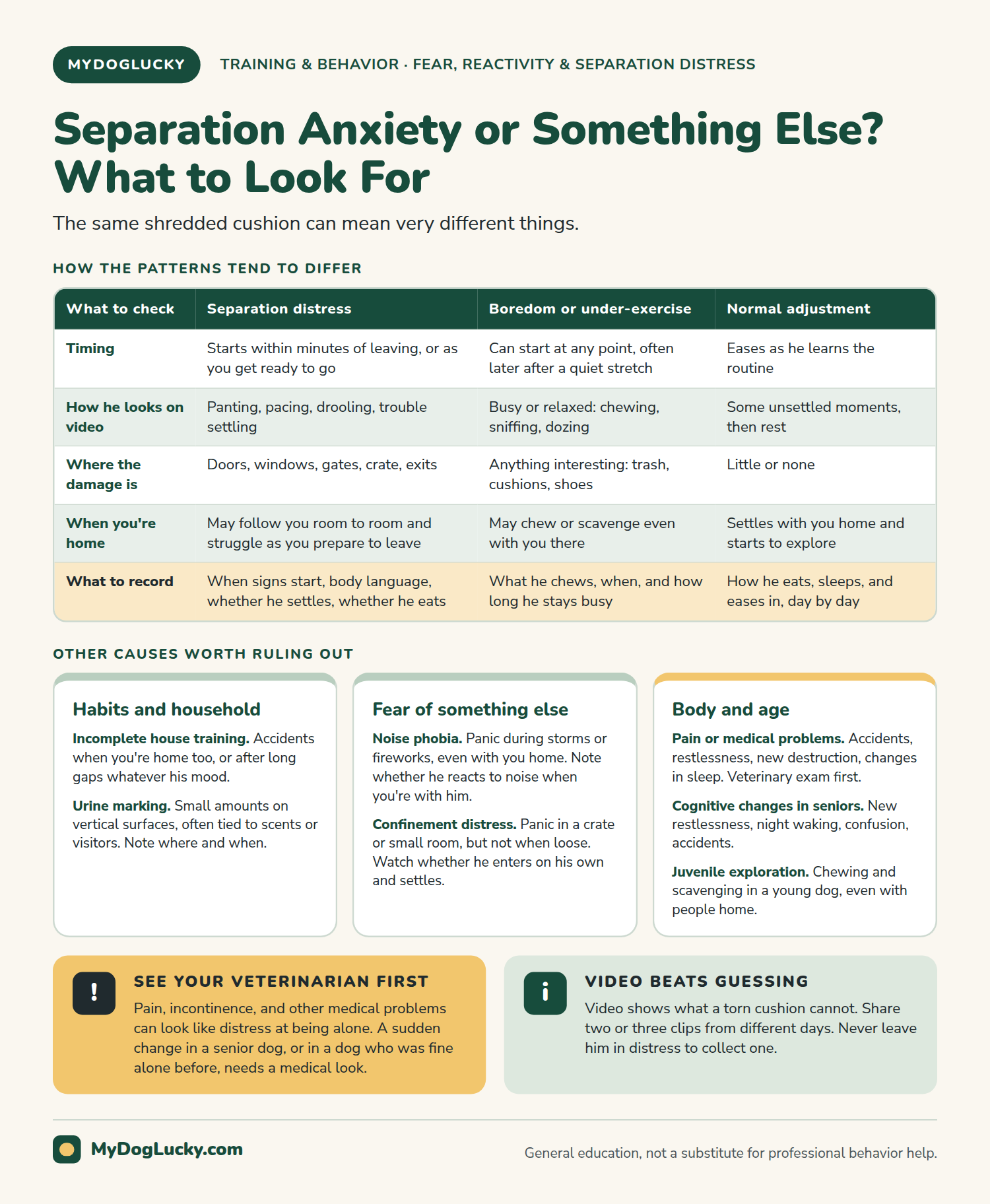
Two dogs can shred the same cushion for very different reasons. One is bored and busy. The other is terrified and trying to reach you. The damage looks similar. The dog’s state doesn’t.
The table below shows how the patterns tend to differ. Treat it as a guide for what to record, not as a way to diagnose your own dog.
| What to check | Separation distress | Boredom or under-exercise | Normal adjustment |
|---|---|---|---|
| Timing | Starts within minutes of leaving, or as you get ready to go | Can start at any point, often later after a quiet stretch | Eases as he learns the routine |
| How he looks on video | Panting, pacing, drooling, trouble settling | Busy or relaxed: chewing, sniffing, dozing | Some unsettled moments, then rest |
| Where the damage is | Doors, windows, gates, crate, exits | Anything interesting: trash, cushions, shoes | Little or none |
| When you’re home | May follow you room to room and struggle as you prepare to leave | May chew or scavenge even with you there | Settles with you home and starts to explore |
| What to record | When signs start, body language, whether he ever settles, whether he eats | What he chews, when, and how long he stays busy | How he eats, sleeps, and eases in, day by day |
Boredom and Under-Exercise: Why “Just Exercise Him More” Falls Short
Exercise and enrichment matter for every dog. The AKC lists a lack of daily exercise as one possible contributor, and the ASPCA includes at least 30 minutes of aerobic activity in its plan. So yes, a well-exercised dog is easier to help.
But exercise doesn’t treat panic. A dog who is truly afraid of being alone can still be afraid after a long run. If your dog is calm on video but chewing the couch, exercise and enrichment may be the missing piece. If he’s frantic, they’re a support, not the solution.
A New Dog in a New Home
A recently adopted dog may be unsettled for days. Everything is new: the smells, the people, the schedule. Some of that is a normal adjustment and eases with a steady routine.
Still, don’t assume it will pass. If he panics, hurts himself, or isn’t settling as the days go by, treat it as a real problem and call your veterinarian.
Other Causes Worth Ruling Out
Several other problems can mimic separation distress, and some can occur alongside it. Merck’s list includes incomplete house training, exploratory play and scavenging, noise aversion, and confinement anxiety. Medical causes belong on the list too.
| Possible cause | What it can look like | What helps sort it out |
|---|---|---|
| Incomplete house training | Accidents when you’re home too, or after long gaps whatever his mood | Review the routine; video shows whether he’s calm when he goes |
| Urine marking | Small amounts on vertical surfaces, often tied to scents or visitors | Veterinary check; note where and when |
| Noise phobia | Panic during storms or fireworks, even with you home | Note whether he reacts to noise when you’re with him |
| Confinement distress | Panic in a crate or small room, but not when loose | Watch whether he enters on his own and settles; ask a professional |
| Pain or medical problems | Accidents, restlessness, new destruction, changes in sleep | Veterinary exam first |
| Cognitive changes in seniors | New restlessness, night waking, confusion, accidents | Veterinary exam; describe the timeline |
| Juvenile exploration | Chewing and scavenging in a young dog, even with people home | Supervision, safe chews, management |
Medical Causes Come First
Medical conditions can cause accidents, restlessness, and new destruction. The ASPCA says medical causes must be excluded, including incontinence from urinary infections, hormonal issues, and medication side effects. Merck adds pain and, in geriatric dogs, cognitive dysfunction.
That’s why the veterinary exam comes before the training plan. A dog who leaks urine because of a medical problem needs treatment, not a departure protocol. And a senior dog who has become restless when alone may be experiencing something other than a new fear of separation.
Why Home Video Matters
Video is the closest you can get to standing in the room while your dog is alone. Merck calls video recording “an invaluable diagnostic tool” for observing the behavior and any other signs of anxiety. It also protects you from guessing.
Why Guessing Fails
What you come home to isn’t always what happened. A dog might be fine for 25 minutes and then panic. Or he might chew a cushion calmly for an hour and then nap. Without footage, a torn cushion could point to boredom or to panic.
The AKC advises confirming with audio or video that destruction isn’t simply a training gap or incomplete house training before deciding it’s separation anxiety. In other words, look before you label.
How to Record Without Making Things Worse
Set a phone or camera where it can see the exits and the places he rests. Turn the sound on. Record during the short absences you already have, such as a quick errand, instead of creating a long one just to get footage.
If you can, watch a live stream from somewhere close by. If he starts to panic, go back in and note the time. Never leave him in distress for an hour to collect a clip. And if the video shows him hurting himself, stop leaving him until you have a plan.
What to write down after each recording
- The date, and how long you were gone.
- What you did before leaving, and what he did.
- The time the first sign appeared, and what it was.
- What he did next: pacing, vocalizing, drooling, scratching, or trying to reach you.
- Whether he ever settled, and how long that took.
- Whether he touched food or chews.
- What he looked like when you returned, and how long he needed to calm down.
- Anything unusual: noise, weather, visitors, a changed schedule.
What a Professional Looks For
A trained eye watches body posture, panting, and drooling. They note how soon the first sign appears, which exit he targets, whether he eats, and whether he ever rests. They also look for the earliest, subtlest signs, because those help mark his threshold.
Share two or three clips from different days. A single bad day can mislead, and so can a single good one.
What Assessment Involves: Vet Visit, History, Video, Behaviorist
Diagnosing separation anxiety in dogs isn’t a quiz or a one-line guess. It’s a process that pulls together a physical exam, a detailed history, and video. Here’s what to expect.
Step One: The Veterinary Exam
Your veterinarian will look for pain, dental problems, mobility issues, and anything affecting bladder or bowel control. They may consider lab work, depending on your dog’s age and history. For a senior, they’ll think about cognitive changes, hearing, and vision.
Bring your video, your log, and a list of everything your dog takes, including supplements. Bring the timeline too: when it began, and what changed around then.
Good questions for the veterinary visit
- Could pain, incontinence, or another medical problem explain any of this?
- Does the video look like distress, boredom, or something else to you?
- Would you refer us to a veterinary behaviorist or another qualified professional?
- Is there anything we should change today to keep him safe?
Step Two: The Behavior History
A behavior professional will ask detailed questions. Expect to talk through:
- When the signs began, and what else changed at the time.
- What happens as you prepare to leave, and what he does when you’re home.
- Who lives in the home, and who leaves when.
- Where he stays when alone, and how he behaves in that space.
- His exercise, feeding, and sleep routines.
- His history before he joined you, if you know it.
- Any noise, storm, or other fears.
Write your answers down beforehand. You’ll feel less put on the spot.
Step Three: Video Review and Finding the Threshold
The threshold is the point where your dog first shows stress. It might be the sound of keys. It might be a closed door. It might be 30 seconds alone. Below that point, he’s calm. Above it, he’s practicing distress.
The professional uses your footage to estimate where that line sits. Then the plan starts from there, not from wherever your schedule happens to land.
What You Should Leave With
A good assessment ends with a written plan. It should include first steps sized to your dog, a way to cover your workdays, a check-in schedule, and guidance for bad days. It should also say how a medication conversation fits in, if it does.
Tell the professional about your real schedule and budget. A plan you can’t follow isn’t a plan.
The Humane Approach: Keep Your Dog Below Threshold
Treatment for separation anxiety in dogs rests on one simple idea. Your dog learns to be alone by practicing being alone calmly. Every time he panics, he practices panic instead. So the plan keeps absences short enough that he stays relaxed, and lengthens them slowly.
Merck describes behavior modification built on positive reinforcement and counterconditioning, with graduated departures and safety signals over months. The ASPCA puts the goal plainly: the dog should never experience the full-blown version of whatever provokes his anxiety.
What “Below Threshold” Looks Like
Calm looks like a loose body, normal breathing, and interest in a chew or a nap. The early signs of stress are quieter: he stops chewing, his ears tighten, he stares at the door, he licks his lips, or he starts to pace.
When you see those signs, you’ve reached the threshold. Go back to an easier step. That isn’t failure. It’s the method working.
Graduated Absences: Tiny Steps
The ASPCA suggests starting with absences of just one or two seconds and increasing slowly. Its guidance builds toward 40-minute absences, because most of an anxious dog’s responses occur within the first 40 minutes. That’s a milestone, not a schedule.
The ladder below is an illustration only. A professional sets the size of each step for your dog.
An illustrative ladder (your professional sets the real one)
- Stand up, walk to the door, and sit back down.
- Step out and come right back in.
- Stay out for a few seconds.
- Stay out for ten or twenty seconds.
- Build toward a minute, then several minutes, mixing short and slightly longer steps.
Before you raise the difficulty, look for calm across several repetitions in a row, on more than one day. If he shows early signs, drop back and stay at the easier step for a while. Progress won’t run in a straight line, and it doesn’t need to.
Desensitizing Departure Cues
Many dogs react to the routine before you leave. The ASPCA suggests repeating those cues without leaving, so they don’t always lead to your departure. Pick up your keys and put them down. Put on your shoes and sit on the couch.
Work on one cue at a time. If he reacts even to the smallest one, start with a gentler version, such as touching the keys without lifting them. Move on only when the cue barely registers.
Calm Exits and Returns
The ASPCA recommends behaving in a very calm and quiet manner when going out and coming in. That means skipping the long goodbye and the big reunion. Greet him once he’s settled, not while he’s frantic.
Where Food Toys Fit
For milder cases, the ASPCA suggests a puzzle toy stuffed with food that takes 20 to 30 minutes to finish, offered only when you leave. This works only if your dog will eat when you go. A dog who refuses food is telling you the absence is above his threshold.
So treat the food toy as one small tool, not the plan. Watch whether he eats it. If he doesn’t, that’s worth recording.
Coverage During Training: Getting Through Real Workdays
Here’s the hard part, and the one many articles skip. You still have a job, a commute, and errands. A graduated plan asks you to avoid long absences while your dog learns. Merck says a dog in treatment should be left alone as rarely as possible, and the ASPCA suggests arranging care with family members, dog sitters, or daycare.
The gap between that advice and a Monday morning is where many owners get stuck. Coverage is the bridge, and there’s more than one way to build it.
| Option | Works well when | Watch for |
|---|---|---|
| Work-from-home swaps | You or a partner can shift days or flex hours | Plan swaps as a schedule; ask about hybrid days |
| Family or friend | Someone your dog knows well can stay with him or host him | Written instructions and an agreed plan if he panics |
| In-home sitter or walker | He’s calm with the person and does better in his own space | A short visit may not cover a full workday; plan for the gaps |
| Daycare or day boarding | He relaxes there, eats, and rests well afterward | Some anxious dogs find groups stressful; try a trial and ask staff what they saw |
| Dog-friendly workplace | Your employer allows it and he settles by your desk | A busy office can be stressful; he needs a quiet spot |
| Neighbor or coworker trade | You need short-term help during a crunch | Same instructions and the same safety checks as any sitter |
Write Instructions for Whoever Helps
Anyone who covers for you needs the plan in writing. Include what distress looks like and what to do if it appears. Add his feeding routine, where he can safely be, and who to call.
Be firm about three points: no scolding, no forcing him into a crate, and no long stretches alone. A helper who means well but punishes a panicking dog can undo weeks of work.
When Coverage Isn’t Possible
Some households can’t cover every gap. Say so to your veterinarian and your professional. They can help you prioritize, shrink the number of long absences, and decide which days matter most.
If cost is the barrier, ask for the lowest-cost version of the plan. Free help counts: trades with neighbors, a relative, or a short block of vacation days timed to the first steps. Complete coverage isn’t required. Fewer bad absences is the goal.
What Does Not Help, and What Can Make It Worse
Some of the most common fixes are well meant and can backfire. Here are the ones to skip, and why.
Punishment
Scolding, “correcting” him for a mess, or using spray, shock, or noise-based tools adds fear to a dog who’s already afraid. The ASPCA says plainly not to scold or punish. Merck lists avoiding punishment as a treatment principle, and the AVSAB’s humane-training position supports reward-based methods over aversive ones.
A dog who looks “guilty” when you find a mess is more likely reacting to your tone than remembering what he did. He can’t connect your anger to something that happened an hour ago.
Crating an Anxious Dog Without Checking the Crate
The ASPCA says a crate is only appropriate if the dog sees it as a safe space, and for some dogs it adds stress. Merck lists confinement anxiety as a look-alike. So a crate can be a comfort for one dog and the trigger for another.
Watch whether he walks in on his own and settles when you’re home. Look at your video for scratched bars, drool, or soaked bedding. If he’s hurt himself in a crate, stop using it until a professional weighs in.
Adopting a Second Dog
The veterinary sources we reviewed don’t list adopting another dog as a treatment. For many dogs, the distress is tied to specific people leaving, and another dog may not change that. A second dog also adds cost, training, and a second animal who may need help.
If you already have another dog, don’t assume he’s a comfort. Each dog may need his own plan.
“Just Exercise Him More”
Exercise helps. It doesn’t replace the plan. A dog who’s afraid of being alone can still be afraid after a long walk. Use exercise as a support, and keep working on the real issue.
Waiting It Out
Owners sometimes hope the dog will get used to it. Some mild cases do ease. But for a dog who panics, each long absence is another round of practicing panic.
A new puppy who whines during the first few alone-time lessons is a different situation, and it belongs in a puppy-training article. If signs are intense, if they include injury, or if they aren’t easing, don’t wait.
Cameras, Treat Tossers, and Talking Through the Speaker
A camera is a window, not a treatment. Some dogs calm briefly at the sound of your voice. Others get more upset because they hear you and can’t reach you. A treat tossed from across town doesn’t teach a frightened dog to be alone.
If your dog won’t take the treat, that’s information. Use the camera to watch, record, and come home if he’s struggling.
Calming Products on Their Own
Supplements, pheromone products, and pressure wraps are common suggestions. Ask your veterinarian which, if any, are reasonable for your dog, and check before giving any supplement. Products can sit alongside a plan. They aren’t a plan.
Behavior Medication: A Veterinary Decision, Not a Shortcut
Medication can be one part of a treatment plan for separation distress. It’s a veterinary decision, and it belongs in a conversation with your veterinarian or a veterinary behaviorist. This guide doesn’t name drugs or doses, and it can’t tell you whether your dog needs one.
The ASPCA says medications “can be very helpful, especially for severe cases” and can help a dog tolerate some isolation without anxiety, which may speed up treatment. Merck lists FDA-approved veterinary medications as an adjunct to behavior modification. In other words, medication supports training. It doesn’t replace it.
When the Conversation Makes Sense
Ask about it if your dog panics, hurts himself, or can’t stay calm even at the first step of the plan. Ask if coverage isn’t possible, or if progress has stalled. Also ask if the risk of injury is high.
For some dogs, lowering the anxiety is what makes training possible. For others, it isn’t needed. Only an examination and a history can tell.
What Your Veterinarian Will Do First
Expect a physical exam, questions about history, and a review of everything your dog already takes. Your veterinarian may suggest lab work, and may refer you to a veterinary behaviorist. They’ll also explain what side effects to watch for and when to check back.
What Not to Do
Don’t give human medication. Don’t use leftover pills from another pet. Don’t start, stop, or adjust anything without your veterinarian. Some medications are risky for dogs, and only a veterinarian who knows your dog can weigh the choices.
Questions to bring to the medication conversation
- What would we be trying to change?
- How will we know if it’s helping?
- What side effects should we watch for?
- When will we reassess, and when might we reduce or stop?
- How does it fit with the training plan?
- Should we see a veterinary behaviorist?
No medication is a promise. Some dogs respond well, some need adjustments, and some don’t need one at all. Your veterinarian can tell you what to expect for your dog.
Finding the Right Professional: Credentials and Questions
Dog training isn’t a licensed profession in most of the U.S. Anyone can call themselves a trainer or a behavior consultant. That’s why credentials and methods matter, especially with a fearful dog.
| Credential | What it generally means | Good to know |
|---|---|---|
| Veterinary behaviorist (DACVB) | A veterinarian board-certified in veterinary behavior through the American College of Veterinary Behaviorists | Can address medical and behavioral factors and prescribe medication when appropriate; a strong first stop for panic or self-injury |
| Certified Applied Animal Behaviorist (CAAB) | Certified by the Animal Behavior Society; advanced education in animal behavior | Not a veterinarian, so medication decisions stay with your vet |
| Certified Separation Anxiety Trainer (CSAT) | A certification focused on separation anxiety, from a private program | Ask about methods and about how they coordinate with your vet |
| IAABC-certified consultant | Certification through the International Association of Animal Behavior Consultants | Ask which certification they hold and what methods they use |
| CPDT-KA or CBCC-KA | Certifications from the Certification Council for Professional Dog Trainers for trainers and behavior consultants | Broad credentials; ask specifically about separation anxiety experience |
| KPA-trained trainer | Completed a reward-based training program through Karen Pryor Academy | Strong on teaching skills; ask about separation anxiety experience |
A credential is a starting point, not proof of a good fit. Look up any credential on the issuing organization’s own directory, and then ask about methods.
How to Vet Anyone
Ask these questions before you book:
- What methods will you use with my dog?
- Do you ever use shock, prong, choke, spray, or noise-based tools? (The right answer is no.)
- What’s your experience with separation anxiety in dogs specifically?
- How will you use video?
- Will you coordinate with my veterinarian?
- How will we handle workdays during training?
- How will we measure progress, and what happens if it stalls?
Walk away from anyone who promises a fixed timeline or a sure fix. Do the same if they blame your dog’s character, suggest leaving him to “cry it out,” or dismiss the need for a veterinary check.
Remote and Lower-Cost Paths
Many trainers work remotely. One third-party directory of certified separation anxiety trainers reports that most of its listed trainers offer virtual sessions. Remote work can widen your options and cut costs.
Fees vary widely, so ask what a package includes. Your veterinarian may know local referrals, and some veterinary schools and humane organizations offer behavior services. You can also ask a professional for a shorter consultation with a plan you carry out yourself.
A Realistic Timeline, Without Promises
Nobody can tell you how long your dog’s plan will take, and anyone who names a number is guessing. Merck describes graduated departure training over months. The AKC says separation anxiety in dogs has a high rate of treatment success with patience and consistent training. Both can be true: the work is slow, and many dogs improve.
What Shapes the Pace
Severity matters. So do how long the problem has run, how well you can cover the hard hours, and your dog’s health. Household consistency, medication decisions, and your own energy all play a role.
What Progress Looks Like
Progress is often small and measurable. The threshold rises from 10 seconds to 40. He recovers faster after a hard moment. He takes a chew and eats it. Your video shows him resting instead of pacing.
Setbacks Are Part of It
Schedule changes, illness, holidays, storms, and moves can all set a dog back. When that happens, drop to an easier step and rebuild. If progress stalls for a long stretch, tell your professional and revisit your veterinarian. Pain or a change in health can be hiding underneath.
Some dogs need ongoing support for a long time. That doesn’t mean you’ve failed. It means the plan is still doing its work.
Caregiver Well-Being, Landlords, and Neighbors
Guilt and Exhaustion Are Common
Living with a distressed dog wears people down. You may be sleeping badly, canceling plans, and dreading every departure. Guilt tends to move in as well, and it rarely helps.
You can love your dog deeply and still need a break, a better plan, or help. Ask a friend to take one shift. Break practice into small pieces. If the strain becomes overwhelming, talk with your own doctor or a counselor. Taking care of yourself is part of taking care of him.
When Neighbors Hear Your Dog
A brief, kind note can lower the temperature. Tell them you’re working with a professional, and give them a way to reach you, such as a phone number for texts. Your video also shows exactly how long the vocalizing lasts, which helps everyone stay grounded.
Avoid overexplaining. A short message says enough.
Talking With Your Landlord
Housing rules vary, so read your lease. If noise or damage is a concern, raise it early and describe your plan. A short letter from your veterinarian or professional showing that you’re getting help may support the conversation, though it can’t promise a result. For legal questions, a local tenant organization can help more than a dog article can.
If You’re Thinking About Rehoming
Some people reach a point where they wonder whether they can keep going. If that’s you, say it out loud to your veterinarian or professional. It isn’t shameful, and support exists. Talk it through before deciding, since separation distress can follow a dog to a new home.
Setting Up a Safer Home While You Train
Safety planning protects your dog on the days when the plan isn’t working yet.
- Check every exit. Secure windows, screens, balcony doors, gates, and pet doors. Upper floors add a fall risk.
- Clear the exit zone. Move cords, blind pulls, cleaning products, medications, and trash out of reach.
- Review confinement. If he’s injured himself in a crate or pen, stop using it until a professional advises you.
- Keep ID current. Microchip details should be up to date, in case an escape succeeds.
- Watch the temperature. Keep the home at a safe temperature with water available, and never leave him in a parked car. Panting anxious dogs, seniors, and flat-faced breeds need extra care.
- Offer only safe chews. An anxious dog may gulp, so choose sizes he can’t swallow whole.
- Think about children. Kids shouldn’t block exits or crowd a stressed dog. Supervise, and give him a quiet place.
Common Mistakes That Slow Progress
Raising the Difficulty Too Fast
A calm day isn’t a green light for a three-hour absence. Add small steps and wait for calm across several repeats.
Skipping the Veterinary Visit
Pain and health changes can hide behind the behavior. The medical check protects your dog and your plan.
Leaving Long Gaps Uncovered
A few long absences can erase weeks of small wins. Cover the hard hours, even if the coverage is patchy.
Inconsistent Household Rules
If one person practices and another skips it, your dog gets mixed lessons. Share the written plan.
Changing Too Many Things at Once
New food, new schedule, new product, and new routine make it hard to tell what helped. Change one thing at a time when you can.
Picking a Professional on a Sales Pitch
Fast promises and dramatic before-and-after stories aren’t proof of skill. Ask about methods and experience.
Giving Up After a Plateau
Plateaus are common. Tell your professional, revisit your vet, and adjust the plan.
A Realistic First Two Weeks
This is a starting point, not a treatment plan. If your dog panics or injures himself, skip straight to calling your veterinarian today.
- Day 1: Call your veterinarian, book an exam, and describe the pattern. Ask about same-day care if he’s hurt. Start your log.
- Days 1 to 3: Set up the camera for the short absences you already have. Keep other absences brief or covered.
- Days 2 to 4: Make a coverage list. Put helpers on the calendar for the next two weeks.
- Days 4 to 7: Attend the exam and share your video. Ask about a referral, and contact two professionals about methods and availability.
- Week 2: Book the first consult. While you wait, practice calm exits, and if he stays relaxed, work on one departure cue without leaving. Stop at the first sign of stress.

Frequently Asked Questions About Separation Anxiety in Dogs
How do I know if it’s separation anxiety or boredom?
Look at the dog, not the damage. A frantic dog who pants, drools, paces, or targets exits is showing distress. A relaxed dog who chews and naps is more likely bored. Video is the best way to tell, and a professional can help you read it.
Can a dog have separation anxiety if he only barks?
Barking alone doesn’t confirm it. Dogs bark for many reasons, including outside noises. Video shows whether the barking comes with pacing, panting, or panic, and whether it starts soon after you leave.
How long can I leave a dog with separation anxiety?
It depends on his threshold, not a general rule. Your professional will help you find it. A general schedule for healthy dogs is a different topic, covered in a separate MyDogLucky article on how long a dog can stay home alone.
Will a second dog help?
Not reliably. The veterinary sources we reviewed don’t list it as a treatment. It can also add cost and complexity, so talk with your professional before making that choice.
Should I crate my dog?
Only if the crate is a safe place for him. The ASPCA says crates suit dogs who see them as safe, and can add stress for others. Watch how he responds, and ask your professional.
Do calming supplements or wraps work?
Ask your veterinarian. Some owners find these products a helpful extra, but they aren’t a plan on their own. Check before giving any supplement.
Is it my fault?
No. Separation anxiety in dogs has no single known cause. Common triggers include life changes and a lack of practice being alone, and many dogs have neither. Your job now is to get him support, not to assign blame.
Can puppies have separation anxiety?
Puppies can struggle with being alone, and mild whining is common early on. Intense panic, injury, or signs that aren’t easing deserve a call to your veterinarian. General alone-time training for puppies belongs in a puppy-training guide.
Can a senior dog develop it suddenly?
Yes, but a new problem in an older dog should prompt a veterinary check first. Merck lists cognitive dysfunction among the conditions to rule out. Pain, hearing loss, and vision changes can also play a role.
Will medication solve it?
No medication is a promise. It may help some dogs learn more comfortably, and your veterinarian decides whether it belongs in the plan. It works alongside behavior training, not instead of it.
Can I do this without a professional?
Mild cases may respond to owner-led steps, such as those described by the ASPCA. But panic, self-injury, damage that could harm your dog, or a plan that isn’t moving are all reasons to bring in a professional.
Will my dog ever be okay alone?
Many dogs improve a great deal with the right plan and support. Nobody can promise the outcome for your dog. What you can do is start, and keep going in small steps.
Where to Start This Week
Start with one phone call. Book the veterinary exam, and say plainly what you’ve seen: what your dog does, how soon it starts, and whether he has ever hurt himself. Then set up a camera for the short absences you already have. Two or three clips will tell a professional more than an hour of description.
While you wait, keep the hard absences to a minimum. Ask one person to cover one stretch of your week. Practice one departure cue without leaving, but only if your dog stays relaxed. If he doesn’t, stop and wait for the plan.
Separation distress is hard on dogs and on the people who love them. It’s also something you can get help with, and asking early is the strongest move you have. He isn’t choosing this, and he can’t fix it by himself. You can help him, and you deserve help along the way.
Sources
- Borns-Weil S (reviewed by Siracusa C). Merck Veterinary Manual, professional version. Behavior Problems of Dogs (separation anxiety section). Last updated September 2025.
- ASPCA. Separation Anxiety. Undated page; accessed September 28, 2026.
- Gibeault S. American Kennel Club. Separation Anxiety in Dogs. Updated October 30, 2025.
- American Veterinary Society of Animal Behavior. Humane Dog Training Position Statement (2021).
- American College of Veterinary Behaviorists. About veterinary behaviorists (DACVB). Accessed September 28, 2026.
- Animal Behavior Society. Certified Applied Animal Behaviorist certification. Accessed September 28, 2026.
- International Association of Animal Behavior Consultants. Certification and consultant directory. Accessed September 28, 2026.
- Certification Council for Professional Dog Trainers. CPDT-KA and CBCC-KA certifications. Accessed September 28, 2026.
- Karen Pryor Academy. Certified Training Partner program. Accessed September 28, 2026.
- Separation Buddy. Find Certified Separation Anxiety Dog Trainers. Third-party directory; states the CSAT credential is administered by a private company. Accessed September 28, 2026.
This article is general education for U.S. dog owners. It is not individualized training, behavior, or veterinary advice for your dog. Panic, self-injury, destruction that could harm your dog, a dog who can’t settle when alone, or any bite should be evaluated by your veterinarian and a qualified behavior professional, such as a veterinary behaviorist or Certified Applied Animal Behaviorist. Sudden behavior changes are a reason to talk with your veterinarian first, because pain and illness can change how a dog acts when alone.